Showing posts with label Julie Phillips. Show all posts

Monday, December 30, 2019

The Pleasures of Reading, Viewing, and Listening in 2019, pt. 24: Julie Phillips


 A Year of Shifting Perceptions
by Julie Phillips


It’s been a year of shifting perceptions for me, in which some things that have been stuck for a long time came loose, I can only hope for the better. Among my favorites this year are some books and a film about how to take useful action, whether or not you know where you’re heading.

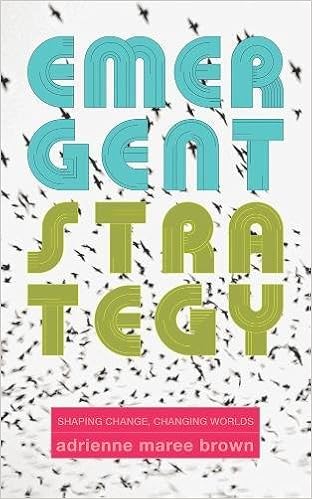
The most encouraging book I read all year was Adrienne Maree Brown’s Emergent Strategy, a meditation on social justice and science fiction that is also a kind of carrier bag for ideas about imagination and change. Emergence has to do with allowing small interactions to become linked together in complex patterns of community and persistence. Taking inspiration from the work of Octavia Butler, as well as from biology and chaos theory, Brown emphasizes resilience and adaptivity as useful qualities and suggests learning from the survival strategies of dandelions, mushrooms, and oak trees. 

She also advises “collaborative ideation—what are the ideas that liberate all of us? The more people that collaborate on that ideation, the more that people will be served by the resulting world(s). Science fiction is simply a way to practice the future together.” Citing Toni Cade Bambara, she says, “We must make just and liberated futures irresistible.” 

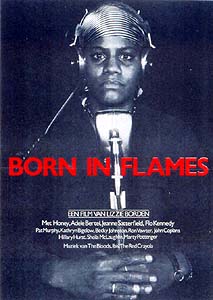
While I was reading Emergent Strategy and marching in demos, an old friend took me to see Born in Flames, Lizzie Borden’s 1983 science fiction film about women plotting a revolution. It deals with the potential power of small-scale direct action, and I just can’t tell you how good this movie is and how amazing it feels to watch in this moment. Visually and thematically, it illustrates Brown’s patterns of emergence: Gangs of women on bicycles circulate for safer streets. Two pirate radio stations create links between feminist cells citywide. And an older activist (played by feminist lawyer Flo Kennedy) advises a younger one: “Which would you rather see come through the door, one unified lion or 500 mice? You know, 500 mice can do a lot of damage.”

The central narrative of armed revolution is not the film’s strongest point, although a scene of the Women’s Army hijacking a New York City TV station does have a kind of anti-Fox News satisfaction. But its class- and race-conscious analysis of feminism is fine, and I enjoyed its ’80s feminist anti-style (one of my responses to it was “Hey, I used to wear that”) and terrific punk soundtrack. You can watch it on demand here: https://vimeo.com/ondemand/borninflames

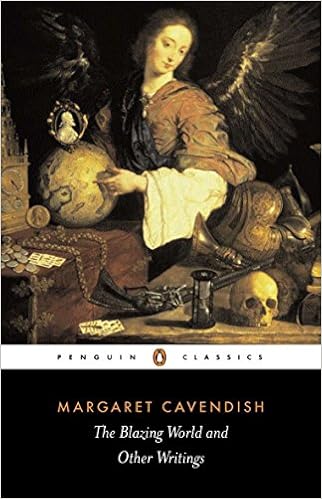
The feminism of Born in Flames grows out of patterns of verbal exchange, and so do the weird liberating qualities of The Blazing World, the epically strange 1666 work of fiction by Margaret Cavendish, the Duchess of Newcastle. A friend asked me to write about it, and knowing very little about it, I expected it to be a utopia of place—its creator’s perfect world. What I found was a utopia of process, of dialogue and relationships. The Blazing World isn’t actually on fire, sadly, though it has the usual buildings made of gemstones and so on. Its most remarkable property is that many of its inhabitants are half-human, half-animal—bird-men, lice-men, fish-men, worm-men—and the human scientist who becomes its empress persuades them to help her research the causes of natural phenomena. Where the science of the time placed men above women and the natural world, Cavendish advocated scientific inquiry as interspecies collaboration. 

It’s also very funny. After a while the empress decides she needs a secretary, and the spirits of the Blazing World tell her she can choose anyone, living or dead.


Instead she asks for a contemporary philosopher like Galileo or Descartes, but the Spirits answer that they’re too arrogant to be a secretary to a woman. Then the Spirits say, why not try the Duchess of Newcastle? So she summons the Duchess, who says, I’d love to, but my handwriting is terrible. And the Empress says, I can live with that. So they start having long conversations and making up new fantasy worlds. Collaborative ideation!

Also in 2019 I wrote about Suzette Haden Elgin’s Native Tongue https://4columns.org/phillips-julie/native-tongue. I went to a great reading by my old Voice colleague Colson Whitehead, who is very funny about growing up a nerd as well as a profound and imaginative thinker about the use and misuse of power. I reviewed Margaret Atwood’s The Testaments and thought about how subtly she’s always written about the space between individual women and their roles. https://www.julie-phillips.com/wp/?p=1048 I rediscovered the wonderful film Céline et Julie vont en bateau (1974) by Jacques Rivette, a fantasy in which three female characters stage a jailbreak from a heterosexist love story and go off in search of a better plot.

I was sad that we lost Vonda N. McIntyre this year, and moved by her generosity in donating her estate to Clarion West. Another project she encouraged friends to support was research into the Southern Resident orcas who live in the waters of the Pacific Northwest. When I renewed my family’s orca adoption again this December, I thought of her, of the matriarchal society of the orcas, and how hard it is to keep imagining my way toward others, even though it feels like the work that needs to be done.

I don’t know if that’s part of un-stuckness, but I’m trying.


Julie Phillips is a book critic and the author of the NBCC and Hugo Award-winning biography James Tiptree, Jr.: The Double Life of Alice B. Sheldon. She lives in Amsterdam, where she’s working on a biographical look at writing and mothering in the 20th century, to be called The Baby on the Fire Escape.


Thursday, November 8, 2018

The Cascadia Subduction Zone, Vol. 8, 4


The Fall issue of The Cascadia Subduction Zone is out. The issue includes a short fiction by Susana Vallejo (translated from the Spanish by Lawrence Schimel), poetry by Deborah L. Davitt, Lesley Wheeler, and Sonya Taaffe, a Grandmother Magma column by Julie Phillips, Karen Burnham's column, and reviews of work by Rebecca Roanhorse, Rachel Fellman and others. The issue's featured artist is Heather Tatarek. You can purchase single copies or subscriptions at http://thecsz.com/; the electronic edition is $3 for an issue or $10 for a year's subscription, while the print edition is $5 for an issue or $16 for a year's subscription.


Volume 8, 4
Flash Fiction
Returning
    
by Susana Vallejo
 
Poems
Haunted ~ Ceres ~ Reborn in Blood ~ Contemplation ~ The Barn-Raising
   by Deborah L. Davitt

Racketing Spirits ~ Hairy On the Inside ~ 
Bad Dragon ~ Where Dragons Come From ~ 
White Noise Machine Now With Twelve Settings!
    by Lesley Wheeler

Ariadne in Queens A ~ Vixen When She Went to School
    by Sonya Taaffe
 
Grandmother Magma
The Hearth in the Spaceship
“The Shobies’ Story” by Ursula K. Le Guin

   reviewed by Julie Phillips 

Dust Lanes
Short fiction reviews
   by Karen Burnham

Book Reviews
The Breath of the Sun, by Rachel Fellman
   reviewed by Arley Sorg
Heroine’s Journey, by Sarah Kuhn
   reviewed by Erin Roberts
Down Girl: The Logic of Misogyny, by Kate Manne
   reviewed by Nancy Jane Moore
Trail of Lightning, by Rebecca Roanhorse
  reviewed by Kathleen Alcalá

Featured Artist
Heather Tatarek

Wednesday, December 23, 2015

The Pleasures of Reading, Viewing, and Listening in 2015: part 22: Julie Phillips

Reading, 2015
by Julie Phillips


I’m writing you from a misused summer cabin, one that I’m misusing by staying in it alone, in a season in the Pacific Northwest when the rain falls, the trees sway, the power goes out, and a day is a short gray undimming of the long dark. Offline and far from home, I’ve been descending through circles of solitude into a cobwebby interior castle or low-ceilinged basement of the mind, where I sit and read for my ongoing project, a study of writers and artists who were also mothers, working title The Baby on the Fire Escape.

It may be the silence that’s making books speak to me so clearly, but there are two in the pile here at the cabin that are giving me enormous pleasure. One is The Other Blacklist: The African American Literary and Cultural Left of the 1950s (2014), by Mary Helen Washington. I wanted to read it because a couple of the writers Washington deals with were mothers (Gwendolyn Brooks, the playwright Alice Childress), and because some of my subjects had Communist sympathies (Alice Neel, Doris Lessing). In the Thirties and Forties Communism was the only political movement that offered a critique of the family as an oppressive institution. At the same time, its critique of racism made it especially attractive to black artists and intellectuals.

The Other Blacklist turns out to be the kind of book I love, full of writers and artists talking to each other on the artistic margins. Here are voices to fill my solitude, brought alive in quotes from archives and private papers—or, often, from their FBI surveillance files. They act and work against a backdrop of little-known history, from the struggles of black railroad workers in the early twentieth century to the rise and fall of the American Negro Theater, where Childress raised the political consciousness of the young Sidney Poitier. I admire it for being such a well-built book, and even more for giving a fascinating taste of the many, many voices and opportunities, political and artistic, that were lost to America during and after the blacklist years.

Another book I came to for mothering and fell in love with for other reasons is 100 Essays I Don’t Have Time to Write (2014) by the American playwright and MacArthur fellow Sarah Ruhl. In these very short “essays” (if one or two paragraphs can be an essay), Ruhl questions, with charm, skill, and authority, everything that theater and fiction generally are supposed to be and do. Does theater have to have people in it? Does a narrative have to draw an “arc” or can it look like a circle or a vase? Why do writing teachers talk about “tracking the character’s journey” instead of looking at the ways great writers cover their footprints? 

Ruhl is splendidly funny. She comes out against too-neat narratives and in favor of illogic, lightness, fantasy, poetry, the “untidy-sublime.” She sometimes seems to think like Ursula Le Guin, when she talks about the “sacred and mysterious” work of naming one’s characters or wonders if you could write a play about rocks. Like Le Guin, she places her faith in language, in what she calls “the drama of the sentence: how it will unfold, how it will go up and down, how it will stop.…A writer’s special purview and intimate power is how a word follows a word.”

Ruhl’s essays are wonderful for thinking about reading and writing, but she also says something important about “the great systole and diastole of work and children.” In her essay “On Interruptions” she writes that when her children were small she saw writing and parenthood as enemies to each other and feared her children were “annihilating” her as a writer. “Finally I came to the thought, All right then, annihilate me; that other self was a fiction anyhow. And then I could breathe. I could investigate the pauses. I found that life intruding on writing was, in fact, life.” In her surrender to life, paradoxically, she recollects herself and recovers her artistic agency.

The work about mothering I’ve loved most lately is “Who Will Greet You at Home,” a fantasy story by Lesley Nneka Arimah that was published in The New Yorker in October. Set in Nigeria, it’s about what mothers desire and what mothering costs, and it said more than my whole stack of books together. Read it here: http://www.newyorker.com/magazine/2015/10/26/who-will-greet-you-at-home

The biggest mystery of the year for me was Elena Ferrante’s My Brilliant Friend. I enjoyed it; it certainly wasn’t boring. But I didn’t connect with it the way so many of my friends seem to do. Does anyone else have this problem?


Julie Phillips is a book critic and the author of the NBCC and Hugo Award-winning biography James Tiptree, Jr.: The Double Life of Alice B. Sheldon. She lives in Amsterdam, where she’s working on a biographical look at writing and mothering in the 20th century, to be called The Baby on the Fire Escape. Earlier this month she gave the keynote speech at the University of Oregon’s symposium on Tiptree. She’s been hanging around the Pacific Northwest ever since.


Monday, December 7, 2015

Report on the Tiptree Symposium


I spent last weekend in Eugene, Oregon, attending the Tiptree Symposium, which was hosted by the University of Oregon Libraries in honor of Alice Sheldon's centennial. In case you haven't heard,the University of Oregon Libraries' special collections include the papers of James Tiptree JR/Alice Sheldon, Joanna Russ, Ursula K. Le Guin, Suzy McKee Charnas, Kate Wilhelm, Suzette Haden Elgin, and other feminist writers who are so critically important to our field and its history. I say I attended, but Aqueduct also attended: Kath presided over three tables with generous help from attending Aqueductistas. We sold several dozen books of our own, plus a variety of Tiptree-related books from other publishers and Tiptree Award tee-shirts.

During the welcome speeches made at the opening of the symposium, Senior Vice Provost Doug Blandy quoted from the introduction to Octavia's Brood in order to emphasize the importance of speculation and "visionary thinking" and declared that the symposium "advances our academic mission." This was a particularly nice touch, I thought, especially since none of the programming carried even a whiff of what most non-academics dislike about academic presentations. (As someone at home with academics, I'm always especially happy to find such harmonious blending.)


The first afternoon featured keynote speaker Julie Phillips, who gave a frequently funny and always moving account of two important correspondences, between Tiptree and Le Guin and Tiptree and Russ. These correspondences record, among other things, how Alli Sheldon spent the last ten years of life--following the disclosure that Tiptree was also, somehow, Alice Sheldon--"trying to find out who she was." After the revelation, she often felt that she didn't have any self at all, that she was caught up in "an animated puppet show." The value of the correspondence in these archives, Julie noted, is about refusing splitting things into compartments and labeling them (something Joanna Russ's letters talk about explicitly).

Following Julie's talk, students of Carol Stabile's Feminist Science Fiction course read selections from the correspondence, and Ursula read her letter in response to Tiptree's disclosure of Alice Sheldon. Many of us cried.

Karen Joy Fowler then introduced an audio production of "The Women Men Don't See," complete with sound effects. The actor reading Don Fenton's narration and dialogue was perfect. I've read that story men times, of course, but I found I couldn't bringing myself to leave the auditorium before it was finished. (Two tours of the Titpree Exhibit and Knight Library began as the tape was playing.) I did get to see the exhibit anyway, though, thanks to Julie Phillips doing the honors for me and her family members, who attended the symposium.

That evening, the Tiptree Motherboard hosted a party, full of conversation, with great refreshments and decorated with gorgeous flower arrangements and posters of Tiptree Award winners lining the walls.


Next morning began with a panel that was originally conceived to be on the subject of "feminist sf publishing." (Somewhere along the way, and without my noticing, "feminist" got dropped.) I was on this panel with Jacob Weisman, publisher of Tachyon Publications (who has done a lot of feminist sf publishing, including three Tiptree Award anthologies), Lisa Rogers, assistant editor at The Magazine of Fantasy and Science Fiction, and Gordon van Gelder, the publisher of , who was also Julie Phillips' editor for her life of Alli Sheldon. We were all a bit gobsmacked when moderator Prof. Phil Scher began by asking us about whether the mainstreaming of sf movies had significantly changed the status and fortunes of sf publishing. When my turn came to respond, I noted how vexed an issue sf film is for women: that films representing women well are considered "flukes" when they're successful, because Hollywood assumes "people" want to see stories about white men only. 

We talked about more interesting subjects, though, when the moderator asked us about "aha" moments when reading mss. (I chose to describe my exhilaration when reading the ms of Andrea Hairston's first novel, Mindscape.) And when the audience entered the discussion, it became promiscuously wide-ranging. This is the only way I can account for the introduction of the subject of "transparent" prose. I think it may have stemmed from a thread provoked by Eileen Gunn; I do recall that Eileen noted that some people don't seem to recognize certain styles of writing as styles, and that it takes a good deal of effort to write in such styles. And Ursula Le Guin, seated in the front row, provided a pungent remark that scotched the notion that "transparent prose" is "journalistic." The conversation was moving too fast for me to insert some of my own concerns about the use of the term "transparent prose"; these relate, of course, to my ongoing reflections about intelligibility-- that intelligibility is neither obvious nor "natural," but always a consequence of the stories, labels, words, etc that are generated by dominant, mainstream (dare I say "hegemonic"?) culture. Some stories, some identities, are simply invisible to those who don't venture outside mainstream culture. While any socially marginalized person is intimately acquainted with this problem and it seems to me to be an important issue that belongs in any discussion about "sf publishing" (feminist or otherwise), that's a minority view, I know, and requires connecting dots that are likely to go unnoticed by most people. Toward the end of the panel, though, Carol Stabile asked about whether the internet and social media had had an impact on sf publishing. And here I was able to note that these had made presses like Aqueduct possible--allowing the amplification of voices that are usually inaudible to the mainstream and the telling of stories unfamiliar and therefore otherwise unintelligible to mainstream publishing. 


I thought about the issue of intelligibility of non-mainstream stories again, when on the next panel, moderated by Karen, featuring Ursula, Suzy Charnas, and David Gerrold, Suzy talked about her first sf convention in 1976, in Kansas City, where she discovered "a community of women writers and readers, coalescing and beginning to create the world of feminist sf." The men at the convention, she said, didn't want to discuss sf by women or stories written from a woman's pov--and yet were outraged that women would want to meet separately simply so that they could discuss such sf (without being told how boring and awful it was and being constantly interrupted, as they were whenever they tried to say anything in the presence of men). Suzy said she'd been "taught that a woman's pov is too constricting and boring. But emerging feminist voices challenged that attitude." Ursula noted "It was a man's world. Feminism had been tried and abandoned earlier in [the twentieth] century. I thought literature was written by men, about men, for men." And so she wrote as a man-- "until I started to feel it wasn't right. Vonda [McIntyre] kept pinging me gently on the head." And: "I wanted to learn how to write as a woman. (But I was happy being a woman.)" And here followed a flurry of discussion affirming that writing like a woman had to be learned, and that it took hard work.

This made me remember how dissatisfied I was with some of the attempts of men writers to write a woman's pov in the 1980s & 1990s & of how Samuel R. Delany has more than once noted that for 19th-century European novelists, being able to write well from a woman's pov was an index of the quality of their art. Since writing from a woman's pov became declasse with modernism, of course both reading and writing stories by women, at least to begin with, takes an effort. And so it is for other marginalized identities. Remember Octavia Butler telling an interviewer that for a long time she thought her protagonist and pov character had to be a hard-drinking, chain-smoking 30-year-old white guy? We write not only from life, but from models. It's something we always have to keep in mind when we're thinkining and talking about gender issues in fiction.

After lunch, Jeff Smith very kindly submitted to questions about his friendship with Alli Sheldon/James Tiptree from Carol Stabile's students and then the audience. This was vivid and often poignant, a very fine reminder of how important oral histories are. And I have to say I'm fascinated to hear that for a while, Sheldon had a living tree growing inside her house. (Surely that's even more remarkable than her feeding a raccoon oatmeal cookies in her kitchen every afternoon?)

Next we had the pleasure of listening to Alli Sheldon's voice, by way of three audio recordings dating from the 1970s. One of these talked about Robert Heinlein's I Will Fear No Evil, another about the play of gender differences in marriage, and the third about pain. 


And finally, the last item on the program was a panel discussion of the James Tiptree Jr Award, moderated by Joan Haran (now a professor at the Center for the Study of Women in Society at the University of Oregon), featuring Jeanne Gomoll, Margaret McBride, Pat Murphy, and Heather Whipple. Pat began by telling one of the "many versions of the birth of the award," in which Pat's GoH speech at WisCon announced the award as a spoof but the audience insisted on taking it literally and making it real. Heather, who is the award's archivist, talked about the materials documenting jury discussions etc. When Joan asked the panelists where the award was going now, I think the response that most interested me was Pat's observation that "what 'exploring or expanding the sense of gender' is different now than when we started the award," and that that meant the award would necessarily always be changing. Oh, & I should also perhaps mention that a request was made that new nominations for the Award not be submitted until after the new website design had been implemented (which will, I gather, be fairly soon).

At the end of the panel, Nisi Shawl, having insisted that music was part of the award's tradition, joined the panel as Pat led the room in a rendition of a song sung at one Tiptree Award Ceremony.

Finally, Carol Stabile made the stunning announcement that more Tiptree Symposia would be held-- next year with a focus on Joanna Russ, and the following year with a focus on Suzy McKee Charnas.

All in all, it was a stimulating weekend. I do have one reservation, though: it is that Nisi Shawl could remark that perhaps only one other black person attended the symposium. Obviously, this strikes me as a blindspot, given that all three Aqueduct authors who have been honored with the Tiptree Award are black women, that Jeff Smith identified Alli as a "social justice warrior," and that the newest Tiptree and Le Guin fellowship awards have gone to black women. 


Wednesday, December 12, 2012

Coping with Le Guin

Bookslut has posted an essay by Julie Phillips, The Real and Unreal: Ursula K. Le Guin, American Novelist, that is as much about placing Le Guin's work in literature as it is a review of The Unreal and the Real: Selected Stories of Ursula K. Le Guin." She writes:
It wouldn't surprise me if future literary critics read Le Guin as an important ancestor, the writer who brought imagination into realist American literature. She helped teach a generation of young writers to mix literature with the low-culture energy of genre.
Writers who venture into what Michael Chabon calls the "borderlands," literary fiction that draws on the fantastic, are almost all following Le Guin's map. Junot Díaz, Kelly Link, David Mitchell, Jonathan Lethem, Victor LaValle all cite her influence. Just think of her as the éminence grise of the American imagination.
Phillips notes, "It's been hard for reviewers to cope with Le Guin. She's often seemed like a writer without a critical context. But that may just mean that the context is still to come." And although a lot of scholars of science fiction have written about her work (usually in thematic terms), I think she's absolutely right about that.Phillips' essay is a start at thinking how a critical context might actually begin to take shape.

Thursday, December 16, 2010

The Pleasures of Reading, Viewing, and Listening in 2010, pt. 13: Julie Phillips

2010 in Review
by Julie Phillips


I do a lot of book reviewing, and it confronts me with my limitations. I want to have big opinions about books. I want to stand high on a lonely tower, looking out over the forest, picking out the landmarks of the county I rule, searching out where the stream runs, the path emerges from beneath the overhanging boughs. Where I actually am is down in the underbrush, stumbling around, identifying a tree here or there, picking up burrs and mud.

That’s why right now I’m reading Zadie Smith’s collection of reviews and essays, Changing My Mind, with such admiration. Here’s someone who sees the forest and knows the names of the trees. While her sentences flow like Virginia Woolf’s, she tells me things about the novel and subjectivity that I’m only barely smart enough to understand, while enlightening me on Katharine Hepburn, Fawlty Towers, and why Henry James was wrong about Middlemarch. Her taste is generous where mine is impatient, broad where mine is narrow. (One of my faults as a critic is that I don’t like enough of what I read—including most of the realistic novels of manners that readers love, the Cunninghams and Franzens of the world. Is that wrong?) Gently, cheerfully, she lifts me up out of the weeds.

Actually, the piece of Smith’s that I love most isn’t a review. Written just after the 2008 election, it starts out with her own experience of being able to speak with two accents (working-class Willesden and educated Cambridge), then glides past Shaw’s Pygmalion, Cary Grant, Shakespeare, and Keats’s negative capability to arrive at Barack Obama, the man of multiple identities. Some see his gift of speaking in many voices—white, black, intellectual, popular—as duplicitous, disloyal. “He’s not really an American.” Smith insists that for many people, the self simply is plural, “no contradiction and no equivocation, but rather a proper and decent human harmony.”

I identify, especially since I live my life in more than one language. But is there a science fiction fan who doesn’t feel she has at least two identities, citizen of the lands of Quotidian and Dream?

Meanwhile, Elaine Showalter is right down in the bushes beside me, only she’s busy picking out flowers and edible plants, telling me their names and making a taxonomy. A Jury of Her Peers is an overwhelming and exhilarating flood of information on America women writers. Of course, in my tiny area of expertise, the section on Tiptree, I can see the places where she’s—inevitably—oversimplifying. I also think she gives the rest of SF short shrift. But just the taste she gives of so many different women’s work challenges me to read like crazy.

I really enjoyed the brand-new biography of the painter Alice Neel and Patti Smith’s memoir Just Kids. The Neel book is blithery, and the writer is often a little dim in her judgments of why people do things. (It’s possible that I’m being too picky.) But her research is great and Neel with her indestructible character comes through. So many questions come up around her career: work vs. motherhood, the struggle against poverty, the decision to work in the unpopular genre of portraiture. Toward the end Neel said of her art, “You know, I had to do this. I couldn’t have lived, otherwise.” Here’s me on Neel, plus Carol Cooper saying it better than I can on Smith.

Unlike Ursula and Lisa, I couldn’t quite love Barbara Kingsolver’s The Lacuna. I admired it, and I was glad she reminded us of political events that we forget at our peril. But the main character is such a cipher. I can see that Shepherd’s helplessness is part of the point: Kingsolver is pretty pessimistic about human nature. But I felt lonely in his company.

I liked another book with a hero named Shepherd, Lionel Shriver’s So Much for That. It’s less subtle than The Lacuna but very lively and deliciously cynical, especially about the way money gets into every aspect of our emotional lives like a creeping infestation of dollars. Shriver likes thinking about power relations in domestic life. Not everyone does.

I didn’t read a single work of fiction this year that I didn’t think was too long. What’s with all the extraneous detail? Have writers embraced the consumer society? Are they picking up their extra clauses cheap at big-box word stores, shipped in containers from prose sweatshops overseas? Call me a snob, but you can keep your bulk-buy chapters. I’d rather read one carefully selected, gourmet, organic page.

That said, I forgave A.S. Byatt for making The Children’s Book too long, because I loved every unnecessary detail, for the same reason I love the William Morris wallpaper and Art Nouveau ornaments she describes: the excess can’t be separated from the beauty. And even though Connie Willis’s Blackout and All Clear don’t say much more in 1100 pages than her story “Fire Watch” said in 20, and I sort of have a problem with her Londoners being so saintly during the Blitz, her historical detail is so good and her ending so satisfying that I pardoned her too.

My favorite artist died this year. “Louise Bourgeois, Sculptor of Freaky Giant Spiders, Dies at 98,” one headline said. If you ever get a chance to see one of her Cells, go. Critics are stuck with forests and trees. An artist like Bourgeois has an entire inner universe.


Julie Phillips is the author of James Tiptree, Jr.: The Double Life of Alice B. Sheldon, which won a prize for the most punctuation marks in one book title. She writes for Ms., The Village Voice, and the Dutch daily Trouw, mostly about books. She lives in Amsterdam.


Sunday, August 16, 2009

Excess! Excess! Read All About It...


A couple of reviews up at the mid-August edition of the SF Site caught my eye this morning.

Paul Kincaid reviews an Aqueduct Press book, Centuries Ago and Very Fast by Rebecca Ore. He seems to think it's a novel rather than a collection of linked short stories. He concludes:

There are passages of beautiful writing in here, scenes of genuine wonder, and a sense of humanity that is palpable. Yet when they emerge it seems to be in despite of the author, whose attentions always are focussed elsewhere. This would have been a much more interesting book if she hadn't chosen to make it about sex.

He also has some general comments to make on slash fiction and on fiction that focuses on sex:

Sex, as a goad for human behaviour and a model for social interactions and relationships, is endlessly fascinating because we still have not discovered the limits to its permutations. Fiction about sex and its ramifications, therefore, is always worth paying attention to. The problem with the sex act, however, in all its limited variations, is that it rarely makes for interesting fiction (it may be arousing, but that is a different thing).

The other review is of Julie Phillips' The Double Life of Alice B. Sheldon, by Richard A. Lupoff. His review doesn't have anything new to say about the book. He praises it for being one of the most important nonfiction works published in the field over the last few years. But he picks as one of its "very small flaws" Phillips' "going overboard with her research and wandering into "TMI (Too Much Information) territory." The Sheldons' purchase of a chicken hatchery and Allie's flower garden was apparently too much for him.

De gustibus, and all that...

Friday, January 25, 2008

Julie Phillips on Boys' Liberation & Other Stuff

Last month this blog featured a couple dozen posts on what various Aqueductians had enjoyed reading, viewing, and listening to in 2007. Julie Phillips had intended to send me a contribution but ran out of time. I assured her I'd be happy to accept it late, and now, here it is.

She writes in an email to me:

I was going to send you an intro to my piece about The Dangerous Book for Boys, wasn’t I? I was looking at the people who’ve already weighed in on your blog. People are so good, they do their assignments right, they come up with useful stuff…

So I feel like I should add a couple of proper recommendations. One book that I really enjoyed last fall is the new Jeanette Winterson, The Stone Gods, which is already out in the UK and is coming out in the US in April. Its science fiction elements are not always all that strong or original (though I liked the robot sex), but it’s very angry and very funny, always a good combination.

And do you have books that have been sitting on your shelves, surrounded by a halo of respect and affection, for so long that you can’t remember what it was that you loved about them? I took down and reread an old Seal Press book, Tove Ditlevsen’s Early Spring, the other day, and now I remember what I loved about it. It’s by a poet who grew up in the slums of Copenhagen during the Depression, enduring miserable poverty and equally miserable parents, and what I enjoy and admire is the clarity with which she’s able to look back at herself and her surroundings. She writes with a funny kind of dispassionate understanding, with anger (and of course humor) boiling just under it. It’s the best book I know about a writer’s childhood.

It’s short, and you can order it on Amazon for 25 cents. Have you ever read it? You would like it.

Anyway, about my piece on The Dangerous Book for Boys, the only intro it really needs is that it’s partly a review of the Dutch/Flemish edition, and I wrote it for a local audience, so I found myself making all kinds of Dutch references, especially to the Dutch ambivalence about history. The Dutch feel uncomfortable teaching their own history. They associate it with national pride (which they don’t like: it reminds them too much of Nazi Germany). And they don’t like to look at the negative parts of their own colonial past. Now that they’re confronted with a large immigrant group, they don’t know what to do. Should immigrants be expected to care about Dutch history? If they don’t learn it, can they integrate into Dutch culture?

The essay is also about superheroes, pink toys, and why girls want to be librarians. In retrospect I think I made too much of an effort to respect this whole “boys will be boys” business, which I would like to think is, as one male friend of mine put it, just a “reactionary last gasp.” But I am a woman and don’t like to look less than understanding. It’s here

What has really put me off the boys’ liberation movement is a book called “Manliness,” in which “natural” male qualities are shown “naturally” to lead to sexism and George W. Bush. I wrote about that too, here.

Actually, the very best thing I’ve read lately is Martha C. Nussbaum’s review of “Manliness” in The New Republic. It’s online here. She takes the book and its author apart with a serene authority that’s a pleasure to see.

+++++++++++++

Be sure to check out Julie' essays. They're well worth the read. (And now I'm going off to check out the Nussbaum piece, which I haven't yet read myself.

Thursday, October 18, 2007

A Conversation with Julie Phillips


Last summer I spent a couple of hours talking with Julie Phillips about her compelling and illuminating biography of the feminist sf writer, Alice Sheldon. The biography, James Tiptree, Jr.: The Double Life of Alice B. Sheldon, which more than a few people have characterized as being a page-turner, has won the National Book Critics Circle Award, the Locus Award, the Washington State Book Award, and the Hugo Award. Julie had just spent several hours talking to the screenwriter who’s working on a film of Alice Sheldon’s life, so the pump was well primed before we even began talking. Perhaps that’s why I failed to notice that I pressed PLAY rather than RECORD on my tape recorder? Only later, as Julie was preparing to leave, did I discover that the tape meant to record our fabulous conversation was blank. But all was not lost! Julie kindly essayed a reconstruction of the salient points of the conversation on tape for me, which I then transcribed. The reconstruction is a bit dryer and more focused than our live conversation; nevertheless it has much to offer anyone interested in the issues Julie tackles in her book.


Timmi: Although literary biography is a recognizable genre, in some sense it is still a hybrid of biography and literary criticism. I’m interested in what your take on the balance and interaction of these two foci were for your biography of Tiptree/Sheldon. Did you have a clear sense of it when you began the work, and did your sense of it change over the course of the decade in which you carried it out? Did you read all of Tiptree’s fiction before you began, or later? Did your understanding of the Sheldon’s life change your reading of the fiction? Did your reading of the fiction ever change what you made of Sheldon’s life?

Julie: The book started as a piece of criticism, a book review. So I had read almost all of Tiptree’s stories while I was writing that first review, and—you know there’s a lot to say about them, but when I started writing the biography, to me the stories were very subordinate to the story of her life. And I tried as much as I could to put them at the service of Alli’s life.

I had to include the stories to some extent if only just to show that she was going to become a writer, to foreshadow that a little bit. I would have liked to mix the stories through the book more, I would have liked to give it a more unconventional structure, but nobody knew anything about Alli’s life; I didn’t think I could pull it off. I thought it would be too frustrating narratively not to make it a straight story. You could get away with that, the way Hermione Lee does in her biography of Virginia Woolf, if it was a life-story where the outlines were known, but not where people didn’t really know anything about her life.

Obviously the stories aren’t autobiographical, and I didn’t see the fiction as a reliable guide to her life. But I do think that knowing something about Alice’s life helped me in reading the fiction. “The Girl Who Was Plugged In” didn’t make much sense to me at first, because I kept trying to read it as an ugly duckling story. It was only when I knew more about Alli’s life that I began to feel that it was about the opposite experience, of growing up in a beautiful body that doesn’t feel like it matches the mind inside.

I did include some literary criticism. I had to do that, to explain to readers what Tiptree’s literary achievement was. And in some places I put in bits of literary criticism where I felt like I had come up with something that hadn’t been said before and I was just pleased with it.

But to me the book was primarily a story. And I don’t think that I would go back and write more about her fiction. I think actually that I’m a better storyteller than a critic, which surprised me, because I had thought of myself the other way around. I struggled with the lit-crit parts of it. They were very hard for me to write. I felt like they were some of the most boring parts of the book. I hope that there will be more criticism of Tiptree written because of my book, and I hope that other people will do it and not me.

Timmi: By the time I finished reading your book, I had formed the distinct impression that for all that Alli admired her mother and was anxious to establish professional friendships with women as well as men writers, at bottom, she was a male-identified woman. Do you think this is a faulty conclusion on my part?

Julie: I think that’s absolutely true, that she was a male-identified woman. I think that almost every woman of her period who had any talent was male-identified, because there weren’t that many opportunities for talented women. You can say “Oh well, you know but look at her mother,” but her mother’s only one example, and when she needed to separate from her mother in order to get her own life, there weren’t any other examples, there wasn’t anyone else that she could model herself on or attach herself to.

She wanted to like women and she was dying to find women with whom she could identify. They just weren’t there. She was very politically minded, very technically minded, and even now there aren’t that many women who are like that. There are still very few women engineers, for instance, or women computer scientists. Women aren’t necessarily encouraged to think that way, and women who do think that way are not believed and not given credit, and it was easier just to think of oneself as a man. Besides, Alli liked men and felt very comfortable in their company.

I think that Alli was very good—I said in the book somewhere—at defining women so as to exclude herself. I think that it was frightening to her to identify with women because if you were too womanly, that was a kind of a trap; but if you fell in love with women, that was also a kind of trap. To identify with men was very much off limits for Alli. As much as she wanted to be a man at some moments of her life, she was terrified of that desire and spent a lot of time trying not to feel that, and I think that probably had to do with her closeted sexuality. The more she admitted to herself that she wanted to be a man, the more it must have made her think of her generation’s image of a lesbian, and that must have been scary.

Alli was ambivalent about feminism too. She believed in it but, like a lot of women of her generation, felt uncomfortable with consciousness-raising. It was too emotional for her, too personal. And she thought younger women, like Joanna Russ, were naïve to think that they could get away with being so angry.

One of the interesting things about her looking back on having been Tiptree—because I don’t think she thought through why she had become Tiptree, and what it meant to her to be Tiptree, very much until after it was over. Charles Platt interviewed her, and he later told me that it was very hard for him to get her to admit that she had wanted to be a man. He thought that’s what the deception was about, and she didn’t want to say that. And I wondered why? To me it seemed like the most obvious thing in the world to admit that she had wanted to be a man, because of course who doesn’t want a man’s privilege and a man’s literary opportunity? And in her journal, for instance, just after Tiptree was unmasked, she said that she had wanted to be a man. It’s possible that she had revised her opinion by the time she talked to Charles Platt. But I wondered if her sexuality, and her fear of not just of admitting but giving in to her sexuality, didn’t play a part in that reluctance.

(I think we rambled on quite a bit about this question when we talked and I’m not sure I’m including all of the important bits. I know we were talking about women’s intellectual life and how women didn’t get much of it.) Alli wasn’t exposed to much of it. Maybe if she had gone to Vassar where the women were more intellectual she would have had an easier time, but she really deliberately turned her back on that, too. To please her mother, maybe? To spite her mother, maybe? To try to fulfill this promise of glamour that she had at an early age? To try to turn her back on the precocious child-prodigy-genius expectations that her parents had of her? I don’t know. Her choice not to explore her intellectual side until very late in her life was always a really strange one to me, because I started out with a very strong intellectual side and I couldn’t imagine anyone as brilliant as Alice who didn’t want to study, who didn’t want to learn. I came to feel that I understood it, or could accept it anyway, but that took awhile.

Timmi: In her review of your book, Elizabeth Hand characterizes Alice Sheldon as “a woman tragically born a half-century too soon.” She doesn’t say precisely what she means by this, although I think we are meant to infer that if Alice Sheldon had been born in 1965, she would have been able to have come out as a lesbian or else had gender reassignment therapy. (Quote: “Later, after Alli’s identity was revealed, [Harry Harrison] concluded that his friend had not been ‘nuts’ but ‘a woman was just being very female about it.’ Phillips refrains from commenting on Harrison’s observation, but I won’t. Why is behavior that would be considered ‘nuts’ for a man considered normal for a female? This is the crux of Alice Sheldon’s often tormented life, the disconnect between her projected voice—her stories—and her everyday self. She sometimes seems like a prime candidate for gender-reassignment therapy; at other times, a lesbian so deeply closeted that one’s instinct is to drag her into daylight and shout, ‘See? IT’S NOT SO BAD AFTER ALL.’”) & yet Hand also acknowledges that Alice’s childhood had a great deal to do with her problems as an adult. Is there any sense in which you would be able to agree with Hand’s characterization?

Julie: I certainly think she would have approached her sexuality and her sense of her gendered self very differently. But I could not possibly say how she would have done it. She’s so very much a person of her own time; who am I to say what she might have done in a different time? There’s no way I can know whether she would have been transgendered, whether she would have chosen for women or for men. The opportunities would have been so different for her. And the way she saw herself I think would have been really different.

Timmi: Hand ends her review by talking about the essential scariness of the human being who wrote could write that “finish[ing] the series with one about a man who kills EVERYBODY, that will make me feel better” and claiming that the reader encountering “The Screwfly Solution” or “The Last Voyage of Dr. Ain” or “The Women Men Don’t See” for the first time will feel “the same emotion, perhaps, that gripped that physical education teacher in For Des Moines, or Alice Sheldon’s husband when he realized, as Phillips suggests, that his wife was going to kill him: pure fear.” One person I recently talked to said that when they’d received a fan letter from Tiptree, they were wary and so did not respond. Another person who had a correspondence with Tiptree said that there was something “creepy” about certain questions Tiptree sometimes pressed on her. Do these responses surprise you? Or do they resonate with your own reading of Sheldon’s life?

Julie: Finishing the series about a man who kills everybody. Elizabeth Hand thought that was frightening. I don’t. There’s something to me very liberating about Alice Sheldon’s anger. I don’t think it was necessarily liberating for her—it certainly didn’t make her happy—but I’m always cheering her on when she’s angry, and wanting her to explore her anger and use it and use it to pry open the parts of her life that were hidden to herself. In the story Hand is referring to, “The Last Flight of Dr. Ain,” there’s also a promise at the end that killing off people will save the world, and that life will begin again. What I think Alli’s doing in that story is tipping over the chessboard, an act I find childish, unsatisfying, and exhilarating all at once.

Besides, some of Tiptree’s friends and fans, Mark Siegel in particular, saw her as this wise, compassionate figure, concerned with the world’s problems. Whereas I thought she used worrying about the world as an escape from her own problems, and that she ought to save some of her compassion for herself. So I was pleased whenever I got a chance to contradict that limited and, I thought, damaging, image of kindness and concern.

At the same time it disappoints me that Alli wasn’t able to finish her stories except by killing everybody. She was often able to explore more satisfying futures for women or imagine more satisfying futures for women, but she was never able to resolve those stories in any positive way. Instead she shut everything down. She didn’t dare, maybe, to allow herself to imagine a future in which she could be herself. No, I don’t think that her anger is frightening. I have mixed feelings about it, but I think it needs to be there.

I don’t think Alli murdered Ting, by the way. I don’t think he was very happy about the pact, but I think he went along with it. Peter Sheldon thought the same; I remember he told me (though I didn’t put it in the book because I couldn’t confirm it) that they had been found in the guest bed, not in their own. Rightly or not, he took that as a sign that Ting had lain down willingly in that bed.

People shouldn’t go too far the other way and make a scary monster out of Alli, either.

Timmi: What in your opinion is her best work?

Julie: I would say her performance as Tiptree in the letters she wrote as Tiptree. Other than that, of course, there are lots of stories I love. “The Women Men Don’t See” is one. “A Momentary Taste of Being” is another; it’s funny, it’s very gloomy, it’s incredibly psychologically rich, and I still don’t feel like I’ve got to the bottom of it. I just admire it incredibly for its depth.

Timmi: In an essay in Asimov’s SF reviewing your book, Paul di Filippo writes:

It seems to me that a cabin in Yucatan and a lodge in Wisconsin, among other perks, were necessary prerequisites for the exfoliation of Tiptree’s odd and extravagant personality, in a way that, say, having to support oneself scrubbing toilets would have precluded. I hesitate to call Tiptree a “drama queen,” since she was so often stoic and silent in her suffering, but perhaps you’ll take my meaning if I say that had Tiptree been born equally talented, but black and poor, or even white and lower middle-class, it’s hard to imagine she could have afforded such self-indulgence and often morbid introspection as she exhibited and was permitted. And although such counterfactual speculations are really beyond the pale of a biography, still it would have been nice to see more acknowledgment of the role Tiptree’s above-average economic freedom played in allowing her character to become so involuted.

Would you care to comment?

Julie: Paul di Filippo is not the only one who has wondered why a woman with all Alli’s privilege had such a hard time. He gives some of the answers himself: her brain chemistry and her relationship to her parents, which made it particularly hard for her to break out of their mold. (A book I drew on a lot in thinking about Alli was The Drama of the Gifted Child, by Alice Miller, which talks about how children who are enlisted in the project of comforting their parents can end up constructing a “false self,” which makes their own desires and emotions inaccessible to them.) To your point, that introspection and unhappiness are absolutely not limited by class, I would add that daughters of privilege, in Alice’s generation, led terrifically constricted lives. Don’t forget what happened to Alice’s talented, rich friends: they were married off or became alcoholics. If Alli had “economic freedom,” then it was of a very limited and contingent kind. The “economic freedom” of marriage, same story.

Besides, a lot of her free time to think and write came as the result of her not being able to have children. So it wasn’t exactly an unmixed blessing. *

I’m not quite sure what Di Filippo wants me to say. That she was spoiled and privileged? That her money allowed her to be arrogant about, for instance, not looking for a teaching job after she got her Ph.D.? I kind of thought I made that clear.

Timmi: I suspect he’s missing a context largely invisible to a lot of men. Perhaps he ought to read a few more biographies of twentieth-century women writers to get a clearer sense of what creative women have been (and to some extent continue to be) up against.

Thank you, Julie, for taking the pains to recreate our discussion. It’s always a pleasure talking with you.
________________
* Would Alice have been happy having children? I wonder. But that’s another story.