We’re thrilled to announce that a group of our generous WisCon Member
Assistance Fund donors have set us a challenge to raise funds to meet
the needs of the folks in our community who need a little help to
attend.
Sigrid Ellis, Jesse the K, Andrea Hairston, Kayla Fouch, Jed Hartman,
Phredd Groves, and Aqueduct Press have stepped up, combining forces to
make your donations go twice as far, and matching your donations up to
$2,600. We’re so incredibly grateful to them!
If you donate $10, thanks to their generosity and belief in WisCon,
$20 will go into the Fund. Give now to help meet their challenge—head to
our Donation page to send a check or set up recurring donations, or keep it simple and go straight to paypal.me/WisCon!
Back to me again: if you can possibly spare just a small donation, please do. Some of Aqueduct's authors, & of course many of its readers, have been able to attend because they've received assistance from this fund. And that matters to all of us.
Wow. I slept in this morning, then packed, checked out of my room, & left my luggage in the bellman's closet & ambled over to Michelangelo's for coffee & a bagel. I'm there now, & as happy & relaxed as could be. Why? Because I had a wonderful WisCon, one of the best ever. As most people who've been to WisCon know, one of the most common small-talk questions at the con is, "How's your WisCon?" Unless you have a serious problem that needs articulating, the de rigueur answer is a positive one. My answer in past years has ranged between whole- and half-hearted. No half about it this year, though.
I read from my forthcoming novel, "The Waterdancer's World," but otherwise did not participate in programming. This was the first year of all the WisCons I've attended, in which I didn't appear on a panel. I wasn't sure how I would feel about it, but it feels, in retrospect, like a brilliant decision to have made. I'm going to listen, reflect, & ask questions this year, I told myself. I in fact still did a lot of talking this year (especially on Friday, for some reason, as a few people who might be reading this might readily attest to), but looking back over the weekend, I think I did spend more time than I usually do listening with my full attention to what other people had to say. I half-think this had to do with my decision not to sit on any panels (thus unconsciously shifting my orientation), & also suspect it might have to do with the fact that last year I was depressed, which meant that my energy level was way down & my interest in the rest of the world sadly reduced. This year I was hungry for news of what others had been thinking & doing. I was also pretty lucky in my choice of programming to attend. (I made one wrong choice, which is actually not so bad.) & I sadly had to miss the panel on Octavia Butler's work (which I've heard was dynamite), because it coincided with one of the three Aqueduct Press authors' readings. I missed another panel I wanted to attend because I was in the middle of a conversation when it started and had gotten caught up in another when it was about two-thirds through. It can be a tough call, choosing between conversation & a panel one wants to attend, but the fact is, for me, those conversations are part of what makes WisCon so vital for me. They're the reason I always go home from WisCon changed. At 65, I've never been more aware of how important it is to me to feel myself still learning & changing. I may not have the energy & stamina I once had, but my capacity for engagement is, I hope, as strong as it's ever been.
Speaking of those Aqueduct author readings, I have photos for each, which I'll be posting once I'm home (& rested). The photos above are from readings. The other one, below is of our tables in the Dealers Room that I took as we were finishing setting them up. This was the first year we didn't bring at least one copy of all our books. We have too many titles now to bring them all, even with three tables. Can you believe that? But then our next volume in the Conversation Pieces series, Sleeping Under the Tree of Life by Sheree Renee Thomas, will be the fiftieth.
I've understood for a long time-- sometimes it seems
like forever-- that many (though obviously not all) instances of sexual
harassment invoke, often unconsciously, the binary formula that has its roots
in patriarchal social organization, viz., the notion that public space is for
men's business and play and that "decent," "respectable"
women will stay secluded in the private spaces unless adequately shielded by a
man's protection. As a graduate student in history, medieval and early modern
Florence provided a perfect model for understanding this. The prostitute was
the prototype for women who lived and worked in public space: a sexualized
commodity, available to anyone. A woman without male protection must
necessarily expect to be insulted if not assaulted.
Later, in the mid-1990s, I read Catherine Gallagher’s inteteresting
Nobody’s Story: The Vanishing Acts of
Women Writers in the Marketplace 1670-1820, and my understanding of the
connection developed considerably. I’d long been familiar with the anecdotes
about the woman who delivered lectures on the law at the University of Bologna from
behind a screen to conceal her identity and thus protect her identity, and knew
that very few women in the late medieval and early modern world dared to
publish their work under their own names. (Marie de France, Christine de Pizan,
Artemesia Gentilleschi, and Margaret Cavendish, brilliant exceptions to the
rule, stand out as outliers in their audacity and even pride in doing so.) But
I didn’t entirely get it until I read Gallagher’s book. Gallagher’s book looks
at the development of authorial personae in fiction by women writers in England,
dating roughly from Aphra Behn to Maria Edgeworth. Both male and female
authors, she suggests, “in quite dissimilar social and economic conditions and
across a range of discourses, portrayed themselves as dispossessed, in debt,
and on the brink of disembodiment…. [A]uthors of both sexes called attention to
their existence in and through their commodification and their inseparability
from it. The rhetoric of female authorship differs, in this regard, from that
of authorship in general by exaggerating and sexualizing the common theme….As
authors, they imply, they themselves are effects of exchange. They do not
present their texts as places where they have stored themselves, nor do they
portray their authorship as an originary act of creation….Indeed, these authors
commonly figured their labor as the accumulation of credit rather than the
production of property.” Aphra Behn and her open, public success as a woman
writing marked the beginning, really, of Anglophone women publicly claiming
authorship (which in her case included writing plays that were publicly
performed). And how did Behn fashion that public authorial persona? Gallagher
examines how she audaciously used “the metaphor of the author as prostitute to
create distinctions between the obliging playwright and the withholding private
person, the woman’s body and her self, the stage and real life.” Behn did this
as a way in to a role previously reserved for men, allowing the many writing
women who followed to fashion other (“feminine”) means for becoming public—ie.,writing—subjects.
It's been about two decades since I was informed by an
sf editor editing one of my essays that the "sexual double standard"
is "dead." Really? One of the social premises underlying many
instances of sexual harassment is that any woman venturing into public space is
subject to sexualization. That is why, of course, women who dare to speak in
public space so often become targets for elaborately vicious rape threats. Or
slut shaming. Or "doxxing." Remember the English proverb, "Caesar's wife must be above suspicion"? Women daring to negotiate
public spaces (which include, of course, the workplace) are effectively in the
position of Caesar’s wife. It's an impossible position for anyone claiming full
public subjectivity, of course, since merely pointing out her possession of a
vagina can suffice to stain her public integrity and the value of anything she
says or does or even her right to speak. Can anyone deny that in our culture
all it takes to call a woman's integrity and creditability into question is
exposing the fact that she has a vagina is not a cis-male?
I've heard it suggested that sexual harassment has
become such a hot issue (an issue that I will remind you was forced into premature
retirement by the smearing of Anita Hill during the US Senate’s Judiciary Committee
hearings for vetting the nomination of Clarence Thomas to the Supreme Court) because
young women have been raised to expect to be treated respectfully and so aren't
willing to put up with what women have always had to put up with. I don't think
it's so simple. I think that the difference for the second decade of the
twenty-first century lies in the stunning, important fact that women are
increasingly claiming a place in public space and are consequently transforming
public discourse in ways that challenge male entitlement to a serious degree. What
else is at issue when evaluations of women’s professional work can be (and often
are) smeared by social complaints, which seldom have any place in evaluations
of men’s professional work? When the new chief of Microsoft publicly tells
women attending a women in tech conference that women shouldn’t be so brassy as
to ask for raises? When revealing the gender of the authors of scientific and
academic papers results in markedly disadvantaging those identified as women?
The implication is that women are in public space on sufferance, as special
cases, being given privileges that can be revoked for any one of a number of
arbitrary reasons, usually amounting to not in some ways being above rubies.
I've been very clear for some time (since starting the
WisCon Chronicles, in fact) that WisCon has been developing into an interesting
public space concerned, above all, with issues of access (especially, but not, with
regard to gender). When I first attended in the mid-1990s, it felt to me like a
semi-private space—a little pocket universe one could visit as a refuge from
everyday life. Now I see it as a mix of public and private space, where small,
brief private spaces thread and intersect the public. It's still, for me, its
own unique space, a place of warmth and generosity, but it has become, as well,
a vibrant public space where things happen that reverberate and generate and
engender and transform, sometimes in ways that entail discomfort. (Change is
like that, no?) In short, I’ve come to
see it as a laboratory for change rather than a clubhouse: for me, the very ideal
of a feminist space. Above all, it's a place where women are encouraged to
claim public space. And that's why the issue of sexual harassment is such a
serious one for WisCon. If we (meaning all of us in this culture we live in)
are to learn to accept and value women's contributions as easily and fully as we
do men's, the double standard, which rests on the assumption that visibility in
public space strips a woman of her respectability, has got to go. And that
means, of course, that most sexual harassment that occurs in public space must
be recognized as an instrument intended to instruct women that they can exist
in public space only as sexualized objects, never as speaking subjects.
ETA: After posting this, I read about the latest threat leveled in the Anita-Sarkeesian silencing campaign. Sarkeesian is scheduled to speak at Utah State University. Staff members there received a threat of a massacre if Sarkeesian is allowed to speak. Sarkeesian, the threat writer claims, "poses 'everything wrong with the feminist woman' and that is
why she is being targeted. “She is going to die
screaming like the craven little whore that she is if you let her come
to USU.” It's all about expelling Sarkeesian from public space, and fantasizing her reduction to an inarticulate, whimpering markedly female body. What is wrong with "the feminist woman"? She speaks in public.
"Because We Are All So Royal" is my contribution to Aqueduct Press's WisCon Chronicles 2; it's about making crowns at the Carl Brandon Society's annual party. This year CBS co-founder MJ Hardman and her husband Dimas Bautista bought the tinsel and flowers and plastic fruit and giant moths and toy motorcycles partygoers used to construct crowns. Health issues (cancer, embolisms) have kept them at home for the last two years, but they support the event and commissioned the creation of a crown because they love being part of the creativity.
Here's what I came up with for them. To a circular base of fluttering white hearts I added a silver purse begemmed with multi-colored plastic, a golden candelabra, and a huge honkin hibiscus. Someone took photos of me wearing this crown, but I can't find them at the moment. Still, you get the idea, right? All the elements I used here are symbolic of something I wish for MJ and Dimas to have. I'll mail the crown tomorrow and hope they get what I want to send.
Occult wisdom says you get back what you put out. So helping others externally concretize their inherent noblesse makes MJ and Dimas true royalty. The kind without armies. The kind we love. The kind we can become.
Here's MJ at WisCon 33, ready to work it.
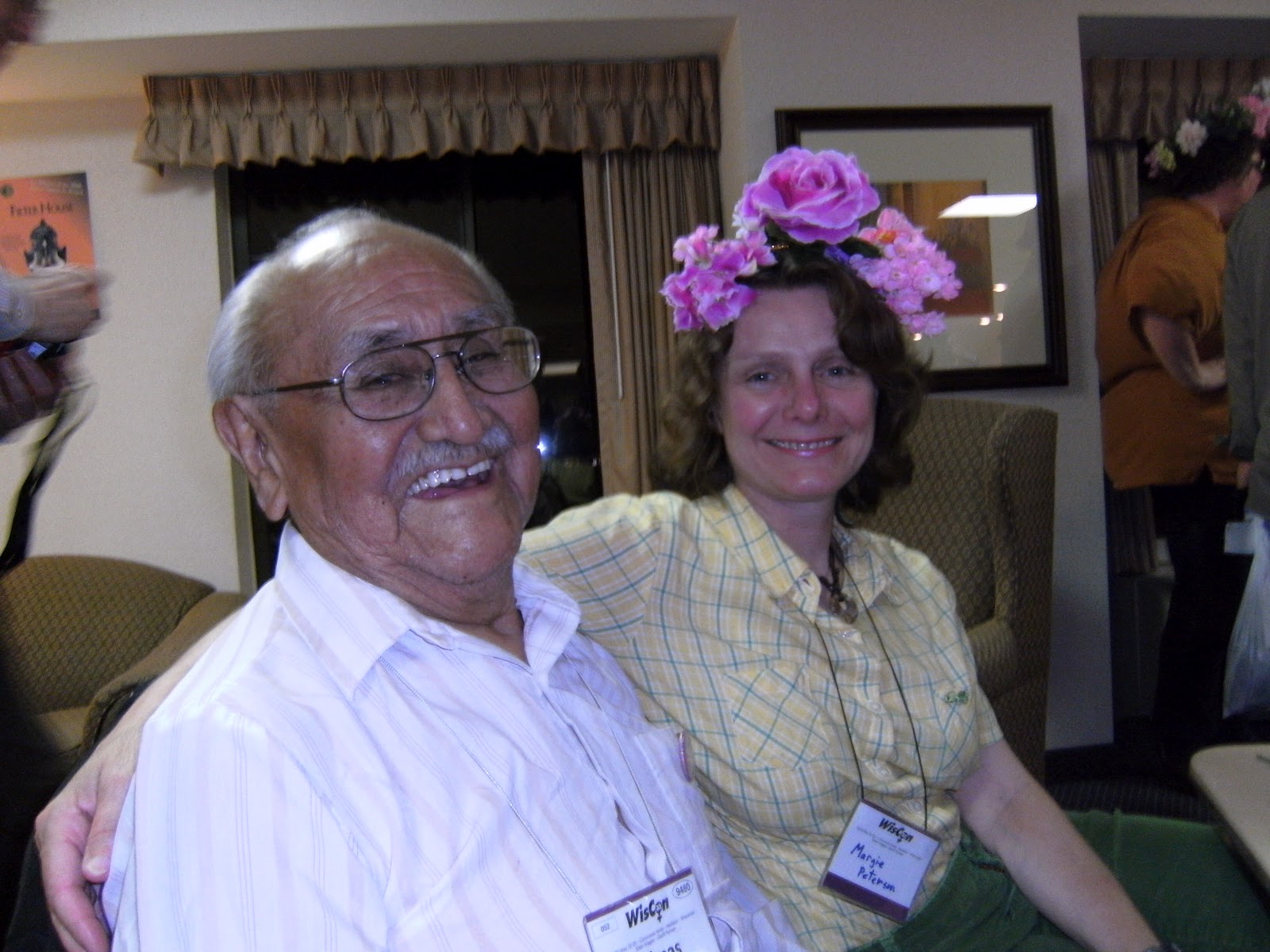
Here's Dimas with Margie Peterson at WisCon 33, enjoying their handiwork.
I wrote a picture book called "The Secret Princess" about how to do what MJ and Dimas have done. It starts out this way:
Once there was a secret princess: Princess Herminutia. She was a secret princess because nobody knew about her royal status. Her mama and daddy called her Minnie and made her take out the garbage.
With the assistance of a wise costumer, her neighbor Mizz Cherry, the secret princess constructs crowns for all her family and finally receives the respect she deserves. She gets what she gives. What I want for us all.
It occurred to me, particularly after reading Nancy Jane Moore's comment on my Post Readercon report, that for most of us, signing up for and appearing on panels usually entails only a limited amount of reflection. Would it be correct to say that the only thing most people who sign up for particular panels are sure of is that they have (or might have) something to say about the proposed topic? And that that certainty is the only criterion they have for participation? And is it also true that most people sit down in front of an audience first and foremost with the purpose of talking on that subject and with the confidence (whether warranted or not) that the audience (if not the other panelists) will be interested in hearing them speak?
Speaking to the subject of the panel is, after all, what they as panelists are there to do. But it's not really just that simple, is it. Panelists are there to engage in a collective communication-- with fellow panelists, and with the audience (even when the audience isn't speaking). When you start to think about it, it's a difficult form of communication to describe. Unless, of course, you think of each panelist as present in isolation from all the others, relating singly to the audience. But what sort of experience would that be for the audience? Three or four or five different speakers, performing intermittently, like university lecturers taking turns addressing a class of students? That's not my idea of a panel.
Presuming that's not a correct description of what a panel is, let's ask ourselves just what the appropriate description for the kind of communication that panelists should be engaging in is. Andrea Hairston, in her second comment to the post, used the word "conversation." When I'm moderating a panel, I definitely think of the discussion as a conversation-- among panelists, and between the audience and the entire panel. The character of a panel discussion is significantly different when audience participation is allowed or encouraged early in the panel rather than late. (I've moderated both kinds of panels, and both are legitimate, since verbal participation by the audience, while usually desirable, is not always necessary for creating a worthwhile experience for all.) Since Readercon panels last for only 50 minutes (as opposed to WisCon's eighty minutes), it's not surprising that quite a few panels at Readercon don't allow the audience into the conversation until very near the end (if at all). This is always fine with me, as an audience member, if the panelists have interesting things to say and are engaging in genuine conversation (rather than holding forth to the audience without bothering to engage with one another).
Did you catch that I just used the expression "holding forth"? I'm sure that just about everyone reading this post will know what I mean. The problem with seeing one's purpose on a panel as primarily that of speaking--"sharing" insights or regurgitating something recently read that relates to the subject--is that it turns panelists into lecturers. Speaking for myself, I've often found that the thinking, reading, and note-taking I've done in preparation for a panel may often have nothing to do with what the other panelists are talking about. So what does a responsible panelist do? Wait one's turn and hold forth? Many do. But that's not my idea of participating in a discussion. Even when I'm the moderator of the panel, I try to take my cue from the other panelists--and sometimes the audience-- and am prepared, when necessary, to abandon my preparation and go with the flow. (I.e., as a moderator or leader of a panel, my priority is to foster and organize as best I can an engaged discussion, a priority above that of setting an agenda for the discussion. I do, of course, start out setting an agenda, particularly when it's a panel I've proposed myself, but I'm always prepared to abandon it when I can see its either unintelligible or uninteresting to the other panelists.)
There are some problems, though, in thinking of panel discussion as conversation. A panel discussion can actually become too casual and informal, encouraging certain types of people to blather on uninhibited in ways that in a more informal setting could easily be headed off by the speaker's interlocutors. Informality can encourage a loss of consciousness that you're demanding attention from a large group of people who have no way of using the usual gambits interlocutors can use in conversations involving less than, say, six people. Informality can also contribute to panelists ignoring the cues of the moderator. Even worse, I've seen panelists actually lose it when stopped mid-flow--completely oblivious to the fact that the tangent they've gone off on may not be of interest to anyone else in the room. When there's an audience, cutting off someone whose gone on and on and on can be fraught, even if everyone else in the room is just waiting for that person to stop.
Would it be unreasonable to suggest that people ought not to agree to be on a panel unless at least one or two of the other panelists are people they're interested in hearing talk and interested in engaging with? It might well be that mere interest in and knowledgeability about the topic are not sufficient reasons for being on a panel. (They are obviously necessary reasons.) Perhaps all of us who participate in programming need to have the sense, going into a panel, that we're interested in hearing what the other panelists (or most of the other panelists) will have to say.
I strikes me that when serving on a panel we need to start from an attitude of respect for the panelists (and audience--which is something good writers will presumably already have, since you can't really be a good writer without presuming your readers are smart and perceptive), and a desire to hear what they're going to say, and of course the hope that the other panelists will be as interested in engaging with what you have to say as you are with what they have to say.
Does that sound utopian? I don't really think it is, since I've seen the difference these attitudes can make to panels I've been on. (The Imagining Radical Democracy panel at the last WisCon was a perfect example of that. I found it an electrifying experience. And I was not alone in that.) I feel pretty confident that much of the insensitive behavior of panelists at cons is a result of a particular panelist coming into the panel with a predetermined lack of interest in what the other panelists might have to say and regarding all the time on the panel when they're not talking as wasted, boring moments to be waited out.
WisCon-- and probably many other cons as well-- offers guidelines (and even a little course) on effective moderation of panels. Everyone considers panel behavior to be obvious. I wonder. Perhaps we ought to have a primer for prospective panelists. Not just on etiquette (though that would be a start, particularly in educating the clueless about what their relationship to the moderator ought to be), but also on purpose and attitude.
--On October 4, SF3, WisCon's parent organization, passed two motions on the Elizabeth Moon situation.
--Inspired by 80! Memories & Reflections on Ursula K. Le Guin, Michael Swanwick revists Poughskeepie (Part 1 here, Part 2 here). He writes:
Now, either you want this book (I did and now I have it) or you don't, and you already know which camp you dwell within, and no amount of descriptive analysis will budge you one way or the other.
So I'm not going to review the book. Why bother?
However, I was inspired by Lisa Tuttle's heartfelt contribution, "'From Elfland to Poughkeepsie' and Back Again, or, I Think We're in Poughkeepsie Now, Toto," on how important a single seminal Le Guin essay was to her, to go back and revisit said essay.
--Tansy Rayner Roberts reviewsThe WisCon Chronicles, Vol.4.
A snippet:
The highlight of the book for me was “We See What You Did There,” a group chat among various POC about their various experiences at the convention, and discussing their relationship with WisCon as a continuing event. This, combined with several standalone “My WisCon” con reports by different participants, definitely gives the impression that the book has achieved wide coverage as far as who and what WisCon is all about.
--Rex at Savage Mindswrites aboutThe Trashing of Margaret Mead: Anatomy of an Anthropoligcal Controversy by Paul Shankman, which examines Derek Freeman's attack on Margaret Mead's Coming of Age in Samoa (after Mead's death, of course). (Link thanks to the Mumpsimus.) It did my heart good to read
Impartial, but not noncommittal. Shankman describes the personal stakes and intimate social networks on both sides of the debate, and is frank in his assessment of how people’s personal commitments and backgrounds influenced their arguments. In addition, a major part of the book deals with the question of who is right about Samoa and this involves making judgments about the scholarly adequacy of Mead and Freeman’s work. As judicious as Shankman is, then, you still get a sense of where he stands.
And where he stands is overwhelmingly against Freeman. Freeman’s bizarre personal life — including his mental breakdown — is documented here in a scholarly monograph by a major press for (as far as I know) the first time. The stories that had been circulating about his atrocious behavior, such as contacting universities and demanding that they revoke the Ph.D.s of his opponents, finally get their full airing. Freeman’s arguments about Mead are shown not to hold very much water, and his own claims about Samoa don’t seem to stand close scholarly scrutiny either. At times one feels the book should be called The Trashing of Derek Freeman. But Shankman’s criticisms never seem vindictive and his discussion of Freeman’s psyche never degenerate into ad hominems — despite how easy it would be to do so. In reality, Freeman’s own worse enemy is himself — or at least himself and a scholar willing to rigorously document his actions.
Shankman is not uncritical of Mead and points out the ways in which Coming of Age reaches conclusions about American life that Mead quite liked but which were not really supported by the Samoan data. Still, it is clear from his book that Mead was basically a decent fieldworker and a careful scholar while Freeman was, frankly, a nutcake.
--And finally, I can't resist mentioning the recent research on great bowerbirds, which are apparently as common in Australia as black-capped chickadees are in my region of North America. When a report on this new piece of research was published in Current Biology on Sept 9, several magazines and newspapers leaped on it, including Science and Discover. Birds, of course, are wondrously various in their sexed division of labor (which variety should, really, be a lesson to to humans). In the case of great bowerbirds, the male spends a good chunk of the year building an elaborate nest for attracting females. Discover Magazine has a post about it on their blog that sums up some of the interesting bits. For instance,
Bowerbirds are relatives of crows and jays that live in Australian and New Guinea. To attract mates, males from each of the 20 or so species build an intricate structure called a bower, which he decorates with specially chosen objects. Some species favour blue trinkets; others collect a mishmash of flowers, fruits, insect shells and more. Surrounded by these knick-knacks, the artistic male performs an elaborate display; the female judges him on his skill as a performer, builder and decorator.
The great bowerbird’s taste for interior design seems quite Spartan compared to his relatives. He creates an avenue of sticks leading up to a courtyard, decorated with gray and white objects, such as shells, bones and pebbles. The male performs in the courtyard while the female watches from the lined avenue. Her point of view is fixed and narrow, and according to Endler*, the male knows how to exploit that.
He found that the males place the largest objects towards the rear of the courtyard and the smallest objects in the front near the avenue. This creates forced perspective. From the female’s point of view, the bigger objects that are further away look to be the same size the smaller objects that are close by. If bowerbird vision is anything like humans, the courtyard as a whole looks smaller to a watching female, the opposite effect to the one that Disney visitors experience.
Science, the biologists "mapped the positions of thousands of objects in front of 33 male bowerbirds' avenues. [...] When the researchers rearranged the designs, the males put them back in the original order. This behavior suggests that the birds are making deliberate choices, possibly implying some kind of cognitive talent."
National Geographic, by the way, has a wonderful gallery of photos of the nest males have built to woo females, here.
_______________
One of the authors of the research paper. The abstract of the paper can be found here, and here's a quote from it:
Males make courts with gray and white objects that increase in size with distance from the avenue entrance. This gradient creates forced visual perspective for the audience; court object visual angles subtended on the female viewer's eye are more uniform than if the objects were placed at random. Forced perspective can yield false perception of size and distance [12,15]. After experimental reversal of their size-distance gradient, males recovered their gradients within 3 days, and there was little difference from the original after 2 wks. Variation among males in their forced-perspective quality as seen by their female audience indicates that visual perspective is available for use in mate choice, perhaps as an indicator of cognitive ability. Regardless of function, the creation and maintenance of forced visual perspective is clearly important to great bowerbirds and suggests the possibility of a previously unknown dimension of bird cognition.
Anyone familiar with online discussion knows that it takes only one person in a particular venue to poison or stunt an interesting, thoughtful conversation among half a dozen or even two or three dozen people. It has happened a lot on the internet and is the reason most discussion groups have moderators and most bloggers moderate their comments. Arguably, the success of an online discussion depends heavily on the care and skill with which the discussion is moderated. This is often true for panels at science fiction conventions, too.*
Many individual moderators and bloggers may be savvy to the difficulties of creating and preserving a space for open, constructive conversation, but this is obviously not the case in the larger public sphere. Over the last nine years in the United States, extremist speech has proliferated throughout many areas of the internet as well as the public sphere, and the major "news" media have come to love extremist speech (as long as it's right-wing), especially when its racist or homophobic. There have always been right-wing extremists in the United States, but they've seldom been allowed to dominate public discourse as they do now.
One might argue that the reason right-wing extremists are now dominating public discourse is that the news media have decided that right-wing extremism serves the important functions of distorting our sense of the political spectrum and drowning out the conversations we would otherwise be having. Certainly that's how it's working for the larger political picture. How often, for instance, do journalists engage in consideration of the human rights issues that were so pressing in the run-up to the last presidential election-- issues that the Obama Administration have refused to confront? Or the dire environmental crisis that the extremists persist in denying? Or the chicanery in the financial sector that has thrown millions of people out of work and into poverty? Countering ridiculous disinformation is an endless treadmill of distraction.
My take on the politics of discourse in both the public and the blogosphere has shaped my sense of the impact the Elizabeth Moon controversy may have on WisCon 35. Over the years, WisCon's concom has helped to create and preserve a space for open, constructive conversation. Their success in doing this has made WisCon the unique event and place that it is. Creating and preserving a space for open, constructive conversation is not the concom's only role, but it is surely an important one. And so as a regular attendee of WisCon, I read with care the WisCon 35 co-chairs' statement to the WisCon Community, addressing the subject of Elizabeth Moon's post, in the latest issue of e-Cube e-Cube. They write:
We know that opinions are not changed by running away from them, but instead by engaging with them, challenging their assumptions, sharing knowledge, seeking understanding, and by lively and candid discourse. And we think that provides a pretty good short description of a typical WisCon.
One might say that WisCon excels at the difficult conversation -- and sometimes the hardest conversation is with an idol who turns out to be human. We have begun addressing our difference of views with Ms. Moon directly, and will continue to do so over the coming months and at the con itself. We hope you will join us in this difficult conversation.
Extremist speech like Elizabeth Moon's is threatening and harmful in itself to individuals, as the co-chairs acknowledge. But what the co-chairs do not acknowledge is that extremist speech is extremely detrimental when it is allowed into particular discourses. Many people at WisCon have over the last several years worked diligently to make WisCon inclusive not only of those who are othered in the larger culture but also in its discourse. Making WisCon's discourse more fully inclusive means finally beginning to move beyond the same-old bingo card exchanges that go on constantly in the culture at large, to a different sort of conversational framework that enables truly open conversation. I don't know Elizabeth Moon personally, and I don't know what she has said to the concom to make them believe that allowing WisCon discourse to be dominated by the issue of her ignorance will generate a conversation in any way worth the tax, but judging by her ignorant, extremist post (which is all we have to go on at the moment), it will be like trying to have a "conversation" with a Fox "News" pundit.
The fact that Elizabeth Moon summarily and indiscriminately erased every comment to her post, which she at the same time left standing, argues that even that limited form of conversation is unwelcome to her. On the basis of that act, the prospects for even "difficult conversation" are dim-- even if she does, belatedly, issue an apology (as Nisi Shawl hopes she will do).
Imagine if the concom had invited someone who had spouted off a Larry Summers-type remark about women being genetically handicapped at math and science. Would the concom then have decided to hold a fresh round of Feminism 101 panels to counter it-- thus reducing WisCon to being like all the other cons where the only feminist-interest panels one can find are of the Feminism 101 variety?
Here is a more general question: is treating an outburst of extremism as an attempt at dialogue a moderate response? Where, I would ask the "moderate," does one draw the line? What if Elizabeth Moon had said that she agreed with the Obama Administration's decision to assassinate a US citizen currently living abroad? Or that, building on her claim that what Muslims believe "unfits them for citizenship," she had announced that she agreed with the extremists who favor taking citizenship away from Muslim citizens of the US? Or if she had said she thought all citizens and residents who practice Islam ought to be expelled from the US or put into camps, as Japanese Americans were after the bombing of Pearl Harbor?
I raise the hypothetical question of where the line should be drawn because it strikes me that part of the difficulty here is that the WisCon concom apparently lacks a policy for dealing with extremist speech. In such a situation, the co-chairs, who speak for the concom and whose job tends more toward putting out fires rather than preventing them, seemingly have little recourse but to "disavow" the objectionable "elements of Ms. Moon's post." The primary definition of "disavow" is "to deny responsibility."** And denying responsibility for Elizabeth Moon's extremist speech is all, apparently, that they feel empowered to do in this situation-- that and putting the best face on the dissension, hurt, and distrust that will likely result from Elizabeth Moon's appearance at the con. Granted, they are in a tough spot. But perhaps the lack of an organizational policy giving the co-chairs other options in this situation would not be so limiting if US culture at large had a clearer notion of the stakes involved with legitimizing extremist speech. I'm sure that like most people, they believe that meeting extremism "half way"-- that engaging with it-- is a constructive, moderate, and even "objective" response. This attitude goes a long way in explaining how it happens that we in the US are steeped in a culture that allows the farthest reaches of the right-wing to determine both the center (which is far to the right of what it was in the 1970s largely because people on even the moderate left of the political spectrum are not allowed to be audible in the public sphere ) as well as the issues of public discourse. An ad hoc response to extremism-- which is what the co-chairs found themselves making in this situation-- mirrors the practice of the mainstream media-- viz., to allow such extremists to dominate discourse and dictate which issues are discussed.
I'll confess I had high hopes for this WisCon. I was tremendously excited that Nisi Shawl would be a GoH. It's hard for me to look forward to Nisi's speech now, though, without wondering how the protest against Elizabeth Moon's speech will affect what should be a joyous occasion. Will there be anyone left in the ballroom to celebrate the 20th anniversary of the Tiptree Awards? Just how will all of these disruptions play out? Without question, Elizabeth Moon's presence will cast a shadow over WisCon 35.
_______
*For more about panels, see my article in the second volume of the WisCon Chronicles, "Whose romance? Whose revolution? The operations of race and gender in panel discourse at WisCon.")
**"Disavow" is an unfortunate word choice. I can't help but think of Freud's use of the word in theorizing the etiology of sexual fetish. It generally conveys the sense of having it both ways.And I really don't think that's what the co-chairs see themselves as doing.
Yay IBARW for making me post, despite it being months late?
Although I had a very positive Wiscon experience this year, it was amidst a lot of fail. I heard and saw Black and South Asian women being mistaken for other Black and South Asian women, fishbowlogling, and a lot of reports of people asking POC to be their special POC friends ("I have had no prior interaction with you before, but let me waylay you for half an hour to pepper you with questions about proper ally behavior or ask for your permission to do X!"). I personally managed to avoid a lot of fail, I think because a) I limit my panel appearances, b) I only go to panels in which I know and like the panelists, and c) I am antisocial, do not really go to parties, and only talk to people I know and like. Given the shenanigans, I do not think I will be changing my interaction habits in the future.
This works fine for me since I am, as mentioned, antisocial, but seriously. POC should not have to limit all their social interactions at a con just so they can be treated like a normal human being.
With all those caveats in mind, I was so happy to see so many brown faces this year, to make connections with people I've only seen online, to get the chance to talk in person instead of via comments.
One of the highlights of the con for me was being on a panel about Andrea Smith's Conquest with Andrea Hairston and Diantha Day Sprouse and talking with them afterward. First, I'm thankful I got the chance to apologize to Diantha for calling her too angry years ago; I read that now and think "She is so right! Make people with their horrible grabby hands GO AWAY!" But mostly, I cannot emphasize how good it was to talk to women of color from different generations than me about their journeys and their experiences.
The women I grew up with—my mother, my grandmothers, my aunties—gave me many things, but they did not give me the tools to deal with issues of social justice. And although I love them dearly, the models they have to offer aren't very radical. I think it's pretty sad that it took me going to Wiscon, which is mostly white, to find other women of color whom I looked up to as role models, but that's what happened. And I'm grateful that even though the initial connections I made with people were online or at Wiscon, they have been moving offline and outside the con. I'm glad I've been able to talk with more people locally, to have discussions in email and on the phone and in person so I can work through things without having random white passerbys ogling at my mental processes.
I can't even say how much it means for me to finally find these communities of women of color who are committed to social justice, especially in SF/F, which is what I grew up on. So thank you to the women I've gotten to know, the women I sometimes disagree with, the women I don't know, the women who have passed on, to all of you out there creating and critiquing and blogging and talking and being fannish and just being yourselves.
Having your multitude of voices means so much to me, especially as I continue to work on who I want to be and what I want to do.
I'm away from home, briefly, visiting the Columbia Gorge, staying in Hood River, OR. It's a beautiful area, but (for me) a bit hot for September.
I see that Strange Horizons has posted an interview with Jeanne Gomoll on Feminist SF, the Tiptree Award, and WisCon, complete with the image of Space Babe (which Jeanne designed). Check it out!