Showing posts with label reading list. Show all posts

Thursday, December 10, 2020

The Pleasures of Reading, Viewing, and Listening in 2020, pt. 1: Lesley Wheeler


The Best Thing About 2020

by Lesley Wheeler

There were stretches, this year, when I could barely read through the haze of worry and outrage. Many amazing books reached me anyway. I spend most of this column on recent publications in sympathy for authors trying to get the word out right now but also because my 2020 reading tilted toward the contemporary. 


When I’m low, I look for page-turners: novels high in suspense and full of characters whose fates I care about. Little else can clear the mental static. The experience of reading The Only Good Indians by Stephen Graham Jones was perfect. At a virtual convention this fall, he described the story as a slasher—not my genre, usually. Yet even as Jones delivers on the slasher’s propulsive energy, he dissects its pleasures. I’m still in awe of his more-than-human monster (a mother animal) and his intensely moving riff on the “final girl” trope. From an utterly different world, Leigh Bardugo’s Ninth House also depends on formula while uncovering a genre’s disturbing understory. This school-of-magic tale is set at Yale, where secret societies manage terrible powers whose costs are paid by scholarship students, especially by vulnerable women. Cherie Dimaline’s Empire of Wild offers a riveting Métis rougarou visitation, and Nova Ren Suma’s The Walls Around Us is a brilliant ghost story.

As I reflect on the novels that affected me most this year, I realize they’re not only page-turners but investigations of race, class, gender, and social power generally, both well-told and urgent. I needed them and learned from them. For the same reasons, I’ve been working my way through Victor LaValle’s wonderful backlist. I downloaded the audiobook of Geraldine Brooks’ Year of Wonders—about literacy, social mobility, and the bubonic plague—before the contemporary plague was on my radar but found its account of seventeenth-century quarantine close-to-home. 


I also loved newer historical fictions penetrated by tendrils of the Weird, especially Afia Atakora’s Conjure Women and Sarah Tolmie’s The Little Animals. The latter is more than a year old now, but I’m nowhere near caught up with 2019, much less 2020. Among recent works I’m excited to crack is Master of Poisons by Andrea Hairston. I did read an advance copy of a late December release by Edward Austin Hall, Dread Isle, and it’s a terrific gender-bending, twisty novel with lots of Jules Verne in its DNA.


Poetry also kept me afloat this year, especially when I couldn’t sustain multi-hour literary voyages. Some favorite recent collections are Little Big Bully by Heid E. Erdrich, a manual for how to survive violence through a love of people and land; Leila Chatti’s Deluge, a first book about faith and the course of a bleeding disorder; and Kiki Petrosino’s White Blood, which brims with Virginia history and sharp meditations on mixed-race identity. 


I reviewed Anna Maria Hong’s fabulous Fablesque here, and my review of Destiny O. Birdsong’s Negotiations will appear soon in Harvard Review, but in short, it’s a knockout. For charm-like poems intensified by letterpress printing beauty, see Anna Lena Phillips Bell’s Smaller Songs. Although I have a tiny entry in each and it might seem self-serving, I strongly recommend Annie Finch’s stunning Choice Words: Writers On Abortion; Rocked by the Waters: Poems of Motherhood, coedited by Margaret Hasse and Athena Kildegaard; and Deep Beauty, coedited by Catherin Lee and Rosemary Winslow. They are wisely orchestrated anthologies, at moments breathtaking. I felt so grateful to receive my copies and to all the other editors and authors who made a tough year better.  


Lesley Wheeler’s debut novel is Unbecoming. She is also the author of five poetry collections, most recently The State She’s In, from Tinderbox Editions; The Receptionist and Other Tales was a finalist for what was then the James Tiptree, Jr. Award. Poetry’s Possible Worlds, Wheeler’s essay collection about twenty-first-century poetry, is forthcoming in 2021. Her poems and essays appear in Massachusetts Review, Strange Horizons, Poetry, Lady Churchill’s Rosebud Wristlet, Kenyon Review, and other magazines. Wheeler is Poetry Editor of Shenandoah and lives in Virginia.


Monday, December 30, 2019

The Pleasures of Reading, Viewing, and Listening in 2019, pt. 24: Julie Phillips


 A Year of Shifting Perceptions
by Julie Phillips


It’s been a year of shifting perceptions for me, in which some things that have been stuck for a long time came loose, I can only hope for the better. Among my favorites this year are some books and a film about how to take useful action, whether or not you know where you’re heading.

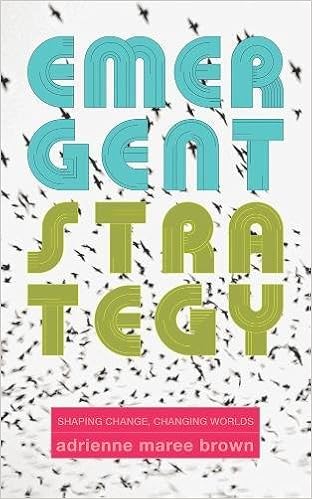
The most encouraging book I read all year was Adrienne Maree Brown’s Emergent Strategy, a meditation on social justice and science fiction that is also a kind of carrier bag for ideas about imagination and change. Emergence has to do with allowing small interactions to become linked together in complex patterns of community and persistence. Taking inspiration from the work of Octavia Butler, as well as from biology and chaos theory, Brown emphasizes resilience and adaptivity as useful qualities and suggests learning from the survival strategies of dandelions, mushrooms, and oak trees. 

She also advises “collaborative ideation—what are the ideas that liberate all of us? The more people that collaborate on that ideation, the more that people will be served by the resulting world(s). Science fiction is simply a way to practice the future together.” Citing Toni Cade Bambara, she says, “We must make just and liberated futures irresistible.” 

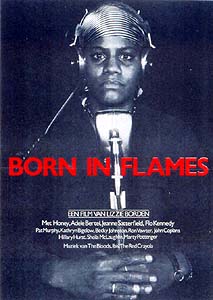
While I was reading Emergent Strategy and marching in demos, an old friend took me to see Born in Flames, Lizzie Borden’s 1983 science fiction film about women plotting a revolution. It deals with the potential power of small-scale direct action, and I just can’t tell you how good this movie is and how amazing it feels to watch in this moment. Visually and thematically, it illustrates Brown’s patterns of emergence: Gangs of women on bicycles circulate for safer streets. Two pirate radio stations create links between feminist cells citywide. And an older activist (played by feminist lawyer Flo Kennedy) advises a younger one: “Which would you rather see come through the door, one unified lion or 500 mice? You know, 500 mice can do a lot of damage.”

The central narrative of armed revolution is not the film’s strongest point, although a scene of the Women’s Army hijacking a New York City TV station does have a kind of anti-Fox News satisfaction. But its class- and race-conscious analysis of feminism is fine, and I enjoyed its ’80s feminist anti-style (one of my responses to it was “Hey, I used to wear that”) and terrific punk soundtrack. You can watch it on demand here: https://vimeo.com/ondemand/borninflames

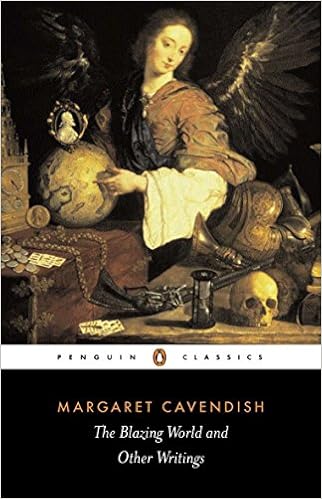
The feminism of Born in Flames grows out of patterns of verbal exchange, and so do the weird liberating qualities of The Blazing World, the epically strange 1666 work of fiction by Margaret Cavendish, the Duchess of Newcastle. A friend asked me to write about it, and knowing very little about it, I expected it to be a utopia of place—its creator’s perfect world. What I found was a utopia of process, of dialogue and relationships. The Blazing World isn’t actually on fire, sadly, though it has the usual buildings made of gemstones and so on. Its most remarkable property is that many of its inhabitants are half-human, half-animal—bird-men, lice-men, fish-men, worm-men—and the human scientist who becomes its empress persuades them to help her research the causes of natural phenomena. Where the science of the time placed men above women and the natural world, Cavendish advocated scientific inquiry as interspecies collaboration. 

It’s also very funny. After a while the empress decides she needs a secretary, and the spirits of the Blazing World tell her she can choose anyone, living or dead.


Instead she asks for a contemporary philosopher like Galileo or Descartes, but the Spirits answer that they’re too arrogant to be a secretary to a woman. Then the Spirits say, why not try the Duchess of Newcastle? So she summons the Duchess, who says, I’d love to, but my handwriting is terrible. And the Empress says, I can live with that. So they start having long conversations and making up new fantasy worlds. Collaborative ideation!

Also in 2019 I wrote about Suzette Haden Elgin’s Native Tongue https://4columns.org/phillips-julie/native-tongue. I went to a great reading by my old Voice colleague Colson Whitehead, who is very funny about growing up a nerd as well as a profound and imaginative thinker about the use and misuse of power. I reviewed Margaret Atwood’s The Testaments and thought about how subtly she’s always written about the space between individual women and their roles. https://www.julie-phillips.com/wp/?p=1048 I rediscovered the wonderful film Céline et Julie vont en bateau (1974) by Jacques Rivette, a fantasy in which three female characters stage a jailbreak from a heterosexist love story and go off in search of a better plot.

I was sad that we lost Vonda N. McIntyre this year, and moved by her generosity in donating her estate to Clarion West. Another project she encouraged friends to support was research into the Southern Resident orcas who live in the waters of the Pacific Northwest. When I renewed my family’s orca adoption again this December, I thought of her, of the matriarchal society of the orcas, and how hard it is to keep imagining my way toward others, even though it feels like the work that needs to be done.

I don’t know if that’s part of un-stuckness, but I’m trying.


Julie Phillips is a book critic and the author of the NBCC and Hugo Award-winning biography James Tiptree, Jr.: The Double Life of Alice B. Sheldon. She lives in Amsterdam, where she’s working on a biographical look at writing and mothering in the 20th century, to be called The Baby on the Fire Escape.


Wednesday, September 28, 2011

What I read last summer, part 2

[Note: the first installment of this series of posts can be found here.]

One of my most compelling reads last summer was Palle Yourgrau's Simone Weil, published in a gorgeous edition, lavishly illustrated, by Reaktion Books as part of their Critical Lives series. I say that it was compelling, but it also pushed some of my buttons and made me think hard, forcing me to momentarily set aside my usual categories for sorting and associating ideas, since my understanding of the implications of certain of Weil's statements were in apparent contradiction with my understanding of other of her statements. In short, I had to tolerate a certain amount of uncertainty and confusion about the meaning and implications of Weil's ideas throughout my reading of the book, which was a bit like fitting together the pieces of a jigsaw puzzle without a picture of the image you're supposed to be constructing. That uncertainty, of course, added a dash of urgency to the reading, which countered some of the negative feelings about Weil that I had had before I'd even picked up the book-- though I ended up thinking that some of my reservations about her (particularly her attitude toward embodiment) were justified.

As the series title indicates, Simone Weil's life is the focus of the book-- even as its central theme is its insistence that an appreciation for and understanding of Weil's thought has been distorted and overshadowed by the received notion of what that life was. Yourgrau notes in his introduction that Weil was omitted from the "groundbreaking" 1996 collection, edited by Mary Warnock, Women Philosophers, because Warnock grouped Weil's work with "the writing of women who, to put it crudely, seem to rely more on dogma, revelation or mystical experience than on argument." Yourgrau's bio of Weil, though most interested in Weil's Platonist preoccupations, does take note of Weil's work in political philosophy. So that makes me wonder: did Warnock know of Weil's work in political theory, or did Weil's political theory not count as "philosophy" (given how closely it was tied with analysis of labor issues)? Yourgrau notes that Warnock included Iris Murdoch--who, ironically, was strongly influenced by Weil-- in the book, then suggests that
Weil, by contrast [to Murdoch], resists all categories. While it is not accurate to say, as Warnock has, that she does not engage in extended argument, it is true that argument was but one of her weapons--and 'weapon' is the appropriate term, since Weil is an extremely dangerous thinker. The same is true, however, of Nietzsche and Wittgenstein, yet both of these thinkers (men, to be sure, a not incidental fact) occupy well-established niches in the philosophical canon. Indeed, one of the key tasks of a presentation of Weil's life and mind that pretends to any kind of seirousness is to try to provide a ocnvincing account of exactly what kind of thinker Weil was.(13)
I think it is indeed true that more slack is cut for thinkers who don't fit neatly into formally recognized categories when they are men. Although Weil's thought is in many ways almost orthogonal to Nietzsche's (most glaringly in Nietzsche's pronouncing Christianity as the religion of slaves and castigating it as therefore insidious and demoralizing, while Weil pronounced it as is the religion of slaves and cherished it for that very reason), Yourgrau is right to point out some of the parallels between them (and between Weil and Wittgenstein, as well).

Reading this intellectual biography, what struck me most (apart from the fierce, even rigid stubbornness of this woman) was not how short her life was, but how much she accomplished and how seriously she lived for someone who died at the age of 34. I can well imagine that Simone de Beauvoir (who attended the Sorbonne when Weil did, and whose test score for entering the Normale Superieure was the second highest for the year in France-- while Weil's was the highest) found her intimidating, as Yourgrau comments:
'Her intelligence,' notes Beauvoir,' her asceticism, her total commitment and her sheer courage, all these filled me with admiration, [though] I could not absorb her into my universe, and this seemed to constitute a vague threat to me.'

Neither Beauvoir, it seems, nor Sartre, could, for all their admiration, incorporate Weil into ther life's view, a discordance unsurprising, as [John] Hellman wisely remarks, 'in a couple who remained pure intellectuals, seeking a "meaning" for human existence sooner than addressing its sufferings and misfortunes....' Whereas Weil aspired to become a 'slave,' Beauvoir's goal was to become a master, of herself if not of others. Where Beauvoir is the mother of feminism, Weil would reject even the label. Asked to lead a discussion group, she lashed out, 'I'm not a feminist!(41)
I'd have been interested to hear what Beauvoir made of that response, myself. Yourgrau, though, denies us that pleasure.

It seems to me that Weil's early and persistent identification with "the slave" lies at the heart of her life, her thought-- and my long-time difficulty of opening my mind to her ideas. This identification started, not surprisingly, in early childhood, since children often hold the notion of sacrificing oneself as a proof or achievement of goodness, sometimes on a grand scale. Weil was raised in an extremely affluent (secular) Jewish family in Paris in the first decades of the 20th century. (She was born in 1909.) She was raised like her brother Andre (yes, the famous gifted mathematician) as a boy, and they were very close. Yourgrau observes: "Signing her letters, 'your respectful son,' Simone became Simon-- a favourite nickname for her in the family-- a brother to her only brother, a second son. When, in the course of time, she wrote about the legendary Cathar civilization of Laguedoc, she adopted the pen name of a man, the anagrammatical 'Emile Novalis.'"(17) When, as a child during World War I, Simone learned that soldiers at the front were "being denied their ration of sweets," she gave up chocolate. As an adult, she developed the habit of sleeping on the floor (as a practice of humility). As early as the age of three, she refused a gift on the grounds that it was "luxurious." Here's Yourgrau:
It was other people's pain that moved her, not her own. From early in life to late, no border could contain her empathy for the plight of others, from soldiers on the front lines to enemies subjected to harsh treaties, from workers in the luxury hotels in which her family vacationed to factory workers, slaves to machines, from present holocausts to those buried in the distant past. But what she could least bear was separation-- holding herself apart from those outside, in pain....

....As a child, she would sit herself down in the cold snow and refuse to budge if her brother was given the heavier bags to carry. Why should his burdens exceed hers? On vacation during her gradute studies, she shared the harvest in Normandy, heaving sheaves of thistles bigger than herself....When the war came, she could never understand why only men should be asked to die. Hence her plan, never realized, of organizing a volunteer corps of front line nurses, aimed more at the sharing of death than at the saving of life. (22)
My mother would have derided Weil as suffering from a "martyr complex"-- a sneering phrase she trotted out to counter my own tendencies, as a child, toward self-sacrifice (because I associated it with "being good."). As an adult, Weil would ask people who were providing her with hospitality to give her "the worst room" in the house. On reading that, my response was to imagine being confronted with that request from a guest. Except for the most unwelcome guests (and sometimes even for them), most people are anxious to make their guests as comfortable as possible. (Their own self-esteem and self-respect depends on it!)

I found her utter obsession with being assigned a resistance taks that would inevitably result in her death the most repellent thing about her. But what makes me feel that I'm unlikely to ever properly appreciate her thinking is her attitude toward embodiment. Yourgrau asserts that Weil was "suspcious of the very fact of embodiment" (17)--which, to my mind, dovetails perfectly with her passion for Plato and Platonism. She could not tolerate being touched or embraced by anyone. She pretty much malnourished herself all her life (something that would eventually hasten her death from TB), she hated her own beauty and did everything she could to conceal it (except when, during her phase of forsaking teaching in order to take up the harsh-- and ultimately flattening and depressing-- life of a factory worker, she needed to doll herself up to get hired at Renault). It occurred to me, though, reading that as an infant she became seriously ill and could not tolerate her mother's milk, and that when she was weaned, refused food entirely, and that in general sh "never really recovered her taste for food" [if before 11 months she had ever had one], that abstaining from food was not the sacrifice it would have been for most people, particularly since as an adult she was a caffeine and nicotine addict. Ascetism is much more of a challenge for people who love the things of the flesh than for those who have all their lives felt indifferent to them even before they came to despise them.

As you've no doubt figured out by now, Weil's distate for embodiment and the wish to be exalted by the glory of sacrificing her life for others added up, for me, to something pretty negative.

I got pulled up short, though, when I read this, because it initially called into question my sense of her loathing and contempt for the body:
God is in the details, it is said. For Weil, as for van Gogh, he is in the vineyard--close to mother earth. Indeed, especially in his early paintings, it is difficult to distinguish van Gogh's peasants from the earth they are working. In his famous De Aardappeleters ('The Potato Eaters'), there is a kind of alchemy in which there is as much potato (aardappel, 'apple of the earth') in the peasant as there is on the table. In Weil's alchemy, too, the transformation comes from labour. Her 'labour theory of value,' like van Gogh's, owes more to St. Augustine than to Karl Marx. Yet, with Marx, she comes to believe that it is precisely one of the sins of capitalism, of industrial society, that it not only separates the worker from his product, but more importantly robs his activity of its intrinsic worth and dignity, for it is 'work... [which] creates respect for the human person, and equality'. For both, the opposition of mental work to physical work is one of the great lies of the modern world. 'From the bottom of her heart,' writes Jacques Cabaud, 'Simone Weil desired to work for the abolition of the degrading division between intellectual work and manual labor.' And not just a degrading division, but the illusion of a chasm in epistemology. '[Even] to see space', she writes at Normale (to the amusement of all), 'is to grasp work's raw material...Geometry, like all thought, perhaps, is the daughter of labour's fortitude' ain work not only is the person himself realized but for Weil, it is there that his mind takes command. A Cartesian, for Weil it is not a question of cognito ergo sum but rather, 'je veux, donc je suis' ('I will, therefore I am'); I bend my will to work.
This mishmash of the Platonic and the Cartesian with the organic at first appeared (to me) to be carnephilic. That, I think, was an illusion created by Yourgrau's invocation of Van Gogh's De Aardappeleters). For slowly I began to realize that Weil did not value laboring with one's hands for its organic connection with the world and as a valorization of embodiment, but rather because-- for her, a highly educated child of wealthy parents who voluntarily left her comfortable job teaching to repeatedly damage her malnourished, clumsy body with dangerous factory work (entailing repeated burns and cuts and other injuries)-- laboring with her body required an act of will to subject herself to the harsh discipline of manual labor. She found it good, in other words, because she chose (willed herself) to do it. But just think about it: that kind of reasoning simply cannot work for people who labor in order to eat and keep a roof over their own and their children's heads. They don't have a choice (other than to starve)! I think I can see how that might not have occurred to her, ever-- and how the people around her might not have thought of mentioning that to her, either. It strikes me as a somewhat...tragic misunderstanding, one that some people might see as presumptious rather than glorious.

On the other hand, I have no problem grokking her intense distress over exclusion, which, I think mistakenly, she held against the Jewish religion, and which ultimately prevented her from becoming a Roman Catholic, and which also prompted her to think of the Vietnamese when the Nazis marched into Paris, and write in her notebook "A great day for Indo-China"-- meaning that the colonialist French who had been occupying Indochina for so long were now the occupied themselves-- a remark that Jeffrey Mehlman interpreted as indicating that she was siding with the Nazis rather than expressing her awareness that the oppressed could also be oppressors. (73) In fact, the invasion and occupation of France prompted Weil to do a lot of interesting, critical thinking on the subject of patriotism, and I think I would like sometime to read the writings that resulted (and were later collected and published as The Need for Roots.

I realize that except for mentioning her critical thinking about patriotism I've mostly talked about the aspects of Weil I have trouble with. There was more than that that I found interesting, and I think I'd be very interested to read what she has to say on the Cathars as well as on Homer's Illiad. So please don't be put off by my focus on her disdain for embodiment. I assure you, her strength of will and persistence in thinking beyond the obvious come through with such clarity in this book that I have no reservations about recommending the book highly. There is nothing dry about it, and the author's choice of presenting Weil's thought side-by-side with her development and the events of her life makes it a surprisingly easy, sometimes amusing, and occasionally poignant read.