Showing posts with label Ritch Calvin. Show all posts

Wednesday, December 24, 2025

The Pleasures of Reading, Viewing, and Listening in 2025, pt. 15: Ritch Calvin


Pleasures of Reading: All about Knowledge  

by Ritch Calvin 


Sometimes, readings students’ writing feel like drudgery; sometimes, it is such a pleasure.

 So, for the past 6 months, or so, I have been heavily steeped in reading epistemology.


 If you have followed me at all, that shouldn’t be surprising. After all, my 2016 book was titled: Feminist Science Fiction and Feminist Epistemology; it’s right there in the title. Further, I wrote about epistemology in Pleasures of Reading 2022 edition.

 However, in my previous encounters, I had been heavily focused on Western epistemology. I’d read Aristotle and Plato, Descartes and Quine, Locke and Hume, etc., etc.

But in early 2025, I was asked to teach a revamped class for the Honors College called a History of Human Understanding. I was provided with a few sample syllabi, and I said “No thanks” to that. Those syllabi, too, were completely focused on Western epistemology. I informed the Honors College that, if I were to teach the class, it would include much more diverse readings. They said, “Fantastic!”

 And the great read-a-thon began.

 I spent Spring and Summer prepping for the class and trying to wrestle (a nod to Plato) a syllabus into shape. So much to cover. So many false starts. So many discarded attempts.

 In the end, we did read four texts from the Western tradition.

 Beyond that, we read Chinese epistemology, Indian epistemology, African epistemology, African diaspora epistemology, Native American epistemology, indigenous epistemology, feminist epistemology, queer epistemology, trans epistemology, epistemology and science, epistemology and democracy, epistemology and medicine, epistemology and fake news.

 Many of you will note that most of the epistemologies mentioned are vast and complex. Indeed, they are. We could have spent the entire semester on any one of them. But we did discuss that problem and what it means to reduce an entire culture to a few “representative” texts. It is the very nature of introductory level courses.

 One of the things that students noticed and discussed (frequently) was the fact that the Western epistemological tradition (or at least some of it) centers on the individual knower. In Plato’s Theaetetus, it is a question of whether or not Theaetetus can know anything or not. In Descartes’s Meditations, he distrusts his senses and all those around him, and he retreats into his own mind. Only what he as an individual thinks is knowledge.

 On the other hand, the non-Western epistemologies see knowledge as both a communal effort and a relative thing. The knowledge is produced by all the individuals—across generations—and is handed down and shared. As such, they are less interested in universal Truths and more interested in what is relevant for their own existence. They recognize that what may be true for their community might not be true for another community.

Furthermore, the vast majority of my students were taken by the lower-case truths of community-based knowledge. At the same time, they were largely flummoxed by the idea that these small communities were perfectly content with the “stagnation” and were not motivated by “progress.” Nevertheless, they seemed to take comfort in the idea of knowledge as a communal project.

 And then we turned to generative AI. (Ah, there is already so much to read about AI!) We read about how large language models (LLMS) work—and don’t. Whether what AIs produce is “knowledge”—or not.  And about the ways in which LLMs replicate the marginalizations and biases that we already see in society. We also tried out a few AIs in class to see how useful they were as a learning tool. Almost to a person, they rejected the AIs we used. They did not think they were useful (except maybe to create study guides). They believed that what the AIs produced was meaningless unless they had already read the source material.

 And the students were so enthusiastic. For one, they loved the fact that the class did not focus on Western thought. They were already well aware of the Western tradition (or so they thought). For another, they were eager to read an expansive history of epistemology. Many noted how refreshing it was to read something from their own culture. And finally, they were eager to see some of the ways in which it directly impacts their own lives.

 As I am writing this essay, I am bouncing back and forth between writing this reflection and grading the final essays from the class. And I have to say, reading these 24 essays written by 18-year-olds is the real pleasure of reading. These final essays by this group of first-year college students have been fantastic.

 For their essay, they were asked to consider the long tradition of knowledge as the product of an individual and the long tradition of knowledge as a product of a community. Finally, they were asked to consider how the emergence of generative AI supported or undermined those two traditions. What does knowledge consist of today?

 They examine both the pros and cons of Western epistemological models. They examine the pros and cons of non-Western epistemological traditions. They’re thoughtful, and articulate, and engaged.

 And then they turn to what AI has wrought.

 The results are both devastating and heartening. They engage with these ideas in meaningful ways. They recognize the importance of these questions. And they are grappling with the role of these new tools in their lives.

 It is science-fictional thinking of the first order, and the task has been a complete pleasure.


Ritch Calvin (he/him) has published essays in Extrapolation, Femspec, Science Fiction Film and Television, Science Fiction Studies, New York Review of Science Fiction, and SFRA Review. His bibliography of the works of Octavia E. Butler appeared in Utopian Studies in 2008. His first edited collection, on Gilmore Girls, appeared in 2007. In 2014, he edited (with Doug Davis, Karen Hellekson, and Craig Jacobsen) a volume of essays entitled SF 101: An Introduction to Teaching and Studying Science Fiction. In 2016, he published Feminist Epistemology and Feminist Science Fiction: Four Modes (Palgrave). He has published three volumes with Aqueduct: The Merril Theory of Lit'ry Criticism (edited, 2016), Queering SF: Readings (2022), and Queering SF Comics: Readings (2024). He is currently working on a volume on short science fiction film (with Paweł Frelik) and a book on C. J. Cherryh.

He was a juror for the 2014 Philip K. Dick Award and for the 2018 James Tiptree Award (Otherwise). He lives on Long Island. One of his chickens has now decided that she lives inside the house.


Sunday, December 29, 2024

The Pleasures of Reading, Viewing, and Listening in 2024, part 19: Ritch Calvin


The Crowded Pleasures of Reading

by Ritch Calvin


In November 2024, I received an email from a college student based in Belgium who was conducting research on science fiction and the predictive component of SF. They asked me if I would participate in an interview to discuss the issue. I said, “Certainly, though you may not like my answer.” Based on the way they had framed the question, I anticipated that they would be making the argument that science fiction is a mode of prediction. We had a lovely, engaged conversation that ran well past the allotted one-hour time limit. The belief is common enough—SF will tell us what the future looks like. And/or that science fiction writers are visionaries. Further, isn’t one of the primary modes of science fiction extrapolation? So, can SF tell us what the future will look like?

 Well, I don’t think SF is particularly good at predicting the future.

But wait, didn’t Dick Tracy’s (he/him) wrist watch predict the iWatch? Didn’t Arthur C. Clarke (he/him) predict geosynchronous communications satellites? Didn’t Isaac Asimov (he/him) predict ethical issues with autonomous robots (and AI)? All arguable. Nevertheless, SF gets it wrong more often that it gets it right. For every correct (or vaguely correct) prediction in Brave New World, the novels gets another two or three incorrect.

Despite all of that, sometimes a work of SF can seem scarily prophetic.

In preparation for Queering SF Comics, I read Crowded—a graphic novel in 17 parts, published between 2018 and 2022. Written by Christopher Sebela (he/him), drawn by Ted Brandt (he/they), and colored by Tríona Ferrell (she/her), the comic is a vibrant, energetic, and colorful look into a near-future US society. As a comic, it is fast-paced and equal parts fun and frustrating—and more than a little sobering.


 In the comic, the protagonist Charlie Ellison (she/her) patches together a living via the gig economy. She walks other people’s dogs; she rents out her clothing; she rents out her car; she provides companionship for elderly individuals. Etc. Etc. Charlie lives precariously and uses apps in order to eke out a living. While comical in its variety and scope, Charlie’s lived reality may seem quite close to some people’s current reality. Charlie’s life is not much of an extrapolation.

 And then one day, someone uses an app to have Charlie killed. In the Crowded future, even murder can be crowd-sourced via an app called Reapr. When the first crowd-sourced murder happened, of course, everyone was shocked and scandalized. However, over time, crowd-sourced murder becomes an accepted mode of conflict resolution. As the comic comically notes, for a price, one can put out a hit on a family member, a co-worker, a politician, or someone who has ruined a beloved film franchise. Others can also add to the bounty, fueling the number of would-be assassins—and the likelihood that the murder will be successful.

 And, just as murder-for-hire emerges, complementary professions emerge alongside it. For example, Dfenders are those who, for a fee, protect the would-be target from murder. Although the practice (and the app) have become legal, gig economy murderers have to follow rules. If the target can survive 30 days,  the contract is null-and-void. Things just go back to “normal.”

 In the story-line of Crowded, the bounty on Charlie keeps growing, and growing. With a huge price on her head, Charlie hires a Dfender, Vita Slatter (she/her), a queer ex-cop who has a strong affinity for following the rules. Vita’s willing to kill, but it must be by the book—if primarily to avoid the paperwork.

Two more different personalities one could not find, which fuels the fun and the frustration throughout the narrative.

Perhaps inevitably, I thought of Crowded as I read the news of the murder of UnitedHealthcare CEO, Brian Thompson in Manhattan in December, 2024. To be clear, the details do not exactly fit the future laid out in Crowded. However, a number of elements seemed disconcertingly true.

For one, in our current US economy, more and more of the population live a precarious life. Many people live partly or wholly via the gig economy. (I don’t want to paint a too-simplistic picture of that. The gig economy does offer some benefits, and some people prefer it to the steady 9-to-5 model.)

For another, public spectacle has become more and more the norm. Individuals, from all walks of life, stream their own lives for profit. From RealLife where people go about their daily lives with live cameras throughout their home to live-streamed events to social media. Our lives have become fodder for the web. Our lives take meaning by way of likes or clicks. We’re willing to broadcast our personal and intimate lives. We’re willing to stream our rage and frustration.

 So, to be clear, the murder of Thompson was not a hit; it was not live-streamed. Nevertheless, it certainly felt as though it played out in realtime as the search for the killer was conducted: non-stop news coverage; non-stop reports of his movements; and non-stop commentary on the causes and effects of Thompson’s murder. And, of course, just as many, many citizens cheered on the murder of Charlie, so, too, did many citizens cheer on the murder of Thompson.

 In Crowded, as the bounty increases and as the number of people who want Charlie dead increases, the chase becomes more and more public. We meet Trotter (he/him), who is a professional, real-time murderer. He and his team track bounties, and they livestream the completion of the contract. Live-streamed murder-for-hire is a lucrative business, and Trotter does quite well.

 It all sounds macabre and inhumane. It all sounds too familiar.

 In Crowded, people use the Reapr app for all sorts of reasons, large and small, personal and public. The slightest insult can result in a Reapr contract. That, too, seems too familiar. It is as though we no longer have the ability to negotiate conflict, to shrug off an insult (intended or perceived). Tensions escalate; violence ensues. I am not naïve; I know that violence has always been a part of human existence. That violence has never been so public before.

 The point is—is the world of Crowded and the existence of a murder-for-hire app such as Reapr that far-fetched?


In Crowded, Sebela has used science fiction to extrapolate a possible future. Not predict the future, but offer a possible outcome of current social and technological trends. And, for me, that’s one of the beauties of science fiction. The thought experiment of Ursula K. Le Guin (she/her) in The Left Hand of Darkness. The social and technological concerns raised by Pamela Sargent (she/her) in Cloned Lives. The extrapolation of Margaret Atwood (she/her) in The Handmaid’s Tale. Atwood was told that her world of Gilead was too far-fetched and too unrealistic. We know better.

SF can provide the space for us to imagine and to reflect on current social and technological developments. It allows us to ask what our world might look like “if this goes on.”

However, I still maintain that SF (in general) and Crowded (in particular) are not predictions. They are extrapolations. They are not inevitable. When we see the future of Crowded, how do we respond? Are we amused? Are we entertained? Are we petrified? Are we moved? Are we moved to thought? Are we moved into action?

 That is (one of) the pleasures of reading (SF).


Ritch Calvin (he/him) has published essays in Extrapolation, Femspec, Science Fiction Film and Television, Science Fiction Studies, New York Review of Science Fiction, and SFRA Review. His bibliography of the works of Octavia E. Butler appeared in Utopian Studies in 2008. His first edited collection, on Gilmore Girls, appeared in 2007. In 2014, he edited (with Doug Davis, Karen Hellekson, and Craig Jacobsen) a volume of essays entitled SF 101: An Introduction to Teaching and Studying Science Fiction. In 2016, he published Feminist Epistemology and Feminist Science Fiction: Four Modes (Palgrave). He has published three volumes with Aqueduct: The Merril Theory of Lit'ry Criticism (edited, 2016), Queering SF: Readings (2022), and Queering SF Comics: Readings (2024). He is currently working on a volume on short science fiction film (with Paweł Frelik) and a book on C. J. Cherryh.

He was a juror for the 2014 Philip K. Dick Award and for the 2018 James Tiptree Award (Otherwise). He lives on Long Island. One of his chickens has now decided that she lives inside the house.

Tuesday, October 15, 2024

Queering SF Comics by Ritch Calvin


I'm pleased to announce the release of Queering SF Comics: Readings by Ritch Calvin in both print and e-book editions from Aqueduct Press. It's available now at http://www.aqueductpress.com.

 You can read a sample from the book here:  http://www.aqueductpress.com/books/samples/978-1-61976-264-0.pdf


The 45 essays contained in Queering Science Fiction Comics build on the work of Queering Science Fiction (2022). The Introduction provides a concise history of comics and of the ways in which queer writers have made use of the comic form. These essays focus on queer SF comics published between the years 2010 and 2023, and show that queer writers take a variety of approaches to both science fiction and comics.

The comics featured in Queering Science Fiction Comics were published by well-known companies, by lesser-known companies, and via self-publishing, and were selected to highlight queer content creators, queer characters, and the ways in which both creators and characters can work to queer the content and form of SF comics.

This is an exciting time to delve into queer SF comics, and these essays provide a rich and wide introduction to this creative genre.


Wednesday, January 11, 2023

The Pleasures of Reading, Viewing, and Listening in 2022, pt. 31: Ritch Calvin


Pleasures of Reading, 2022

by Ritch Calvin


--It’s really one of the best parts of the job.

 Part the First

 Another year, another year of prepping to teach classes. This past semester (Fall 2022), I taught two Feminist Theory classes. One of the most time-consuming aspects of teaching is the prep work. Whenever I create a new syllabus, I read three to four times as many works as I eventually include on the syllabus. For a graduate seminar, that would typically mean 30-35 essays on the syllabus and 2 or 3 books. That would mean that I read somewhere between 90 and 140 essays and between 6 and 12 books in preparation. Narrowing down that list of possible texts is sometimes painful. And then, of course, I re-read the selected texts in a much more intentional and directed way when the day of the actual class arrives.

 This semester, the course focused on two interrelated topics: epistemology and linguistics. How exciting is it to read and catch up on developments in the fields of epistemology and linguistics? Very.

Regarding epistemology, we included the foundational thinkers and ideas. We began by discussing Plato’s notion of “justified true belief” (Theaetetus) and worked our way through René Descartes’s notion of “cogito ergo sum” (Meditation II). However, we spent most of the time discussing feminist, BIPOC, queer, and trans interventions into the field. Early feminist epistemologists, such as Lorraine Code and Sandra Harding, thought about ways to make epistemology work in less biased ways, and their interventions made certain re-conceptualizations possible. Traditional western epistemology constructed the very idea of knowledge upon a universalized, knowing Subject. And, as you might expect, that disembodied knowing Subject looked a lot like the men who presupposed him. Code, in particular, directly challenged that notion by asking “Is the Sex of the Knower Epistemically Significant?” That question went a long way to challenge and undermine the assumption of a disembodied, male Subject. What if the knower is a woman? Does that make a difference regarding truth? What if the knower is Black? Is queer? Is trans? What difference would these subject positions, these loci of enunciation, matter?


Sandra Harding (“Feminist Standpoint Epistemology”) sets out the ways in which knowledge should begin with the lives of marginalized individuals and could, thereby, create a closer approximation of the truth. Lanita Jacobs-Huey (“Epistemological Deliberations”) argues that black women’s hair opens a space to rethink politics of the body and marginalized knoweldge. Uma Narayan (“The Project of Feminist Epistemology”) points to the ways in which non-Western subjectivities complicate the knowing subject, along with the dangers of occupying two different knowledge systems. Susan Wendell “Feminism, Disability, and the Transcendence of the Body”) begins with the disabled body and illustrates the ways in which the relationship between body and mind is complicated by the body in chronic pain. Wendell’s transcendence is not the same as Descartes’s. K. Q. Hall (“Queer Epistemology and Epistemic Injustice”) discusses some of the ways in which an epistemology that begins with queer bodies illustrates the ways in which the knowledge of queer folx is discounted.

 And, yet.

 And, yet, recent scholarship has shifted away from the very idea that knowledge is an individual proposition. I mean, that’s been the model in the west for a long time, hasn’t it? Each of us, as individuals, learn about the world. Imagine Mary Shelley’s Monster (Frankenstein), newly brought to life, wandering around the countryside, making sense of the world. As he stumbles around, he learns—on his own—the particulars of how the world and people work. Well, that’s a fiction and not the reality of most people’s lives. We live among other humans, and we learn and validate knowledge as a community. It’s a stimulating idea.


Patricia Hill Collins (“Toward an Afrocentric Epistemology”<https://www.woldww.net/classes/Principles_of_Inquiry/Collins-AfrocFemEpistemology+.htm>)—perhaps not quite deliberately—opens the door for a non-individual epistemology. Recently, some scholars have argued that the knowledge that we have is not produced by individuals but by communities. Everything we know comes from the community (family, neighborhood, town, country, biology, literary scholarship, LGBTQ activism). What does it mean to displace the individual from the center?


Regarding linguistics, we also began with some foundational thinkers and ideas, including Ferdinand de Saussure’s notion of the separation of signifier and signified (Course in General Linguistics) and Sapir and Whorf’s notion of linguistic relativity (Language, Thought, Reality). An underlying idea was that the world existed outside of us, that a collection of words exist (in any given language) that correspond to that reality. We, as speakers of language, enter into that system of signs and, significantly, those words shape the reality we understand the reality that we see. Writers such as Robin Lakoff (Language and Woman’s Place) and Dale Spender (Man-Made Language) illuminate some of the ways in which language contains a bias and how that bias affects women’s lives. They argue that language was made by men and benefited men. This “man-made language” had to go. As above, women, BIPOC, queer, and trans writers look for “women’s language,” “gay and lesbian language,” “bisexual language,” and “trans language.” They look for the effects of white, cishet patriarchal language, for authentic selves, and for modes of resistance.


Paul Baker’s (Polari) offers a history of the “secret language of gay men” in England. Polari, with a long history, was used by gay men to both signal inclusion in the community and to remain secret in public. Don Kulik’s (“Gay and Lesbian Language”) catalogues words and expressions used by gay men and lesbians in the US. Birch Moonwomon-Baird (“Toward a Theory of Lesbian Speech”) conducts experiments to determine what ways—if any—lesbian speech differs from non-lesbian speech. Buso Makoni (“Black Female Scholarship Matters”) points to the ways in which research and publication about language has been—and remains—white, US centered.

 And, yet. Recent scholarship was shifted away from “authentic” languages and from top-down models of the control of language. Instead, much recent work has partaken of “discourse analysis.” Discourse—that ubiquitous noun that seems to float in the air. While traditional linguistics focused on the sentence (how is it formed, how is it parsed, etc.), discourse includes everything “beyond the sentence.” For example, William Leap (“Queer Linguistics As Critical Discourse”) looks at the ways in which the discourse about queer folx disrupts our normative notions of gender. And Lex Konnelly (“Nuance and Normativity in Trans Linguistic Research”) examines the ways in which trans individuals must linguistically negotiate the medical professions. They must utilize language carefully in order to be “read” by doctors and to receive the kinds of affirming care they need.

 It’s a brave new world. Women, feminist, BIPOC, queer, and trans thinkers and writers have really transformed the theoretical landscape.


Part the Second

Apart from teaching, I also worked on a new book, a sequel (as it were) to last year’s Queering SF: Readings. For this new project, I focused on queer SF comics for a book I hope to call Queering SF Comics: Readings. And, much like with prepping for a class, prepping for a book entails a lot of reading. But how exciting is it to read piles of comics for a book project? Very.

The current manuscript contains 45 chapters. In order to write the 45 chapters, I read more than 60 comics—all published since 2010. Not 60 individual issues of a comic (which run approximately 24 pages each). No, 60+ full series and/or graphic novels. Granted, some series consisted of as few as 6 issues. In fact, though, most of the others were considerably longer—up to as many as 800 pages (thanks, Paper Girls).

 Some of the works that I eliminated from the final manuscript include Steven Universe (2014-2020), a massive comic with an important place in the history of queer comics, but it has already drawn a considerable amount of attention; QU33R (2014) is a large and lovely anthology, though too little of it was clearly SF or fantasy; Embodied (2021) is “an intersectional feminist comics poetry anthology, though, again, it is not consistently SF or fantasy. Highly recommended, though. La Borinqueña (2016-2020) is a multipart series that is a nice addition to the superhero trope, but offers only minor queer characters. Pinoy Monster Boyfriend Anthology (2017) is an independently produced book which also did not consistently meet the criteria. I also eliminated both Star Wars: Doctor Aphra (2017-2022) and Shuri: The Search for Black Panther (2019). For one, I already include a number of Marvel and DC comics. For another, they are prominent titles, by prominent writers, connected to large franchises. I suspect they will get attention elsewhere.


In the end I included two from Marvel (Angela: Asgard’s Assassin and América Chávez: Made in the USA) and two from DC Comics (Primer and I Am Not Starfire). Three of those works fit into the larger Marvel and DC universes, and, as such, I find them to be a bit constrained. Primer is a YA comic and develops a new superhero and so has a bit more leeway.


Beyond the two major publishers, a number of second-tier publishers are producing fantastic work. Those publishers include Black Mask (The Wilds and Kim & Kim), IDW (The Infinite Loop), Image Comics (ODY-C, SfSx, Crowded, Kaptara, and Paper Girls), Dark Horse Comics (Killer Queens and Barbalien: Red Planet), and BOOM! Comics (Joyride and Alienated).


Several non-comic publishers have also gotten into the game. Feminist Press published Apsara Engine, while Scholastic published Girl from the Sea. Two subsidiaries, Amulet Books (Pixels of You) and Little Bee (Always Human) also published YA graphic novels.


Webcomics continue to flourish. Some (Decrypting Rita and Inhibit) were webcomics that were published in book form. The online form of Decrypting Rita make amazing use of online capabilities. The comic scrolls as one continuous strip. The printed book takes an elongated form, though it cannot do the webcomic justice. Other comics remained online (Galanthus, Love Circuits, and Crossed Wires).


The self-published comic series and graphic novels include Slice of Life, Contact High, Inhibit, Don’t Go without Me, and Decrypting Rita. FTL, Y’ll! bears special mention. It was funded through a Kickstarter campaign. While works funded through Kickstarter were once dismissed, they are becoming more common and more accepted. Perhaps most importantly, they have become a way to pay writers and artists an above-market rate.


I find much to love about these comics. For one, they are giving space to qfeminist, BIPOC, and queer creators. Whereas larger publishers long rejected their work, these smaller publishing outlets provide a much-needed venue. For another, they give space to queer and queer of color characters. They are no longer relegated to the funny sidekick who, ultimately, has to sacrifice or to die to allow the protagonist to carry on. No, they are front and center. They are varied in backgrounds, storylines, and outcomes. For another still, they give voice to queer storylines. In some cases (for example, Marvel’s Angela and Far Sector), the comic features a queer character, but that fact barely figures into the story. Not true in most of these stories. Finally, what I love the most about them, are the ways in which they are fundamentally changing the comic industry. They are throwing down the gauntlet. They are upping the stakes. They are making it impossible for large publishers—for all publishers—to ignore formerly marginalized characters and stories.


Part the Third

 Just how do these two things cohere? To be clear, they don’t really need to do so. Nevertheless, I think they do.

 (1) Consider epistemology. Feminist, BIPOC, and queer scholars have argued that different kinds of knowledge, different kinds of truths are produced via different Subjects. They have argued that the truth, that our understanding of the world have been too narrowly imagined. What happens, then, when queer and BIPOC creators offer their stories? What portions of the world do we now see? What formerly marginalized perspectives now take center stage? For example, the writers of SfSx (Safe Sex), offer a storyline shaped by the experiences and knowledge of sex workers. They see things differently. Similarly, the writers of Barbalien offer a take on the AIDS crisis, Otherness, and community in (an analog of) San Francisco. The individual discovers the importance and the wisdom of the community. It is a powerful paean.


(2) Consider linguistics. Feminist, BIPOC, and queer scholars have argued that the words we use and the words used about us make a difference. The teaching comic A Quick and Easy Guide to They/Them Pronouns offers a tutorial about the history and significance of using appropriate pronouns. The comic is only tangentially science fiction, though it does try to imagine a future in which pronouns are no longer an issue but standard practice. What would that world look like? In Galanthus, the very young human Farah finds herself on a ship crewed by a range of aliens. Perhaps because the aliens are all so different from one another, they are always aware of pronouns. For them, asking for and respecting pronouns is simply a way of life. On the other hand, in The Pride, the group of queer superheroes interact with kids on the street. White Trash addresses a young man’s believe that White Trash cannot be a “faggot” because he kicked the bad guys’ ass. A lot to unpack there. But the words used matter.


(3) Consider the superhero trope. Imagine the global politics of 1939. Fascism on the rise. Massive immigration. A looming world war. Technological developments that pose an existential risk. (Hmm. Wait, that sounds familiar!) Superman emerges, the one who can restore democracy, the one who can end the war and save us all. That figure has persisted ever since, and, unless you’ve been living in an isolated cave with no wifi, you would know that the superhero figure thrives in 2022. I can’t even count the number of superhero comics and movies that have been released in the past decade. (And the day I was writing this, Donald Trump publicly announced that “America needs a superhero.”)


The queer SF comics also—unsurprisingly—feature a lot of superheroes. Sometimes that superhero fits the historical model, but sometimes, they break it. And they break it in interesting ways. In The Pride, the team of all-queer superheroes must learn to think and work as a community. Individual actions threaten the team—and by extension the world. In the future world of Inhibit, superheroes are a common thing. But young Victor (some interesting ties to Victor Frankenstein here!) is a failed superhero. He’s warehoused in a school for failures, but those “failures” include a lot of queer kids who just see things differently. What does it mean for a queer kid to “fail” at superhero? In Strong Female Protagonist, we find another reluctant superhero. Alison rejects the very premise. She argues that superheroes fix nothing. Instead, she argues for larger systemic change. Which is precisely what our feminist, BIPOC, and queer epistemologists and linguists have been suggesting.


So, not really “reading for pleasure,” whatever that means. It was all reading for work, but what a pleasure.
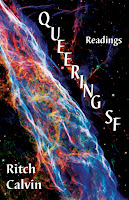
 

Ritch Calvin (he/him) has published essays in Extrapolation, Femspec, Science Fiction Film and Television, Science Fiction Studies, New York Review of Science Fiction, and SFRA Review. His bibliography of the works of Octavia E. Butler appeared in Utopian Studies in 2008. His first edited collection, on Gilmore Girls, appeared in 2007. In 2014, he edited (with Doug Davis, Karen Hellekson, and Craig Jacobsen) a volume of essays entitled SF 101: An Introduction to Teaching and Studying Science Fiction. In 2016, he published Feminist Epistemology and Feminist Science Fiction: Four Modes (Palgrave). He has published two volumes with Aqueduct: The Merril Theory of Lit'ry Criticism (edited, 2016) and Queering SF: Readings (2022). He is currently working on volume on short science fiction film (with Paweł Frelik) and a book on C. J. Cherryh.

He was a juror for the 2014 Philip K. Dick Award and for the 2018 James Tiptree Award (Otherwise). He lives on Long Island. One of his chickens has now decided that she lives inside the house.