I don't know how it happened, but I somehow missed that Donna Haraway won the Science Fiction Research Association's Pilgrim Award in 2011. (This year's winner, as you may recall, was Pamela Sargent.) I realized this today, when I finally got around to opening a triple-issue of the SFRA Review, which arrived in my mailbox months and months ago. This publication printed Haraway's lengthy acceptance speech. It's also available in pdf here-- as well as a 29-minute Vimeo video, which you might want to check out here. To give you an idea of why you might want to read or watch it, here are the last few paragraphs of the speech:
In this n-dimensional niche space, I am reminded that in her acceptance of the Pilgrim
Award in 2008, Gwyneth Jones defined SF “as a volume, a set (overlapping with many others),
in the vast, contained yet unlimited ocean of information—furnished with the icons of the
genre....Within this volume, every significant writer opens up a new Imagination Space….Maybe
the work of science fiction scholarship…[is] to forge links, build complexity, refine the
details: and rescue the genuine novelty from each writer’s generic contribution.” I like this
approach, but I want to characterize the work of SF scholarship, and SF as a whole, also as a
game of cat’s cradle or string figures, of giving and receiving patterns, dropping threads and so
mostly failing but sometimes finding something that works, something consequential and maybe
even beautiful, that wasn’t there before, of relaying connections that matter, of telling stories in
hand upon hand, digit upon digit, attachment site upon attachment site, to craft conditions for
flourishing in terran worlding. Like me, Jones says that she received her baptism in science
fiction’s sexual politics from The Female Man. I want to end with string figures as SF partly in
homage to Joanna Russ’s Janet Evason, who landed on a desk in front of, to her Whileaway eyes,
oddly dressed men, whom we, in Joanna’s world, know to be in military uniform, and proposes a
game of cat’s cradle to calm them down. They did not understand; they did not pick up the
threads and marvel at the patternmaking. Innocent that she is, Janet reasoned that cat’s cradle is
a universal sign of peace. It is surely one of humanity’s oldest games, but like guman instead of
homo, string figures are not everywhere the same game.
Like all offspring of colonizing and imperial histories, I—we—have to relearn that all
string figures are not exactly the same as English and U.S. American cat’s cradle. In the late 19th
and early 20th centuries, United States and European ethnologists collected string figure games
from all over the world; these discipline-making travelers were surprised that when they showed
the string figure games that they had learned as children at home, their hosts already knew such
games in greater variety. String figure games came late to Europe, probably from Asian trade
routes. All of the epistemological desires and fables of this period of the history of comparative
anthropology were ignited by the similarities and differences, with their undecidably independent
inventions or cultural diffusions, tied together by the threads of hand and brain, making and
thinking, in the relays of patterning in the “Native” and “Western” string figure games.
In the Navajo language, string figure games are called na'atl'o'. They are
one form of “continuous weaving,” practices for telling the stories of the
constellations, of the emergence of the People, of the Diné. These string figures
are thinking as well as making practices, pedagogical practices and cosmological
performances. Some Navajo thinkers describe string figures as one kind of
patterning for restoring hózhó, a term imperfectly translated into English as
harmony, beauty, and right relations of the world, including right relations of
humans and nonhumans. Not in the world, but of the world; that is what leads me
to include Navajo string figures, na'atl'o', in the web of SF worlding. The worlds
of SF are not containers; they are patternings, risky co-makings, speculative
fabulations. It matters which ideas we think other ideas with; thinking or making
cat’s cradle with string figures with na'atl'o' is not an innocent universal gesture,
but a risky proposition in relentless historical relational contingency. Janet
Evason refused to hear Jael’s claim that the wonderful world of Whileaway got its
start from an act of biological warfare—genocide— that killed off all the human
males. Like Joanna, we cannot afford that kind of forgetting. Anyone who
recognizes the repeated acts of genocide that undergird that nonetheless precious
thing called democracy surely knows this basic fact. How to be response-able is
the consequential question in SF worlding.
String figure games are practices of scholarship, relaying, thinking with, becoming with
in material-semiotic makings. Like SF, cat’s cradle is a game of relaying patterns, of one hand,
or pair of hands, or mouths and feet, or other sorts of tentacular things, holding still to receive
something from another, and then relaying by adding something new, by proposing another knot,
another web. Or better, it is not the hands that give and receive exactly, but the patterns, the
patterning. Cat’s cradle, string figures, na'atl'o' can be played by many, on all sorts of limbs, as
long as the rhythm of accepting and giving is sustained. Scholarship is like that too; it is passing
on in twists and skeins that require passion and action, holding still and moving, anchoring and
launching.
So I end with renewed thanks to the SFRA and ongoing astonishment at receiving the
Pilgrim Award. I hope that with others I can contribute to weaving this honor into the
multicolored skeins and twists of SF worlding.
Monday, December 3, 2012


Saturday, December 1, 2012
Rebecca Ore's Slow Funeral now available as an e-book

Here's a brief description of the novel:
Bracken County, nestled in the Blue Ridge region of the American South, is like no other place on earth. Behind its facade of small-town Southern life, magic works and corrupts all it touches. Maude Fuller ran away from Bracken County when her parents were killed. She has been running ever since, trying to deny her innate magical talent. Now Maude's grandmother is dying, and Maude is drawn home and succumbs to the temptation to draw Doug, a Berkeley engineer, after her. Once home, she tries to see through the layers and layers of deceptions snaring everyone in Bracken County, including its most powerful witches. Can she resist using her talent and still find a way to save her grannie's soul and Doug's life?
Michael Swanwick blurbed the book: "Slow Funeral is gritty and clear-eyed, unique and vastly entertaining."
And here are quotes from a couple of reviews:
"Vivid and intense...It's good to find a book this dark that still make the reader think, as well as feel those usual shivers."
—Locus
"Ore Portrays a magical world in conflict that is a superb reflection of the world in which we live."
— Analog
The e-book is available now through Aqueduct's website, and will be available elsewhere (Wizard's Tower, Weightless, Amazon) in a week or so.
Friday, November 30, 2012
Science Fiction Aesthetics and Sensibility
A couple of days ago, Jonathan McCalmont posted Annoyed with the History of Science Fiction to his blog. "Annoyed" notifies us, from the top, that it's to be read as a rant rather than a sampling of his thoughts on the subject of the history of science fiction. Fair enough. The title also-- unintentionally, perhaps-- conflates some hypostasized notion of all the existing histories of science fiction distilled into a single "history" with what non-academics usually mean by the word "history" (viz., the past, which inevitably becomes singularly dicey when treated as a conceptual entity). By "history," McCalmont, I believe, means the former. Rants can be interesting and useful, though, and "Annoyed" is both.
It seems a Locus Online piece by Gary Westfahl provoked McCalmont by making the sort of generalization that seems always to be with us in the sf/f sphere: "the works of Robert A. Heinlein are still occupying a considerable amount of shelf space, and the evidence of his broad impact on the genre is undeniable." McCalmont explains his annoyance thus: "The reason I am singling out Westfahl’s essay is that it illustrates the field’s lamentable tendency to allow these types of broad historical claims to go completely unchallenged and unsupported." So far so good. But when he says
Now let me get on to the interesting and useful parts of McCalmont's post. He takes John Berger's excellent Ways of Seeing and David Bordwell's On the History of Film Style as examples of approaches to an aesthetic field's history (art history and film history, respectively) that is illuminating rather than stultifying. Bordwell, McCalmont tells us, pays special attention to the impact certain film techniques (particularly "deep focus," "long take" and "dynamic editing") had on film-making and how we watch films. I think McCalmont gets to something important when he writes:
I'll add here that as a publisher and editor of a small press, I'm absolutely aware of there being a major shift in sf writing-- one that I think involves sf aesthetics and sensibility more than narrative techniques-- underway. I've been assuming that the reason I can't really put my impressions and conjectures into words is because it's very difficult to get enough distance at this point to do so: isn't that the nature of being inside a shift? But another reason might be that this is an aspect of science fiction that hasn't been as well worked as, say, narrative conventions and tropes, have.
Anyone have any thoughts on this? I'd love to see more discussion of this subject. Unfortunately, most of the emphasis in McCalmont's post and in the comments to it has focused on language and textual style-- important aspects of aesthetics, certainly, but doesn't cover issues of form (which is briefly alluded to with reference to Kim Stanley Robinson and John Brunner).
I'd be particular interested, of course, in a discussion that talks about the aesthetics and sensibility I recognize in the work of, say, Nalo Hopkinson, Andrea Hairston, and Kiini Ibura Salaam, or the particular aesthetics and sensibility of feminist sf generally (which I can recognize by feel when I encounter it but have never tried to explain).
It seems a Locus Online piece by Gary Westfahl provoked McCalmont by making the sort of generalization that seems always to be with us in the sf/f sphere: "the works of Robert A. Heinlein are still occupying a considerable amount of shelf space, and the evidence of his broad impact on the genre is undeniable." McCalmont explains his annoyance thus: "The reason I am singling out Westfahl’s essay is that it illustrates the field’s lamentable tendency to allow these types of broad historical claims to go completely unchallenged and unsupported." So far so good. But when he says
I believe that the historical approach to science fiction lacks the critical apparatus required to support the sweeping claims made by people who use this approach. Far from being a rigorous analysis of historical fact, the historical approach to genre writing is all too often little more than a hotbed of empty phrases, unexamined assumptions and received wisdom.Here, I have a bit of trouble with McCalmont's own generalization. Yes, I see what he calls "the historical approach" used by some academics and many non-academics in the field all the time, but unlike McCalmont, I assume they're doing so because they've chosen to ignore the variety of attempts quite a few smart academic critics have lately made (and continue to make) to grapple with the ungainly, difficult-to-grasp subject without falling into pitfalls Samuel R. Delany has often and effectively excoriated (and which McCalmont duly alludes to). A science fiction work's closeness to the culture and politics of its time means that any history necessarily has to take shifts in culture and politics (and scientific practice as well as science!) into account. There are scholars in the field attempting to do that-- taking a variety of approaches that try their damnedest to eschew generalizations like the one McCalmont cites about Heinlein's influence.
Now let me get on to the interesting and useful parts of McCalmont's post. He takes John Berger's excellent Ways of Seeing and David Bordwell's On the History of Film Style as examples of approaches to an aesthetic field's history (art history and film history, respectively) that is illuminating rather than stultifying. Bordwell, McCalmont tells us, pays special attention to the impact certain film techniques (particularly "deep focus," "long take" and "dynamic editing") had on film-making and how we watch films. I think McCalmont gets to something important when he writes:
Terms like ‘info-dumping’ are the science fiction equivalent of the film critic’s ‘deep focus’, ‘long take’ and ‘dynamic editing’. However, while film critics are able to draw upon a rich technical lexicon, the few technical terms used by SF critics generally come bundled up with their own unexamined assumptions about how best to write science fiction. For example, the lionisation of show-don’t-tell at the expense of the info-dump assumes that the aim of science fiction is to tell a story that is immersive in that it never causes the reader to break from the story and think about what it is that they have just read. However, some authors such as Stanislaw Lem, Neal Stephenson and Kim Stanley Robinson make frequent use of info-dumps as they believe that wading through densely written expositional text is an integral part of the science fiction experience. I would even go so far as to argue that Lem’s approach to info-dumping is so effective and idiosyncratic that it not only forms an integral part of his novels’ literary affect, it also makes his work substantially more complex and interesting than anything written under the purview of show-don’t-tell.
If we simply assume that show-don’t-tell was a linear improvement on the info-dump then it follows that writers like Stephenson and Lem are nothing more than unsophisticated writers who have yet to acquire the skills necessary for Heinleinian narrative immersion. However, if we assume that science fiction is a literary tradition rich enough to create its own literary techniques and that the info-dump might be a literary technique with its own affective payload then experimental info-dumpers such as Lem and Stephenson immediately appear more important and influential.I've long felt that the most difficult to talk (and therefore think) about aspect of science fiction is its special, particular aesthetics and sensibility. Aesthetics and sensibility don't easily fit into the discussions of a work's narrative techniques, and yet they matter tremendously. (McCalmont cites Delany's wonderful, still important "About 5,175 Words" as an exemplar for how one could go about discussing/analyzing sf aesthetics at the textual level.) Many reviewers and critics and fans and writers just generalize about aesthetics by proclaiming that such and such a work or description imparts a "sense of wonder"-- which for me usually indicates an inability to discuss the aesthetic passage in question in technical terms. McCalmont is right, I think, when saying that Delany shows critics how they could do this with a great degree of specificity. What makes this even more frustrating (for me, anyway), is that like all other aspects of sf writing, sf aesthetics and sensibility have changed over time, are at the moment, in fact, changing in ways that are making some of our veteran critics uneasy and unable to assimilate much current sf to sf as they've known and loved it.
I'll add here that as a publisher and editor of a small press, I'm absolutely aware of there being a major shift in sf writing-- one that I think involves sf aesthetics and sensibility more than narrative techniques-- underway. I've been assuming that the reason I can't really put my impressions and conjectures into words is because it's very difficult to get enough distance at this point to do so: isn't that the nature of being inside a shift? But another reason might be that this is an aspect of science fiction that hasn't been as well worked as, say, narrative conventions and tropes, have.
Anyone have any thoughts on this? I'd love to see more discussion of this subject. Unfortunately, most of the emphasis in McCalmont's post and in the comments to it has focused on language and textual style-- important aspects of aesthetics, certainly, but doesn't cover issues of form (which is briefly alluded to with reference to Kim Stanley Robinson and John Brunner).
I'd be particular interested, of course, in a discussion that talks about the aesthetics and sensibility I recognize in the work of, say, Nalo Hopkinson, Andrea Hairston, and Kiini Ibura Salaam, or the particular aesthetics and sensibility of feminist sf generally (which I can recognize by feel when I encounter it but have never tried to explain).
Monday, November 19, 2012

Thursday, November 15, 2012
Aqueductista News


We'll also be publishing "a pseudotreatise of urbogony" titled Squaring the Circle, a collection of tales by Romanian author Gheorghe Sasarman, which was brought to Aqueduct by Ursula Le Guin, who read the tales in a Spanish translation and was so delighted by them that she began to try her hand at translating them into English. Her labor of love, assisted by Spanish translator Mariano Martín Rodríguez, resulted in Squaring the Circle. I'll just say that although they aren't in Aqueduct's usual line, I couldn't resist publishing Sasarman's tales. And finally,
I'd like to mention, also, that Aqueduct has just acquired another novel for which we haven't yet set a publication date, Stone Boatmen, by Canadian poet and scholar, Sarah Tolmie. (Sarah's scholarly specialty is Piers Plowman.) Curiously enough, Sarah's manuscript also came to me by way of Ursula. Ursula's recommendation warned me that it's not like anything she'd ever read before. "My feeling about it is that it's like Islandia or The Worm Ouroboros or Gormenghast-- a one of a kind." And indeed, that's just what it is. All I can say now is that it's something special, and I'm excited to be publishing it.
Now to some of the links I think you might find interesting:
--Karen Burnham has reviewed Christopher Barzak's Birds and Birthdays for Strange Horizons. Burnham writes: "Barzak presents us with three short stories based on surrealist paintings by women (one of which, "Birthday," is original to this collection) and an essay on the work and history of three female surrealist painters. In under one hundred pages, this volume delivers a neat package of beauty, information, and interpretation." She expresses particular appreciation for the book's prose style.
--Brit Mandelo has also reviewed Birds and Birthdays for Tor.com. She writes: "These two refracted views of the paintings—through fiction, through scholarship—infuse the audience's own readings of the works in question, providing a delightful triple translation of art (painting) to art (fiction) to art (painting) to interpretation (scholarship/fiction). This is what makes the book so definitively interstitial, to my eye: It is many things, in many shades and forms, all looping back together infinitely.
"The end result is a joyful tribute to these three women painters in the form of handsome, lyrical fiction and precisely considered scholarship. Barzak’s awareness and sensitivity bring the project full-circle, as he considers the project/process/praxis of translating these women’s subjectivities to the page from his own personally-inflected position in cultural production."
-- Richard Larson has reviewed Kiini Ibura Salaam's Ancient, Ancient, also for Strange Horizons. Larson writes: "The stories in Kiini Ibura Salaam's debut collection, Ancient, Ancient, from feminist science fiction publisher Aqueduct Press, are imbued with the urgency and expansive scope of imagination that we've come to expect from the best of science fiction. Salaam takes us to distant places but makes them familiar in unsettling ways, ably transforming the fantastic into a mirror through which we can examine—and reckon with—our own struggles."
His particular interest is in the book's vision: "The world as Salaam paints it is full of harsh and beautiful things: she insists that we must venture into dark places to emerge as who we are meant to be. The best of her work is imbued with subtle interventions which ultimately provide the reader with sharply felt revelations, the secrets within the text that we must each decipher independently and which speak to each other to reveal a larger project. The stories work from mutual touchstones: the illustration of sex as an act of power; a visceral relationship to the human body as a mode of currency as well as a site of rebellion; and the examination of the struggle to find oneself, particularly as a woman, in a world that offers so few options. Few writers pay such focused attention to a specific set of ideas and concerns, and this accomplished collection provides a vigorous exploration into Salaam's unique vision."
--At Futuristically Ancient, Aker reviews Ancient, Ancient, too. Her review begins: "The ancient mysteries of life hold in their grasp the power of seduction. We find seduction, being led away, in a sexual experience, a sensual touch, the coming of a new life or death, the physical movement of bodies in a dance, the allure of magic, the call of nature, the possibility of a new truth or that a truth was a lie, or to experience the life of another. There is a freedom and danger, a pleasure and pain in seduction, and Kiini Ibura Salaam compellingly explores them in her collection of speculative short fiction stories, Ancient Ancient."
-- And speaking of Ancient, Ancient, its author has made a short video about it:
-- Brittainy Warman has reviewed Liz Henry's Unruly Islands for Stone Telling. She writes, "Henry's poetry is not at all the kind of poetry most people are thinking of when they say that "they don't like poetry." Viciously modern, biting, sometimes beautiful, and always fascinating, Henry's poetry is very much a product of the world she lives in."
Warman concludes: "My favorite poem in the text, however, was "Mother Frankenstein," which I was familiar with due to its first publication in Stone Telling. This poem has the reader from the very first line — "Mother Frankenstein swollen lightning / stitching needles where my lips kiss / in your smoke-ghost skull where axons / open fire with past love letters electric / little histories of the alphabet gathered / in your pathetic apron's outwash plain" (39). This piece is the perfect example of the way that Henry's poetic style can smack you in your heart and fill your mind with unbidden images and associations. The poem is haunting and I found myself re-reading it again and again.
Overall the collection is full of the compelling and unusual poetry that the world so desperately, constantly needs more of. Henry is a challenging and unique poet, a poet born of stars and the Internet, and I look forward to making more "weird trip[s] through [her] brain" (Henry 2012b)."
--Sue Lange has reviewed the latest issue of the Cascadia Subduction Zone at the Book View Cafe. She begins: "This latest issue of Cascadia Subduction Zone is one of their best, IMHO. The emphasis this time around is on the creative process with visual art taking center stage. Two essays stand out: Kiini Ibura Salaam’s “Painting and Writing: My Yin and Yang,” and Mark Rich’s “Line Improvisation: Notes by the Fly in the Web.”" Her focus is largely on the two essays she mentions and Nic Clarke's review of Birds and Birthdays.
Wednesday, November 14, 2012
Imagining Radical Democracy, in progress
Last year at WisCon, Alexis Lothian moderated a panel titled "Imagining Radical Democracy," that Andrea Hairston, Liz Henry, and I participated in. For most of the panel, we talked about examples of people creating radically democratic spaces-- in real life today, in fiction, and in history. It was one of the most exhilarating panels I've ever participated in (and that's saying something).
Lately, I've been hearing and reading about "Occupy Sandy"-- in which Occupiers (whom the media had dismissed as done and over) have been bringing relief to areas ravaged by Sandy two weeks ago. The Occupiers, it turns out, have a much clearer notion of how to accomplish relief than the best-funded aid corporations (you know, the ones with high-paid executives that collect big bucks from people who'd like to help) do. (The Occupys are, you might say, a "do-ocracy.")
All of this reminds me of one of the aspects of radically democratic spaces we discussed during the panel-- the problem that such spaces frequently face of being required to fix everything for everyone all at once (which of course can't be done)-- and the potential for such demands to wreck the space. I myself remarked, anent this, that little drops of water evaporate in a desert; they need a humid environment to survive. The Occupys are like single drops of water. They--along, of course, with discrete other single drops-- inhabit a massive desert capable of evaporating every bit of precipitation that comes its way .
And yet, how welcome they are! Here's John Knefel, in his account at Truthout:
Lately, I've been hearing and reading about "Occupy Sandy"-- in which Occupiers (whom the media had dismissed as done and over) have been bringing relief to areas ravaged by Sandy two weeks ago. The Occupiers, it turns out, have a much clearer notion of how to accomplish relief than the best-funded aid corporations (you know, the ones with high-paid executives that collect big bucks from people who'd like to help) do. (The Occupys are, you might say, a "do-ocracy.")
All of this reminds me of one of the aspects of radically democratic spaces we discussed during the panel-- the problem that such spaces frequently face of being required to fix everything for everyone all at once (which of course can't be done)-- and the potential for such demands to wreck the space. I myself remarked, anent this, that little drops of water evaporate in a desert; they need a humid environment to survive. The Occupys are like single drops of water. They--along, of course, with discrete other single drops-- inhabit a massive desert capable of evaporating every bit of precipitation that comes its way .
And yet, how welcome they are! Here's John Knefel, in his account at Truthout:
As the full extent of Superstorm Sandy's destruction begins to set in, Occupy Sandy continues to expand its effort to provide relief to ravaged areas in Staten Island, Coney Island, Red Hook, and the Rockaways. The work can roughly be divided into two categories: the primary distribution hubs at St. Jacobi Church on Fourth Avenue and 520 Clinton Ave., and the field, where organizers often go intersection by intersection, sometimes door to door to assess needs of the community.
What I've found, observing these efforts and increasingly participating in them, is that Occupy Sandy has provided the public with a concrete example of the virtue of Occupy's sometimes abstract ideals. One of Occupy's defining features is horizontalism, or non-hierarchical organization, which replaces traditional methods of control with, in theory, mutual affinity and respect. The media often refers to this as "leaderlessness" and calls it a weakness, and when trying to interpret Occupy through the narrow lens of corporate-captured electoral politics that may be a fair criticism. But the premise is completely incorrect. The establishment media never intended to understand Occupy on its own terms when it was in Zuccotti Park or in the streets, but now they are forced to. The fact that volunteers can be trained and assigned to tasks quickly - tasks they aren't compelled by any strict authority to do and so therefore take ownership of almost immediately - is a virtue rather than a fatal flaw. Likewise, emerging narratives of Occupy "refocusing," "reincarnating," or "resurrecting" similarly miss the point and instead rely on lazy, often condescending framing.More interesting is Yotam Marom's post Occupy Sandy: From Relief to Resistance, written by a Hoboken resident who's been facilitating training for hundreds of people who've volunteered to help with the relief effort.
All along, I’ve been coming to terms with the fact that this is what climate change looks like; but it’s also what the beginning of a climate justice movement might look like.
Hurricane Sandy is a crisis in itself; it flooded homes, turned off power, kept people from work, made families cold — it even took lives and put families on the street. And of course it’s more complicated than just bad weather. This hurricane is one more expression of the erratic weather patterns that we can expect more and more as a result of global warming, which is the product of our society’s dependency on fossil fuels, driven by multinational fossil fuel companies. Hurricane Sandy is a reminder that the climate crisis sets off a whole set of other crises, based on social, economic and political systems that are already in place, and that those things land on top of crises already in play. Many of the communities hardest hit by the hurricane are the same ones hardest hit by foreclosure, debt, austerity and mass incarceration. The flood didn’t create those things, but it made them worse and washed away all the crap that made them hard to see.
At the same time, Hurricane Sandy has brought new networks to life and put thousands of people in the streets to rebuild communities with an explicitly political framing. It’s now widely agreed that, despite setbacks, Occupy Sandy’s organizing has put the official agencies to shame. Equity, solidarity and mass participation have been at the center of the effort from the get-go, driven forward by committed organizers with deep politics and foresight. All along the intention has been to see this as an organizing project rather than just a volunteer effort. Still, the question remains of whether those networks in motion now can rise to the occasion and begin to address the underlying crises.Marom sees success for the effort for as long as it's focused on the immediate crisis-- but worries that once the immediate crisis is past, involvement will decline, and all the problems exposed by the crisis will be allowed to slide, back to business as usual. (That is how such spaces usually work, I know...)
Flexible networks like Occupy Sandy are incredible machines — more fluid than big organizations, more dynamic than government agencies. But they rely on having people or strong communities to network. Networks connect dots, but you still need the dots themselves to be ready. Crises and opportunities — like Hurricane Sandy or Occupy Wall Street last fall — put people in motion, but they only become part of a movement beyond those moments when participants are grounded in stable frameworks to keep them going.
We have to build infrastructure and create the institutional frameworks that can sustain a struggle over the long haul. Every movement needs them. The civil rights movement had SNCC and the Highlander School, among countless other organizations, schools, training institutes, churches and foundations. Even Occupy has had institutions all along, from the occupations themselves to the many groups that rose to the occasion to support it; part of the reason Occupy Sandy could mobilize so quickly and effectively is that the Occupy movement already had enough building blocks in place, enough experience with alternative structures, enough relationships built and enough organizing being done behind the scenes to leap into action when it was needed.
If we want to last, we need to create the frameworks, processes and systems that keep us in motion — that keep the windows open — for long enough to win.The rest of his post muses on the problem and what can be done to address it. Definitely worth our while thinking on, especially given that only a week after the election President Obama is already warning progressives that he's soon going to be making them swallow more bitter pills (just in case anyone might have gotten the wild, foolish idea that the elections themselves actually changed anything).
Wednesday, November 7, 2012
Quote of the Day
Obama won the Latino vote, 71 to 27. He also won the Asian vote, 73 to
26. Those voters all look the same to the losers. That's why they're the
losers.-- Tom Scocca, Eighty-eight percent of Romney Voters Were White
Friday, October 26, 2012
New e-book titles from Aqueduct Press
Aqueduct has released three new titles in e-book formats:
--Gwyneth Jones's Spirit
 A space opera set in Gwyneth Jones's Aleutian universe, Spirit re-visions
Dumas's The Count of Monte Cristo and further explores the workings and
consequences of the series' Buonarotti Transit. Bibi, the sole survivor of
her tribe, serves Lady Nef, the wife of General Yu, whose forces
exterminated Bibi's tribe. Constantly embroiled in court intrigues and
conspiracies, Nef and Yu are sent on a dicey diplomatic mission to Sigurt's
World, which culminates in murder and betrayal, resulting in Nef's and
Bibi's imprisonment in the ultimate oubliette, from which escape is
virtually impossible. As Karen Joy Fowler noted in her review for the
Guardian, "Escape is costly; revenge complex." This is, indeed, Dumas for
the 21st Century.
A space opera set in Gwyneth Jones's Aleutian universe, Spirit re-visions
Dumas's The Count of Monte Cristo and further explores the workings and
consequences of the series' Buonarotti Transit. Bibi, the sole survivor of
her tribe, serves Lady Nef, the wife of General Yu, whose forces
exterminated Bibi's tribe. Constantly embroiled in court intrigues and
conspiracies, Nef and Yu are sent on a dicey diplomatic mission to Sigurt's
World, which culminates in murder and betrayal, resulting in Nef's and
Bibi's imprisonment in the ultimate oubliette, from which escape is
virtually impossible. As Karen Joy Fowler noted in her review for the
Guardian, "Escape is costly; revenge complex." This is, indeed, Dumas for
the 21st Century.
--Rebecca Ore's The Illegal Rebirth of Billy the Kid
 In 2067, human cloning is a part of everyday
life. But it is a bizarre form of cloning: not actually the direct copying
of a humans, but rather the construction of custom-made reproductions of
humans using animal DNA. The CIA uses these so-called "chimeras" for
various undercover operations, and one of their technicians, Simon Boyle,
has a sideline making illegal copies: chimeras based on famous criminals,
for rent. His Billy the Kid, a creation unable to comprehend or sometimes
even recognize the sorts of things that didn't exist before the 1880s and endowed with powerful sex pheromones, is
quite popular for a night of historically convincing passion with rich
women, particularly the part where Boyle (as sheriff Pat Garrett) guns him
down. As the story progresses, Billy the Kid starts remembering things from
his previous lives. One of Boyle’s clients sets Billy loose into the mean
streets of the 21st century, where he struggles to seize control of the
myths in his ROM. Jane, a worker in a shelter for abused chimeras, has her life turned upside down as she's caught up in a struggle for possession of Billy. Sex pheromones or not, not only is Billy's identity as a real person at question, but the notion of masculinity as well.
In 2067, human cloning is a part of everyday
life. But it is a bizarre form of cloning: not actually the direct copying
of a humans, but rather the construction of custom-made reproductions of
humans using animal DNA. The CIA uses these so-called "chimeras" for
various undercover operations, and one of their technicians, Simon Boyle,
has a sideline making illegal copies: chimeras based on famous criminals,
for rent. His Billy the Kid, a creation unable to comprehend or sometimes
even recognize the sorts of things that didn't exist before the 1880s and endowed with powerful sex pheromones, is
quite popular for a night of historically convincing passion with rich
women, particularly the part where Boyle (as sheriff Pat Garrett) guns him
down. As the story progresses, Billy the Kid starts remembering things from
his previous lives. One of Boyle’s clients sets Billy loose into the mean
streets of the 21st century, where he struggles to seize control of the
myths in his ROM. Jane, a worker in a shelter for abused chimeras, has her life turned upside down as she's caught up in a struggle for possession of Billy. Sex pheromones or not, not only is Billy's identity as a real person at question, but the notion of masculinity as well.
Eleanor Arnason's Ordinary People (Conversation Pieces series Vol. 7)

Spanning thirty years, this volume collects six stories, one poem, and a WisCon Guest of Honor speech. In the richly ironic "Warlords of Saturn's Moons," first published in 1974, a cigar-puffing woman writes space-opera while the drama of real-life inner-city Detroit goes on around her; "The Grammarian's Five Daughters" offers a playful explication of the uses of the parts of speech; "A Ceremony of Discontent" takes a humorous approach to a modern-day feminist problem; and Arnason's wise, earthy tales of hwarhath serve up new myths explaining the origins of the world and morality (among other things). The work in this collection entertains with its wit, delights with its precision and imagination, and challenges and provokes with its bluntness. Ordinary People offers a small, potent taste of the oeuvre of an important feminist sf author.
Like all of Aqueduct's e-books, these can be purchased, DRM-free, through our site in both mobi and epub formats, as well as from Weightless Books, Wizard's Tower, and Amazon.com.
--Gwyneth Jones's Spirit

--Rebecca Ore's The Illegal Rebirth of Billy the Kid

Eleanor Arnason's Ordinary People (Conversation Pieces series Vol. 7)

Spanning thirty years, this volume collects six stories, one poem, and a WisCon Guest of Honor speech. In the richly ironic "Warlords of Saturn's Moons," first published in 1974, a cigar-puffing woman writes space-opera while the drama of real-life inner-city Detroit goes on around her; "The Grammarian's Five Daughters" offers a playful explication of the uses of the parts of speech; "A Ceremony of Discontent" takes a humorous approach to a modern-day feminist problem; and Arnason's wise, earthy tales of hwarhath serve up new myths explaining the origins of the world and morality (among other things). The work in this collection entertains with its wit, delights with its precision and imagination, and challenges and provokes with its bluntness. Ordinary People offers a small, potent taste of the oeuvre of an important feminist sf author.
Like all of Aqueduct's e-books, these can be purchased, DRM-free, through our site in both mobi and epub formats, as well as from Weightless Books, Wizard's Tower, and Amazon.com.
Tuesday, October 23, 2012
Scientific illiteracy strikes again
Here in the US, we're used to politicians defying logic and pushing policies premised on an outrageous degree of scientific illiteracy, despite the US public's faith that we are the most scientifically "advanced" nation. After all, the US government has the ability to kill at a distance of thousands of miles effortlessly and to read the email and listen to the conversations of anyone, at will. And its citizens have nifty gadgets like smart phones that make them feel like they're "living in the future." (We leave it to less "developed" country to have the fastest, widest internet access and decent healthcare and housing for our citizens-- but then there's nothing about accessible healthcare in the capitalist vision of what the future should be.)
But it seems that in the scientific illiteracy sweepstakes, the politicians of other "developed" nations are giving US politicians a run for their money. A prosecutor and judge in L'Aquila (Italy) present the latest frightening (almost unbelievable) example. Perhaps you remember the earthquake in L'Aquila in 2009, which resulted in more than 300 deaths? Well get this: a jury in L'Aquila, presented with charges against seven of Italy's leading seismologists, moved to convict them of manslaughter for failure to predict the earthquake. Which is to say: one set of politicians-- a prosecutor and all the many tentacles of the apparatus that prosecutors possess, which, as in the United States, is a highly political office, many of whose decisions are highly politically determined, saw fit to dream up such charges in the first place, and a judge, who in both Italy and the US are often politically connected, chose to allow the charges to be brought in the first place and at no time saw no reason to dismiss the case as absurd and inappropriate.
Can you guess what the sentence was?
Prosecutors reportedly argued "that the L'Aquila disaster was tantamount to "monumental negligence," and cited the devastation wrought in 2005 when levees failed to protect New Orleans during Hurricane Katrina." I've heard from university level math faculty that since they no longer teach plane geometry in high schools these days, many students in their class don't understand basic logic. Could that be the problem in L'Aquila, too, do you think? Apparently the decision to convict is pretty popular in some quarters:
But it seems that in the scientific illiteracy sweepstakes, the politicians of other "developed" nations are giving US politicians a run for their money. A prosecutor and judge in L'Aquila (Italy) present the latest frightening (almost unbelievable) example. Perhaps you remember the earthquake in L'Aquila in 2009, which resulted in more than 300 deaths? Well get this: a jury in L'Aquila, presented with charges against seven of Italy's leading seismologists, moved to convict them of manslaughter for failure to predict the earthquake. Which is to say: one set of politicians-- a prosecutor and all the many tentacles of the apparatus that prosecutors possess, which, as in the United States, is a highly political office, many of whose decisions are highly politically determined, saw fit to dream up such charges in the first place, and a judge, who in both Italy and the US are often politically connected, chose to allow the charges to be brought in the first place and at no time saw no reason to dismiss the case as absurd and inappropriate.
Can you guess what the sentence was?
The defendants, all prominent scientists or geological and disaster experts, were sentenced to six years in prison.
Earthquake experts worldwide decried the trial as ridiculous, contending there was no way of knowing that a flurry of tremors would lead to a deadly quake. "It's a sad day for science," said seismologist Susan Hough, of the U.S. Geological Survey in Pasadena, Calif. "It's unsettling." That fellow seismic experts in Italy were singled out in the case "hits you in the gut," she said.
In Italy, convictions aren't definitive until after at least one appeal, so it was unlikely any of the defendants would face jail immediately.The $64 question is whether the conviction will be tossed out by an appeal. Presumably, that will depend on the the political context-- not scientific competence. But I'm sorry to say, even if the scientists' conviction is overturned, we will no doubt hear a loud public chorus of indignation, since the prosecutors and judge have done their damnedest to implant the idea in people's minds that scientists can predict major earthquakes and that the guilty have once again gone free.
Prosecutors reportedly argued "that the L'Aquila disaster was tantamount to "monumental negligence," and cited the devastation wrought in 2005 when levees failed to protect New Orleans during Hurricane Katrina." I've heard from university level math faculty that since they no longer teach plane geometry in high schools these days, many students in their class don't understand basic logic. Could that be the problem in L'Aquila, too, do you think? Apparently the decision to convict is pretty popular in some quarters:
Relatives of some who perished in the 2009 quake said justice had been done. Ilaria Carosi, sister of one of the victims, told Italian state TV that public officials must be held responsible "for taking their job lightly."
The world's largest multidisciplinary science society, the American Association for the Advancement of Science, condemned the charges, verdict and sentencing as a complete misunderstanding about the science behind earthquake probabilities. There are swarms of seismic activity regularly in Italy and most do not end up causing dangerous earthquakes, said geologist Brooks Hanson, deputy editor of the organization's Science magazine. He said that if seismologists had to warn of a quake with every series of tremors, there would be too many false alarms and panic. "With earthquakes we just don't know," Hanson said Monday. "We just don't know how a swarm will proceed."
Quake scientist Maria Beatrice Magnani, who followed the trial closely and knows the defendants professionally, called the outcome "pretty shocking." She disagreed with putting scientists on trial, and contended that the death toll would have been lower had buildings in the quake-prone area been better reinforced.
The verdict left Magnani and others in the field wondering about the way they articulate their work. "We need to be extremely careful about what we say, and the information we provide has to be precise. We cannot allow ourselves to slip," said Magnani, an associate research professor at the University of Memphis.It's interesting (if predictable) to note what escaped consideration in the court case:
Many scientists and commentators have noted that the court case failed to address a major cause of fatalities in disasters like quakes and mudslides: erecting homes, schools, hospitals and other public buildings on quake-prone terrain without the proper construction techniques or materials to make the structures more resilient.
After the April 2009 quake, which left 308 people dead, many experts said that the 6.3-magnitude temblor wouldn't have caused such extensive damage if buildings been constructed or retrofitted to meet modern quake zone construction standards.Naturally, the prosecutors deliberately excluded anything that would allow the jury to understand the damage with a reasonable degree of complexity. In effect, the politicians needed a scapegoat to appease the people who suffered such devastating losses. Rather than examining the real culprits-- the developers and construction contractors and the politicians who failed to enforce reasonable standards-- they went after scientists for failing to predict what could not be predicted, thus exploiting widespread scientific ignorance. There is nothing about this that is not political.
Monday, October 8, 2012
The Cascadia Subduction Zone, Vol.2, 4

Current Issue
Vol. 2 No. 4
October 2012
- Essays
- Painting and Writing: My Yin and Yang
by Kiini Ibura Salaam
- Line Improvisation: Notes
by the Fly in the Web
by Mark Rich
- Poems
- Ortygia to Trimountaine
by Sonya Taaffe
Julia Margaret Cameron, 1860s
by Catherine McGuire
- Grandmother Magma
- Ursula K. Le Guin’s
The Left Hand of Darkness
reviewed by Suzy McKee Charnas - Reviews
- Birds and Birthdays
by Christopher Barzak
reviewed by Nic Clarke
-
Lady Poetesses from Hell
edited by Bag Person Collective
reviewed by David Findlay
- Three
by Annemarie Monahan
reviewed by Deb Taber
- Spacesuit: Fashioning Apollo
by Nicholas de Monchaux
reviewed by Karen Burnham
- Snapshots from a Black Hole & Other Oddities
by K.C. Ball
reviewed by Victoria Elisabeth Garcia - Featured Artist
- Kristine Campbell
Sunday, September 30, 2012
We all know what the masculine mystique is, right?
In today's New York Times, historian Stephanie Coontz addresses The Myth of Male Decline. Not only does she debunk the resentful myth that women have become "the richer sex" and are taking over in the US, but she also proposes the hypothesis that many men are in the throes of a "masculine mystique" that is limiting the development of their individual potential:
ONE thing standing in the way of further progress for many men is the same obstacle that held women back for so long: overinvestment in their gender identity instead of their individual personhood. Men are now experiencing a set of limits — externally enforced as well as self-imposed — strikingly similar to the ones Betty Friedan set out to combat in 1963, when she identified a “feminine mystique” that constrained women’s self-image and options.
Although men don’t face the same discriminatory laws as women did 50 years ago, they do face an equally restrictive gender mystique.
Just as the feminine mystique discouraged women in the 1950s and 1960s from improving their education or job prospects, on the assumption that a man would always provide for them, the masculine mystique encourages men to neglect their own self-improvement on the assumption that sooner or later their “manliness” will be rewarded.
According to a 2011 poll by the Pew Research Center, 77 percent of Americans now believe that a college education is necessary for a woman to get ahead in life today, but only 68 percent think that is true for men. And just as the feminine mystique exposed girls to ridicule and harassment if they excelled at “unladylike” activities like math or sports, the masculine mystique leads to bullying and ostracism of boys who engage in “girlie” activities like studying hard and behaving well in school. One result is that men account for only 2 percent of kindergarten and preschool teachers, 3 percent of dental assistants and 9 percent of registered nurses.Do check out the entire article. Besides being interesting, it's crunchy with statistics about the gender differences in employment, education, and income over the last 15 years you might find worth reviewing.
Thursday, September 27, 2012
SF tropes and the ever-shifting edge of reality
Once in a blue moon I wake up from a dream so soaked with a sense of reality that it feels less like a dream I've just had then a memory of something I've recently done. Oddly enough such dreams tend to be sfnal in character. While I'm in them, I have no perception of their being sfnal-- that only comes after I've woken up.
Such was the case this the morning. In my dream, I was writing an article on a trip I'd just to the moon for a magazine' the article would be comprised of an text, photos, and video clips. I'd decided that the article would focus on a researcher who'd been there for 23 years-- since the beginning of the settlement-- studying kinetics. In my dream, I kept reviewing the video clip of my conversation with her, in which she spoke of her distress at being dumped by her HMO-- which had been covering her for all the 23 years she'd been working on the moon-- because her health problems were different to those of women her age on earth. The image of this woman speaking is the most vivid image of my dream: she is wearing a white lab coat of course, over silk the color of autumn leaves, and small dangling earrings, and has enough ray in her hair and lines and wear in her face to be in her 50s or 60s were she to have been living all that time on earth, though I acknowledged that living in lunar gravity she might well be a good deal older. Thinking about her face, which seemed oddly familiar, after waking, it occurred to me that she might be modeled on Susan S, a dancer I'd know in the early 1970s, suitably aged. (With a personality considerably toned down.) She was someone I hadn't seen or even thought of for years and years. I'd already written the part of my article about how pedestrian travel to the moon actually was, and how surprisingly populous the place seemed, and how though the hotel accommodations were a bit cramped, weren't that much more expensive than hotels in major cities in the US. Etc. All very ordinary, even pedestrian. Which was why my article was focusing on this woman and her difficulties, partially a consequence of her never having budged from the moon for 23 years.
Mulling over the peculiar realization that my most real-seeming dreams tend to be sfnal, it struck me that coherence combined with strongly delineated detail is what makes such dreams feel real. And of course the realization that one is dreaming can occur in any kind of dream-- for me, most often in unpleasant dreams that up until that point feel very real but that I'd like not to be real. The realization is never reasoned (as in: oh, this doesn't make sense, so it can't be true-- not making sense is perfectly normal in dreams). It's when I wake up that I marvel at how coherent and real-seeming the sfnal dream had been-- after that moment of disjunction when I grasp that no, this was a dream, and not something in my actual memory. (Sometimes in fact I am imbued with a partial belief in it as memory for a long time after the dream-- as in dreams about a story I once wrote that I somehow lost and forgot about until I came upon it in a box of old papers-- a part of me somehow feels that that story must be around somewhere, and longs to see it, read it, remember it. I don't feel that way about sfnal dreams, of course, because my mind has identified them as sfnal and thus impossible as memory.)
The thinness of the membrane distinguishing the sfnal from reality has become something of a preoccupation with me lately. I know I've often said over the last ten years that I often have trouble distinguishing reports of real-life behavior and speech from satire, but it occurs to me that despite being accustomed to technological innovations that were once purely sfnal now being materially incarnate in our lives, I still find myself astonished at the thinness of the line between fiction and reality. Consider these three items appearing in the Seattle Times over the last few days:
--State's first case of 'zombie bees' reported in Kent. Honeybees, previously immune to parasitic flies called Apocephalus borealis or scuttle flies-- native to the US and apparently common-- have lately begun to be infected by them. Here's the article's description of the infection:
--And then there's the article on the California legislation, which Gov. Jerry Brown signed yesterday, allowing "autononmous" or driverless cars in California.
--The third item doesn't report on a piece of new technology, but rather on an almost seismic shift in attitude. (Like parasitic creatures wielding ovipostors, infected organisms, and driverless cars, certain attitudes, too, can be sf tropes.) In this case, the shift in attitude is striking for being found in a rather conservative source, the editors of the Seattle Times, who have a long history of endorsing Republicans, which in Washington State can mean way off the spectrum of the local norm. They certainly consider themselves a voice of the mainstream. Four days ago, they published an editorial urging the approval of Initiative 502-- to legalize, regulate, and tax marijuana. Many, many people have been urging this for a long time, including former Seattle Police Chief Norm Stamper. Many conservatives have even urged it. Nevertheless, US jails are crammed with offenders of the prohibition against marijuana use and sale. The editorial is reasoned and reasonable.
The fact is, we are constantly adjusting what is real, what could be real, what probably won't ever be real. Sfnal tropes have a lot to do with the process. But I'm particularly interested these days-- because of my nearly finished novel in progress, "Deep Story"-- in what becomes real,as memory, in an individual's brain, and what the coherence of narrative has to do with the process.
My absence over the last month from this space, by the way, has been due to a family emergency followed by illness. I'm on the mend now, though I'm still a bit shaky and weak, which forces me into making frequent retreats back to bed. I hope to resume regular posting soon.
ETA: I see that the Seattle Times has actually endorsed Obama-- and that they did so last time around, too. Pardon my misperception.
Such was the case this the morning. In my dream, I was writing an article on a trip I'd just to the moon for a magazine' the article would be comprised of an text, photos, and video clips. I'd decided that the article would focus on a researcher who'd been there for 23 years-- since the beginning of the settlement-- studying kinetics. In my dream, I kept reviewing the video clip of my conversation with her, in which she spoke of her distress at being dumped by her HMO-- which had been covering her for all the 23 years she'd been working on the moon-- because her health problems were different to those of women her age on earth. The image of this woman speaking is the most vivid image of my dream: she is wearing a white lab coat of course, over silk the color of autumn leaves, and small dangling earrings, and has enough ray in her hair and lines and wear in her face to be in her 50s or 60s were she to have been living all that time on earth, though I acknowledged that living in lunar gravity she might well be a good deal older. Thinking about her face, which seemed oddly familiar, after waking, it occurred to me that she might be modeled on Susan S, a dancer I'd know in the early 1970s, suitably aged. (With a personality considerably toned down.) She was someone I hadn't seen or even thought of for years and years. I'd already written the part of my article about how pedestrian travel to the moon actually was, and how surprisingly populous the place seemed, and how though the hotel accommodations were a bit cramped, weren't that much more expensive than hotels in major cities in the US. Etc. All very ordinary, even pedestrian. Which was why my article was focusing on this woman and her difficulties, partially a consequence of her never having budged from the moon for 23 years.
Mulling over the peculiar realization that my most real-seeming dreams tend to be sfnal, it struck me that coherence combined with strongly delineated detail is what makes such dreams feel real. And of course the realization that one is dreaming can occur in any kind of dream-- for me, most often in unpleasant dreams that up until that point feel very real but that I'd like not to be real. The realization is never reasoned (as in: oh, this doesn't make sense, so it can't be true-- not making sense is perfectly normal in dreams). It's when I wake up that I marvel at how coherent and real-seeming the sfnal dream had been-- after that moment of disjunction when I grasp that no, this was a dream, and not something in my actual memory. (Sometimes in fact I am imbued with a partial belief in it as memory for a long time after the dream-- as in dreams about a story I once wrote that I somehow lost and forgot about until I came upon it in a box of old papers-- a part of me somehow feels that that story must be around somewhere, and longs to see it, read it, remember it. I don't feel that way about sfnal dreams, of course, because my mind has identified them as sfnal and thus impossible as memory.)
The thinness of the membrane distinguishing the sfnal from reality has become something of a preoccupation with me lately. I know I've often said over the last ten years that I often have trouble distinguishing reports of real-life behavior and speech from satire, but it occurs to me that despite being accustomed to technological innovations that were once purely sfnal now being materially incarnate in our lives, I still find myself astonished at the thinness of the line between fiction and reality. Consider these three items appearing in the Seattle Times over the last few days:
--State's first case of 'zombie bees' reported in Kent. Honeybees, previously immune to parasitic flies called Apocephalus borealis or scuttle flies-- native to the US and apparently common-- have lately begun to be infected by them. Here's the article's description of the infection:
The fly's life cycle is gruesomely reminiscent of the movie "Alien" — though they don't pose a risk to people. Adult females, smaller than a fruit fly, land on the backs of foraging honeybees and use their needle-sharp ovipositors to inject eggs into the bee's abdomen. The eggs hatch into maggots. "They basically eat the insides out of the bee," [biologist John] Hafernik said.Previously, these flies had only been known to infect wasps and bumblebees. They've now infected 80% of the hives in the Bay Area, and have made an appearance in South Dakota. This is particularly alarming, given the recent plummeting of honeybee populations all over the United States. The irony, of course, is that the scuttle flies are native to North American, while the honeybees are imported (or "invasive"), while the sharp point of relevance is that most pollination of fruit and vegetables is performed by honeybees. Why, you may wonder, are infected honeybees called "zombie bees"? "Unlike healthy bees, which spend the night tucked up in their hive, infected bees fly after dark and tend to congregate at lights. Hohn noticed bees buzzing around the light in his shop, flying in jerky patterns and finally flopping on the floor." (There's a video available with the Seattle Times article.) If you're interested in the knowing more about "zombie bees," check out Hafernik's website ZombeeWatch.org.
--And then there's the article on the California legislation, which Gov. Jerry Brown signed yesterday, allowing "autononmous" or driverless cars in California.
"Today we're looking at science fiction becoming tomorrow's reality - the self-driving car," Brown said. "Anyone who gets inside a car and finds out the car is driving will be a little skittish, but they'll get over it."
Google Inc. has been developing autonomous car technology and lobbying for the regulations. The company's fleet of a dozen computer-controlled vehicles has logged more than 300,000 miles of self-driving without an accident, according to Google. "I think the self-driving car can really dramatically improve the quality of life for everyone," Google co-founder Sergey Brin said.
Autonomous cars can make roads safer, free commuters from the drudgery of driving, reduce congestion and provide transport to people who can't drive themselves, such as the blind, disabled, elderly and intoxicated, Brin said. "I expect that self-driving cars will be far safer than human-driven cars," Brin said.
Brin predicted that autonomous vehicles will be commercially available within a decade. He said Google has no plans to produce its own cars, but instead plans to partner with the automobile industry to develop autonomous vehicles.Why is it that this seems much more sfnal to me than smartphones do? I suppose it's because it strikes me as in some ways a more conscious technological development than the by contrast feckless, sometimes frivolous development of all the silly gadgets that distract rather than assist us. Autonomous cars seem hands-down more socially utilitarian and have the tremendous potential of saving many, many lives (and prevent many, many personal bankruptcies due to the catastrophic medical costs and chronic disability that attend most serious traffic accidents. Our (in this case visibly administered) culture tends to oppose sensible solutions for serious, large-scale problems (for instance, affordable health care). The politicians, venture capitalists, and financiers who determine which technologies are brought into existence prefer to support the development of weapons, tools of surveillance, and gadgets and toys big corporations can endlessly "upgrade" to technology that is unglamorously utilitarian. (Here in the US, from infancy most individuals imbibe their values primarily from the advertisements they consume.) Or else they're simply whacko gimmicks based on dubious notions of coolness, like Argentinean publisher Ererna Cadencia's use of ink that vanishes from books two months after the date of purchase. (The idea is that disappearing ink will force consumers to read the books they buy, in a timely fashion. It's supposed to be for the authors' benefit, though I have to say that I myself would hate to see my books vanish and be unavailable for future rereading: rendering books into utterly disposable entertainment.)
--The third item doesn't report on a piece of new technology, but rather on an almost seismic shift in attitude. (Like parasitic creatures wielding ovipostors, infected organisms, and driverless cars, certain attitudes, too, can be sf tropes.) In this case, the shift in attitude is striking for being found in a rather conservative source, the editors of the Seattle Times, who have a long history of endorsing Republicans, which in Washington State can mean way off the spectrum of the local norm. They certainly consider themselves a voice of the mainstream. Four days ago, they published an editorial urging the approval of Initiative 502-- to legalize, regulate, and tax marijuana. Many, many people have been urging this for a long time, including former Seattle Police Chief Norm Stamper. Many conservatives have even urged it. Nevertheless, US jails are crammed with offenders of the prohibition against marijuana use and sale. The editorial is reasoned and reasonable.
What would legal marijuana be like? Consider what has happened in Seattle. The city has become a sanctuary for medical marijuana, with aboveboard dispensaries. Recreational marijuana is readily available in Seattle on the illicit market, and users of small amounts are no longer prosecuted. For several years, recreational marijuana has effectively been decriminalized in Seattle, and there has been no upsurge in crime or road deaths from it.Virtual decriminalization resulted from the force of broad public pressure on prosecutors here in King County. Several years back, while I was performing Superior Court jury service, the prosecuting attorney conducted a discussion among the jury pool of which I was a member about drugs as part of the voir dire for a drug prosecution. About three-quarters of my fellow potential jurors expressed the opinion that marijuana use ought to be decriminalized. (The prosecutor, by the way, was resigned rather than surprised by this opinion.) I read in the Seattle Times not long after that prosecution policies were going to be changed to be more in line with public opinion. I was struck by this. I'd always assumed that jury service was largely a waste of my time, since jurors have in recent years been forbidden the democratic exercise of nullification, a traditional alternative for jurors faced with rubber-stamping unjust outcomes. After that, I wasn't so sure.
The fact is, we are constantly adjusting what is real, what could be real, what probably won't ever be real. Sfnal tropes have a lot to do with the process. But I'm particularly interested these days-- because of my nearly finished novel in progress, "Deep Story"-- in what becomes real,as memory, in an individual's brain, and what the coherence of narrative has to do with the process.
My absence over the last month from this space, by the way, has been due to a family emergency followed by illness. I'm on the mend now, though I'm still a bit shaky and weak, which forces me into making frequent retreats back to bed. I hope to resume regular posting soon.
ETA: I see that the Seattle Times has actually endorsed Obama-- and that they did so last time around, too. Pardon my misperception.
Thursday, August 30, 2012
Shulamith Firestone, 1945-2012
The Women's History site offers a concise description of Firestone's activism:
Shulamith Firestone helped create several radical feminist groups. With Jo Freeman she started The Westside Group, an early consciousness-raising group in Chicago. In 1967, Firestone was one of the founding members of New York Radical Women. When NYRW split into factions amid disagreement about what direction the group should take, she launched Redstockings with Ellen Willis.Kind of makes you cringe, doesn't it, reading about that hearing on abortion. We're now back to talking about contraception-- only with men only, not even nuns allowed to talk.
The members of Redstockings rejected the existing political left. They accused other feminist groups of still being part of a society that oppressed women. Redstockings drew attention when its members disrupted a 1970 abortion hearing in New York City at which the scheduled speakers were a dozen men and a nun. Redstockings later held its own hearing, allowing women to testify about abortion.
Tuesday, August 28, 2012
Chris Barzak posts about Varo, Carrington, and Tanning

Friday, August 17, 2012
Joanna Russ Issue of the CSZ

But for the inhabitants of any building, the foundation matters tremendously." (Quotation from my introductory essay)
Non-subscribers can purchase an electronic version for $4 or both the print & electronic version for $5 here.
Current Issue
Vol. 2 Supplement
August 2012
- Essays
- Outsider, Creative Contrarian,
Lesbian and Feminist Theorist
by L. Timmel Duchamp
Antagonisms
by Farah Mendlesohn
Feminist Futures Out of Time: Reading Joanna Russ’s
What Are We Fighting For?
by Alexis Lothian
- Alienation and “the Other”
in the Short Fiction of Joanna Russ
by Brit Mandelo
- Reviews
- On Joanna Russ
edited by Farah Mendlesohn
reviewed by Candra K. Gill
Heiresses of Russ 2011:
The Year’s Best Lesbian Speculative Fiction
edited by JoSelle Vanderhooft and Steve Berman
reviewed by Cynthia Ward
- Featured Artist
- Monte Rogers
Tuesday, August 14, 2012
Funny uncles

Sunday I told an old friend my family's multi-generational saga of rape and incest. Most of it, anyway. Into her silence at the end I asked, "Aren't all families like that?"
"No," she replied. "No, they're not." But I think our science fiction family might be. At least a little.
The incident that my assertion above will bring immediately to mind for you depends on when you're reading this. At the time I'm writing it, that's most likely the sexual harassment a congoer underwent at Readercon. It wasn't the first incident of its kind. It won't be the last.
I met the Readercon offender when he served as MC for the Carl Brandon Society Awards ceremony at Arisia in 2011. I'm not shocked that he's someone I know. That's how this sort of thing works.
The encounters that affront me are more often racial or cultural in nature than sexual. And the people that hurt me, that stun me with their ignorance and blithe insensitivity, their privileged cluelessness, are my friends, my role models, my elders. My tribe.
Here are two names.
Monday, August 13, 2012
Will there be any stars in our crowns?
"Because We Are All So Royal" is my contribution to Aqueduct Press's WisCon Chronicles 2; it's about making crowns at the Carl Brandon Society's annual party. This year CBS co-founder MJ Hardman and her husband Dimas Bautista bought the tinsel and flowers and plastic fruit and giant moths and toy motorcycles partygoers used to construct crowns. Health issues (cancer, embolisms) have kept them at home for the last two years, but they support the event and commissioned the creation of a crown because they love being part of the creativity.

Here's what I came up with for them. To a circular base of fluttering white hearts I added a silver purse begemmed with multi-colored plastic, a golden candelabra, and a huge honkin hibiscus. Someone took photos of me wearing this crown, but I can't find them at the moment. Still, you get the idea, right? All the elements I used here are symbolic of something I wish for MJ and Dimas to have. I'll mail the crown tomorrow and hope they get what I want to send.
Occult wisdom says you get back what you put out. So helping others externally concretize their inherent noblesse makes MJ and Dimas true royalty. The kind without armies. The kind we love. The kind we can become.

Here's MJ at WisCon 33, ready to work it.

Here's Dimas with Margie Peterson at WisCon 33, enjoying their handiwork.
I wrote a picture book called "The Secret Princess" about how to do what MJ and Dimas have done. It starts out this way:

Occult wisdom says you get back what you put out. So helping others externally concretize their inherent noblesse makes MJ and Dimas true royalty. The kind without armies. The kind we love. The kind we can become.

Here's MJ at WisCon 33, ready to work it.
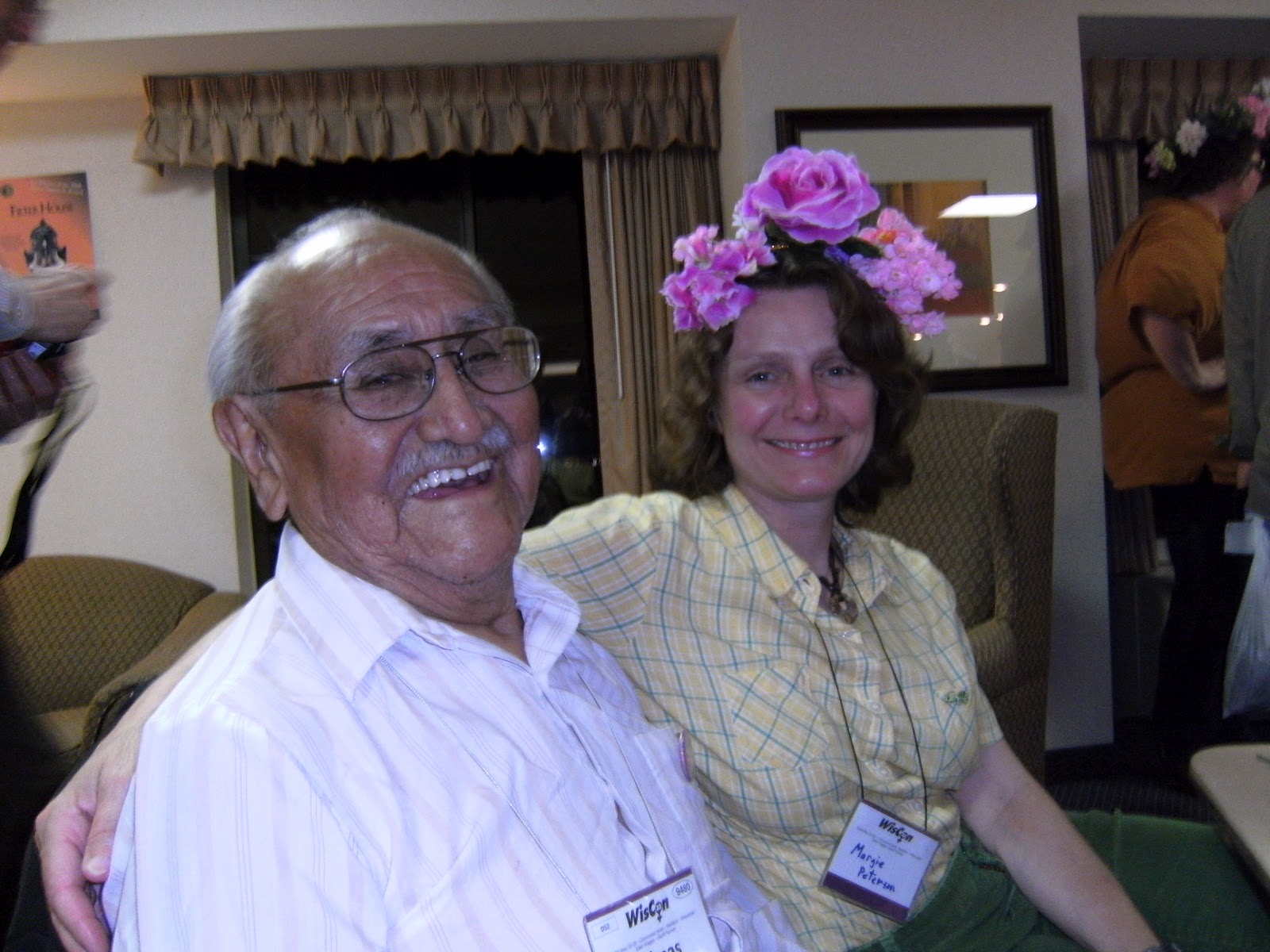
Here's Dimas with Margie Peterson at WisCon 33, enjoying their handiwork.
I wrote a picture book called "The Secret Princess" about how to do what MJ and Dimas have done. It starts out this way:
Once there was a secret princess: Princess Herminutia. She was a secret princess because nobody knew about her royal status. Her mama and daddy called her Minnie and made her take out the garbage.With the assistance of a wise costumer, her neighbor Mizz Cherry, the secret princess constructs crowns for all her family and finally receives the respect she deserves. She gets what she gives. What I want for us all.
Friday, August 10, 2012
Looking at looking

Late Wednesday SFSignal published short essays by me and some other writers on viewpoint in genre. Timmi joined an online discussion of what we'd said, adding:
"I've--more times than I can count--written a second version of a story in first (if the first version was in third) or in third (if the first version was in first)--when unsure of which would best serve the story. It's an illuminating exercise in any case. And sometimes the second version really is the correct one (and brings out different sorts of details that collectively change the reader's affect)."
She rewrites entire stories to make sure she's using the correct viewpoint? That is some mondo literary muscle. That is the authorial equivalent of hauling pianos around with your teeth--but much more useful.
Wednesday, August 8, 2012
Fluid identities
First the brag: I recently edited an essay by Ursula K. Le Guin for The Cascadia Subduction Zone, and afterwards she told me I was "not only a good editor but a nice one." (Thank you, Ursula!) Next the confession: As a zine's "poetry editrix" I once responded to a letter from a rejected submitter by peeing on it and mailing it back. 25 years passed between these two exchanges--years during which I got a lot of experience on both sides of the editing equation. So now I look at where I've ended up and where I started out and I feel qualified to wonder:
Do editors have mighty powers? Do they ever use these powers for ill? Or only for good?
Do editors have mighty powers? Do they ever use these powers for ill? Or only for good?
Tuesday, August 7, 2012
Endarkening us all
Conversation about all things Aqueductian is this blog's remit, and for the next week or so its founder has left it in my hands, desiring me to "enlighten and entertain" you. If my posts aren't entertaining you probably won't bother reading them. But I would rather endarken than enlighten.
Monday, August 6, 2012
Heads up!

Sunday, August 5, 2012
Statement by Readercon's ConCom
In the wake of the mass resignation of Readercon's Board, Readercon's ConCom has issued a statement vis-a-vis the Readercon Board's handling of the sexual harassment issue, overriding the Board's decision by permanently banning Rene Walling from attending. The ConCom also apologizes to Genevieve Valentine and Kate Kligman and notes:
by damaging the convention's reputation as a safe haven where harassment is aggressively discouraged and appropriately dealt with when it happens, we have upset many people who care about the convention and undermined our efforts to make the convention more inclusive and diverse. Women, members of minority groups, and younger people are often especially vulnerable to harassment, and many have been understandably put off by the perception that harassment is tolerated at our convention; we cannot claim to be welcoming them while creating an environment in which they feel unsafe.The statement also promises to take future specified actions to address the general problem of sexual harassment. If Readercon implements all the steps they are proposing, that con will be a trail-blazer in the way WisCon has come to be.
We offer our heartfelt apology to everyone in our community who trusted us and has been hurt by our breach of trust; to everyone who once felt safe at Readercon and no longer does; to those who have linked Readercon's reputation with their own and now feel tarnished by association, especially our past guests of honor and anyone who has officially or informally promoted the convention; and to those who love Readercon and are heartbroken to see its leaders acting contrary to the convention's best interests.
New e-books from Aqueduct Press

Vol. 5: Rosaleen Love's The Traveling Tide ($5.95)
Vol. 15: Lesley A. Hall's Naomi Mitchison: A Profile of Her Life and Work ($5.95)
Vol. 24: Sylvia Kelso's Three Observations and a Dialogue: Round and About Science Fiction ($5.95)
Vol. 34: Christopher Barzak's Birds and Birthdays ($5.95)
You can order them now at http://www.aqueductpress.com/.
Friday, August 3, 2012
Christopher Barzak's Birds and Birthdays

Remedios Varo, Leonora Carrington, Dorothea Tanning: three of the most interesting painters to flourish in male-dominated Surrealism. This is Christopher Barzak’s tribute to them, three stories and an essay that enter into a humane surrealism which turns away from the unconscious and toward magic.
Sometimes the stories themselves seem to be paintings. Sometimes painter and writer may be characters, regarding each other through a painful otherness, talking in shared secrets. Barzak’s stories are huge with the spacious strangeness of worlds where there is always more room for a woman to escape her tormenters, or outgrow an older self. Here we find a bird-maker and a star-catcher whose shared history spills over into the birds and the stars themselves; a girl who outgrows her clothes, her house, and finally her town—and leaves to find her body a new home; a landlord, whose marriage, motherhood, separation, sexual exploration, and excursions into self-portraiture all take place within a single apartment building.
In “Remembering the body: Reconstructing the Female in Surrealism,” Barzak comments on the images that inspired these stories and discusses his own position as a writer among painters--and gender politics within the Surrealist movement.
Here's a passage from "The Creation of Birds," the tale that engages with the paintings of Remedios Varo:
The Bird Woman hasn’t been able to make birds for a long time. Nearly four months have passed without one new bird. The birds in the next room were the last to receive the required teaspoon of moon and starlight needed to give them life. The stars and moons, a lot of them have been disappearing. It’s because of the Star Catcher—he’s been out there again, in the night sky, taking them down, so many of them, as if they were mere ornaments or lanterns. Without them, the Bird Woman won’t be able to complete even this sparrow, small and slight as it is. There isn’t enough available light to make it live. Why do I try, she wonders. Habit, she thinks. Wishful thinking, she decides.
She tries not to attribute anything to hope.
A swan strolls into the workshop, sidling up beside the Bird Woman’s leg, attempting to view the parchment, but its neck isn’t long enough to stretch that high. “Shoo,” the Bird Woman scolds it. “Back with the others, silly swan. We’ll be leaving soon for the market.”
She strokes the top of its head before it turns to leave the room. Her fingers come away damp, sticky with ivory.You can purchase Birds and Birthdays here.
Thursday, August 2, 2012
Lesley Wheeler's The Receptionist and Other Tales

Gwyneth Jones, author of Spirit and The Universe of Things writes: Lesley "Wheeler's The Receptionist is a delight: a stirring narrative of fantasy and derring-do, set in the ivy-clad towers and poky offices of modern academia, in which the warrior princess of an ancient line returns to the fray at last and summons ancient powers to defend the right, all told in technically assured terza rima cantos, full of ingenious rhythms. The forces of evil are all too recognizable, the bad guys satisfyingly bad and the good guys not too goody-goody. The infusion of classic children’s fantasy, and other bedtime folklore sources, is wonderful too. In the bonus package of shorter poems, “Zombie Thanksgiving” (T.S. Eliot's “The Waste Land” retold) is stunning, an absolute tour de force."
Ursula K. Le Guin, author of Lavinia and Cheek by Jowl, writes: "How much Modernism deprives us of when it declared both the fantastic in fiction and the narrative in poetry unrespectable, and what a pleasure it is now to see the exiled witches and the forbidden rhymes return. Where can an evil Dean meet his doom more fitly than in terza rima? Lesley Wheeler’s brief novel of misbehaviour in academia, subtle and funny, rashly inventive and perfectly realistic, uses all the forgotten powers of metaphor and poetry to make the mundane luminous."
Edna, the heroine of "The Receptionist," is a mother and the receptionist for an academic department. The morning after hearing a Voice telling her The first revolution: simply to refuse, going through her email inbox, "Edna thought to check her spam."
There it was, from "Gnomic Utterance." Subject
line: Solve for X. My destiny approaches,
she thought, and chuckled like a cracked crock-pot.
You can purchase it now, here.
Subscribe to:
Posts (Atom)