Wednesday, November 9, 2016

The Day After

Once again, the United States will be inaugurating as president a candidate who did not receive the majority of the votes cast (commonly referred to as "the popular vote," as though it were a popularity contest). The conservative-dominated Supreme Court, which had the privilege of determining the outcome of the 2000 election, insisted then that our system does not guarantee that all citizens have the right to vote or that all citizens' votes count equally. Since then, the Supreme Court's 2013 ruling struck down a key part of the 1965 Voting Rights Act. There's no question in my mind that the curtailment of the protections inherent in the Voting Rights Act was, a factor in the outcomes of yesterday's general election; it's impossible to say yet just how significant a factor it was in the assignment of Electoral College votes (one of the many elitist institutions built into our "democratic" system). I expect we'll be hearing more about this soon.

Very early this morning, over at The New Yorker, David Remnick, clearly in the throes of the initial shock, wrote:
The election of Donald Trump to the Presidency is nothing less than a tragedy for the American republic, a tragedy for the Constitution, and a triumph for the forces, at home and abroad, of nativism, authoritarianism, misogyny, and racism. Trump’s shocking victory, his ascension to the Presidency, is a sickening event in the history of the United States and liberal democracy. On January 20, 2017, we will bid farewell to the first African-American President—a man of integrity, dignity, and generous spirit—and witness the inauguration of a con who did little to spurn endorsement by forces of xenophobia and white supremacy. It is impossible to react to this moment with anything less than revulsion and profound anxiety.
I, too, feel sick and flattened. (And also angry.) But to my mind, we've had many sickening events in the history of the United States and liberal democracy, and over my lifetime I've witnessed or experienced a good many of them, some of which have come into my mind today in a sort of physical resonance of memory. Each time I've been through one of these sickening events it has felt as though this country has gone insane. Each time, I've just had to go on. Last night in the small hours I said to Tom and the friends who had come to watch election results come in, "I'm too old for this." Maybe I'd hoped I wouldn't find myself in this place yet again. Going into the election I'd known it would be a long hard struggle if Clinton won, but I hadn't been able then to bring my mind to bear on the long hard slog we'd face if Clinton lost--precisely because I knew it would be as arduous and exhausting as walking through waist-high mud, something that at my age would involve using muscles that were beginning to weaken and melt to flab. Now I have no choice but to let the fact of this defeat sink in--and then to go on, no matter how high or thick the muck.

A variety of explanations for the triumph of the Republicans, who will now control every branch and aspect of the federal government, are in the air. I could probably list a dozen that I've heard or read in the last eighteen hours. You can read a few of them, mostly centered on the gender issue, in a discussion on the Guardian's website: https://www.theguardian.com/commentisfree/2016/nov/09/us-election-result-misogyny-america-panel-woman. Arwa Mahdawi's commentary particularly moved me:
Trump’s win has trained a spotlight on the extent of the misogyny that runs through America. Importantly, however, it also reveals just how far women’s rights have come; how much has been achieved; how threatened the denizens of a fading America feel. Trump’s victory is the last gasp of a desperate white patriarchy. Clinton may have lost the election but that doesn’t mean women lost on Wednesday morning. Our fight isn’t over.

Ah, but we also need to be careful not to frame Trump’s victory as a case of men versus women. Exit polls show that the majority of white women voted for Trump. It seems that upholding white privilege is a bigger priority for many women in America than protecting legislation that gives them control over their own bodies.
Indeed, if Trump’s win has taught us one thing it’s that we need to stop talking about “women’s rights”. We need to stop pretending that women in America are a homogeneous group with the same privileges and priorities. Feminism is meaningless unless we talk about intersectional feminism. It’s women of colour who should feel the angriest today. It’s women of colour who have been most let down. And it’s women of colour who have the most to lose.
What preoccupies me now, at this moment, is the future ownership of the public sphere.Will the media flip to fawning over the man who can't speak without lying and threatens vengeance on those who take note of this lies, and allow each and every lie to pass without challenge? Will the language of the most blatant, offensive white supremacy become socially acceptable and adopted by the "liberal" media? This occurs to me today because my body and spirit feel, this day after, as it did when the US public sphere went from massively opposing the invasion of Iraq in 1990-91 (with a whopping 90% of the population against it) to celebrating and glorying in the ease with which the US military machine was able to grind down its former ally. US public sentiment is fickle; it always sides with the winner.

I raise this concern not to wallow in despair, though certainly even the most optimistic of us are indeed wallowing today as we reel from a blow we aren't yet able to take in. Rather, I want us, looking to the weeks and months ahead, to do what we can to speak the truth and protect one another from the force of a hatred that will be flowing full-bore through some of the most powerful channels on the planet. Those of us who know how to use words and know how to think past double-speak and dog whistles need to occupy the public sphere to the utmost of our ability. Please, my friends: think, speak, and write. We are not defenseless.    

Saturday, November 5, 2016

Quote of the Day

I'm generally not a big fan of Rousseau, but sometimes he does nail it. This observation strikes this particular Usian who, whatever the outcome of this general election, knows it won't bring an end to our national state of anxiety:

Citizens only allow themselves to be oppressed to the degree that they are carried away by blind ambition. Since they pay more attention to what is below them than to what is above, domination becomes dearer to them than independence, and they consent to wear chains so that they may in turn give them to others. It is very difficult to reduce to obedience anyone who does not seek to command.--Jean-Jacques Rousseau, Discourse on the Origin and Foundations of Inequality among Men

Tuesday, November 1, 2016

Lola Robles' Monteverde: Memoirs of an Interstellar Linguist


I'm pleased to announce the release of Monteverde: Memoirs of an Interstellar Linguist, a novella by Lola Robles translated by Lawrence Schimel, in both small trade paperback and e-book editions, as the fifty-second volume in Aqueduct's Conversation Pieces series.  You can purchase it now from Aqueduct at www.aqueductpress.com.

Terran scholar Rachel Monteverde journeys to Aanuk, a paradisiacal planet famous for both its beaches and the generosity of its nomadic inhabitants. The aanukiens are not the only people on the planet, however: Rachel is eager to meet the Fihdia, a cave-dwelling people who share a congenital condition that makes them blind. Rachel’s relentless determination to communicate with them despite the Aanukien’s dismissal and the Fihdia’s secretiveness will yield more than she ever hoped for.

Rachel Cordasco writes of the novella in a review for Speculative Fiction in Translation, "Robles expertly mixes notes that Terran linguist Rachel Monteverde took for her report to the Society for the Study of Interstellar Languages with Rachel’s reminiscences about life on Aanuk and the ways in which language acts as the common denominator among otherwise wildly distinct cultures. At its heart, this is a story about translation’s importance in breaking down barriers between people, and Lawrence Schimel’s translation of this story about translation is so smooth you almost forget that Monteverde wasn’t originally written in English....Monteverde is unlike anything else you’ll read this year. It raises language itself to the level of a main character, one who may be invisible but nonetheless forms the basis of all interaction and understanding. Without language, we wouldn’t have Monteverde, and without translation, us English-language readers wouldn’t have access to this small but brilliant book."

 A few details about the author and translator:

LOLA ROBLES is the author of three science fiction novels, La rosa de las nieblas (1999), El informe Monteverde (2005) and Flores de Metal (2007) as well as a collection of lesbian science fiction short stories co-written with Ma Concepción Reguiero, Historias del Crazy Bar y otros relatos de lo imposible (2013). Her most recent book is the essay En regiones extrañas: un mapa de la ciencia ficción, lo fantástico y lo maravilloso (Palabaristas, 2016), a panoramic overview for the lay reader of the basic concepts of non-realist genres, their divisions and overlaps.

She has also published numerous articles and studies focusing on Spanish-speaking women authors of science fiction and fantasy, with pioneering works analyzing Gothic narratives through a feminist lens or the treatment of trans* experience and identity in genre literature. From 1987 to 2002, she coordinated the cultural activities of the Biblioteca de Mujeres (the Women's Library) of Madrid and was one of the founding members of the Red de Bibliotecas y Centros de Documentación de Mujeres (The Newtwork of Women's Libraries and Documentation Centers). Since 2006, she has given a monthly lecture and reading group discussion called Fantástikas, focusing on women writers and characters in genre literature. This workshop is adapted for people with visual disability, especially since the author herself has low vision. Blog: Fantástikas: http://escritorasfantastikas.blogspot.com.es/

LAWRENCE SCHIMEL writes in both Spanish and English and has published over 100 books as author or anthologist in many different genres—including fiction, poetry, non-fiction, and comics—and for both children and adults. He has won the Lambda Literary Award twice, for PoMoSEXUALS: Challenging Assumptions about Gender and Sexuality (with Carol Queen; Cleis) and First Person Queer (with Richard Labonté, Arsenal Pulp Press), and has also been a finalist for this award 13 other times. His anthology The Future Is Queer (with Richard Labonté;, Arsenal Pulp Press) won the Spectrum Award, and he has also won an Independent Publisher Book Award, and a Rhysling Award, among others.

Thursday, October 20, 2016

The Cascadia Subduction Zone, October 2016


The new issue of The Cascadia Subduction Zone is out. It features poetry by Gwynne Garfinkle and Sonya Taaffe and an essay about anger by L. Timmel Duchamp; the issue's Grandmother Magma column is by Sarah Zettel, writing about work by Elisabeth Sanxay-Holding; David Findlay, Nancy Jane Moore, and J. M. Siorova contribute reviews; and Madeline Galbraith is our featured artist. You purchase the issue here and download the April 2016 issue for free here.


Current Issue: Volume 6, Number 4 October 2016
Essay
Sometimes Anger Is the Necessary Response: Reading Chris Kraus’s I Love Dick
  by  L. Timmel Duchamp
Poems
Una O’Connor unleashes her scream
   by Gwynne Garfinkle

A Death of Hippolytos
The Other Lives
   by Sonya Taaffe

Grandmother Magma
The Girl We Forgot (and Really Shouldn’t Have) Sarah Zettel on Speak of the Devil and Other Work by Elisabeth Sanxay Holding

Reviews
The Apothecary’s Curse, by Barbara Barnett
   reviewed by J.M. Sidorova

Staying with the Trouble: Making Kin in the Chthulucene , by Donna Haraway
   reviewed by Nancy Jane Moore

Sleeping Under the Tree of Life ,
by Sheree Renée Thomas
   reviewed by David Findlay

Featured Artist
Madeline Galbraith

Tuesday, October 11, 2016

Please support Strange Horizons!

Just a little signal-boost here: Strange Horizons has begun the last week of its fund drive. Many Aqueduct authors have been published in or have served as editors for this excellent publication, which shares some of Aqueduct's dearest values and goals. Here's the pitch from the site:

Our annual fund drive is underway! We're aiming to raise $15,000 to fund Strange Horizons in 2017, and a bit more than that for some special projects. You can make a one-time donation via PayPal or NetworkForGood, or support on an ongoing basis via Patreon—all donors are entered into our prize draw, and various other rewards are also available (and in the US your donations are tax-deductible). As an additional thank-you to donors, as we raise money we're publishing extra material from our fund drive special issue. We've just published "The Troll Who Hid Her Heart" by Jenn Grunigen! When we reach $13,000 we'll release podcasts of all our bonus material!
Special Patreon goal! In addition to the main fund drive special, if our Patreon reaches 300 supporters, as a preview of Samovar, we will publish Lawrence Schimel's translation of "Terpsichore", a story by Argentinian writer Teresa P. Mira de Echeverría. Read a bit more about it here.

Some of the prizes are Aqueduct Press books. Here are the descriptions provided by SH:

Conversation Pieces bundle
A selection of offerings from Aqueduct Press's "Conversation Pieces" series, which showcase connection and conversations within feminist SF. This bundle includes Marginalia to Stone Bird, by Rannu Award winner (and SH contributor) Rose Lemberg, her debut collection reviewed by SH here; A Field Guide to the Spirits, by Jean LeBlanc, exploring the interwoven pathways of ghost, memory, imagination, and desire; Unpronounceable, by Susan diRende, a novel LASplash.com called "reminiscent of the space fantasies of Douglas Adams and Kurt Vonnegut"; and Sleeping Under the Tree of Life, by Sheree Renee Thomas, a collection of the celebrated author's poetry and short stories. All in all, a great introduction to the series. (Donated by Aqueduct Press.)


Will Do Magic for Small Change
A trade paperback copy of Will Do Magic for Small Change by Andrea Hairston. Cinnamon Jones dreams of stepping on stage and acting her heart out like her famous grandparents, Redwood and Wildfire. But at 5'10" and 180 pounds, she's theatrically challenged. Her family life is a tangle of mystery and deadly secrets, and nobody is telling Cinnamon the whole truth. Before her older brother died, he gave Cinnamon The Chronicles of the Great Wanderer, a tale of a Dahomean warrior woman and an alien from another dimension who perform in Paris and at the 1893 Chicago World's Fair. The Chronicles may be magic or alien science, but the story is definitely connected to Cinnamon's family secrets. When an act of violence wounds her family, Cinnamon and her theatre squad determine to solve the mysteries and bring her worlds together. Publishers Weekly had this to say: "The entire work is filled with magic, celebrating West Africans, Native Americans, art, and love that transcends simple binary genders. Hairston's novel is a completely original and stunning work." (Donated by Aqueduct Press.)

 Roadsouls
A trade paperback copy of Roadsouls by Betsy James. Timid Duuni has spent her life as abused and guarded property. Blind, arrogant Raím is determined to be again what he once was: hunter, lover, young lord of the earth. Desperate to escape their lives, the two lift up their hands to the passing Roadsoul caravan, and are—literally—flung together naked. Each of them soon learns that saying "yes" to the Roadsouls is more than just accepting an invitation to a new life—it's a commitment that can't be reversed. For Duuni and Raím, nothing is as it was. Lost to their old lives, hating each other, they are swept out of their cruel old certainties into an unknown, unknowable, ever-changing world of journey and carnival, artists and wrestlers and thieves. Behind them, inexorable, pads a lion. Inexorable, too, is Duuni and Raím's inevitable encounter with it, an encounter that will change everything. (Donated by Aqueduct Press.)

The Waterdancer's World
A trade paperback copy of The Waterdancer's World by L Timmel Duchamp. Humans have been struggling to live on Frogmore for almost five centuries, adapting themselves to punishing gravity and the deadly mistflowers that dominate its ecology. Financier Inez Gauthier, patron of the arts and daughter of the general commanding the planet's occupation forces, dreams of eliminating the mistflowers that make exploitation of the planet's natural wealth so difficult and impede her father's efforts to crush the native insurgency. Fascinated by the new art-form of waterdancing created by Solstice Balalzalar, celebrating the planet's indigenous lifeforms, Inez assumes that her patronage will be enough to sustain Solstice's art even as she ruthlessly pursues windfall profits at the expense of all that has made waterdancing possible. (Donated by Aqueducut Press.)

 Hwarhath Stories
A paperback copy of Eleanor Arnason's Hwarhath Stories. A collection of a dozen Hwarhath tales with commentary by their translator. As the translator notes, "Humanity has encountered only one other species able to travel among the stars. This species, who call themselves the hwarhath, or 'people,' are also the only intelligent species so far encountered." Reviewing for Strange Horizons this September, Kelly Jennings said "This is a powerhouse of a collection. It is not to be missed." Includes stories nominated for the Nebula, Sturgeon, Tiptree and Locus Awards. (Donated by Aqueduct Press.)

  
Flesh & Wires
A trade paperback of the Locus Recommended first novel for 2015, Flesh & Wires, by Jackie Hatton. Following a failed alien invasion the world left is sparsely populated with psychologically scarred survivors, some of them technologically-enhanced women like Lo, leader of the small safe haven of Saugatuck. A book Publisher's Weekly calls "a promising work of feminist science fiction." (Donated by Aqueduct Press.)


Two Travelers
A trade paperback copy of Two Travelers by Sarah Tolmie. In "Dancer on the Stairs," a woman wakes up on a stone staircase in a baroque palace, not speaking the language of the place and lacking the chemical signature that allows people to identify each other within a complex social hierarchy. Unable to communicate in words, she resorts to dance. In "The Burning Furrow," a man who runs a diner in present-day America is also a freedom-fighter in the northern, courtly realm of Dinesen. His people are abused foreigners at home, the servants of strangers, bound not by their overlords, but by their world itself, through a ritual known as the burning of the furrows. Only he and his family are free—for a time. Now that time is ending. (Donated by Aqueduct Press.)

Life-sized ugliness: a mirror for right-wing politicians

I'm in Port Townsend again, writing. Reading essays is one part of my daily routine here. No matter what I read, serendipity always comes into play, and what I read helps me think about the fiction I'm working on. This morning's reading, though, resonated so powerfully with the violent political theater that this year's presidential campaign season has devolved into that I'm going to share a bit of it with you here (with the hope that the distraction from my work will then pass). My current reading is bell hooks' Outlaw Culture: Resisting Representations, which is a relatively old book-- Routledge first published it in 1994. It's a collection of essays that includes a 1993 interview conducted by Marie-France Alderman, chiefly discussing films of the day. The films they discuss are likely unfamiliar to many people now, but the discussion itself doesn't strike me as in the least out of date. Here is the resonant passage:
You know a film I saw recently that was very moving to me--and I kept contrasting it to Menace II Society-- was the film Falling Down. There is a way to talk about Falling Down as describing the end of Western civilization. Black philosopher Cornel West talks about the fact that part of the crisis we're in has to do with Western patriarchal biases no longer functioning, and there is a way in which Falling Down is about a white man who's saying, I trusted in this system. I did exactly what the system told me to and it's not working for me. It's lied to me." That doesn't mean you have the right to be so angry that you can attack people of color or attack other marginal groups. In so many ways, though, that's exactly how a lot of white people feel. There's this sense that if this white supremacist capitalist patriarchy isn't working for white people--most especially for working-class white men, or middle-class white men--it's the fault of some others out there.
Sound familiar? 1994 was the year the Newt Gingrich cohort took over the House of Representatives with a take-no-prisoners approach to holding the federal government hostage (a tactic that has since become a standard arrow in the far-right wing's quiver), that a few years later resulted in the virtual elimination of welfare assistance. And then of course, later, came the even more extreme Tea Party faction, which, though it is a minority, has successfully imposed a state of apparently permanent gridlock in Congress. Gingrich and the Tea Party politicians share most of Trump's values and attitudes. So why are some of these same far-right politicians now so dismayed by Trump's performance? Can it be that they are horrified to see the embodiment of some of their most cherished attitudes and values? (Never have their opinions and values looked as ugly as they do when expounded by Trump, whose primary form of disguise is to claim after he's said something more than usually outrageous he said was joking.) That makes more sense to me than the mainstream media's argument that they're fearing that Trump's boasts targets the kind of women their wives and daughters are. They've certainly never before opposed the language of rape culture. (And in fact, yesterday Rudy Giuliani got laughs at a Trump rally by joking about "locker room talk," which is how Trump characterized his boasting about his adventures sexually assaulting white women.)

Later in the interview, hooks muses on the reactions of many people to women presuming to speak in the public sphere (which in 1993 belonged solely to men--witness the Anita Hill hearings and Alan Simpson's rebuke of then president of NOW Molly Yard for what he called her "tiresome arrogance" in presuming to speak before Congress):
I was just home recently at a family reunion, and people said such mean and brutal things to me that I started to think, "What's going on here?" And my brother said that a lot of what's going on here is envy. [Envy for hooks' success as a well-published author.] ....We hear all these statistics about how many women are raped and beaten every so many seconds yet when we talk about having fear in patriarchy, we're made to feel that that's crazy. What incredible women today--especially those who are feminists--aren't talked about in many contexts as mad?
      Trump keeps playing the crazy card because the crazy card worked just about every time it was deployed against a woman for most of the twentieth century in the US. (I can recall numerous instances in personal life where the conclusion, on a woman's behaving willfully, which is to say, without regard for what the dominant man in her life was insisting on, was that she was "crazy.") These days, this trope doesn't work all that well with younger generations. Targeting Clinton as a woman out of control (crazy and criminal in the same breath--in any case, needing silencing and institutionalization of one sort or another) does work with people who share what hooks calls "this sense that if this white supremacist capitalist patriarchy isn't working for white people--most especially for working-class white men, or middle-class white men--it's the fault of some others out there."

Okay, having vented, I can now get back to work.   

Saturday, October 8, 2016

L. Timmel Duchamp's The Waterdancer's World

I'm pleased (if I'm honest, wildly excited) to announce that my new novel, The Waterdancer's World, is just being released byAqueduct Press in trade paperback and e-book editions. Humans have been struggling to live on Frogmore for almost five centuries, adapting themselves to punishing gravity and the deadly mistflowers that dominate its ecology. Financier Inez Gauthier, patron of the arts and daughter of the general commanding the planet's occupation forces, dreams of eliminating the mistflowers that make exploitation of the planet's natural wealth so difficult and impede her father's efforts to crush the native insurgency. Fascinated by the new art-form of waterdancing created by Solstice Balalzalar celebrating the planet's indigenous lifeforms, Inez assumes that her patronage will be enough to sustain Solstice's art even as she ruthlessly pursues windfall profits at the expense of all that has made waterdancing possible.

Carolyn Ives Gilman, author of Dark Orbit and Halfway Human, writes of the novel: "Timmel Duchamp specializes in rule-breaking fiction, and The Waterdancer's World lives up to her reputation. This passionate book explores the interdependence of art and oppression on a vividly imagined colonial world. It is as challenging and ethically complex as anything Duchamp has written."

Reviews

Frogmore is not the ideal world for human colonists, but they have arrived, they intend to stay, and the military is in control and determined to eliminate any threat to the human population, even if that means doing major damage to the local ecology and trampling the rights of the indigenes. The major player in the story is the daughter of the commanding general, who commands a commercial empire in her own right, and who is firmly behind the plan to terraform the world despite her fascination with a new artform that is directly inspired by the life forms she hopes to eradicate. The interplay of emotions unfolds on both an individual and a mass level, and the role of art in human history becomes a major theme. This author's work is almost always just a bit outside the mainstream of science fiction, and that is I think part of the reason that it is so often, as in this case, intensely appealing.  —Critical Mass, Don D'Ammassa,  October 5, 2016

This creative (though at times academic) novel takes place on the planet, Frogmore, as seen by five different individuals, and features the analytical guidebook, "A Star-Hoppers View of the Galaxy." The narrative explores the struggles the first few generations face while establishing life on the harsh and unforgiving planet... Generations later, when Frogmore is thriving, a government-like group, the Combine's Council for Developmental Strategy, seeks to use the planet only for its resources. The balance of the planet is on the line while groups grapple to gain control while managing oppression and ostracism. Readers looking for a breezy beach read will need to keep looking, for this is a formidable novel that takes concentration and patience. The rewards are great, however, for those who stick with it and wind up reflecting on it long after they've finished.  —Booklist, Stormie Petrakovitz,  September 29, 2016

You can get the book now from Aqueduct at  http://www.aqueductpress.com.

Sunday, September 18, 2016

Karen Heuler's Other Places

I'm pleased to announce the release of Other Places by Karen Heuler, a collection of short fiction, as the fifty-first volume in Aqueduct Press's Conversation Pieces series. In Other Places' tales, life unfolds in strange ways. You may encounter people from your past living in your former apartments, or realize you have a penis as you engage in war-dreams, or find a planet filled with ghosts that look exactly like the ghosts back home. Is it possible they are the same as the ghosts back home? Wherever you travel, you'll have to make tough decisions about the aliens you may have harmed and the aliens who may harm you. Other Places, Karen Heuler's latest story collection, follows travelers as the familiar becomes strange, and the strange becomes life.

Publishers Weekly has reviewed Other Places: "Prolific fantasy and horror writer Heuler continues defying convention and categorization in her latest collection of stories. The first tale, “The Rising Up,” wherein a young woman unexpectedly realizes she has a penis while engaging in dream combat, sets the stage for the weirdness to come. There is fairy tale opulence in “Twelve Sisters, Twelve Sisters, Ten,” in which a dozen sisters spend their evenings dancing in an underwater house. “The Apartments,” in which a woman visits her old haunts and discovers some unsettling personal information, is as much a stroll down memory lane as it is a meditation on narrative. Each story is as inventive as the last. Heuler’s prose illuminates the strangeness of both her characters and her settings. Establishing elaborate themes and morals is no easy feat in such short narrative arcs, but Heuler does it admirably, quickly laying the groundwork for her myriad of worlds, cultures, and travelers. There is no doubt as to Heuler’s creativity, but some of the stories have less pull than others, though the collection as a whole does not feel unbalanced. Exploring difficult questions with imaginative prose, Heuler leaves readers with much food for thought."

 Other Places is available in both print and e-boook editions. You can purchase it now through Aqueduct's website.

Wednesday, September 7, 2016

Nisi Shawl Reads & Signs Her First Novel

Yesterday, Tor released Nisi Shawl's debut novel, Everfair, and last night at University Bookstore in Seattle, a crowd of sixty hung on Nisi's every word spoken and note sung. No one who's been to a recent reading by Nisi will be surprised to hear that she opened her reading with a song important to the characters in her just-released Everfair; but not only did she sing a capella, she also directed the audience to join in the chorus (which we all did). Flashing us a mischievous smile, she promised to read us a sex scene--which she did--but I had to laugh when someone later, standing in the long queue of people waiting to get their copy of the book signed, grumbled with amusement that it was actually a scene of sex interrupted. At any rate, I came away with my own copy in a mood of exultation.

Nisi commented to another writer before the reading that it had taken her sixty years to achieve this book. This resonated powerfully with me when University Bookstore host Duane Wilkins reminded us of Nisi's long view by beginning his introduction with an anecdote of how Nisi had many years back asked him if she could read her first novel at the bookstore and that when he'd said sure and asked her when it was due to be released she replied that she hadn't yet written it. Obviously, she was thinking ahead.  

Nisi's going to be reading in a variety of locations across the US this fall. Tor.com has posted her schedule for September (and presumably will be updating that with more appearances that I know she has planned). I know this blog's regular readers will want to read Everfair. I haven't yet read it myself, but the blurb on the front cover, by Karen Joy Fowler, reads: "A book with gorgeous sweep, spanning years and continents, loves and hates, histories and fantasies...Everfair is sometimes sad, often luminous, and always original. A wonderful achievement." Enough said.


Wednesday, August 10, 2016

WisCon Chronicles Vol. 11: Call for materials

I'm pleased to announce that the editor of the next volume of the WisCon Chronicles is Jaymee Goh, and she's eager to receive submissions. Here's her call for materials:

Call for Submissions
The WisCon Chronicles, Vol. 11: Trials by Whiteness

WisCon40 followed a seismic shift in the demographics of the convention. Following the success of the POC Safer Space, there is now a Genderqueer/Trans Lounge, and a Disability Lounge. Programming actively seeks a diversity of panelists. How have these changes come about, and what have their ramifications been?

The theme, "Trials by Whiteness," examines how what bell hooks calls the white-supremacist capitalist (cishetero)patriarchy has affected the feminism of WisCon and created difficult confrontations and conversations on the clashing perceptions of attendees. "Whiteness" refers to the position from which white supremacy operates. It has constantly moving goalposts by which everyone is measured. Whiteness does not refer only to white people; non-white peoples can also identify with this position and perspective. "Trials by whiteness," therefore, refers to all the problems people have to go through as a result of white supremacy, on various scales from microaggressions to abuse, whether institutionally or through individual behaviours.

I welcome essays and contemplations on the following:

·         the changing faces of WisCon;
·         the challenges in transmitting and sharing knowledge across generations;
·         clashes of ideology, theories, and/or practices as feminism grows; 
·         panel reports;
·         nice listicles, for example suggestions for how to ally with (and not over!) the various folks that come to WisCon!

I encourage personal essays, poems, or roundtable discussions that deal with any of the following, especially in the context of WisCon and within the SFF industry:

·         dialogs and difficult conversations about the rising discomfort of white SFF fans; 
·         intra-community conflicts within marginalized groups, which we fear to discuss because we fear whiteness turning these conflicts against us;
·         spillover of hegemonic whiteness onto other forms of oppression, such as disability, class, and gender expression;
·         productive outcomes of difficult conversations, e.g. Nalo Hopkinson's Lemonade Award;
·         what DID happen over the summer before WC39? for good or for ill, how did that affect WisCon40?

Further afield, I am a big fan of Academic Lite articles and welcome experimental and non-academic forms discussing the following topics:

·         how POC and conditionally white people are treated by people comfortably entrenched in whiteness;
·         the internalization of white/Eurocentric standards and difficulties of unlearning them in order to recognize oneself, whether as part of the system, or apart from it;
·         the challenges of being a white person confronting whiteness and demonstrating solidarity and good allyship, earning trust;
·         uncovering whiteness, the ramifications of naming it and dealing with the cognitive dissonance that it demands.

While this anthology does center the POC gaze, I am also interested in white essayists interrogating these difficult subjects from the intersections of their identities as well.

Don’t reject yourself—that’s my job!

I am particularly interested in articles that are conversations, especially between newer and older attendees, between attendees who identify differently, or in response to WisCon events. For example, attendees of color and white attendees who attended the Hamilton Sing-Along. Pitch me!

Send pitches and submissions to jhameia.goh@gmail.com with "WCC11: [title]" in the subject line. DOC / DOCX / RTF. Submissions open Aug 15, and close Oct 31. All pitched articles should be in by November 15.

Wednesday, August 3, 2016

Poets House Showcase

This year two of Aqueduct's recent poetry titles, Jean LeBlanc's A Field Guide to the Spirits and Rose Lemberg's Marginalia to Stone Bird are appearing in Poet House's annual Showcase. Here's the description from the Poets House website:

The only event of its kind, the annual Poets House Showcase is a free exhibit featuring the new poetry books and poetry-related texts published in the United States in a single year from over 700 commercial, university and independent presses. Displaying volumes by individual authors, anthologies, chapbooks, biographies, critical studies, essay collections, CDs, DVDs, and more, the Poets House Showcase is a diverse and inclusive exhibition in which books from micro-presses receive the same care and attention as major publishers.

Opening on Thursday, July 14th, the 2016 Showcase is on view through Saturday, August 20, 2015. More than 3,000 items are in the 2016 exhibition.


If you live in NYC and are a poetry lover, this may well be for you.

(Photos furnished by Jean Le Blanc.)


Friday, July 22, 2016

The Cascadia Subduction Zone, Vol.6, 3


The new issue of The Cascadia Subduction Zone is out! This issue  opens with an essay by Karen Lord, "Unbought and Unbossed: Jane Eyre, Wide Sargasso Sea, and Amaryllis Collymore." The issue also includes poetry by Tonya Liburd and T.D. Walker, a Grandmother Magma column by Jewelle Gomez, and reviews of six new books; the issue's featured artist is Susan diRende (who is also the author of Unpronounceable, a novella in Aqueduct's Conversation Pieces series). If you're not already a subscriber, you can subscribe or purchase the issue here.


Vol. 6, 3 (July 2016)


Essay
Unbought and Unbossed: Jane Eyre, Wide Sargasso Sea, and Amaryllis Collymore
  by  Karen Lord
Poems
Contemplation
   by Tonya Liburd

Canals of Mars
In Which Miss Emily Bethel Wakes a Hundred Years Later in Every Possible Future
New Moon: Naming, Rites
   by T.D. Walker

Grandmother Magma
The Handmaid’s Tale, by Margaret Atwood
   by Jewelle Gomez

Reviews
The People in the Castle, by Joan Aiken
   reviewed by Victoria Elisabeth Garcia

To Shape the Dark, edited by Athena Andreadis
   reviewed by Lauren Banka

The Devourers, by Indra Das
   reviewed by Anil Menon

The Geek Feminist Revolution, by Kameron Hurley
  reviewed by Karama Horne

Arabella of Mars: The Adventures of Arabella Ashby, by David D. Levine
  reviewed by Cynthia Ward

Fae Visions of the Mediterranean: An Anthology of Horrors and Wonders of the Sea, edited by Valeria Vitale and Djibril al-Ayad
  reviewed by Joanne Rixona

Featured Artist
From a Distance
   by Susan diRende

Tuesday, July 19, 2016

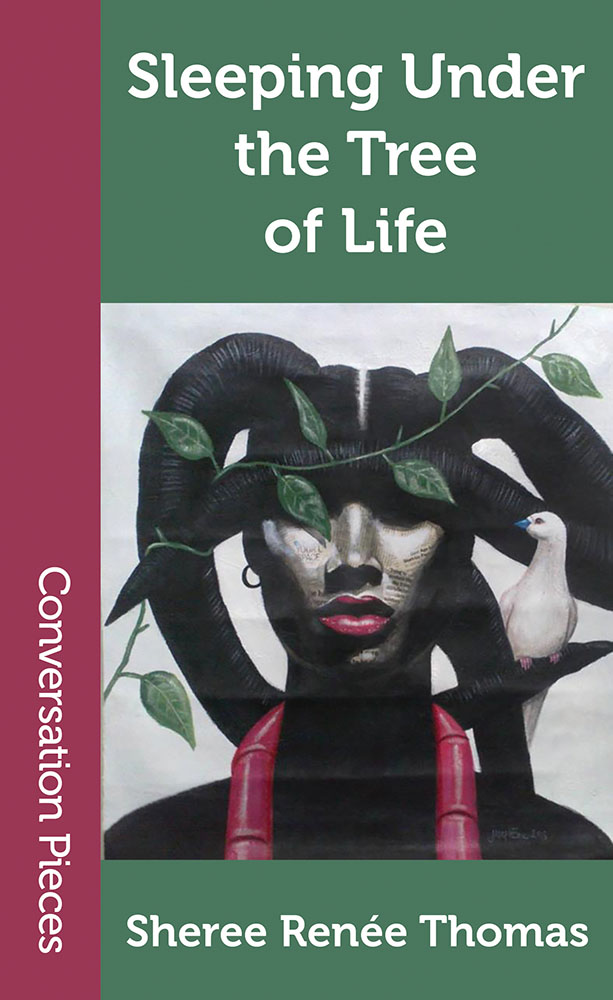
Sheree Renée Thomas's Sleeping Under the Tree of Life


I'm pleased to announce the release of Sleeping Under the Tree of Life, a collection of poetry and stories by Sheree Renée Thomas, as the fiftieth volume in Aqueduct's Conversation Pieces series. Sleeping Under the Tree of Life evokes the realm of ancestral knowledge with a deep respect for the natural world, a love of language, and an invitation—for survival, and asks: Who survives without being transformed? Beneath luminous layers of imagery and mythology, science and nature, fantasy and the recounting of history, is the grace and tenderness of a poet's heart, the unwavering gaze of an oracle's vision, and the dreamlike whimsy of a storyteller's mind. Hope, love, and hard truths spring from these pages of a writer whose imagination conjures an unforgettable journey. Readers enter these poems and stories the way some souls enter church, a quiet garden, or a stand of trees—for rest, for the blessing of silence and reverie, for beauty if not redemption.

Last week Publishers Weekly gave the book a starred review: "The lyrical gifts of Thomas, editor of the celebrated Dark Matter anthologies, are on full display in this collection of poetry and short fiction. Her poems are imbued with rich, sensual imagery and range over subjects mundane, fantastical, and somewhere in between: the memory of a mother braiding her daughter’s hair in “Rootwork”; an oracle in the form of a homeless woman whose “mismatch clothes/ cover robes that got wings” in “Visitation of the Oracle at McKain Street”; and the mythological Arachne, “Star weaver of tears,” in “Arachne Star” and “Arachne on the Rebound.” She invokes the rhythms of African-American ring shouts and the dense, humid atmosphere of the American South. Her stories include reinventions of mythology, such as Medusa and Arachne ambushing the goddess Athena in revenge in “Arachne & Medusa Jump Athena,” and haunting modern folktales about women with their roots in rivers (in “River, Clap Your Hands”) and swamp trees (in “Tree of the Forest Seven Bells”), with references to recent natural disasters and human-created pollution. Thomas’s skill with poetry and prose is remarkable, and even the shortest poems in this volume contain ideas and images that will linger in the reader’s mind."

The collection has also received a good deal of advance praise:

 "Sleeping Under the Tree of Life is a feat of literary conjuration. Poetry, prose combine in a mythic discourse that combines African, Indigenous, and European tropes to explore the power and plaints of woman hood; the thin line between life and death; the power of the Fates; the volatility of nature; a desire for and the achievement of transformation.... The texts here offer a profound understanding of the Black American South—where trees are sources of shade and succor or memorials to humanity's murderous traits. And it is a sly portrait of Memphis, Tennessee, Thomas' hometown. This is a bold book full of taller than tall tales and delicate lyrics-where birth, death, sex, magic and discovery walk the same path and haunt the writer's dreams. Join her on this journey and find out what it is like to sleep under that tree." —Patricia Spears Jones, author of A Lucent Fire: New and Selected, Painkiller, Femme du Monde, and The Weather That Kills

"These are wise women poems, country lush, bound by myth and science. Thomas's exquisite language inhabits constellations, delta crossroads and the deepest forest to explore our collective troubles. Thomas is also a master storyteller weaving a devilish braid of ancestral reclamation; of sirens, goddesses and elders wrapped in new world grit and a modern hoodoo evocative of the pastoralism of Jean Toomer. This powerful collection is a call to 'save us from ruin.'" —Jacqueline Johnson, author of A Woman's Season

"'Out of the mouth of this holler,' Sheree Renée Thomas' Sleeping Under the Tree of Life springs to life—to give us life. Continuing the work she set out with her Dark Matter anthologies and her first collection, Shotgun Lullabies, Thomas, in this pristine, poised narrative of our beginnings, extends and expands the dialogic paradigm of an art form and genre the world is finally catching up to, to go beyond what Michael McDonald and James Ingram sing— 'Yah Mo Be There!'—to take us back to the future of an Africa that said/that says, as the Bantu— 'Nommo Be There!' In Sleeping Under the Tree of Life, Sheree Renée Thomas collages together a narrative of necessity where her full literary powers and prowess are on full display like a Dogon cup from an ancient river where we drink in the magic of winged words necessitating change, each poem and prose piece not lulling us to sleep—but giving us life, and making sure we stay WOKE!" —Tony Medina, author of Broke Baroque and An Onion of Wars

"Sheree R. Thomas is a hoodoo conjure women. Sleeping Under the Tree of Life is a book of story and poem incantations. Thomas calls on the ancestors, the spirits, and our natural Mississippi mud/ blood history to talk to the future. She tasks, thrills, and twists our minds. Her word magic feels so good in my mouth, I have to jump up and speak her blues, jazz, and warrior woman sass out loud! Sleeping Under the Tree of Life is a book to read again and again and again!" —Andrea Hairston, author of Redwood and Wildfire and Will Do Magic for Small Change

"Sheree Renée Thomas gives us a whirlpool of poem and story, a 'wild and strangeful breed' of cosmology that maps each star from Machu Pichu to Congo Square, from Legba to Medusa. Here in these pages is a ringshout around a tree of brown woman hands and riverbent fantasy, all quilted up in 'indigo/and black silt/ twisting the thick strands/ as if starting a slow fire.' The baptism awaits, the water is living, and we all rise with the tide of these epistles from such a wondrous, ancient, future-bound poet." —Tyehimba Jess, author of Olio and Leadbelly

"Sleeping Under the Tree of Life is a collection of tales and poetry reflecting the mythical origins of life inside the dream of 'trees, rivers, stars, blood.' Through Thomas' words every day birth, desire, death becomes a beautiful, dream-like dance full of magic, light and dark. We are shown that things are more than they seem and under the most common skin lies infinite power." —Linda D. Addison, award-winning author of "How to Recognize a Demon Has Become Your Friend"

"This collection of vivid, intense and artful speculative poetry and short fiction is a journey through beautiful, treacherous landscapes simultaneously ancient, futuristic and of-the-moment, inhabited by deities, demiurges, and drylongso conjurefolk. These guides, guardians and shape-shifting survivors illuminate Thomas' meditations on the joys and ravages of history and the resilience of love. Sleep beneath this Tree, dream these dreams, and arise changed."—Ama Patterson

'In Sleeping Under the Tree of Life, Sheree Renée Thomas finds the mythic grandeur in human frailty and apocalyptic storms. This is a book of goddesses and magic, of songs mournful and joyful, of restless trees and falling skies, told in a voice like a river's hypnotic rush. You'll welcome the webs these poems and stories weave." —Mike Allen, three-time Rhysling Award winner, Nebula and Shirley Jackson Award finalist, and editor of Clockwork Phoenix

"Sleeping Under The Tree of Life is a powerful invocation by a literary rootwoman working with both hands, a fusion of prose and poetry that brings to mind Toomer's Cane or Jones' Corregidora, works graced with lyrical riffs like little blue bottles glistening in the sun. With this work, Sheree Thomas has attained a new level of artistic maturity, her unique voice, a Wanganegressian fusion of contemporary and the traditional, singing out in a mastery of craft and vision that adorns every page. Her poetry claims the reader long before prose narratives are introduced in a seamless weave working that boundary/fusion of genres where new aesthetics are born. It is everything a work of art should be, a challenging engagement with the human condition that will try your soul with moments of astounding grace. Sleeping Under the Tree of Life represents a new level of craft, vision and achievement for a consummate artist and cultural icon. With this one, Sherée Thomas' place is assured. When great soul meets great work, what you get is a thing of wonder." —Arthur Flowers, author of I See the Promised Land, Mojo Rising, and Another Good Loving Blues

"In Sleeping Under the tree of Life, Sheree Renée Thomas has created a gorgeously mind-altering collection of poetry and story. She riffs off history like a Jazz master, while invoking a poly-rhythmic present shot through with prophesy. With pulsating word alchemy, she spins luminous imagery, astounding characters, and deep-sea insights. I say, this book will put a spell on you—change you, and rearrange you. Read it right now, twice." —Pan Morigan, composer, Wild Blue and Castles of Gold

Sleeping Under the Tree of Life is available now in print and e-book editions through Aqueduct's site, and will soon be available elsewhere.

Monday, June 6, 2016

Aqueduct Press readings at WisCon 40


Three groups of Aqueduct Press authors read this year at WisCon. We all read in Conference 2--and for the first time in that room were furnished with a mic, which we dutifully used. I reaped a lot of compliments for the readings (as, I hope, did the individual authors) and often heard people marveling at the sheer variety in voices and stories. Given that that's a part of the point of Aqueduct's existence, such comments gratified me immensely.

The first group read, on Saturday afternoon, under the title "We Sing the Body." This is an expression that is usually taken metaphorically, but in this case it applied literally as well as metaphorically. Nisi Shawl, who read from Everfair (forthcoming from Tor in September), began, as is her wont, with a song sung a capella, and taught the audience (and her fellow authors) to sign the refrain along with her. Pan Morigan followed by reading from unpublished work and, accompanying herself on banjo sang a song from her forthcoming album, Storm Hand. Andrea Hairston read the opening pages of her novel, Will Do Magic for Small Change. And I talked about and read Chapter Zero in The Waterdancer's World (a novel forthcoming from Aqueduct in October).


The second group read on Sunday afternoon under the title "Definitely Not Damsels," immediately following the first group, in the same room.  Jackie Hatton read from Flesh & Wires (which Aqueduct published last fall). Mary Anne Mohanraj read from "Webs," a story forthcoming in the July issue of Asimov's. Eleanor Arnason read a short tale from Hwarhath Stories: Transgressive Tales by Aliens. And Lesley Hall read from her delicious, on-going regency pastiche, The Comfortable Courtesan (available here).


The third Aqueduct Press group read on Sunday, under the title "Elsewhere." Susan diRende read from "Unpronounceable," which Aqueduct released in April; Brit Mandelo read from "The Pigeon Summer," recently published online at Tor.com (available online here); Nancy Jane Moore read from The Weave (which Aqueduct published last summer); and Sarah Tolmie read from Two Travelers (which Aqueduct has just released). Prompted by a question from the audience, the reading finished with a discussion of... editing (!).


Sunday, June 5, 2016

About the wonderful time Arrate had at WisCon

WisCon 40! What can I say.


This was my third year attending a gathering I dreamed of long before I could see it for myself. And WisCon 40 has been particularly special for a number of reasons. For starters, the Guests of Honor -- Sofia Samatar, Justine Larbalestier, and returning GoH Nalo Hopkinson, whom I had been really excited about since they were announced last year. I’m also happier and more open to the world than I’ve been in a while. I engaged with all sorts of people around me, and it was beautiful. I made friends! All of whom live on a different continent to mine, but that is secondary.

Timmi, Andrea, Pan, and Nisi after a full-room Aqueduct reading
Some of the panels and readings I attended were the best time I’ve had in a while, too. The panel on code switching, with Nisi Shawl and Andrea Hairston, among others, was good fun and packed with ideas to keep developing for months to come. The incredible panel remembering Octavia Butler, moderated by Sofia Samatar, had us all laughing and tearing up and nodding a lot. Being able to gather together and cherish the many meanings of Octavia Butler’s legacy for both the audience (whom Samatar invited to participate by suggesting topics for discussion) and a panel of authors I love was a real privilege (and it made my anarcha-feminist science fiction book club in Brighton really jealous). I attended two of the three Aqueduct readings, which always have an intimate feel to them, and the Science Fiction Destroys the Gender Binary! reading at Michelangelo’s, which was a varied, consistently good showcase of short fiction by non-binary writers.
The now legendary Octavia Butler panel: Sofia Samatar, Nalo Hopkinson, Lisa Bolekaja, Nisi Shawl, and Walidah Imarisha

Something particularly special about this year for me is that I was a panelist for the first time ever anywhere. Jaymee Goh moderated with great skill and unbelievable energy for a Sunday both of the panels I took part in, one on SFF in translation and one on SFF by women writers around the world. For the first panel I joined S. Qiouyi Lu, author and Chinese-to-English translator, in discussing some of the challenges and joys of our work. Rachel S. Cordasco made a summary of the panel for the Speculative Fiction in Translation website.


How could I miss it
The second panel featured Justine Larbalestier, Jackie Hatton, Emily Jiang, and me, and it involved our taking turns at telling everybody in the room about our favorite SFF from Australia, Japan, China, Finland, Spain, Argentina, and elsewhere. Isabel Schechter live-tweeted both panels (thank you!) and is planning to write up summaries of them, so do visit her twitter account on @MsUppityness.


Sketch of our translation panel by Mat Defiler
I feel really pleased (and relieved) about the warm reception both panels had, the fact that I can pick up a mic and not panic, and the possibility that both translation and international SFF may thrive at WisCon in following editions. Building bridges between English- and Spanish-language SFF is pretty much my goal in life, and seeing so clearly that I’m not alone planting those seeds in such an extraordinary community fills me with wonder about the future. As I type, Jaymee Goh is suggesting that #InternationalSFF be an regular twitter conversation. It feels great to see things moving.


And then there were also the non-panel fun times. I danced and glowed at the Floomp, got my first pair of earrings in exchange for a haiku, hung out with rad authors and booksellers, ate dessert and shed a few tears (no surprises there) during the GoH speeches and Tiptree award ceremony, and celebrated my birthday with a bunch of good people who made me feel so special despite hardly knowing me. I even got a book (Sofia Samatar’s new novel The Winged Histories), the most amazing cosmic hoodie from the clothes swap, and a paper bag full of ridiculously nice improvised gifts (Beer and chocolate? How did they know!). Kath got me a cool snake earring on behalf of Aqueduct, because they're the best.

Jaymee Goh, moderator extraordinaire, et moi.
In some aspects I still feel a bit like an outsider at WisCon, perhaps for purely geographical reasons, perhaps because I’m not very knowledgeable of the many changes that long-term attendees are perceiving, and which some active members of the community are currently commenting on. But I feel deeply grateful for the space WisCon provides, for the room for improvement and discussion, for all the volunteers that make it happen year after year. Personally, WisCon 41 can't come soon enough.

Friday, June 3, 2016

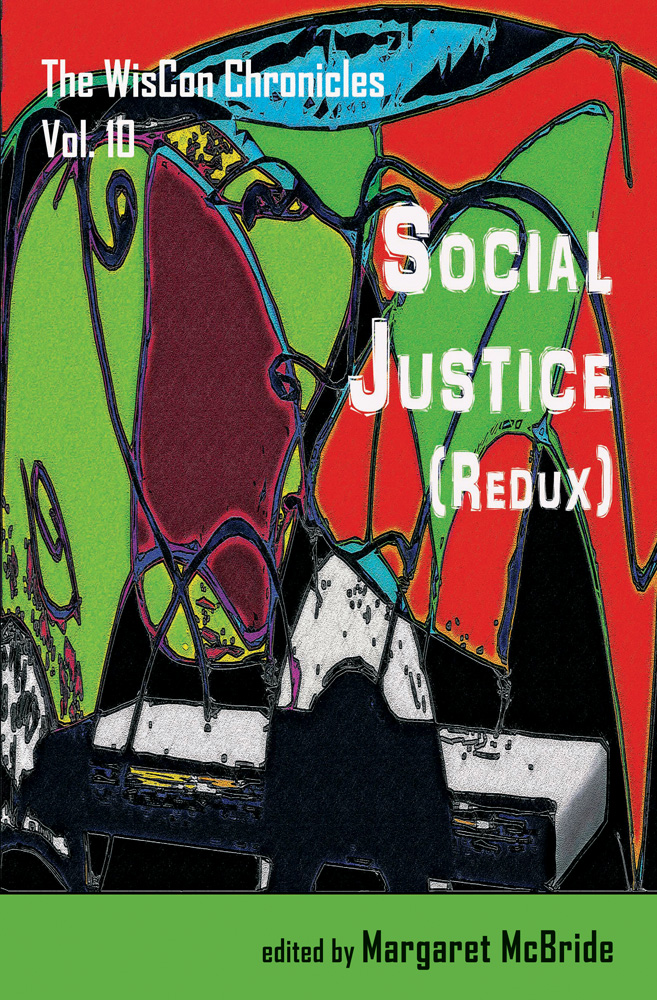
The WisCon Chronicles, Vol. 10: Social Justice (Redux)

I'm pleased to announce the release from Aqueduct Press of the tenth volume of the WisCon Chronicles, Social Justice (Redux), edited by Margaret McBride, in both print and e-book editions. WisCon 39's Guest of Honor speeches by Alaya Dawn Johnson and Kim Stanley Robinson inspired the theme of this volume. In her speech, Johnson delivered a cri de coeur: "We need diverse stories, we need a million mirrors of different shapes and sizes. Not just so we can see ourselves. So that they can see us through our own eyes." Robinson exhorted: "We now need to institute global justice and equality for all, for two reasons that bond together into a single reason: It's the right thing to do morally, and it's the survival thing to do."

In her introduction, McBride quotes Grace Paley: "Although writers may not want to be in charge of justice or anything like that, to some extent they are if they really are illuminating what isn't seen."

The volume includes the texts of Johnson and Robinson's speeches, as well as the keynote speech Julie Phillips delivered at the Tiptree Symposium in December 2015, and essays by Cheryl Morgan, Takayuki Tatsumi, Nisi Shawl, Johanna Sinisalo, Kathryn Allan, Ian Hagemann, Sandra J. Lindow, Ajani Brown, and others.

You can purchase this volume from Aqueduct now, at http://www.aqueductpress.com/books/978-1-61976-113-1.php.

WisCon 40 panel report-- "Our Stories Matter"

One of my favorite panels at WisCon 40 was "YES, Our Stories Matter: Encouragement and Support for Creators with Marginalized Identities." It was held on Friday afternoon at 4, in a small room (University C), moderated by Jaymee Goh, featuring panelists Susan Simensky Bietila, Alex Jennings, Mark Oshiro, and Riley. More people attended than WisCon's programming mavens anticipated (I imagine that most of the time, estimating attendance for a particular panel is a crap-shoot), resulting in attendees standing against the back wall and sitting on the floor in the aisle.

The panel's topic was one that many of us have been thinking about for a long time now; certainly it's one that writers and other creators attending WisCon are likely to be grappling with or have in the past grappled with. What strikes me as new about the subject, though, is an accumulating understanding of and greater consciousness all around that people with marginalized identities are likely to meet with an additional set of obstacles when attempting to sell and otherwise disseminate their work. For most of my life I found it difficult to articulate this problem without finding myself thrust into a scripted defensiveness. Founding Aqueduct Press allowed me, for the first time, to escape that script. I'm more pleased than I can say that many, many people are now getting it. And I was delighted to find that the discussion afforded by this panel was both practical and sophisticated. Here's the official description, taken from the Pocket Program Book:
Marginalization affects our success as creators, oppression impacts our ability to create and can grind us down. At the same time, encouragement can come in many ways, from reader comments to supporting each other as marginalized creators. Let's discuss issues like: Why do you keep creating? When do you know you've touched someone with your art? How do you recharge after a setback? How can we support each other within and between different marginalized groups? When it feels like the whole world is telling you that your story doesn't matter, where do you find the strength to pick up the pen?
The notes I took are, I'm sorry to say, sketchy, perhaps because so much of the discussion was rooted in very particular experiences I felt I couldn't abstract generalizations from lest the lack of context introduce distortion.

First: I found the composition of the panel a great advantage. Sue Bitelia drew on her experience of her long struggle to get around the barriers confronting her in the 1960s when she began her career as an artist, an experience that at many points resonated with the experiences of the three younger members of the panel--offering, I think, some hope, since Sue has, after decades, achieved gratifying recognition. Alex, Riley, and Mark, working in twenty-first century media as they are, face different circumstances but are, in the main, grappling with some of the same issues Sue had to take on to pursue a career in art. The one generalization I can safely make is that for all of them, engaging in some degree of Do It Yourself has been essential. This makes great sense to me, of course, not only because of my having founded Aqueduct Press (a prime example of DIY, if I do say so myself), but also because when I was 19and still composing music I understood that organizing performances without official sanction was the best chance I had of getting my music performed and heard. (This only stopped working for me when I lost all confidence in myself as a composer; many of this blog's readers will be familiar with the story of how I lost confidence, which I described in my WisCon 32 GoH speech.)

Perhaps the most striking moments of the panel came when the panelists discussed networking. For decades now, "networking" has been offered up as the most important thing young creators (or even academics) can do. But as one panelist noted, networking with people who have said horribly racist things on panels is horrifying. Conventions--including science fiction conventions-- often (usually?) serve up boundaries and obstacles creators with marginalized identities can't escape. "The whole weekend at most conventions are a nightmare for me of one bad experience after another," one panelist said.

I should also point out that Sue, Alex, Mark, and Riley all noted the importance to them of feedback from individuals who appreciate their work. Creators who are out of the mainstream for one reason or another don't receive the public notice mainstream creators do; that makes extra-institutional (and here I'm using "institutional" so broadly as to include reviews in periodicals) feedback of greater import than it might be. (Which is a hint, by the way, for all of us to make the extra effort to offer that kind of support when we can.) 

 Finally, I'll end by confessing that my notes come to an abrupt halt with the intriguing phrase "leveraging with language." I have some memory of what this refers to but not enough confidence in that memory to try to expand on it. If anyone who attended that panel is reading this and can expand on it, please do so in a comment. The more illumination we have on this subject, the better.