Monday, July 14, 2014

Post-Readercon

Readercon this year, for me, anyway, had a bit of the feel of WisCon (except, of course, for the Dealers Room, which had no Aqueduct press table and essentially no Aqueduct Press titles anywhere, unless one counts the satchel of her books Guest of Honor Andrea Hairston schlepped around to sell to attendees who were interested in buying her books). Several of the panels would have fit comfortably into WisCon programming, and of course many of the people who are often to be found at WisCon were present at Readercon. Also? More than once I found myself torn between two panels--an experience I've hitherto suffered only at WisCon. I had an enjoyable--and mighty stimulating--weekend. My only complaint was that the hotel absolutely insisted that the music in the bar be loud enough to be heard all over the first floor (and too loud to permit conversation with drinks after about 8 o'clock in the evening).

I thought I'd mention a few of the panels that particularly interested me. At the top of my list was a panel on Saturday morning titled "When the Other Is You," featuring Samuel R. Delany, Chesya Burke, Sabrina Vourvoulias (M), Peter Dubé, Mikki Kendall, and Vandana Singh. (ETA: a video of this can be found here: http://www.youtube.com/watch?feature=player_embedded&v=QPvyCcNsAmk.) The panel pretty much took its lead from the panel description: "Being part of an underrepresented group and trying to write our experience into our work can be tricky. We might have internalized some prejudice about ourselves, we might not have the craft to get our meaning across perfectly, and even if we depict our own experience totally accurately (as Chimamanda Ngozi Adichie observed in her TED Talk "The Danger of a Single Story"), we do so while struggling against the expectation that our experience is or isn't "representative" or "authentic." How do we navigate the pitfalls and responsibilities of being perceived as spokespeople? What potentially pernicious dynamics allow us that dubious privilege in the first place? Which works make us cringe with their representations of us, and which make us sigh with relief and recognition?"

Toward the beginning of the discussion Vourvoulias raised the question of whether the conversation was inflected by generational differences. Delany offered a dramatic example of cultural amnesia-- how the issues of contraception and abortion tragically impacted the lives of women he knew pre-Roe v. Wade, resulting in many, many deaths that young people today never imagine could be the result of destraoying access to abortion. 

The issue that received the most attention was that of "authenticity." One aspect of this is that the authenticity of the voices of those positioned outside mainstream culture is often judged by the expectations of mainstream readers (and editors). At the same time, the mainstream reader is often oblivious to emphasis, nuance, and multiple meanings. Kendall noted that we seldom hear the stories of the people who resist oppression in small ways: "The stories that get heard are the low and the high." I found myself thinking that this is partly because the ordinary person of color is largely invisible in mainstream culture (except when they're depicted in relation to white people), and partly because small everyday acts of resistance are considered too boring and undramatic to be depicted in fiction, unless the consequences are dramatic. 

Most of my notes for this panel are paraphrases or quotations from panelists, sans elaboration:

Vourvoulias: Does diversity just mean "be nice to everyone?" The bottom line is that respect for the other is essential for the health of the genre.

Kendall: We don't have a single language: the question becomes, "whose language?" (This was said in the context of discussing Black English and diverse forms of colloquial English, regional and ethnic, and their representations in fiction.)

 Dubé: Language is the single most important lens; translation is the creation of new meaning. More meanings is good, fewer meanings is bad. (Someone else on the panel, I can't remember whom, observed that when a member of a marginalized group speaks to the mainstream, they are always translating.)

Vourvoulias: There's a political weight to Spanglish, or other languages. There are levels and levels of nuance.

Singh: When I'm writing or reading about non-mainstream (in the US) cultures, emphasis matters.

Vourvoulias: Language itself is hierarchical; certain voices aren't heard.

Vourvoulias: Who listens to the victims of the genocide of Guatemala? We re-victimize epople by giving them less agency than the government that repressed them when there stoy is told by others who are heard, not by themselves, as though they can't be trusted to tell their own stories.

Delany: only one review of his most recent novel, Through the Valley of the Nest of Spiders, got that the novel doesn't engage in exceptionalism for his poor, black, gay characters: the world of his novel makes black gay men unexceptionable and offers them an environment in which they can thrive-- as themselves, and not transformed into characters who aren't poor, black, and gay.

Dubé: Alterity gives you an outsider's view--which is valuable. As a gay man, he's distressed by the marriage/assimilation emphasis.

To tell the truth, I wanted this panel to go on for another hour at least. Or to have been about one or two of the various issues that the panelists discussed, to allow greater depth. But all in all, it offered me a lot to think about.


Another panel of interest sometimes overlapped "When You Are the Other" in the issues it addressed, viz., "East, West and Everything Between: A Roundtable on Latin@ Speculative Fiction," featuring Sabrina Vourvoulias (M), Daniel Jose Older, Matthew Goodwin, Carlos Hernandez, and Julia Rios. Vourvoulias asked the panel to begin by addressing the challenges facing Latin Speculative fiction. (ETA: Scott Edelman has posted a YouTube video of this one, too: http://www.youtube.com/watch?v=rBOJsqktspU.)

 Vourvoulias: Why is it so invisible? Is it because Latinos don't read?

Hernandez: The pressures of assimilation are enormous. Assimilating leads to camouflage.


 Older: Gatekeepers-- i.e., booksellers, editors: Latino writers have to get through bottlenecks controlled by Anglos; our stories can be threatening to Anglos.

Rios: Dialect & Spanglish can be threatening.


Older: Nalo Hopkinson's use of Caribbean vernacular was a revelation to me. We translate ourselves-- trying to water down our voice and narratives to please white gatekeepers.

Hernandez: Cites Junot Diaz's observation that sf/f readers will negotiate 200 pages in elvish without complaint, but will freak out at the presence of two Spanish words in a novel. He suggests there's a double standard about real-world difference, which makes its presence political. (Spanish can't be neutral in the way that English or Elvish can.)

Vourvoulias: Accent becomes a signifier in fiction.

Goodwin: When we start thinking about the category [Latin sf/f], it makes us think about past work as well. The screenplay of Blade Runner was written by a Mexican-American. The Chicano character he placed in the film [who wasn't in the Dick original] enriched it. We need to uncover the long presence of Latinos in spec fic.

Older: Latin presence in "urban fantasy"usually involves a white person having sex with a Chicano werewolf etc. But what about the urban fantasy stories Latinos have always created? The ghost stories and zombies-- that were long found in our oral tales. The crude mechanisms of publishing-- of power, money, and race, excludes those stories.


Vourvoulias: There are regional differences. There are agrarian latinos-- there's a long history of them in California. The urban latino is the story that has become a trope. We don't often see agrarian latinos in sf/f.


Rios: A lot of white America is listening to Fox News and are terrified of the "flood" across the border.

Vourvoulias: As Americans, we're invested in the exception. Junot Diaz is our exception. It's the Latino quotient for the century.

Older: We have to beware of the one-and-only model of success, in which breaking out means breaking away from your community-- and getting out. How do we conceive of diversity? We need to have an analysis of power, and leadership from those who are successful.

Vourvoulias:  We need to be mentoring young writers-- or someone who's more emergent than you are.

The panel concluded with remarks on packaging, teaching, and reaching young Latinos some exposure to Latino spec fic.


I stayed, after this panel, for the next one: Readercon Classic Fiction Bookclub: Memoirs of a Space Woman with Amal El-Mohtar, Lila Garrott (M), Sonya Taaffe. I didn't take many notes for this one, at least partly because of my familiarity with the book. I thought the panel did an excellent job of giving the audience (most of whom hadn't read the book) an idea of its richness and interest. Certainly as I was listening I had the thought that this was one of those books that came out before its time, which was heavily in the throes of essentialism of every sort (though particularly, of course, gender essentialism, Simone de Beauvoir notwithstanding). Here's the program description: "Naomi Mitchison's 1962 exploration of a life lived nearly entirely in space has deep humanist themes. Mary's specialty in alien communication leads to a life and profession of embracing the Other, literally realized in her accidental pregnancy via a Martian. We'll discuss criticisms of the book's heteronormativity and biological determinism as well as the themes of Mary's immersion in alien
cultures." 


El-Mohtar: She initiated this panel because she got angry that Mitchison was not a name on the lists of authors considered canonical.

 Taaffe: The protagonist, Mary, doesn't gender her career roles (contrary to what you might expect from the title's "Space Woman"). The narrative uses casual-sounding words to convey huge amounts of information about the society and culture Mary comes from. 


El-Mohtar: The society that produces these characters is incredibly flexible and elastic in its attitudes, giving us a fascinating window on a society that somehow, over the course of centuries, developed into such a livable place.

 Garrott: This is an egalitarian, non-homophobic utopia-- written in 1962.

Taaffe: It has almost no sexual social stigmas-- except for the taboo against intergenerational sex, which they are especially conscious of as the result of the time dilaltion of space travel.


El-Mohtar: This book is about space travel and exploration without colonization-- something we almost never see in sf.


Garrott: The book is episodic, without a plot; the protagonist is passive.

El-Mohtar: But how much of that is due to the book's being in the form of her memoirs?


Garrott: But memoirs are usually artfully crafted.

Taafffe: The book just stops. At the end, you turn the page, expecting the text to continue, and there's an ad for Despatches from the Frontiers of the Female Mind.

El-Mohtar: But the episodes gain in complexity as the book goes on. The trajectory is almost fractal.

Garrott: You get the feeling that the utopia is a result of people just finally growing up.

Taaffe: You can't tell how far into the future this is.

 A member of the audience brings up the point that in the book, humans can no longer eat animals because they can and do communicate with them.

Taaffe: In this future world, space travel solved the problems of vegetarianism-- introducing new fruits and vegetables to humans.

Garrott: This is mostly a comfort read, even though she has a lot of stuff that most people would find horrific and terrifying; but Mary isn't bothered by any of it.

Taaffe: There are mostly heterosexual relationships in the novel. But all the children Mary has are by choice. Mary worries lest she might be becoming monogamous.


The panelists discussed some of the details of Mitchison's remarkable life. (For more, I urge those interested to check out Lesley Hall's Naomi Mitchison: A Profile of Her Life and Work, which is the fifteenth volume in Aqueduct's Conversation Pieces series, and is available in both print & digital editions.)


I want to mention just two other panels. One is the last panel I popped into-- I managed to catch only the last 20 minutes, alas (because I was delayed by a conversation I didn't care to abandon), a panel on unreliable narrators. Eileen Gunn commented that all narrators are unreliable, and that in her experience, all people are unreliable narrators. "As you get older," she said, "you realize you need to have your smart hat on when people tell you their stories." Dora Goss, reflecting on the prevalence on unreliability of narrators, said: "It's a magical trick we pull, making any narrators reliable."


The other panel I wanted to mention was one of my own-- simply because it's on YouTube and has some interesting discussion (which I moderated): Empathy, Identity, and Stories:
Matthew Kressel, L. Timmel Duchamp (moderator), Julia Rios, Andrea Hairston, and Walt Williams appeared on the panel "Empathy, Identification, and Stories." Here's the description from the program book: "At a panel at Arisia 2013, Andrea Hairston said, 'I can only tell you a story if you're a human who can hear a story and imagine what it's like to be someone who isn't you.' Tannanarive Due added that access to stories matters: some children, for instance, can easily find books about characters like themselves, while others have to read books from outside a position of identification. Culture creates structures of identification and empathy; or, to put it another way, ways of feeling from within and ways of feeling from without. How do stories create structures of feeling, and how can writers and readers both benefit from awareness of these structures?" The link to the video is: http://www.youtube.com/watch?v=PY0SqMjb8Js 

This round-up only scratches the surface, of course. I don't have enough time to go into greater detail, alas. But certainly it made me, as Eileen would have, "put on my smart hat."

ETA: A video of Mikki Kendall's excellent interview of Andrea Hairston is now available, here: 
http://www.youtube.com/watch?feature=player_embedded&v=JkuyG2Q_XQ8.)

Wednesday, July 9, 2014

Readercon

I'll be attending Readercon this weekend in Burlington, Mass., along with numerous other Aqueductistas, including one of this year's Guests of Honor, Andrea Hairston. It's a safe bet that with so many Aqueductistas present, there'll be a plenitude of stimulation and challenge on tap. My own programming is:


Friday July 11 11:00 AM    F    Empathy, Identification, and Stories . L. Timmel Duchamp (moderator), Andrea Hairston, Matthew Kressel, Julia Rios, Walt Williams. At a panel at Arisia 2013, Andrea Hairston said, "I can only tell you a story if you're a human who can hear a story and imagine what it's like to be someone who isn't you." Tannanarive Due added that access to stories matters: some children, for instance, can easily find books about characters like themselves, while others have to read books from outside a position of identification. Culture creates structures of identification and empathy; or, to put it another way, ways of feeling from within and ways of feeling from without. How do stories create structures of feeling, and how can writers and readers both benefit from awareness of these structures?


Friday July 11 12:30 PM    ENV    L. Timmel Duchamp reads from a novel in progress

Saturday, July 12 1:00 PM    G    Audience-centric Narratives . Judith Berman, L. Timmel Duchamp (leader), Chris Gerwel, Ken Houghton, James Patrick Kelly. Several subgenres of speculative fiction, such as horror, satire, and slipstream, focus on creating a particular feeling or experience within the reader, rather than on the more typical plot-driver of a protagonist's inner or outer conflicts. The failure mode of this sort of writing is manipulation and didacticism. What makes an audience-centric story successful, from the author's point of view and the reader's?

Aqueduct won't be in the Dealers Room, and I haven't scheduled an autograph session, but I'll be available for conversation and book-signing throughout. See you there!

Thursday, July 3, 2014

The Cascadia Subduction Zone, Vol. 4, 3


Summer, oh summer, how I love it. Amazing things happen in summer, here in Seattle. For instance: the day before yesterday we had, out of the blue, a day in which the thermometer hit 94F. (It had mostly been in the 60s and 70s for all of June.) And voila, by zucchini tripled in size, and my tomato plants enjoyed a fabulous growth spurt.


And so, since it's July, the summer issue of The Cascadia Subduction Zone has arrived from the printer and is now available in print and digital editions here. This is another excellent issue, with poetry by Terry A. Garey (who will be a Guest of Honor at Diversicon later this month) and a retrospective essay on Garey's oeuvre. It also includes an insightful essay by Kim Stanley Robinson on The Female Man in particular and Joanna Russ in general, as well as a variety of reviews that will be of keen interest to Aqueduct readers, and art work by Mark Rich (who wears two of his large collection of hats in this issue).

 Here's the issue's table of contents:Vol. 4 No. 3 — July 2014
Essay
Imaginary Junctions: On Terry A. Garey and
Speculative Poetry
   by Mark Rich
Poems
Elephants in the Alley
    &
Cave Discovery
   by Terry A. Garey
Grandmother Magma
The Female Man by Joanna Russ
   by Kim Stanley Robinson

Reviews
Lovecraft’s Monsters, edited by Ellen Datlow
   reviewed by Usman T. Malik

Long Hidden, edited by Rose Fox and Daniel José Older
   reviewed by Maria Velazquez

Lonely Stardust: Two Plays, a Speech, and Eight Essays,
by Andrea Hairston
  reviewed by Adrian Khactu

Kantianism, Liberalism, and Feminism:
Resisting Oppression
, by Carol Hay
   reviewed by Nancy Jane Moore

Daughter of Mystery, by Heather Rose Jones
   reviewed by Liz Bourke

The Memory Garden, by Mary Rickert
   reviewed by Caren Gussoff

What Makes This Book So Great and
My Real Children, by Jo Walton
   reviewed by Cat Rambo
Featured Artist
Mark Rich

Monday, June 30, 2014

The Aqueduct Gazette, Vol. 9 Spring/Summer 2014


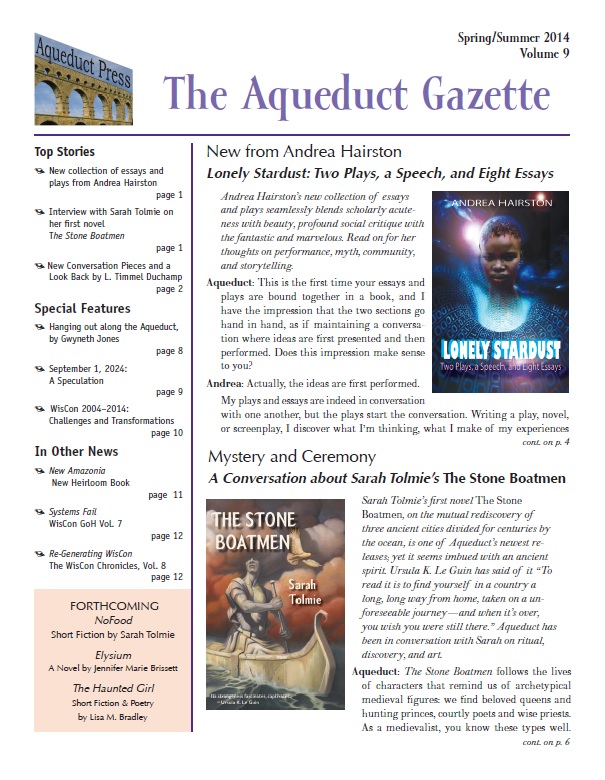
Aqueduct Press has published a new issue of the Aqueduct Gazette, edited by Arrate Hidalgo, to celebrate our tenth anniversary. We distributed print copies of the issue at WisCon, and will be bringing some to Readercon and Diversicon. But you can download a pdf of it (free) here. The table of contents includes:

A conversation with Andrea Hairston, discussing her new collection Lonely Stardust: Two Plays, a Speech, and Eight Essays;

A conversation with Sarah Tolmie, discussing her debut novel, The Stone Boatmen; 

An original essay by Gwyneth Jones, "I Don't Fly";

"September 1, 2024: A Speculation" by Joan Haran, Kristin King, Josh Lukin, Annalee Newitz, and Kiini Ibura Salaam;

"WisCon 2004-2014: Challenges and Transformations" by Sandy Olson, Debbie Notkin, and Ian Hagemann;

An excerpt from Alexis Lothians' introduction to New Amazonia: A Foretaste of the Future by Elizabeth Burgoyne Corbett;

And a reflection by me on the Conversation Pieces series.

Thursday, June 12, 2014

Systems Fail by Hiromi Goto and N.K. Jemisin


I'm pleased to announce the release of another book launched at WisCon, Systems Fail, by Hiroi Goto and N.K. Jemisin. This is a numbered, limited edition celebrating the work of WisCon 38's Guest of Honor, in Aqueduct's WisCon GoH series. The volume includes two pieces of Goto’s short fiction, N.K. Jemisin’s Nebula Award-nominated story “Non-Zero Probabilities,” and a selection of Jemisin’s essays as well as her 2013 Continuum IX Guest of Honor speech. In addition, the authors talk at length with interviewers knowledgeable about their work: Goto with writer and editor Nisi Shawl, and Jemisin with critic and scholar Karen Burnham.

Here's the Table of Contents:

1. The Sleep Clinic for Troubled Souls (Hiromi Goto)
2. What Isn't Remembered (Hiromi Goto)
3. Hiromi Goto: Interviewed by Nisi Shawl
3. Non-Zero Probablities (N.K. Jemisin)
4. Essays: 2010-2013 (N.K. Jemisin)
    Dreaming Awake
    There's No Such Thing as a Good Stereotype
     Fantastic Profanity
     Why I Think RaceFail Was the Bestest Thing Evar for SFF
      Guest of Honor Speech for Continuum IX
      Time to Pick a Side
5. N.K. Jemisin Interviewed by Karen Burnheim

It's available now at Aqueduct, and will be available elsewhere soon.

Tuesday, June 10, 2014

The WisCon Chronicles, Vol. 8: Re-Generating WisCon

I'm happy to announce Aqueduct's release of The WisCon Chronicles, 8: Re-Generating WisCon, which Aqueduct launched last month at WisCon. This volume is edited by Rebecca J. Holden, who notes that WisCon is filled with strong opinions and loud voices, and that central to any discussion about definitions of feminisms are questions about outsiders and insiders: Who is WisCon? Who is feminist? Whose opinion matters? Whose voice is heard? Who counts? Who belongs to which generation and does that matter? What does WisCon mean now? What will it mean for future generations?
 
This volume collects stories, poems, essays, blog posts, and speeches that explore these questions within the framework of the feminism(s) of WisCon spanning “waves,” generations, and media. In addition to three speeches —by WisCon 37 Guests of Honor Joan Slonczewski and Jo Walton, and Tiptree Award winner Kiini Ibura Salaam—the volume includes a spotlight section on poetry and visual arts, Heather Whipple’s statistical study of con attendance, Elise Matthesen’s and Nancy Jane Moore’s thoughts on reporting and ending sexual harassment in conventions, and Janice Mynchenberg’s reflections on being a Christian pastor within the sf/f community. Other contributors include Heather Lindsley, Sandra Lindow, Beth Putchak, L. Timmel Duchamp, Nisi Shawl, Joan Haran, Naomi Mercer, Rachel Kronick, Lesley Wheeler, Sofia Samatar, Lisa Bolekaja, Kristen Kest, Clara Abnet-Holden, and Anne Lane Sheldon.

Re-Generating WisCon is available now through Aqueduct in both print and e-book editions, and will be available elsewhere soon. 

Tuesday, June 3, 2014

So that was WisCon!

One thing I have learned is that reading about other people’s first time at WisCon has little to do with living it in your own flesh. (And that writing about it is much harder than I had anticipated.) WisCon has been exciting, hectic, challenging at times—and lots of fun.

Living in Europe and being the only feminist sf/f fan I knew, my prospects of ever making it to Madison for the convention were on the limited side. Two years later, my first incursion into the WisCon community has in fact been rather spectacular: being a trainee at Aqueduct is a tremendous privilege, in that it has made it easier for me to meet so many interesting, talented people that I would have been shy to approach otherwise. Not to mention the excitement of linking friendly faces to names whose work I admire and chatting with them as if it were the most natural thing in the world. Which it is.

Visual proof that I was in Madison
A lot of WisCon, I felt, is about sharing a passion for radical ideas in a space that is constantly challenging itself, and about creating situations in which everybody gets to participate in that sharing, discussing, and transforming. Many of the panels I attended (on radical queer politics, on decolonizing science fiction, on Afrofuturism) made clear that we have no final answers; that the conversation is always growing in size, in complexity, in perspectives; and that we will always need at least one more WisCon to figure out what science fiction can do to face and fight oppressive structures in all their current manifestations.

There were at least two panels in which survival was discussed as a form of successful resistance. And, prevalent as this notion is, I was really interested to hear Sheree Renée Thomas, in the context of Afrofuturism, point out her aiming beyond survival—an attitude that I’m excited to encounter in current and future Afrofuturist works. The panel, chaired by Jennifer Marie Brissett (her new novel Elysium is forthcoming from Aqueduct), succeeded in introducing some of the basics to those members of the audience who might have needed it, without losing focus on the challenges and new directions that Afrofuturism may take. What is clear is its power as a theoretical lens, as Thomas put it, through which to look at the black experience, which is, she pointed out, far from monolithic.

Hiromi Goto’s and N.K. Jemisin’s Guest of Honor speeches, powerful and extremely relevant to the current situation in sf/f publishing and fandom, had a lot to say in this respect. They confirmed once and for all why I want to keep doing what I’m doing. Both authors’ readings at A Room of One’s Own also turned me, inevitably, into a fan.

Not all was political debate, however: there were other things apart from radical change to celebrate. Aqueduct’s 10-year anniversary party was a blast. Raffle tickets were drawn, prizes were won, cake was eaten, wine was drunk, and the party wrapped up nicely around the time several Aqueductians hoped to retire, satisfied, to their rooms, while some of us continued our journey down the conveniently plastic-covered party corridor.

WisCon has room for plenty of different things, including ukuleles, dozing, tapas(!), tiny party hats, and compulsive book buying. It also has all the room in the world for making friends. Many people happily assume that we are all coming back next year and, whether they last a couple of minutes, hours, or days, the conversations started will probably continue then—which is just as well, because I wouldn’t miss WisCon 39 for the world.

Wednesday, May 28, 2014

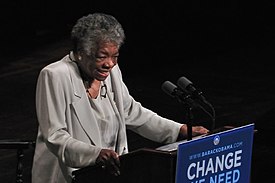
Maya Angelou (1928-2014)

Poet, critical memoirist, jazz singer, actor, producer, screenwriter, Civil Rights activist, and wise elder Maya Angelou died today at age 86. Her best-known work was I Know Why the Caged Bird Sings, which relates her struggle to survive and literally regain her voice following the trauma of being raped at the age of eight and learning that her rapist had been murdered after she named him. She said that she believed that her voice had killed him and that she feared her voice could kill anyone. Caged Bird is also, of course, about the experience of being a black child growing up in the Jim-Crow South. “If growing up is painful for the Southern Black girl," she remarks in that book, "being aware of her displacement is the rust on the razor that threatens the throat."

I had the pleasure of hearing her speak at a women's writers conference in Seattle in the early 1980s. The auditorium literally could not hold all the people who wanted to hear her, meaning that some people had to be accommodated in an overflow space where they could listen to her live over the PA system. She was an electrifying speaker, and the power of her voice was matched by her physical presence. I have a vivid memory of how, before she began her prepared talk, she called out some bad--racist--behavior that had occurred during one of the conference's workshops. I think that may have been one of the first times I ever hear anyone call out a piece of local, specific bad behavior in this way, so openly and publicly, and it impressed me tremendously.

The New York Times' obituary has a video of Angelou's performance of the poem she wrote for President Bill Clinton's inauguration, as well as a slide show and summary of her life and work. Mother Jones is running a piece titled 7 Pieces of Timeless Wisdom from Maya Angelou. In the Guardian, Gary Younge's piece is titled Maya Angelou: American titan who lived as though there were no tomorrow, which begins with a description of how his scheduled 45-minute interview in 2002 turned into 16 hours during which the whiskey flowed freely.The best thing to do to remember her, of course, is to seek out her work.

Monday, May 19, 2014

Hitting the Road to WisCon

Yesterday we loaded Kath's car with Aqueduct Press books, and off she drove, heading for Madison. This year at WisCon Aqueduct will be marking its 10th anniversary. Tom tells me that if most humans didn't grow ten fingers and ten toes, 2014 would just be another year for Aqueduct. And part of me feels that it is just another year. But part of me has been hosting the persistent idea that a tenth anniversary is a time for stock-taking--and looking forward. Will Aqueduct exist in another ten years? (When we started, I couldn't imagine our getting to be ten years old.) We have a lot of forward momentum, but the three of us who mostly run the press are in our sixties. So that's something I'm thinking about, too.

To celebrate, we'll be hosting a party on Sunday night. We'll be holding drawings for three prizes: a complete set of the Conversation Pieces series to date; a subscription to The Cascadia Subduction Zone; and a set of two Gwyneth Jones collections-- The Universe of Things and Imagination/Space. We'll also be raffling off a wall hanging made by Kath, celebrating Aqueduct authors and their books, with autographs signed by the authors. (See the photo below of the quilt hanging on one of Kath's looms; it unfortunately doesn't come close to capturing the hanging's charms. We'll be displaying it in the Dealers Room, at our table.) The proceeds from the raffle will be donated to the Carl Brandon Society and the James Tiptree Jr. Award Council. The party will offer other delights as well, including, lubricating beverages and, of course, conversation of the feminist kind (which is not exactly hard to find at WisCon).

Many of Aqueduct's authors will be attending the con, and most of those will be reading. Some of them will be reading together--  Eleanor Arnason, Jennifer Marie Brissett, Nancy Jane Moore, and Sarah Tolmie for the reading titled "Renaissances" in Conference 2, Saturday at 10 a.m., and Liz Henry, Alexis Lothian, Katrinka Moore, Anne Sheldon, and I for the reading titled "Time Cracks" in Conference 2 on Sunday at 1 p.m.

We'll be launching three new books at WisCon this year-- Andrea Hairston's Lonely Stardust, The WisCon Chronicles, Vol. 8: Re-Generating WisCon edited by Rebecca Holden, and Hiromi Goto and N.K. Jemisin's Systems Fail, a numbered, limited-edition chapbook in our GoH series. We'll also be distributing a new issue of the Aqueduct Gazette, which Arrate edited. This issue includes a new essay by Gwyneth Jones, reflections on change at WisCon, interviews with Andrea Hairston and Sarah Tolmie, and "September 1, 2024: A Speculation" by Joan Haran, Kristin King, Josh Lukin, Annalee Newitz, and Kiini Ibura Salaam. We'll be posting a pdf of the issue on Aqueduct's site for free download, after WisCon.

The editor of the next--the ninth!--volume of The WisCon Chronicles will be Mary Anne Mohanraj. Her thematic focus isn't set yet, but she is thinking about intersections and allies, and about living through times of social change, what leads to change (including the frustrations), how we effect change, the strategies for managing change without too much destruction in the process, whether sometimes destruction is necessary, etc.

And finally, I'm pleased to say that Arrate will be joining us this year, for her first WisCon. You'll see her at our table, at the party, and out and about at the con. As you might imagine, I'm looking forward to hearing her comments on the experience.


Monday, May 5, 2014

On May Day and "Superheroes"

There are reasons to feel hopeful about the small yet important breakthroughs surrounding this year’s May Day in the fight for workers’ rights and, in Spain, the right to protest too. The Catalonian police force, known as Mossos d’Esquadra, are no longer allowed as of May 1 to use rubber bullets for crowd control, a decision that comes too late but is nonetheless welcome in a context in which police brutality in the country has escalated alongside social discontent to tragic degrees. Countless wounded and a death later —the verdict on the death of Iñigo Cabacas at the hands of the Basque riot police after receiving a rubber bullet in the head has been pending for two years— workers could march the streets of Catalonia on International Workers’ Day without fearing to lose an eye, or worse.

Here in Washington State, Seattle Mayor Ed Murray’s announcement of the proposal to increase the city’s minimum wage to $15 an hour seemed like an appropriate backdrop to the May Day march. The proposal, however, will most probably require revising, as Socialist Councilmember Kshama Sawant’s response and the 15 Now campaign clearly show. There is certainly nothing that could justify the three to four years phase to the $15 wage for big companies.


After having spent all May Days of my working life at work, this was my first chance to get out there and march, and the hot, sunny day in Seattle was perfect for it. However, the turnout at the main mobilization by El Comité for workers and immigrant rights started off smaller than what one would have expected by the amount of police that escorted it. Led by the traditional Aztec Ce Atl Tonalli dancing group, the march gathered hundreds of people of diverse backgrounds calling for fair labor practices and, especially, for an end to the deportation of undocumented immigrants, which have already exceeded 2 million under the Obama Administration and have resulted in thousands of children being deported alongside their parents or left in foster care. Earlier in the morning, a solidarity rally had been held at the Northwest Detention Center in Tacoma, 56 days after detainees had begun a series of hunger strikes to bring attention to the abuse and harsh conditions they must endure.


Image credit: Kelly O, via The Stranger

The march concluded uneventfully and on a hopeful note in a rally at Westlake, while smaller, unofficial anti-capitalist protests took over in the evening and inspired reports from all points of the political and journalistic spectrum. One popular interpretation for the evening’s events is that of superheroes vs anarchists/marchers, which is an undeniably catchy tag, albeit far from the truth. Indeed, Seattle has its own league of vigilantes, even though it never asked for one, and the implications of such individuals’ interfering in situations in which the police is involved may seem more harmless, with what the comic book attires, than they actually are.

The Rain City Superhero Movement is a group of costume-clad individuals who patrol the streets at night with the claim of preventing crime. Founded by Phoenix Jones, who calls himself Guardian of Seattle and whose writing emulates that faintly disturbing sense of entitlement of, say, Batman’s internal monologues, the group seems to overlook the fact that what belongs in comic books may not be sensibly applied to real life, to say the least. Leaving aside the scent of megalomania around Phoenix Jones’ persona, the fact is that a group of people who claim to be protecting the city from anarchists serves no purpose but to create even more misleading images of what the act of protesting actually stands for. On the grounds of defending the city, which in many cases translates into defending property, Jones has been known to pepper-spray protesters (around minute 26).
Phoenix Jones and teammates.
Image via gawker.com
While the presence of masked "superheroes" meddling between riot police and protesters could seem just a nuisance that makes the officers' job harder, their potential to help justify actions taken by the police can’t be ignored. Phoenix Jones and his team are, after all, civilians, and hence unconstrained by the limits of policies and procedures, free to act and immediately seek refuge behind the police line, often provoking conflict and police response.

This is now, more than ever, a time for collective action. Can we really afford to celebrate or even chuckle at “justice-making” that regards the people, as too many riot police agents do, as their enemy?

Monday, April 28, 2014

2013's gender & race statistics of sf/s reviewing

Strange Horizons has just posted Niall Harrison's annual count of review publications in the sf/f field. This year's count looks at race as well as gender, which I'm glad to see. I'm not glad to see, however, that the statistics for 2013 reviews of work by women and women reviewers has remained pretty much flat in comparison with those for 2012. By this point, the gender disparity is becoming hard to explain without reference to internalized sexism. 

Check out Niall's count here: http://www.strangehorizons.com/2014/20140428/2sfcount-a.shtml.

Wednesday, April 23, 2014

Andrea Hairston's Lonely Stardust: Two Plays, a Speech, and Eight Essays

I'm pleased to announce Aqueduct Press's publication of Lonely Stardust: Two Plays, a Speech, and Eight Essays by Andrea Hairston. Feminist sf readers primarily know her as the author of Mindscape (winner of the Carl Brandon Society's Parallax Award and shortlisted for the James Tiptree and Philip K. Dick Awards) and Redwood and Wildfire (winner of the James Tiptree Award and Carl Brandon Society's Kindred Award). Those who've attended WisCon, IFCA, and Readercon will also know she writes (and performs) fabulous essays, eight of which appear in this collection. The speech mentioned in the title is her GoH speech for WisCon. Andrea has long been a writer, director, and performer of plays as well, and Artistic Director of Chrysalis Theatre and Louise Wolff Kahn 1931 Professor of Theatre and Afro-American Studies at Smith College. Not surprisingly, given Andrea's interests and cast of mind, her plays are science fictional, and two of these, "Hummingbird Flying Backward" and "Lonely Stardust," are included in the collection.

How to sum up the collection as a whole? I can only try:  Lonely Stardust: Two Plays, a Speech, and Eight Essays brings us the texts of nine marvelous works of scholarly performance as well as two works of drama in which the fantastic shows us the way through despair. In several of the pieces here, Andrea's sharp, visionary eye examines Hollywood blockbusters and finds a great deal to think about, even as she impatiently slices through hackneyed received views that do popular culture and its fans no favors. Taken together, these essays and plays broadcast a message of hope and intelligence that defiantly insists that our ability and desire to tell stories defines our humanity and is one of our most valuable resources.

This collection, for me personally, is an exceedingly valuable resource. Andrea's vision, though infused with hope and love, never ever pulls its punches. I can't tell you how happy I am to be publishing it.

Aqueduct will be selling Lonely Stardust through our website at a reduced price until June 1, 2014, its official date of release. The e-book edition is also available there now.  

Sunday, April 20, 2014

The Cascadia Subduction Zone, Vol. 4, 2


The new issue of The Cascadia Subduction Zone is out. Brit Mandelo leads off with "Revisiting In the Chinks of the World Machine: Feminism and Science Fiction by Sarah Lefanu"; Minister Faust gives us this issue's Grandmother Magma column; Mark Rich, Sona Taaffe, and Bogi Takács offer us poetry; and Victoria Elisabeth Garcia, Caren Gussoff, Gord Sellar, Cynthia Ward, and Tom Foster review books by Eileen Gunn, Bart R. Leib, Patrick Ness, Gail Simone and Walter Geovanni, and Sarah Tolmie. The issue also features the art of Dale McBride.

Table of Contents

Essay
Revisiting In the Chinks of the World Machine:
Feminism and Science Fiction
by Sarah Lefanu
   by Brit Mandelo

Poems
The Swooning
   by Mark Rich

The Etruscan Prince
   by Sonya Taaffe
Autonomous, Spacefaring
     &
Grow
   by Bogi Takács

Grandmother Magma
On Angela Davis’s An Autobiography
   by Minister Faust

Reviews
Questionable Practices, by Eileen Gunn
   reviewed by Victoria Elisabeth Garcia

Fierce Family, edited by Bart R. Leib
   reviewed by Caren Gussoff

The Crane Wife, by Patrick Ness
  reviewed by Gord Sellar

Red Sonja, Volume 1: Queen of the Plagues,
by Gail Simone and Walter Geovanni
   reviewed by Cynthia Ward

The Stone Boatmen, by Sarah Tolmie
   reviewed by Thomas Foster


Featured Artist
Dale McBride


You can purchase the issue at http://www.thecsz.com/subscribe.html for $3 or a year's subscription for $10. And like all issues of the CSZ, it will be available for free download six months from the date of publication.

Thursday, April 3, 2014

Sheila Finch's Myths, Metaphors, and Science Fiction

I'm pleased to announce the release of the 39th volume in Aqueduct's Conversation Pieces series, Myths, Metaphors, and Science Fiction: Ancient Roots of the Literature of the Future, by Nebula-award winning Sheila Finch.It's available now through Aqueduct's website in both print and e-book editions, and will be soon be available in all the usual places.  Here's a bit from the introduction:

"The great myths seek to explain us to ourselves--our exploits, passions, triumphs, and failures. They can be found all over the world, often displaying remarkable similarity.

"Nobody--scientist, seer or science fiction writer-- can reliably predict what will happen two days from now, let alone two millennia. Science fiction is really about us as humans--living, loving, fighting, raising families-- but set in another place and time so that the message may get through without being censored by the self-protective function of our egos."


“This welcome discussion of the connections between future fiction and stories about human inception emphasizes how mythic roots contribute to the emotional power of narrative. Finch investigates the inexplicable awe and wonder that emanates from close encounters between myth and science fiction. This juxtaposition emphatically indicates that science fiction is the predominant mythic metaphor of our time.” –Marleen S. Barr, author of Feminist Fabulation and Oy! Pioneer

James Gunn, author of The Listeners and Transcendental, writes: “The gifted writer Bob Sheckley once told me that when he was hard up for a story idea he opened his book of fairy tales. Now the gifted and insightful Sheila Finch tells us why.”