Thursday, December 12, 2013

The Pleasures of Reading, Viewing, and Listening in 2013, pt.6: Kiini Ibura Salaam

A Sampling of What I Enjoyed This Year
by Kiini Ibura Salaam


 Bottle Caps, Tin Cans, and Chainsaw Sculpture
El Anatsui at the Brooklyn Museum 
Color, scale, texture, and sweeping movement. What looks like luxurious folds of cloth is actually sculpture made from bottle caps—sculpture that can be rearranged and reformed by art handlers at every new exhibition.


“What I do is a combination of painting and sculpture.”—El Anatsui


Watershed of Images and the Scarred Beings Who Navigate Global Greed
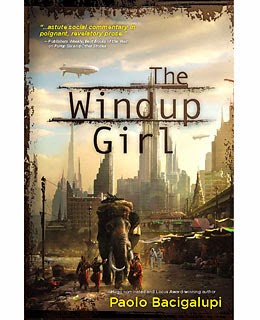
The Windup Girl by Paolo Bacigalupi
Layered, unrelenting unraveling of a nation, of a cadre of characters who live at the margins in a dystopic future based in a reality we see unfolding today.


“If she were to scrub for a thousand years she would not be clean, but she is too tired to care and she has grown accustomed to scars she cannot scour away.”—Paolo Bacigalupi, The Windup Girl 


Organic Forms That Reclaim That Which Is Unwanted 
Ann Weber’s Cardboard Sculptures
Delightful discoveries of textured forms made of discarded cardboard that organically tower, bulge, balance, and hang.


“How far can I build this before it collapses?”—Ann Weber

 
Passion and Full Throated Voice
Alice Smith at Bowery Ballroom
A captivating performer, Alice Smith delivers full-bodied, incandescent, startling performances that are moving and emotionally rousing.


“Where are you going with your life? What kind of chances will you take?”—Alice Smith


Multi-stranded and Maddening, A Torrent of Non-traditional Fleet Imaginings
Toni Cade Bambara’s The Salt Eaters
Like downing a bracing double shot of something homegrown and bathtub-brewed, reading The Salt Eaters was a confusing, destabilizing experience that left me stimulated by Toni Cade Bambara’s bravura to write an entire novel with her own narrative structure, heedless of the reader’s needs.


“Are you sure, sweetheart, that you want to be well?… Just so’s you’re sure, sweetheart, and ready to be healed, cause wholeness is no trifling matter. A lot of weight when you’re well.”—Toni Cade Bambara, The Salt Eaters


Melancholy, Passion, and Meaning
Christian Scott at Weeksville
A young jazz artist who plays in the tradition while bringing the heart, fearlessness, and restlessness of the young to audiences through his horn.


“His jazz chops are impeccable, it’s coming up as part of the hip-hop generation that adds bite to his playing.”—The Village Voice’s Phillip Miynar on Christian Scott


Dead-ends, Senseless Death and Alienation
Fruitvale Station
This Sundance Grand Jury prizewinner is film I had not planned to see, did not think I could stomach, yet it became the tonic and the witnessing I needed after the verdict was rendered in the case against Trayvon Martin’s murderer. The bodies of dead black Americans continue to pile up with little or no justice, retribution, or consequence. It was and is absolutely necessary to witness to the people/spirits who live(d) in those bodies, the lives we snuff out with our laws, prejudices, and phobias.


“At the end of the day, when I first made this project, it was about humanity, and how we treat the people who we love the most, and the people who we don’t know.”—Ryan Coogler, director of Fruitvale 


Tar Baby Doll, Reconstructed Sculptures, a Torrent of Words
Tar Baby Jane: A Documentary About Vanessa German 
Refusing to let class, color, weight, insecurity, mental health challenges stifle the electric pulse of creativity that flies through her soul.


“What if these figures were not worthless?.. What if we lived a different way? What if we believed different things about each other?”—Vanessa German


Graphic, Gorgeous, and Deliciously Weird
Saga by Brian K. Vaughan, illustrated by Fiona Staples
The bounty hunter with a woman’s head and torso and spider legs, the murderous bounty hunter nursing a broken heart and on a mission to save a child sex slave, the planet that is an egg, the tree ship, the ghost nanny, a wildly imaginative ride with stunning illustrations and some new bizarre creation to ponder at every turn. This is not something to read, it’s something to inhale.


“What kind of assholes bring a kid into worlds like these?”—Brian K. Vaughn, from Saga, Volume 1


Raucous, Irreverent, and Random
 Seasons 1 and 2 of Misfits on Hulu
Out-of-control teens who suddenly have superpowers yet no privileges and no freedom in a dark world.


A Moment of Sweetness
Matthew Schuler’s rendition of “Hallelujah” on The Voice


 Kiini Ibura Salaam is a writer and painter from New Orleans, LA. Her work is rooted in eroticism, speculative events and worlds, and women's perspectives. Her fiction has been published in a number of anthologies, including Dark Matter, Mojo: Conjure Stories, and Dark Eros. Her essays have been published in Essence, Ms., and Colonize This. She is the author of the KIS.list, an e-column that explores the writing life. Her first collection of short stories, Ancient, Ancient, was published by Aqueduct Press in May 2012 and was a co-winner of the James Tiptree Jr. Award. She lives in Brooklyn.

The Pleasures of Reading, Viewing, and Listening in 2013, pt.5: Tansy Rayner Roberts

Reading, Watching & Listening in 2013
 by Tansy Rayner Roberts

I’ve had an odd sort of year, reading classics rather than science fiction or fantasy, catching up with and re-reading older works, and entirely failing to “keep up with the field.”  It’s been rather liberating in some ways, though I do feel somewhat guilty at not doing my usual job of finding the great SF and fantasy by women to recommend to listeners of the Galactic Suburbia podcast.

Next year, perhaps! I do feel somewhat accomplished for having read the entirety of A Song of Ice and Fire back in March-April, though, a marathon effort that I greatly enjoyed. Like the TV show, even where the books are problematic, it’s usually in such interesting ways that I can’t turn away.

One science fiction novel that did manage to worm its way past my defences was Ancillary Justice by Ann Leckie, an excellent story with a terrific pace to it - and considering that every other chapter is a flashback, that’s really saying something! I liked the emphasis on linguistic and gender perception differences between cultures, and how complicated they were even for an AI to parse them, especially one with fewer resources than she used to have. Very clever and promising - and I’ve been delighted to hear so very much buzz about this book over the year.

I also very much enjoyed Diana Peterfreund’s YA science fictional retelling of Jane Austen’s Persuasion, For Darkness Shows the Stars, which veered a lot further from the original than I expected but also contained a great deal of interesting SF worldbuilding in order to make the story work. I am looking forward to her gender-swapped Scarlet Pimpernel novel, Across the Windswept Sea, which is set in the same imagined future.

A new favourite novel which may have to be reread in many years to come is Elizabeth Gaskell’s Cranford. I’ve been meaning to attempt Gaskell’s novels for some time and was really delighted with this slender oddball volume about domesticity and the lives of gentlewomen from a previous generation to the author. I often feel that historical fiction and science fiction are a lot closer than anyone likes to admit, and there was something oddly SFnal about this work set in a village where almost all the men are simply absent, due to death, scandal or business elsewhere, and all is ruled by the women with their rituals of calling upon each other, their concern with ‘elegant economy’ and their complex communication methods when it comes to scandal, appropriate behaviour and even charity and kindness. If Cranford is science fiction, then it’s a gently feminist work of science fiction.

Also, there’s a cat who eats French lace.

In comics, I have read some marvellous “graphic novel” collections this year, including the first two volumes of the edgy and weird space opera Saga, which so deserved this year’s Hugo, and the second volumes each of the continuing Captain Marvel and Hawkeye series which are the best superhero comics right now. I also very much liked the first two volumes of Brian Michael Bendis’ All New X-Men with its crazy ‘original X-Men travel forward to meet their future selves’ premise, and the first few issues of the new Red Sonja title by Gail Simone.

Slightly related to my love of superhero comics is the clever and adorable collection of superhero poetry, Flying Higher, edited by Michael Damian Thomas and Shira Lipkin. Also, my favourite airplane novel this year was The She-Hulk Diaries by Marta Acosta - a super heroine reinterpreted as the centre of a chick lit novel, pretty much exactly what it says on the tin.

The Doctor Who 50th anniversary has loomed large in my head and my reading this year, not least because of my year-long blogging project to commemorate the history of the show. The books that have had the most lasting effect on me were Elisabeth Sladen’s Autobiography, which made for a great social history about theatre life as television production in the 60’s and 70’s, and Richard Marson’s biography of 1980’s producer John Nathan Turner which is far more sensitive and nuanced than you might expect of a book titled The Life and Scandalous Times of JN-T.

My favourite Doctor Who book of the year, though, was The Wife in Space by Neil Perryman, chronicling one fan’s lifelong relationship with Doctor Who as a counterpart to his relationship with his non-fan wife Sue, culminating in the epic experiment in which they watched every episode of the show in order (including the reconstructions and telesnaps/audio tracks of missing 60’s stories). I followed their blogging project from the beginning and adored Sue’s pragmatic, snarky and hilarious take on the show - especially her habit of not only dismissing sacred cows of Doctor Who fandom, but also of bringing a new perspective and appreciation to stories that are often underrated.

The book is just as funny as the blog, and provides context via a family history, and a discussion of the effect of the massively popular blogging experiment on their lives. The Wife in Space is a surprisingly intimate story of how love for a TV show can intersect with marriage and parenthood, for better and worse.

I’ve been listening to more audio plays and books than ever before, often at the expense of reading time. The BBC Radio 4 adaptation of Neil Gaiman’s Neverwhere was absolutely wonderful, conveying the clever ideas of the original story far better than either of its previous iterations as a TV show or a rather slight novel. The cast is spectacular, with James McAvoy, Natalie Dormer, Bernard Cribbins, Benedict Cumberbatch, Anthony Stewart Head… and Christopher Lee. Among others. Highly recommended.


I also enjoyed the audio adaptation of Oscar Wilde’s The Picture of Dorian Gray, from Big Finish, starring Alexander Vlahos. I’ve been following their Dorian Gray series for the last couple of years (based on the premise that he survived through the 20th Century, haunted by various ghosts from the past and occasionally fighting sinister monsters) so it was rather nice to add this dimension by hearing an interpretation of the original that includes “our” Dorian. Miles Richardson is also in this, playing an elegant and morally dubious character, which added some lovely dimension to the piece.

Speaking of Miles Richardson, I also wanted to draw attention to the Gallifrey audio series from Big Finish, which has had six seasons (of 3-4 plays each) produced over the last decade. Based somewhere between all the references to Gallifrey in the Classic era of Doctor Who, but before the Time War and New Who, this was intended to be a straight political drama based around the Time Lords. It also encompasses mystery and science fiction, but at it’s heart it is The West Wing/Yes Prime Minister in space.

The main cast consists of two former Doctor Who companions: Lalla Ward as the long-suffering and idealistic Lady President Romana, and Louise Jamieson as her bodyguard Leela, a former “savage” who had to adapt to the “civilised” ways of the Capitol when she married a Gallifreyan. Supporting these two amazing women (and how often do you see a science fiction series of any kind with two 50+ actresses playing the protagonists) are Miles Richardson as Braxiatel, Sean Carlsen as Narvin, and of course John Leeson as two different versions of K9.

From politics and diplomacy on Gallifrey to time viruses, the dangers of other dimensions and finally a battle between Time Lords and Daleks which shows the shape of the Time War to come, this is really good, solid radio science fiction, and the final series which was released only a couple of months ago brings it home powerfully. Along with many appearances by Mary Tamm as the first Romana (or a version thereof) and Lynda Bellingham as the Inquisitor, they made the bold choice to cast a Romana III in this final series and Juliet Landau puts in a fabulous performance as Lalla Ward’s future self. Absolutely worth tracking down, especially now that the series is complete. Early seasons are only available as CD rather than direct download, but they are priced very low.

Finally, I wanted to give a shout out for some Latin poetry. Yes, really! Clare Pollard has done a fantastic, very modern translation of Ovid’s Heroides (published as Ovid’s Heroines), a book which feels quite feminist in conception. The original poems are all framed as letters from a tragic woman of Greek myth addressing a man in her life (mostly husbands or lovers, some fathers, sons and objects of unrequited passion). By collecting these together and giving a voice to characters often rendered almost invisible, Ovid certainly demonstrates the appalling way in which women are indeed used as objects or made to suffer in the storytelling traditions which were so important in his day and continue to resonate now, thousands of years later. The downside, of course, is that it is also a book very much about woman-as-victim, which can be wearing if taken all at once. Pollard does a great job of capturing Ovid’s snark and humour, something many translators have struggled with over the centuries. She makes the poems and their protagonists feel terribly relevant, but the best part about the book is that she is really only using modern language to reveal what was already there.


Tansy Rayner Roberts is a co-host of Galactic Suburbia, and the author of the Creature Court trilogy. In 2013, she joined an all female Doctor Who podcast, Verity!, finished a 50 week blogging project about Doctor Who, and won the Hugo for Best Fan Writer. Her most recent release is Ink Black Magic, a comic fantasy novel about superheroes, pirates, and the ethics of magic. Check out Tansy's blog, or follow her on Twitter at @tansyrr

Wednesday, December 11, 2013

The Pleasures of Reading, Viewing, and Listening in 2013, pt.4: Sarah Tolmie

Enjoyed in 2013
by Sarah Tolmie

What did I read this year? Not nearly enough, looking back on it. This may well be true for many of you, but I tend to go through fairly distinct input and output phases. I was definitely in output mode. Moreover, I was conducting the final editing phase of The Stone Boatmen with Kath Wilham, which seemed to involve reading the whole novel about 97 times. I am sure she feels the same -- but it will be out in April! (PR moment there, apologies.) The upside to this was that other people's prose really came as a relief...

Starting with Sofia Samatar's A Stranger in Olondria, which I bought at WisCon. As she was there, I have a signed copy. I notice I am in the company of the reviewers at The Guardian in thinking this is a wonderful book. The texture of the prose is lush but never gooey; it is learned without being overbearing, original and intensely atmospheric. It conveys with great poignancy the position of an island community off the coast of a great empire, mapping on in various ways to the historical experience of Sri Lanka to India, or Taiwan to China, or any of several island cultures off the coast of Africa. It is not constrained by any of these, however, being a very fully imagined world of its own, and like many of my favorite speculative fictions, one overwhelmingly concerned with the act of writing and its implications. In this it reminds me of several later works by Le Guin like The Telling or the Voices/Powers/Gifts trilogy, or Lavinia. All of these books share a vision of the sheer heroism of poetry (in the capacious sense that Sidney meant it in his Defense of Poetry, meaning "works of imagination") that is not the least bit Hemingway.

On the Le Guin theme, I also bought her translation of Angela Gorodischer's Kalpa Imperial while at WisCon, and enjoyed it a lot. It was a pleasure to discover a whole new magic realist that I knew nothing about, and to get another sample of Le Guin's supremely unfussed style as a translator.

And while it was definitely not a relief, I did, in the end, enjoy Don Paterson's God's Gift to Women, proof that aggressively male modernist poetry is not dead. (This collection is ten years old, by the way. I am rarely up to date in poetry.) This was a project that involved much more cursing, eye-rolling and considerably more drinking, but it was rewarding. The guy has won every award there is, including the TS Eliot prize, and he really does have the chops. Not to mention that he gets to drop all kinds of funky Scots dialect words and you can't fault him for it, as he teaches at St Andrews, and hey, the drunk man has to keep looking at the thistle, right? Otherwise it will disappear.

Also really enjoyed Lesley Wheeler's The Receptionist and Other Tales, another WisCon find, which was hilarious. I read too many poets who are desperately unfunny, and it really gets old.

Movies, forget it. I think I watched Pacific Rim, and marveled again at how long the Crispin Crispianus speech from Henry V has lasted. Other than that, what was there? Remakes, comics, mumblecore. No, no and no. People are surely making intelligent movies somewhere, but I have not made the effort to seek them out. My loss, I am sure, but there you are. I continued to watch Dr Who, and now both my children are well into it (7 and 9). Both have asked for sonic screwdrivers for Christmas. Sherlock went on enjoyably, despite the sudden superstardom of Benedict Cumberbatch (bet he's the only one in the union, huh?). Elementary really grew on me, as I like both of the leads, each extraordinarily sexy in their way. And the British series Misfits was absolutely a scream, just beautiful: world's most gormless adolescent superheroes. I kept on with True Blood, more out of loyalty than anything. Maybe 2014 will be more of an outgoing year. But, all of the above I truly enjoyed, and you can't say fairer than that.


 Sarah Tolmie is an Associate Professor in the English department at the University of Waterloo, where she teaches medieval and renaissance literature, general British literature, and creative writing. She publishes on the bizarre late medieval visionary poem Piers Plowman and its relations to logic and language and has been developing a virtual reality translation of the text — what she calls a “wearable poem” that the reader walks into via a head-mounted display — called the Salvation Suit, since 2009. This technological experiment has led to several other research-creation projects, among them building an augmented reality angel out of a human dancer and a pair of dynamically-responsive virtual wings, and making a whispering gallery of voices saying “goodbye” with a Kinect, an interactive theatre piece about mourning.  Aqueduct Press will be releasing her debut novel, The Stone Boatmen, in April 2014.

The Pleasures of Reading, Viewing, and Listening in 2013, pt. 3: Ursula K. Le Guin

Wu Ming-Yi, a name to remember 
by Ursula K. Le Guin 

Harvill Secker in England has published, and Random House in NY will publish in May, a novel called The Man with the Compound Eyes -- a klunk of a title, unlikely to attract even sf readers.

The author, Wu Ming-Yi, is well known in his native Taiwan, but this is his first appearance in English. So the book’s starting out here with a lot of strikes against it, not least its defiance of genre, mixing near-future sf, anthropological fantasy, real tribalism, romance, adventure, realism, to arrive at a visionary apocalypse via tidal waves of garbage -- oh, the damn thing is indescribable! It’s informed, accurate, fiercely imaginative, and deeply adult in its understanding of how humans connect and misconnect with one another and other beings on our vulnerable Earth. It’s uneven, but some of the trouble may be in the translation, or in our unfamiliarity with the Taiwanese mindset – exhilaratingly different, on this evidence, from Mainland Chinese.


The book is beautiful, and daring, and though utterly unsentimental, full of human tenderness. I think a lot of people who read this blog will will find it to their liking. If you order it (not through amazondotcom, please?) from England, you will get a fine dust-jacket with whales, turtles, mountains, and a cat riding the styrofam tsunami.


Ursula K. Le Guin has written many, many books and won many, many awards. At 82, she makes awesomeness look wonderfully easy. Aqueduct Press published her collection of essays, Cheek by Jowl, in 2009 and 80! Memories and Reflections on Ursula K. Le Guin, a collection honoring her 80th birthday, edited by Karen Joy Fowler and Debbie Notkin. Last spring Aqueduct published Gheorghe Sasarman's Squaring the Circle: A Pseudotreatise of Urbogony, which she translated. She blogs at Book View Cafe.

Tuesday, December 10, 2013

The Pleasures of Reading, Viewing, and Listening in 2013, pt.2: Rachel Swirsky

The Beauty and Pleasures of YA 
by Rachel Swirsky

A few years ago, I started reading young adult fiction.

                I’d read some before, sure. But I started reading it seriously. And then ravenously.

                At first, I read because I wanted to write a young adult novel. I still do. However, I’ve also fallen in love.

                There’s a lot of argument about what can and can’t be done in young adult novels, and I’m pretty convinced with the people who say “you can do anything.” For every example you can think of, there are exceptions. For instance, people will argue that you can’t have young adult novels without a young adult protagonist, but that hasn’t stopped people from writing from the perspectives of, e.g., centuries-old inanimate objects. 

                I’m sure there’s an exception to this rule, too, but my friend Katie Sparrow once told me that young adult novels can do anything but ennui.

                That’s something I love about young adult novels, the energy of freshness and discovery. Reading YA, adopting the mindset of a young person who hasn’t been there and done that, I can enjoy the illusion of new encounters. Lone teen protagonists whining a lot as they search for meaning in a world they don’t understand? Okay! Epic plotlines so worn they have grooves? Yup! Ridiculous, angsty angel-winged warriors? You got it. They have feathers!  

                Of course, I still like my ennui. I’m a both/and kind of girl.

                For me, loving young adult novels is partially about loving teenagers. I don’t mean that I love all teenagers (oy) or that I loved being one (at least not all the time). But there are beautiful things about that developmental stage, and I think that young adult novels allow us to explore those. 

                Right now, I’m just absolutely in love with the process of adolescent awakening as children move from trying to become familiar with the wondrous basics of their immediate surroundings and senses, and are starting to come to terms with the deeper mysteries of their minds, and the even more strange discoveries of the complexity of the world.

                Young adult novels can form an interesting exploration of politics, for instance. Even something like THE HUNGER GAMES—which some have dismissed as pulp or fluff—really, at its heart, is chronicling the main character’s development of a social consciousness. In Shipbreaker and Drowning Cities, Paolo Bacigalupi broadens young people’s political awareness by showing them other young people. His protagonists are presented in science fictional scenarios, but their circumstances exist, horrifyingly, in the real world, and his books provide young people with a framework for learning about those realities.

                I love the rich engagement between young adults and their literature. I want to participate in that conversation, both as a reader who’s absorbing it, and as a writer who hopes to contribute new energy in the future.

A few truly wonderful young adult novels to consider:

One for Sorrow by Chris Barzak
The Summer Prince by Alaya Dawn Johnson
Please Ignore Vera Dietz by A. S. King
Liar by Justine Larbalestier

 
Rachel Swirsky is an award-winning literary, speculative fiction and fantasy writer, poet, and editor living in California. She was the founding editor of the PodCastle podcast and served as editor from 2008 to 2010. Her novella "The Lady Who Plucked Red Flowers Beneath the Queen’s Window" won the 2010 Nebula Award and was also a nominee in the Best Novella category for a 2011 Hugo Award and in the Novella category of the 2011 World Fantasy Award. Aqueduct published her short fiction and poetry collection, Through the Drowsy Dark, in 2010. Her new collection, How the World Became Quiet, has just been released by Subterranean Press. 


2011 Carl Brandon Society Awards Announced


The Carl Brandon Society has announced the winners of their awards for 2011: Tenea D. Johnson, for the Carl Brandon Parallax Award for her novel Smoketown, and Aqueduct's own Andrea Hairston, for the Carl Brandon Kindred Award for her novel Redwood and Wildfire. Congratulations to both of them!


The CBS has also announced an Honor list for 2011:

  • Zen Cho for "The House of Aunts"
  • Zen Cho for "èµ·ç‹®,行礼 (Rising Lion – The Lion Bows)"
  • Minister Faust for The Alchemists of Kush
  • Tenea D. Johnson for R/evolution
  • Yoon Ha Lee for "Ghostweight"
  • An Owomoyela “All That Touches the Air"
  • Nisi Shawl for "Black Betty"
  • JoSelle Vanderhooft for Steam-Powered: Lesbian Steampunk Stories
The 2011 Carl Brandon Awards will be presented at Arisia, January 17-20, 2014 in Boston, MA, USA. The members of the 2011 jury are Liz Henry, Zola Mumford, K. Joyce Tsai, and Maria Velazquez.

The Pleasures of Reading, Viewing, and Listening in 2013, pt. 1: Eleanor Arnason

Pleasures of 2013
by Eleanor Arnason

In recent years I’ve had trouble reading fiction. This is apparently something that can happen to writers as they age. Michael Swanwick has written a brief essay on the topic in his blog Flogging Babel. (http://floggingbabel.blogspot.com/2013/11/the-evolution-of-writers-reading.html) It’s worth reading and thinking about. Swanwick argues that a writer who stops reading will diminish his own work. I suspect this is true, and that I need to start reading more.

While I struggle with this problem, I have been watching movies and TV shows on DVD. My current passion is screen versions of the novels of Jane Austen. My partner has been reading Austen novels for the first time. I have been reading them for the umpteenth time. We have both been watching the TV series and movies. Right now I would say our favorites are the 1995 TV series version of Pride and Prejudice with Colin Firth and Jennifer Ehle, the 1995 movie of Persuasion with Amanda Root, the 1995 movie of Sense and Sensibility with Emma Thompson and Alan Rickman as an insanely romantic Colonel Brandon, and the 1996 TV movie of Emma with Kate Beckinsale. All have their problems. It isn’t easy to make a movie of an Austen novel. She is both dense and inward. Much of what happens is inside people, told either through the narrator’s description of their thoughts or through information directly given by the narrator. The scripts all try to make Austen more dramatic and romantic, less inward and restrained than her fiction actually is.

Sir Walter Scott wrote in his journal: “Also read again, and for the third time at least, Miss Austen’s very finely written novel of Pride and Prejudice. That young lady had a talent for describing the involvements and feelings and characters of ordinary life, which is to me the most wonderful I ever met with. The Big Bow-wow strain I can do myself like any now going; but the exquisite touch, which renders ordinary commonplace things and characters interesting, from the truth of the description and the sentiment, is denied to me. What a pity such a gifted creature died so early!”

I don’t know of Austen invented the bourgeois novel of character and psychology, but she certainly was an early practitioner of this art form. It doesn’t translate easily into drama. She is a fierce portrayer of greed and selfishness, well-known bourgeois traits; and she is funny as all heck.

In addition to Austen, I am continuing my fascination with Marvel superhero action movies. The one I’ve seen this year – Thor: The Dark World -- is not as good as the earlier origin movies: Iron Man, Thor and Captain America. There is far too much violence and noise. I felt shell-shocked coming out of the theater. I had the same response to The Avengers, which I also did not like.

At some point I am going to have to figure out the appeal of these flicks. A facebook friend of mine says they are the modern version of Great Depression musicals, distractions in a bleak, gray time.

In some ways they are the opposite of Austen: outward rather than inward, simple rather than Thor: The Dark World destroys large parts of Asgard and London, with small thought to the people killed. The most interesting characters in the Marvel movies are the inventor and capitalist Tony Stark, who clearly suffers from Antisocial Personality Disorder -- previously known as sociopathy, and Loki, who cannot be diagnosed with Antisocial Personality Disorder only because he is a god, and the diagnoses in the DSM do not apply to gods.
complex. Everything is solved by violence, and the violence usually has little in the way of consequences.

Nonetheless, I enjoy the movies. They are big, bright, fast-moving and often funny, though not in an Austen way. Robert Downey Jr. and Tom Hiddleston are both wonderful as people you really do not want to meet.

I wonder if it’s possible to argue that Austen begins the great era of bourgeois culture in the 19th and early 20th centuries and Marvel action flicks come at the end. We move from a fiction of personality and morality to Slam! Bang! Smash! Pow! The fine moral decisions that Austen describes turn into cartoonish epic battles and Might Makes Right.

This is not entirely accurate. As Spiderman (another Marvel superhero) tells us, “With great power comes great irresponsibility.”

Maybe it's better to argue that Marvel superheroes, coming after the rise and fall of classic 19th-century imperialism and the two great, terrible world wars of the 20th century, cannot focus on the nuances of everyday life. Something bigger and bolder is needed to deal with the late 20th and 21st centuries.


Eleanor Arnason has written several novels and many short stories. Her fourth novel, A Woman of the Iron People (2001), won the James Tiptree Jr. award for gender-bending science fiction and the Mythopoeic Society Award for adult fantasy. Her fifth novel, Ring of Swords (1995), won a Minnesota Book Award. Aqueduct Press published her collection Big Mama Stories this year, her Lydia Duluth adventure, Tomb of the Fathers, in 2010, and her collection, Ordinary People, in 2005.

Monday, December 9, 2013

Just how many people hanging out in Second Life are intelligence operatives, anyway?

Revelations about some of the NSA's mind-numbingly massive surveillance operations have been trickling out for months now. We've learned of cell phone tracking and collection of cellphone metadata, tracking of internet usage, of back doors inserted into programs holding confidential details, thus putting both commercial and private users at risk, not to mention the agency's avowal that its mission is to collect "everything" about everybody. Today's revelation, though, is a real head-scratcher, though I suppose it falls under the collect everything about everybody rubric: the NSA and other intelligence agencies has been spending who knows how much on infiltrating Xbox games and Second Life. Here's a bit of The Guardian's introduction to the revelation:
To the National Security Agency analyst writing a briefing to his superiors, the situation was clear: their current surveillance efforts were lacking something. The agency's impressive arsenal of cable taps and sophisticated hacking attacks was not enough. What it really needed was a horde of undercover Orcs.

That vision of spycraft sparked a concerted drive by the NSA and its UK sister agency GCHQ to infiltrate the massive communities playing online games, according to secret documents disclosed by whistleblower Edward Snowden.

The files were obtained by the Guardian and are being published on Monday in partnership with the New York Times and ProPublica.

The agencies, the documents show, have built mass-collection capabilities against the Xbox Live console network, which has more than 48 million players. Real-life agents have been deployed into virtual realms, from those Orc hordes in World of Warcraft to the human avatars of Second Life. There were attempts, too, to recruit potential informants from the games' tech-friendly users.

Online gaming is big business, attracting tens of millions of users worldwide who inhabit their digital worlds as make-believe characters, living and competing with the avatars of other players. What the intelligence agencies feared, however, was that among these clans of elves and goblins, terrorists were lurking.

The NSA document, written in 2008 and titled Exploiting Terrorist Use of Games & Virtual Environments, stressed the risk of leaving games communities under-monitored, describing them as a "target-rich communications network" where intelligence targets could "hide in plain sight".
The New York Times dryly noted:
The documents do not cite any counterterrorism successes from the effort, and former American intelligence officials, current and former gaming company employees and outside experts said in interviews that they knew of little evidence that terrorist groups viewed the games as havens to communicate and plot operations.

Games “are built and operated by companies looking to make money, so the players’ identity and activity is tracked,” said Peter W. Singer of the Brookings Institution, an author of “Cybersecurity and Cyberwar: What Everyone Needs to Know.” “For terror groups looking to keep their communications secret, there are far more effective and easier ways to do so than putting on a troll avatar.”

The surveillance, which also included Microsoft’s Xbox Live, could raise privacy concerns. It is not clear exactly how the agencies got access to gamers’ data or communications, how many players may have been monitored or whether Americans’ communications or activities were captured.

One American company, the maker of World of Warcraft, said that neither the N.S.A. nor its British counterpart, the Government Communications Headquarters, had gotten permission to gather intelligence in its game. Many players are Americans, who can be targeted for surveillance only with approval from the nation’s secret intelligence court. The spy agencies, though, face far fewer restrictions on collecting certain data or communications overseas.
The whole thing sounds like a scheme generated by employees who brainstormed a way to get paid for spending all the working hours playing games, don't you think? I mean, consider this passage in the  Guardian article:
One problem the paper's unnamed author and others in the agency faced in making their case – and avoiding suspicion that their goal was merely to play computer games at work without getting fired – was the difficulty of proving terrorists were even thinking about using games to communicate.

A 2007 invitation to a secret internal briefing noted "terrorists use online games – but perhaps not for their amusement. They are suspected of using them to communicate secretly and to transfer funds." But the agencies had no evidence to support their suspicions.

The same still seemed to hold true a year later, albeit with a measure of progress: games data that had been found in connection with internet protocol addresses, email addresses and similar information linked to terrorist groups.

"Al-Qaida terrorist target selectors and … have been found associated with Xbox Live, Second Life, World of Warcraft, and other GVEs [games and virtual environments]," the document notes. "Other targets include Chinese hackers, an Iranian nuclear scientist, Hizballah, and Hamas members."
However, that information was not enough to show terrorists are hiding out as pixels to discuss their next plot. Such data could merely mean someone else in an internet cafe was gaming, or a shared computer had previously been used to play games.
 Despite the lack of evidence that terrorists were using gaming for nefarious ends, it turns out that so many intelligence agencies were involved in infiltrating virtual environments that they actually had to hold meetings to reveal to one another which avatars belonged to infiltrators:
Meanwhile, the FBI, CIA, and the Defense Humint Service were all running human intelligence operations – undercover agents – within Second Life. In fact, so crowded were the virtual worlds with staff from the different agencies, that there was a need to try to "deconflict" their efforts – or, in other words, to make sure each agency wasn't just duplicating what the others were doing.
Eventually the NSA started worrying about the content of the games they were monitoring. (Isn't that always the way?)  Here's The Guardian: "Much like the pressure groups that worry about the effect of computer games on the minds of children, the NSA expressed concerns that games could be used to "reinforce prejudices and cultural stereotypes", noting that Hezbollah had produced a game called Special Forces 2." Turns out that the US Army has done the same thing. What's next, do you think? An NSA-generated game in which an NSA agent saves the world because the NSA has vacuumed up everything about everybody? Anyway, I figure this particular revelation can only help recruitment efforts at the NSA's Gaming Monitoring Division. Aren't unlimited "black" budgets a wonderful thing? Why bother with funding the things that make a population strong and thriving (good education for all, decent housing for all, medical care for all, healthful food for all) when you have so much money to blow that you can even afford to allocate some of it to looking for terrorists spending their off-hours playing games? How I love living in the future!

The Plesaures of Reading, Viewing, and Listening in 2013

Our annual series of posts on reading, viewing, and listening in 2013 is about to begin! Once again I've solicited piece from a bevy of writers and critics to tell us what they particularly enjoyed reading, viewing, and listening to in the last year, and once again I'm finding the responses as fascinating as they are idiosyncratic. I'm sure I'm not the only one who's picked up suggestions for future reading, listening, and viewing from our past editions of the series. This year's edition will include posts by Eleanor Arnason, Lisa Tuttle, Ursula K. Le Guin, Mark Rich, Carrie Devall, Kiini Ibura Salaam, Tansy Rayner Roberts, Rachel Swirsky, and many others. This time around I'm going to add links to this post (i.e., below) as I upload each new contribution, to provide a list for convenient reference.

Part 1:  Eleanor Arnason
Part 2:  Rachel Swirsky
Part 3:  Ursula K. Le Guin
Part 4:  Sarah Tolmie
Part 5:  Tansy Rayner Roberts
Part 6:  Kiini Ibura Salaam
Part 7:  Nisi Shawl
Part 8:  Cheryl Morgan
Part 9:  Alisa Alering
Part 10: Nancy Jane Moore
Part 11: Lisa Tuttle
Part 12: Andrea Hairston
Part 13: Fiona Lehn
Part 14: Richard Bowes
Part 15: Carrie Devall
Part 16: Vandana Singh
Part 17: Mark Rich
Part 18: Lesley Hall
Part 19: Brit Mandelo 
Part 20: Larissa Lai
Part 21: Kristin King
Part 21: Sheree Renée Thomas


Sunday, December 8, 2013

Nicola Griffith to read at the Seattle Public Library

For those is the Seattle area:

Nicola Griffith will be reading Tuesday evening at the central branch of the Seattle Public Library. She will read from her new novel, Hild, and do a Q&A after, followed by a signing. The University Bookstore will be on hand to sell copies of the novel. More information can be found here.

I've had the pleasure of hearing Nicola read several times, so I can assure you that the occasion will be a treat.

Thursday, December 5, 2013

Nelson Mandela, 1918-2013

One of the towering moral and political figures of our time, Nelson Mandela, died today. For a big chunk of my adult life, he held an iconic status as a bold, thoughtful political activist defying an extraordinarily intransigent authoritarian regime that enjoyed the full and total backing of the US Government--while confined to South Africa's notorious Robben Island prison in an 8x7 damp concrete cell at night after breaking rocks all day in the harsh sunlight. His story is long and rich, but here are a few of the highlights: Mandela became politicized in the 1940s, and joined the African National Congress. In 1953, he and Oliver Tambo opened the only black-run law firm in South Africa, which soon ran afoul of the authorities. In 1961, following the Sharpeville Massacre and other defeats of mass nonviolent protest, Mandela, Walter Sisulu, and Joe Slovo founded Umkhonto we Sizwe (Spear of the Nation), with the aim of organizing attacks on South African infrastructure. At his trial in 1964, he argued the necessity of taking such a step:
[W]e felt that without sabotage there would be no way open to the African people to succeed in their struggle against the principle of white supremacy. All lawful modes of expressing opposition to this principle had been closed by legislation, and we were placed in a position in which we had either to accept a permanent state of inferiority, or to defy the Government. We chose to defy the Government. We first broke the law in a way which avoided any recourse to violence; when this form was legislated against, and when the Government resorted to a show of force to crush opposition to its policies, only then did we decide to answer violence with violence.
But the violence which we chose to adopt was not terrorism. We who formed Umkhonto were all members of the African National Congress, and had behind us the ANC tradition of nonviolence and negotiation as a means of solving political disputes. We believed that South Africa belonged to all the people who lived in it, and not to one group, be it black or white. We did not want an inter-racial war, and tried to avoid it to the last minute.
Throughout the 1970s and 1980s, as international opposition to apartheid grew and multinational corporations (banks, especially) began to find the pressure from shareholders as well as consumers increasingly difficult to stave off, Mandela became such a focus of international concern that the South African apartheid regime that in the mid-1980s President Botha tried bargaining with Mandela for his release. Heroically Mandela replied: "What freedom am I being offered while the organisation of the people remains banned? Only free men can negotiate. A prisoner cannot enter into contracts." Mandela passed his 70th birthday in prison. In 1990, the South African government released not only Mandela but all other imprisoned ANC members--and legalized all the political parties they had previously banned.

There's much, much more, of course. But these are the parts I remember best.

Monday, December 2, 2013

Suddenly, it's winter in Seattle

Winter is rolling in. We may not have reached the solstice yet, but it's a fact: here in Seattle the days are now short, the sun (when it appears)  low in the sky, and the leaves all fallen from the deciduous trees. When I went away for the long holiday weekend on Thursday morning, it still felt like fall, for the temperature was in the 50s and enough leaves remained on the grand old cherry tree in my backyard to turn the light shining through it golden. When I arrived home yesterday, the leaves had all vanished, and the temperature was dropping. Will the thyme and marjoram in the garden survive the winter? Who can say? Some winters they do, others they don't. (The marjoram usually doesn't.) Big portions of my yard have gone dormant. Some herbs and greens continue to thrive, but everything else is sleeping or dead. Which is, of course, as it should be.

I'm always aware that many people find winters in Seattle difficult to survive. The scantiness of the light, alone, can bring great suffering. But though I'm of a horribly moody temperament, I don't suffer from seasonal affective disorder. And so I can take great pleasure in Seattle's winter face. I've developed an affection for the strangeness of the light filtered always through the atmosphere (because, of course, of the sun's lowness in the sky). And I've learned to know to look for the birds, especially waterfowl, that visit here in the winter. (In a few weeks I can expect to find swans, for instance, swimming in Lake Washington, and snow geese on the Skagit Flats.) And of course the beaches are always beautiful, even when they're socked in with fog. (And of course for those who ski or snowshoe, day trips into the mountains can be spectacular.)

Wednesday, November 27, 2013

SPECULATIVE LITERATURE FOUNDATION ANNOUNCES GULLIVER TRAVEL GRANT WINNER

For Immediate Release: Nov 26, 2013

The Speculative Literature Foundation is delighted to announce that Daniel Jose Older is the winner of the 2013 Gulliver Travel Grant.

Older's novel, "The Book of Lost Saints," weaves post-revolutionary Cuba with present-day New Jersey, tied together by unsettled ghosts drawn to the music of a culture that has evolved without them. Older will use the $800 grant to travel to Cuba to research prisons that Cuban political prisoners were held in.

The Travel Grant judges said of Older's entry, "Wonderful narrative voice: playful, engaging, quick, and written with a seriousness, humor, and a storytelling acuity not often seen."

Also shortlisted were: Akwaeke Emezi, Russell Nichols, Eden Robins, Oksana Marifioti, and Alina Rios, for their outstanding submissions, which made the selection of the eventual winner a difficult but enjoyable process.
 
SPECULATIVE LITERATURE FOUNDATION
PO Box 1693 
Dubuque, IA 52004-1693


Friday, November 22, 2013

Remember Gywneth Jones's Eve Wars?

Remember my post last month linking to a NY Times article about the problems faced by women and girls doing science? And about how the article discussed the difficulties created by US culture in particular? Browsing the SF Signal's linkpost for today, I came across a piece titled "Saving Science Fiction from Strong Female Characters." (If you want the link, you'll have to go to the SF Signal to find it.) This lengthy rant is a farrago of assertions so confused and irrational that I finally had to give up trying to make sense of. What I did make out, though, is that the post's author, one John C. Wright thinks science fiction is (once again) being threatened, particularly by reviewers who draw a distinction between sex and gender-- on the grounds that it is obscuring the true, essential categories of "masculinity" and "femininity." I gather, also, that he sees the distinction as an attack on culture tout court (not on a culture, but on culture itself).

Here's the nub of his argument:
Anyone reading reviews or discussions of science fiction has no doubt come across the oddity that most discussions of female characters in science fiction center around whether the female character is strong or not.

As far as recollection serves, not a single discussion touches on whether the female character is feminine or not.

These discussions have an ulterior motive. Either by the deliberate intent of the reviewer, or by the deliberate intention of the mentors, trendsetters, gurus, and thought-police to whom the unwitting reviewer has innocently entrusted the formation of his opinions, the reviewer who discusses the strength of female characters is fighting his solitary duel or small sortie in the limited battlefield of science fiction literature in the large and longstanding campaign of the Culture Wars.

He is on the side, by the way, fighting against culture.

Hence, he fights in favor of barbarism, hence against beauty in art and progress in science, and, hence the intersection of these two topics which means against science fiction.
I suspect it's significant that the author's antagonism is directed at reviewers (who are, in his view, apparently only innocent dupes). Whether these reviewers are male or female or both is unknown, since we can safely assume that someone who suggests that innocent reviewers are subject to the corrupting influence of "mentors, trendsetters, gurus, and thought-police" is likely to insist that "he" is a "universal" pronoun. The very idea of a gender-neutral pronoun, of course, would be anathema to someone who believes that drawing a distinction between sex and gender is barbarous. And distinguishing between culture in general and US culture in particular is also probably anathema.  Regarding US culture as merely one of many cultures (and US culture as it currently exists as only one possibility among many) would of course make gender essentialism impossible, since the white heterosexual male of US culture could not then stand for the unmarked universal human such arguments insist he is. 

Why, you may wonder, am I granting any attention at all to such a confused mess of a post written by someone I've never heard of? I suppose it's because I see it as coming from the same place as the more laconic but equally simplistic pronouncements of more powerful speakers who keep insisting that "real girls" and "real women" have only limited capabilities for doing so science and that women/girls who excel at science must therefore not be "real women" or "real girls." What particularly interests me in this case is that it illustrates how visible and more apparent the complications of gender have become in our field than in US culture as a whole. This rant against "strong female characters" is not unusual within the field, of course. (And certainly the attack last summer on NK Jemison was by far more vicious.) But it strikes me as significant that the argument here has shifted from attacking the active presence of women in the field to attacking an acknowledgment of any degree of complexity of gender, making the very idea of gender the enemy of science fiction in particular and culture in general. It is precisely the scenario of Monique Wittig's utopia Les Guérillères.When a translation of that novel was first published in the US, the very idea of separating sex from gender was still new and strange. And so quite a few people reading it didn't understand that the war "the women" were fighting was not against men, but against gender essentialism. (Gwyneth Jones's "Eve Wars" in her Aleutian series offers another version of that war, fought by men and women on both sides of the conflict.)

Have defenders of gender essentialism actually become conscious of the distinction between sex and gender? If so, we might be entering a new phase of the struggle. Changed consciousness about gender isn't necessarily a positive thing. (See the Aleutian series for more on that.) But it is certainly something to think about, especially with reference to certain works of feminist sf.


Tuesday, November 19, 2013

Building Feminist Worlds reading list

The CSWS has posted a list of materials discussed on the Building Feminist Worlds panel I mentioned in my last post. You can find it at http://csws.uoregon.edu/wp-content/docs/events/40th/40th_anniversary_recommended_scifi_list. In addition to fiction, the list includes plays, films, and links to podcasts.

Wednesday, November 13, 2013

A few notes and thoughts on the Worlds Beyond World and Women's Stories, Women's Lives Symposia

I wanted to write at least a little about the conference I attended last weekend in Eugene, celebrating the 40th anniversary of the Center for the Study of Women in Society at the University of Oregon. The conference kicked off with a documentary film, "Agents of Change: A legacy of feminist research, teaching, and activism at the University of Oregon" by Gabriela Martinez and Sonia De La Cruz, which I'm sorry to say I missed because I was helping Kath to unload Aqueduct's books and set up our tables in the vendors' room. But I did attend about half of the sessions of the first symposium and all of the sessions of the second. I took the occasional note on some of them.

The first symposium, titled "Women's Stories, Women's Lives," was held on Thursday. The sessions were nominally organized by decades-- 1970s, 1980s, 1990s, and the 2000s-- but since most of the work presented was historically conceived, in fact ranged over larger spans of times. Shelley Grosjean's presentation "Lesbian Lands in Oregon," for instance, began with the 1960s and went beyond the 1980s in tracing the history of a lesbian separatist community. It is quite a while since I've thought of feminist separatism-- probably since reading Joanna Russ's What Are We Fighting For (which devotes a chapter to it). Listening to the presentation, I realized that probably a lot of younger feminists don't realize that separatist communities often came about in the way this one seems to have done. Apparently, when a couple of women in a mixed-sex, "back to the land" group, Jeanne and Ruth, challenged the group's conservative gender roles, they were booted out--and promptly organized a group of women to form a new community. This community explicitly defined itself as seeking spiritual connection via women's physical bodies in relationship to the landscape, and published Woman Spirit Magazine (1974-1984) as a means of doing "long-distance consciousness raising." (I think she may have said that Mother Kali's bookstore in Eugene was associated with the community. I remember Mother Kali's from visits I made there in the 1980s. Just thinking about it made me long for the days when feminist bookstores were to be found all across the country.) The presentation did not attempt to gloss over the community's feminist shortcomings. The community was white-- lacking in "universal sisterhood in reality," and so "attempted to appropriate other cultures to give them sense of being universal." The presenter said that the women she talked to viewed separatism as "a hospital"-- a place for being healed. But, she says, the community discovered that women severely damaged by patriarchy could never leave separatism because they were never healed. The presenter summed up the community's ideological differences from contemporary feminism as "hugely emancipatory, hugely exclusionary."

Cheris Kramarae, a longtime women's studies scholar, who is probably best known for her statement "Feminism is the radical notion that women are human beings," presented next, on the subject of Global Antiviolence. "Feminism 'dies' continually," she remarked at the beginning of her talk. (So true, so true...) She finished by noting how the issues of sexual harassment, sex trafficking, and domestic violence remain important issues. "There is still no economic aid for battered women-- only individualized solutions for social problems." Most of the money appropriated for dealing with domestic violence, she says, goes to anger management programs for men rather than foucsing on the complexity of the social problem. "There is no ancient history as in 'gone'," she concluded. "The issues of the 1960s are still with us."

The third presenter in the session was Eugene's mayor, Kitty Piercy, speaking on reproductive rights activism. I couldn't help be struck by her story of being recruited at a NARAL booth in the 1980s. (I was recruited at a NARAL house party in 1981.) She referred, amusingly, to "speculum parties" where women had the opportunity to see their own cervices. As I recall, at least some of these parties had a lot to do with Our Bodies, Ourselves developments--which had a major impact on all feminists. (Indeed, it changes many practices in the medical mainstream, not only in gynecology, but in family practice as well. Medical practice in the US has never been the same, thank the goddess.)  Piercy emphasized that she was strongly motivated by personal experience to work for reproductive rights-- and as a result became a "more public person." (More personal resonance here-- the NARAL organizers I worked with in the 1980s also attempted to get me to do public speaking, but I begged off--and instead did a lot of writing and analysis for them.) In Piercy's case, one thing led to another-- which eventually included election to public office.

Margaret Hallock, a member of the faculty in Economics at the University of Oregon, spoke next on Pay Equity and union organizing in the 1980s. She helped organize the Oregon Public Employees Union. Clerical workers, whose jobs were labeled "unskilled," joined the fight for pay equity. Many of these public employees needed food stamps to supplement their pay. (Like quite a few workers today, actually.) Eventually they came up with the idea of a "rolling strike," which was do-able in the way a general strike was not. The rolling strike was so successful that the legislature has since outlawed it. Every day the clerical workers in a different department walked off the job. (Imagine the surprise of all the people relying on the labor of clerical workers discovering how dependent they were on it...) Briefly, the gender gap in pay was closed. (Sad closing note: the gender gap in pay is back.)

Shannon Elizabeth Bell spoke about the origin of the environmental justice movement in the poorest county of North Carolina. This is a movement aimed at protecting health and economic well-being of communities (rather than focusing on protecting the Earth). It is grassroots and on-going, particularly in Appalachia vis-a-vis the coal industry. The presenter played a moving audio clip of an Appalachian woman talking about why she fights for environmental justice and the backlash she faces within her own community.

Next we broke for lunch, after which we had the pleasure of listening to Molly Gloss reading from her Tiptree-Award novel Wildlife. I'm afraid I can't find my notes for the afternoon sessions. I missed most of the first session (presumably because I was talking to someone at the time, though my memory is weirdly hazy). The second afternoon session, on the 21st century, entailed Gabriela Martinez on the University of Oregon's Diversity Project, Nichole Maher on Native American Families ( a wonderful success story of community organizing and coalition work), Susan Sygall on disability rights in the global context, and Charli Carpenter on "interest gaps between intentions and outcomes" in national security policies. Carpenter is particularly interested in the gendered norms for defining civilian immunity and the "Making Amends" campaign, based on the idea that governments need to not only not commit war crimes, but also need to assist civilians harmed by violent conflict. (I have to say-- and several members of the audience agreed with me, this latter would have been more effective without an overwrought sound track.)

Dinner break was a bit of a rush, since seating for the Ursula Le Guin reading began at 6 p.m. The reading was, as you might expect, wonderful. Ursula read from an unpublished story that only three people (I think) had previously read. I won't say any more about it, though, since Ursula swore us all to silence. (Given the hundreds of people listening, I'll be interested to see if details of the story leak out.) After the reading, Ursula did some Q&A, first with a professor and graduate student and then with the audience. A signing, which I and several other writers participated in, followed.(I was seated between Suzy McKee Charnas and Kate Wilhelm.) And then it was back to the hotel and the hotel's bar, where a good time was had by many (including me), and it felt a lot like WisCon, if you know what I mean.

Saturday's symposium was "Worlds Beyond World," and was all about feminist sf. The first panel, moderated by Roxane Samer, featured three undergraduates and one graduate student talking about class projects using the University of Oregon archives (which includes the papers of Ursula Le Guin and Joanna Russ). Laura Strait talked about Ursula Le Guin's correspondence with Eleanor Cameron and Cameron's run-in with Roald Dahl and her critique of the racism in his work. Strait made the point that she believes an understanding of an author's intentionality can inform literary criticism of the author's work. Grace Shunn, who admitted knowing very little about science fiction, talked about reading UKL's correspondence with Alice Sheldon. Mahkah Wu, who spoke so quickly the person writing captions gave up even trying to follow his presentation, talked about men's advantages in debates-- because men are allowed to be verbally aggressive without penalty and can talk as fast as they want and still be intelligible (especially if their voices are deep). Debate, he said, creates a hostile atmosphere toward women. He mentioned debating the proposition that "Women should not be allowed access to political institutions" (on the con side)-- though I have no memory of how this related to anything else he was saying-- about which, later, someone (I think it may have been Vonda McIntyre) wondered why the proposition hadn't been "Men should not be allowed access to political institutions" instead. He finally, after much preamble, noted that he had chosen to focus on an argument Ursula had with Darko Suvin. Amy Jones concluded the session by talking about reading documents in the archives to trace changes in language use (which is something that interests me mightily).

I was a panelist for the next two sessions, one before and one after lunch, and so I'm afraid I can't really say much about them. (I was told that a written transcript of the sessions is being prepared. When/if I hear of one, I'll let you know.) I was a bit uncertain going into these because I wasn't sure of what our audience would be. Nevertheless, the level of the discussion was in no way a sort of "feminist science fiction 101." My impression after the event is that the audience's level of comprehension was varied. The first panel focused on "Feminist Science Fiction as Political Theory." Larissa Lai moderated this beautifully, and Suzy McKee Charnas, Vonda N. McIntyre, Kate Wilhelm, and I were the panelists. I enjoyed it immensely, as I did the second panel, "Building Feminist Worlds," moderated by Margaret McBride, with panelists Molly Gloss, Andrea Hairston, Larissa Lai, and me. I think we talked more specifically about particular works on the second panel. (Though I may be wrong!) My hope is that we conveyed a sense of just how lively, diverse, and burgeoning feminist science fiction is.

The last session, moderated by Grace Dillon, included Kathryn Allan, Joan Haran, Andrea Hairston, and Alexis Lothian. Grace Dillon questioned the prevalence of frontier and pioneer metaphors in science fiction research and cited Katie King's Networking Re-enactments. "True tradition," she asserted, "is dynamic" rather than static. Joan talked about her article with Katie King in the new issue of Ada. (Which I liked to in an earlier entry on this blog.) She argued that new historiographies enable us to think about alternative futures (an idea I've gotten behind myself, particularly in my "Toward a Genealogy of Feminist Science Fiction"). She emphasized how wrong it is to assume that the present is single and unified. Alexis talked about feminist science fiction's exploration of ways of knowing, which allows us other ways of looking at the world. Andrea declared that when she sits down to write a paper, it is as "a performance monologue by Andrea the Professor." "I follow the desire for knowledge and then I write about it," she said. Kathryn Allan studies "feminist post-cyberpunk" as an independent scholar. She works on disability in science fiction and has written "Cripping the Future" using an approach to disability studies that takes the modeling of disability away from the medical estabilishment and gives it to the disabled.

In retrospect, I'm struck by how the discussions that unfolded over the last three sessions always came back to the importance of community for feminist science fiction. On one of the panels (probably "Feminist Science Fiction as Political Theory") I noted that for me, three metaphors characterize feminist science fiction. The first is the one Carol Stabile (one of the key organizers of the conference) articulated at the beginning of the Worlds Beyond World symposium: Feminist science fiction provides space for creating alternatives to "what is" (which is especially important now that most people in the US have been taught to believe that how things are is the only way they can be). Karen Joy Fowler gave me the second metaphor when she wrote to me (back in 2002, I think) that "feminist science fiction is the sea I swim in." The third metaphor is my own: feminist science fiction is a grand conversation. Each of these metaphor help us to see different aspects of feminist science fiction, all of them absolutely critical. The first explains what feminist sf does and why it matters. The second tells us about how the individual reader or writer engages in feminist science fiction within a crucial, indispensible context. (A work of feminist sf is only possible and intelligible because of the existence of feminist science fiction as a whole.) And the third metaphor makes explicit the connections the second one implies and explains how it is intelligible at all.

It was a wonderful weekend, y'all. I wish more of you could have been there.

Monday, November 11, 2013

Science Fiction as Theory Incarnate

I've just posted, on my personal website, an essay that was published in 2007 in Sci-Fi in the Mind's Eye: Reading Science through Science Fiction. It came to me, after my panels this weekend in Eugene, that it might be interesting reading for people wanting to know more about the relationship of feminist science fiction to political theory. You can download it at http://ltimmelduchamp.com/essays/theory_incarnate.html.

Ada's Feminist Science Fiction issue

I'm just back from Eugene and the CSWS's 40th-Anniversary Celebration. And I have lots and lots of stuff I want to blog about. The first thing I want to tell you about, though, is the new issue of Ada: A Journal of Gender, New Media, and Technology. This is Ada's third issue, which is devoted to feminist science fiction, edited by Alexis Lothian and the Fembot Collective, has a cover by Jeanne Gomoll, and a wonderful variety of articles by Joan Haran and Katie King, Donna Haraway, Marleen Barr, and others. Do, do, do go check it out! All of the journal's content is available for free download. Because I've been just a leetle busy since the issue launched last week, I've just begun to read individual pieces, but I can already assure you that I'm finding it interesting and provocative (two adjectives with overlapping meanings for me, anyway).  

Sunday, November 3, 2013

Two new e-book editions from Aqueduct Press

Aqueduct Press has released two more volumes in the Conversation Pieces series as e-books:

--Spring in Geneva, a novella by Sylvia Kelso

--The XY Conspiracy, a novella by Lori Selke


 You can order them now, DRM-free, for $5.95 at http://www.aqueductpress.com/.


They'll soon be available elsewhere.

Friday, November 1, 2013

Quote of the Day

Many, if not most, Americans are unaware that the Constitution contains no explicit right to vote. To be sure, such a right is implicit in the Fifteenth, Nineteenth, and Twenty-Sixth amendments that deal with voting discrimination based on race, gender, and age. But the lack of an explicit right opens the door to the courts' ratifying the sweeping kinds of voter-restrictions and voter-suppression tactics that are becoming depressingly common.

An explicit constitutional right to vote would give traction to individual Americans who are facing these tactics, and to legal cases challenging restrictive laws. The courts have up to now said that the concern about voter fraud—largely manufactured and exaggerated—provides an opening for severe restrictions on voting by many groups of Americans. That balance would have to shift in the face of an explicit right to vote. Finally, a major national debate on this issue would alert and educate voters to the twin realities: There is no right to vote in the Constitution, and many political actors are trying to take away what should be that right from many millions of Americans.

Reps. Mark Pocan, D-Wis., and Keith Ellison, D-Minn., have introduced in Congress a constitutional amendment that would guarantee the right to vote. It has garnered little attention and no momentum. Now is the time to change that dynamic before more states decide to be Putinesque with our democracy.--Norm Ornstein, The U.S. Needs a Constitutional Right to Vote

Monday, October 28, 2013

The Cascadia Subduction Zone, Vol. 3, 4


The Fall issue of The Cascadia Subduction Zone is out! You can purchase the issue for $3 (or subscribe for $10) at http://www.thecsz.com/.


Vol. 3, No. 4:Vol No. 4 — October 2013
Essay
Seeing C.M. Kornbluth as Gender-Egalitarian
  by Mark Rich
Poem
a tipping point
  by Gwynne Garfinkl
Grandmother Magma
Two Eleusinian Mysteries
Lud-in-the-Mist and
Paris: A Poem by Hope Mirrlees
 by Michael Swanwick

Reviews
Big Mama Stories
by Eleanor Arnason
  reviewed by Andrea Hairston

We See a Different Frontier
edited by Fabio Fernandes
and Djibril al-Ayad
  reviewed by Cynthia Ward

Caution: Contains Small Parts
by Kirstyn McDermott
  reviewed by Kiini Ibura Salaam

She Walks in Darkness
by Evangeline Walton
  reviewed by Caren Gussoff

One Small Step
edited by Tehani Wessely
  reviewed by Karen Burnham

Sea Change

by S.M. Wheeler
  reviewed by Nisi Shawl

Featured Artist
Luisah Teish