Monday, June 4, 2018

"We Fell into Patriarchy": MLA 2018, part two

This is the second part of a series wherein I share my notes on the panels I attended at January's convention of the Modern Language Association. Here is part one.

69: Queer Faith, Queer Love
[yes, it was Panel 69, I’m not making this up—jbl]

This was one of the many panels the membership of which was altered by severe weather. Kris Trujillo was stuck in the air, and Eric Selinger was attending by phone. About 20 people were in the audience.

Carrie Shanafelt began her talk on “Jeremy Bentham’s Queer Christ” by addressing the current thinking about queer sex. Queer sex, it is said, is Defiantly Useless in the face of the order in which sexual desire serves to perpetuate patriarchy. Queer scholars in the tradition of Lee Edelman refuse to instrumentalize pleasure; in the wake of Kathryn Bond Stockton’s God Between Their Lips, they assert that the queer subject is put beyond discourse. In a friendly addendum to the monasticism of queer discourse, CS wants to present an excerpt from her Bentham project. All this uselessness prompts the question, What is utility? Utility to what end? In Bentham, the end is not economic productivity or bare life or the bourgeois order: it’s the greatest happiness for the greatest number, among whom Bentham explicitly includes women, disabled people, people of color, and sexual minorities.


Bentham approaches queer sexuality from a great many angles and in less-than-flowing prose: he says he wishes for a great literary author like Beckford (then in exile for sodomy) to help him convey his ideas. He finds himself mobilizing an excess of methodologies to defend sexual freedom. Bentham’s Not Paul but Jesus, as published, is 500 pages refuting Paul and dismissing such Pauline ideas as the antichrist, asceticism, and self-denial. But Bentham originally intended for it to include more Jesus, depicting Jesus as a champion and practitioner of queer sex. To Bentham, Christ is a prophet and apostle of noneconomic pleasure, Who’s entirely at odds with colonialism, patriarchy, and empire: He encouraged His followers not to surrender their capacity for pleasure to those institutions. The religion of Jesus has been perverted into a religion of self-denial used for dominance, which saddened Bentham much as the results of the U.S. and French revolutions had saddened him by ultimately creating new small dominant groups.

Bentham is trying to understand the reason for homophobic violence—vide Paul Kelleher’s Making Love on how love became more heteronormative in c18 literature—and points out, We don’t gang up to attack drunks: their pleasure costs money, which entitles them to enjoyment. Queer sexual pleasure somehow becomes associated with love, luxury, and an excess of pleasure; but if it were a luxury good and fit into the capitalist order, Bentham observes, no one would begrudge it. Unlike Old Testament prophets who tended to use miracles as witnesses to the Lord’s power, Jesus instructed His followers not to tell anyone that He had lessened their suffering: let’s not force pleasure to stand for something else—let it be an end in itself [Here Shanafelt delivered a great final line that I did not manage to take down: my notes just say “great final line”—jbl].

Rev. Justin Crisp, the panel’s token theologian, spoke of “Joy and Jouissance: Mystical Theology and the Ecstatic Politics of Leo Bersani.” He observed that most early Christian thought about sex is notable for its astonishingly low expectations. Like queer theory, it dissociates sex from intimacy. The patristic thinkers find the good of sex outweighed by the sin or the incontinence associated with it: look at Augustine, for whom even marital sex bears the mark of sin. Sex, they teach, is not capable of fostering the kind of intimacy that Christ has with his Church. Couples should have as little sex as possible: look at Joseph and Mary, according to the doctrine of Mary’s perpetual virginity. The Eastern church also perpetuates this stigma against sex: Gregory of Nyssa says God did not originally intend, before the Fall, for us to reproduce this way and as it is, it just propagates our mortal forms and ultimately adds to the number of corpses.

Queer theory shares the antipastoralizing attitude of Christianity. Sex to Freud and Lacan is not about a union with the other but is something more solipsistic: “There is no sexual relation.” What are its effects on the subject of pleasure? For Bersani and Laplanche, sex = masochism, the shattering of one’s ego and fantasy of unity via confrontation with a jouissance . . . it is a mode of askesis! Christians and psychoanalytic scholars reduce sex to pleasure and notice how much disciplining has been required to make a discourse in which it is instead all about reproduction. Consider Tertullian on ejaculation! Both the Christian and the queer theorist see pleasure as a threat to the self. Of course, they have different feelings about that self: Augustine likes it, seeing the self as manifesting reasoned sovereignty over the will. And we know Bersani’s so not into that.

St. John of the Cross identifies pleasure as problematic not in that it overwhelms the self but because, in pursuing it, we value attachment and possession, as “Dark Night of the Soul” suggests. These are the root of the spiritual sins: he enumerates all the self-denials that are made in the service of egoism. Active asceticism reinforces the very self that must be destroyed for our union with God. Life makes ascetical selves of us all. The jouissance shows sex as an act of dispossession rather than possession. It’s compatible with other ascetic techniques that help us prepare ourselves for grace. Theology opens up a range of ways jouissance can be experienced: ego-based agency, for example, is destroyed in a transcendent jouissance. The progressive Christian’s usual YAY SEX approach has an alternative, uniting two forms of sexual pessimism.

Eric Selinger’s “Abundant Life and Metafictional Aplomb: Deployments of Christianity in Queer Popular Romance Fiction” looked at the genre that’s marketed as “M/M romance by straight women for straight women” but that is in fact by two bisexual women, a gay man, and an asexual individual who’s unsure about this whole gender concept. One of these novels, Alex Beecroft’s False Colors, contains theological arguments between two self-punitive 18th century sailors: “Would a good God have created an appetite within us but forbidden us to satisfy it?” Beecroft’s Blue Steel Chain actively disaggregates the generic features of queer romance novels listed by [Roche?]. Invoking Christian discourse, it subverts the association of intimacy with sex. Whereas Beecroft identifies as a “committed Christian,” Alexis Hall styles himself a blasphemer. The hero of Hall’s Glitterland is felled by mental illness and poststructuralism. He and romantic love both have to be redeemed by a Saviour in the form of an “idiotic glitterpirate from Essex.” The novel makes overt and oblique allusions to Scripture as well as to Shakespeare, Philip Larkin, C.S. Lewis, et alia. Hall celebrates the use of dialect, and Christian discourse here is to some extent just another lexis.

A member of the audience asked Reverend Justin, Was early Christian sex-pessimism an aversion to the act of intercourse, to bodies, or to pleasure? Justin said, Pleasure is that which the ascetical life is supposed to extinguish. Augustine thinks that the chariot of the passions has run away from its driver. Pleasure coincides with concupiscence and therefore sin.

Another asked Dr. Shanafelt whether “this Bentham” was accessible to 19th-century readers. She said no, it’s from just-released notes and drafts. There were quite a few published Bentham works that suggest these points, but no it was not. And if you’re interested, the Bentham project is still seeking help in transcribing millions of words and deciphering his terrible handwriting. The newly-published stuff is very very messy, but some of it is so powerful that Shanafelt, reading it on a friend’s porch, fell out of a hammock. His concern with the rights of women and of sexual minorities is remarkable; his radical attention to people who are not himself is amazing.

A guy in the audience whose demeanor had reminded me of Narrative Medicine maven Rita Charon asked about the panelists’ reductionism, specifically the liberatory potential of reducing sexuality to pleasure, citing a “spiritually curative orgasm” such as appears in that one painting of Saint Teresa: is there a difference among these ideals of liberation? Shanafelt said Adam Kotsko had just blogged that morning about how the punishment of Eve is “And your desire shall be to your husband”: heterosexuality is a curse. “We fell into patriarchy,” Not-Rita agreed. Shanafelt paraphrased Bentham saying We can’t claim that two political equals desiring to have sex with each other is harm, especially when we don’t even claim that heterosexual intercourse is harm. Justin said he was trying to make a critique of the liberal Christian take on sex that’s analogous to the queer critique of foregrounding marriage rights, but he’s in favor of freedom to rather than freedom from. What we see in Saints Teresa and John is freedom to feel joy. But he admitted to liking prayer more than sex as a route to this jouissance.

A question was posed about affective experience beyond psychic organization. What about Tomkins and views that assert the primacy of affect? Affect as characterized by intensity, as opposed to pain/pleasure? I mean, it’s not as if we lack pleasure under late capitalism. Justin replied that he’d been thinking hard about Bersani’s attempt to synthesize the late Foucault and early Freud, and a move into the space of affect could be very productive. Eric suggested that the asexual hero of Blue Steel Chain may be going back to that line in Genesis that Augustine said was not about sex but about the societas of the married couple. Then he asked his copanelists, There’s been a lot more talk about sex and pleasure than about the “love” in the panel’s title: why is that? As the panel’s time slot came to an end and I departed, someone was asking about coming-out narratives and whether this is not a good discursive moment for love and whether there’s F/F Christian romance fiction . . .

Sunday, June 3, 2018

"Normativity Makes Little Sense": MLA 2018, part one

This is the first installment of a series wherein I share my notes on the panels I attended at January's convention of the Modern Language Association.


44. Neurodiversity. Elizabeth Donaldson, Michael Mahoney, Ittai Orr, Ralph Savarese. About thirty people in the audience, including Cynthia Wu, Janet Sayre, Rebecca Sanchez, Julia Miele Rodas, Michael Bérubé.

Jonathan Kramnick’s introduction of the panelists contained some exciting info, including the fact that Donaldson had co-edited an “Emotion and Disability” issue of the Journal of Literary and Cultural Disability Studies, and that Savarese’s See It Feelingly: Classic Novels, Autistic Readers, and the Schooling of a No-good English Professor is coming out imminently. Savarese has also co-edited the first collection of essays on neurodiversity.

Elizabeth Donaldson apologized for the fact that her talk, “Psychosis Blues: Distributed Cognition, Collaborative Media, and Schizophrenia” is two parts of two projects: she hopes it makes sense. She began by suggesting that schizophrenia is the most feared and stigmatized of all mental illness categories. In the spirit of Lawrence Carter-Long’s “Say the Word” campaign, which urges us to embrace the term #disabled, E.D. wants us to go with #schizophrenia and #sz [that’s a diagnostic shorthand for schizophrenia, not for a Slovenian psychoanalytic scholar—jbl]. She wants to talk about how Ravi Thornton’s cross-media trilogy, HOAX: Our Right to Hope functions as an act of communal problem solving, making a maligned disability experience publicly legible.

While E.D. is supportive of the mad pride and c/s/x movements, she aligns herself not with their doctrines but with memoirist Elyn Saks as “pro-psychiatry and anti-force.” We need to support resources for people with schizophrenia: homelessness and prison should not be our go-to solutions.

Graphic memoirs of mental illness go back at least to the early ‘70s, with
Binky Brown Meets the Holy Virgin Mary. Such narratives later get increasingly medicalized with such memoirs as Stitches and Hospital Suite, both of which start out with physical illness and then move on to mental disability. More recently we’ve seen work by Alison Bechdel, Ellen Forney, Allie Brosh, and Darryl Cunningham. Book-length first-person prose memoirs of schizophrenia are oddly rare. [Makes sense: schizophrenia is more common and more debilitating in men, and most Mental Illness Memoirs are by women—jbl]. Clem and Olivier Martini’s graphic memoirs are written by the neurotypical Clem and illustrated by his schizophrenic brother Liv. They dramatize their struggles with the Canadian mental health care system and, notably, dramatize male caregiving.

The second part of Ravi Thornton’s HOAX: Our Right to Hope, which commemorates her schizophrenic brother Rob, is a graphic narrative, Psychosis Blues. It includes Rob’s poems in between narrative chapters. Each poem is illustrated by a different artist, making the piece a collaborative memorial and an act of distributed cognition. But this foregrounds the ethical questions that Tom Couser has raised, about what we do when we write about someone else’s illness or disability without their consent. Indeed, Ravi confronts us with Rob’s perspective on the unrepresentability of his experience, in a harrowing two-page sequence wherein Rob, in a dimly lit room, insists to Ravi, “You don’t know.” “No. You don’t know. You can’t imagine.” “You think you know. But you don’t know.” Ravi makes affirmative noises and ultimately de-escalates by leaving the room. [I’m not doing justice to E.D.’s close reading of the visual rhetoric here—jbl]
I missed a portion of Michael Mahoney’s “’It Had Something to Do with Paying Attention’: ADHD and the Contemporary Office Novel,” making a brief trip to the rest room. Upon returning, I found it difficult to close the door to the conference room: turned out Michael Bérubé was on the other side, on his way in. I am now in physical therapy in the hopes of improving my posture so that I can see tall people when they’re nearby: slouching and looking downward has its drawbacks.

Mahoney’s piece was a close read of the theme of attention in Wallace’s The Pale King and Helen deWitt’s Lightning Rods, with brief references to Then We Came to the End, Personal Days, and Zone One. He cited Woloch on minor characters and C. Wright Mills on how the occupational demands of self-management arise: “The employer of manual services buys the workers' labor, energy, and skill; the employer of many white-collar services, especially salesmanship, also buys the employees' social personalities. Working for wages with another's industrial property involves a sacrifice of time, power, and energy to the employer; working as a salaried employee often involves in addition the sacrifice of one's self to a multitude of 'consumers' or clients or managers. The relevance of personality traits to the often monotonous tasks at hand is a major source of 'occupational disability,' and requires that in any theory of 'increasing misery' attention be paid to the psychological aspects of white-collar work.” Wallace in particular dramatizes how this occupational disability feels like ADHD.

Ittai Orr’s talk on “Robert Montgomery Bird’s Neurodiversity Hypothesis” pointed out that, if we take neurodiversity seriously, “cognitive normativity makes little sense.” And indeed, the cognitive hierarchy as we know it is a pretty new thing: at the end of the nineteenth century, Galton threw out the Lockean idea of the universal mind, but before the 1880s, intelligence was not ranked in the way (or for the purpose) the eugenicists came up with.


Poe was irked by the fact that Sheppard Lee’s spirit was not consistent or independent of the bodies it inhabits but seemed to be subsumed to the personalities or desires already present in those bodies. The differences among those characters is not in intelligence. Indeed, they’re theatrical stock characters—the Miser, the Philathropist, the Swain, the Happy Slave, et alia. Lee is kind of a method actor. But his lack of activity and of ambition is not stigmatized: it’s regarded as a natural characteristic. This nonjudgmental approach pervades the story, which presents character as a matter of diversity, not hierarchy: the various types the story presents are not blameworthy for their actions. We are very near T.H. Huxley’s “steam-whistle” theory of human agency here, wherein all animals, ourselves included, are “conscious automata”: our thoughts and feelings are epiphenomena of our bodies, with no more possibility of altering the bodies that generate them than a steam-whistle can alter the locomotive whose presence it announces.

Bird’s opposition to disciplining and judging—he posits inherent differences while rejecting a hierarchy of essential worth—recommends radical empathy, but emphasizes how different minds do work differently. Bird’s limitation is that he seems to think society already provides a role suited to every type. This is a dangerous conviction, as we see when he trots out the Happy Slave. He’s oblivious to tragedy, conflict, and the need for social change.


Ralph Savarese’s “Reading Short Stories with Temple Grandin” had its genesis in a consideration he made when assembling his forthcoming book on autistic readers. What will the general reader expect when approaching a book of interviews with autists? Just like when you want to get to the President, you have to go through his Chief of Staff, when you want to attract the attention of the general reader to autism, you have to go through Temple Grandin. Thinking about Miall’s “Emotions and the Structuring of Narrative Responses,” Savarese asked Grandin to read Midge Raymond’s short story, “The Ecstatic Cry,” a tale of illicit passion and death in Antarctica. Grandin’s comments would not address the psychology of the people in the story. She would come up with remarks like, “Of course, under current conditions, you have to accept tourists in order to support scientific research in such a place. But they’re going to generate a lot of garbage, and you have to be prepared to deal with that.” In other words, she was primarily interested in the policy issues the story raises. Her mind, Savarese felt, is like an airline hub from which she randomly catches flights in all directions. On the one hand, Savarese realized that, in wanting Grandin to talk about characters and feelings and motives and relationships, he was trying to hammer a neurodiverse response into a norm; on the other, there’s enormous peril in saying, “She lacks the ability to do that: that’s just the way things are,” a perspective that has been used to justify some grave oppression.


He was nonetheless moved by Grandin’s comments on the penguin, whose cry gives the story its title: “She was identifying with the animal, not erasing it with metaphor, as the narrator does.” And more generally, he was struck by how her comments reflect the problem with empathy, and its arrogances. This resonated with Elizabeth Donaldson and myself, both of whom are also Against Empathy.

The Q&A period began with one guy in the audience saying he could not help thinking of Andrew Solomon’s brilliant book Far from the Tree and Thomas Nagel’s “What Is It Like to Be a Bat?” and adding, can these books help us expand our circles of compassion as Peter Singer suggests we should. Donaldson flinched at hearing Singer’s name and said she is not in favor of instrumentalizing literature like they do in the Medical Humanities. Savarese said we should ask of people, “Do they want to be in the circle?” Bérubé elaborated, “Sometimes when someone says, ‘You think you know, but you don’t know,’ you should just leave the room.” Mahoney opined that we do need to listen to other voices, and cited the classic Amanda Baggs video in which she explains how she perceives language as exemplary of the sort of thing we should be listening to.


Another questioner asked, “Are we all Sheppard Lee? Our bodies and characters do change, in ways that are inextricably tied together, throughout our lives.” A third asked, “How do graphic narratives of mental disability differ from the kinds that address other disabilities?” Donaldson talked a little about how interior states and things usually hidden get graphically displayed. A questioner remarked, “I’m working on Joanne Greenberg, whose novels cover all of the issues the panel has mentioned” and went on to articulate the correspondences between each of the talks and a different Greenberg novel. It didn’t seem to be a question, exactly. But at the end, she remarked, “Levinas said ethics is founded on the recognition of the vulnerability of the other,” which is useful to know.

I don’t want to give away the climax of the discussion, as it will probably be a major point in the final chapter of Savarese’s book. Suffice it to say that Temple Grandin revealed to Savarese some information about her life that cast a completely different light on her celibacy and her attitude toward sexual relationships, which she had previously explained with a curt “I don’t think my autism would be conducive to addressing the emotional needs of a partner.” Savarese gave all the credit to the Midge Raymond story, saying that it had “created the conditions in which Temple Grandin could articulate a different view of her past/her self than she had in any previous book or interview.” An audience member responded, “We all tend to think that way, but Ralph? It might not have been the story! It might have been you!”

Afterward, I recommended that Bérubé and Donaldson read Le Guin’s “Vaster than Empires and More Slow”; and Donaldson, Savarese, and I talked about the need to dethrone empathy and the evils of Rebecca Solnit.

Wednesday, May 23, 2018

If Not Skin: Collected Transformations by Toby MacNutt


I'm pleased to announce the release of Toby MacNutt's If Not Skin: Collected Transformations, in
both e-book and print formats, as Vol. 61 in Aqueduct's Conversation Pieces series. The pieces in If Not Skin are united by themes of embodiment—all that a body can be, all that can be a body, by magic, science, and experience. Not all bodies grant ease, but neither are all arduous bodies necessarily shaded with horror. Move through pain, pleasure, gender, freedom, age, and memory with every shapeshift, taking them in through richly textured, sense-heavy poetry and prose. You can purchase the book now at http://www.aqueductpress.com. And you can read a sample from the book.

Monday, May 7, 2018

Feed Me the Bones of Our Saint by Alex Dally MacFarlane


I'm pleased to announce the release of Feed Me the Bones of Our Saint, a collection of short fiction by Alex Dally MacFarlane, as the sixtieth volume in Aqueduct's Conversation Pieces series, in both print and e-book editions.

A civilization of only women and foxes fights against its extermination. A series of maps point to the place of our sun in alien skies. A story of vengeance is told and then lost, held only in the wind's teeth and rain-ruined tapestries. A god creates a narrative map of a nation.

Foxes run through these stories, in various guises. They make memories, turn history into truth or toss it aside—but they're as susceptible as we are to being forgotten.

You can read a sample from the book or purchase it now at http://www.aqueductpress.com/books/978-1-61976-142-1.php.

Sunday, April 22, 2018

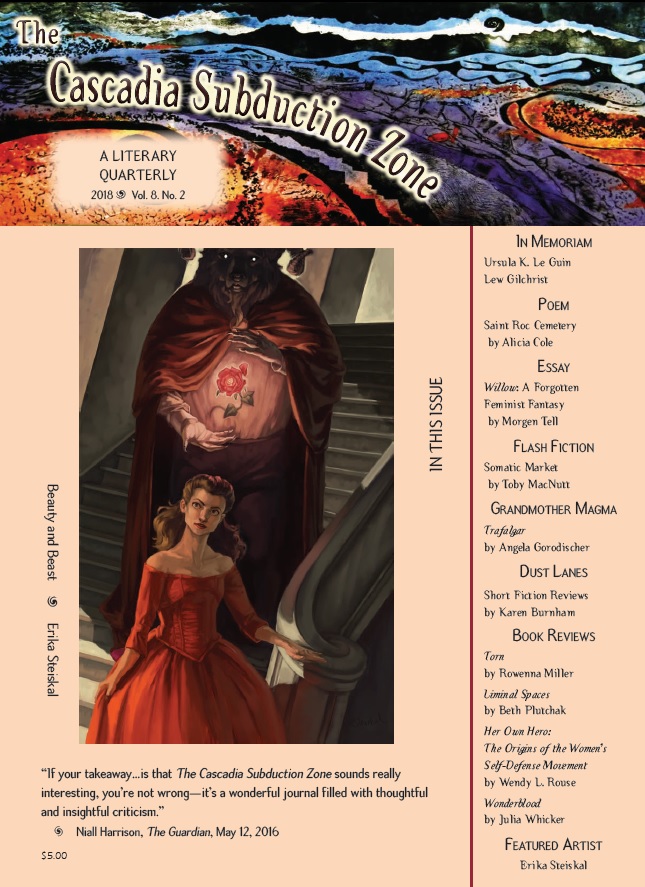
The Cascadia Subduction Zone Vol. 8, 2


The April 2018 issue of The Cascadia Subduction Zone is out. This issue includes short fiction by Toby MacNutt, a poem by Alicia Cole, an essay by Morgen Tell on a forgotten feminist fantasy film, a Grandmother Magma entry on Angelica Gorodischer by Cristina Jurado, a new column by Karen Burhnam, "Dust Lanes," reviewing short fiction, reviews by Arley Sorg, Nancy Jane Moore, and others, as well an appreciation of Ursula K. Le Guin by Nisi Shawl, and an appreciation of the CSZ's first managing editor, Lew Gilchrist, by Kath Wilham. The issue's featured artist is Erika Steiskal.   

The CSZ is available for purchase at http://thecsz.com/. Electronic copies are $3, print copies $5; electronic subscriptions $10, print subscripts $16.


In Memoriam
Ursula K. Le Guin
Lew Gilchrist

 
Poem
Saint Roc Cemetery
  by Alicia Cole
 
Essay
Willow: A Forgotten Feminist Fantasy
  by  Morgen Tell

 
Flash Fiction
Somatic Market
  by Toby MacNutt
 
 
Dust Lanes
Short Fiction Reviews
   by Karen Burnham

Grandmother Magma
Trafalgar, by Angélica Gorodischer
     reviewed by Cristina Jurado 

Book Reviews
Torn, by Rowenna Miller
   reviewed by Kate Schaefer

Liminal Spaces, by Beth Plutchak
  reviewed by Tonya Liburd

Her Own Hero: The Origins of the Women’s Self-Defense Movement, by Wendy L. Rouse
  reviewed by Nancy Jane Moore

Wonderblood, by Julia Whicker
   reviewed by Arley Sorg

Featured Artist
Erika Steiskal

Wednesday, April 4, 2018

Eleanor Arnason's Ring of Swords


I'm pleased to announce the release of a new edition of Eleanor Arnason's Ring of Swords as a volume in Aqueduct's Heirloom Book series in both print and e-book formats. Long out of print and short-listed for the Tiptree Award, many people, including Ursula K. Le Guin and Jo Walton, have wished for a new edition.

In her introduction to this new edition of Eleanor Arnason's Ring of Swords, Le Guin writes, "Ring of Swords is an intellectually fascinating science-fiction story told in the novel tradition, peopled by ordinary people content with their ordinary life, appalled to find themselves swept up into a social crisis, forced into acts and choices of historical consequence. Its ancestry includes not only The War of the Worlds but also A Tale of Two Cities and War and Peace.

"Having recently brought their own competitive, feud-ridden society into a fragile balance of peace, the Hwarhath have been facing an unexpected problem: the lack of enemies. Given the apparently innate male propensity for finding pretexts to fight, and the fact that their men were all trained as warriors, the women running things at home make sure the men stay out in space protecting the home planet. The drawback is that there seems to be nobody to protect it from. So, when in the vastness of space they finally stumble into another intelligent species, they rejoice. Enemies! At last!"

"The usual assumption," Le Guin notes, "is that if you threaten a war early in a novel, you'd better hurry up and get the bombs bursting in air. And they usually do. Novels that portray war as totally destructive and futile still focus on it--war is what they're about, war is central to them, just as it was central to the old epics that glorified heroes and battles. But a war not fought? What kind of subject is that?" Le Guin asks. Her answer? "It's a beautiful subject for a novel, and Ring of Swords is a beautiful novel."

You can read a sample of Ring of Swords here, and purchase it here.


Saturday, March 31, 2018

Congratulations to Liz Bourke

I'm pleased to report that a book published by Aqueduct is on this year's Hugo ballot, in the "Related Work" Category.

Best Related Work

Congratulations to Liz Bourke! I should also add that numerous Aqueduct authors (including me) have pieces in another book on the ballot in this category, Luminescent Threads: Connections to Octavia E. Butler,  published by Twelfth Planet Press; the late Ursula K. Le Guin (who, by the way, is also an Aqueduct author) has a book on the ballot in this category, also. Overall, I'd have to say the ballot in this category is pretty interesting this year.

ETA: You can read a sample of Liz's book here: http://www.aqueductpress.com/books/samples/978-1-61976-123-0.pdf


Wednesday, March 28, 2018

Last chance to get the Feminist Futures bundle!


A reminder, for those who thought they might want to purchase the Feminist Futures e-book bundle--just $4 for the basic four-novel package of books by Caren Gussoff, Krstine Smith, Nicole Kimberling, and me; and just $11 for those four books plus NINE more books by Vonda N. McIntyre, Louise Marley, MCA Hogarth, Athena Andreadis, Janine A. Southard, and Rosemary Kirstein. The sale ends tomorrow.

https://storybundle.com/scifi

Thursday, March 22, 2018

Sheree Thomas has been invited to Breadloaf!

Sheree Renée Thomas, author of two beautiful books published by Aqueduct, has been invited to attend a writer’s workshop with novelist Luis Alberto Urrea at Bread Loaf Environmental Writers Conference at Middlebury College in Vermont this summer. Out of hundreds of applicants only five were chosen to work with this award winning author, whom Sheree admires.

However, this brilliant opportunity comes with a steep price tag. That is where we all come in. Let's raise these costs for Sheree so she can pay the tuition, buy a plane ticket from Tennessee, leave her bills paid at home, (as she will lose paid work to attend the workshop,) and have some dollars left in hand for daily needs and emergencies. 

5,100.00 will cover these expenses. I hope that fans, friends, and colleagues who have admired Sheree’s brilliant writing, or benefited from her visionary editing and teaching, might step up with whatever they can spare. Let's make sure Sheree can take this great opportunity: work with an admired, master writer on her gorgeous new novel, network with other visionaries, and have time to create. As of this afternoon, she's nearly one-fifth there.

Above all, Sheree needs time to focus on her own writing without the constant pressure of financial worries and family obligations. She is an author who has lifted many, many other artists through her generous vision, editorial genius, and producing skills. Won't it be great for her to have a peaceful month to work her own stories and poems, and contemplate her own dreams?
(And then we get to read the new works, too!)

The tuition for the conference and workshop is due in April, 2018, so we have no time to lose. I believe we can do this! Let's make it happen for Sheree! Go here to contribute to the GoFundMe drive Pan Morrigan has set up to get Sheree to the conference.


Please give all you can, and share with everybody you know, as often as you can. I thank you for your consideration! Artists and lovers of the arts gotta stick together!

Please appreciate Sheree's brilliant resume right here, and go check out her gorgeous, groundbreaking books, too. They are available at Aqueduct Press. 
http://www.aqueductpress.com/authors/ShereeThomas.php

Sheree Renée Thomas is the two-time winner of the World Fantasy Award for her groundbreaking anthologies, Dark Matter anthologies (2001, 2005), named a New York Times Notable Book of the Year. She is the 2017 recipient of the L.A. Banks Award for Outstanding Achievement, a 2016 Tennessee Arts Commission Fellow, and the 2015 Lucille Geier-Lakes Writer-in-Residence at Smith College. She is the author of Sleeping Under the Tree of Life (Aqueduct Press), named on the 2016 James Tiptree, Jr. Award Longlist and Shotgun Lullabies: Stories & Poems. Her stories and poetry are translated in French, Urdu, and Spanish and her essays, articles, reviews have appeared in the New York Times and ESSENCE. A multigenre writer, Sheree’s stories and poems appear in several anthologies, including The Ringing Ear edited by Nikky Finney and Ghost Fishing: Eco-Justice Poetry edited by Melissa Tuckey (University of Georgia Press). She has been honored with fellowships from the Cave Canem Foundation, the Wallace Foundation, the Millay Colony of the Arts, the NY Foundation of the Arts, VCCA, Ledig House, and Blue Mountain Center. Based in Memphis, Thomas is the Associate Editor of Obsidian: Literature & Arts in the African Diaspora and the founder of Black Pot Mojo Arts.

I love Sheree's stories and poetry, and so would love to read a novel by Sheree. 


++++++++++++++++++++

ETA: The funding goal has been met! Congratulations, Sheree! 

Monday, March 19, 2018

WisCon's Member Assistance Fund

This just in from the SF3 Fundraising Committee:

Hello from WisCon’s Fundraising team!

We’re thrilled to announce that a group of our generous WisCon Member Assistance Fund donors have set us a challenge to raise funds to meet the needs of the folks in our community who need a little help to attend.

Sigrid Ellis, Jesse the K, Andrea Hairston, Kayla Fouch, Jed Hartman, Phredd Groves, and Aqueduct Press have stepped up, combining forces to make your donations go twice as far, and matching your donations up to $2,600. We’re so incredibly grateful to them!

If you donate $10, thanks to their generosity and belief in WisCon, $20 will go into the Fund. Give now to help meet their challenge—head to our Donation page to send a check or set up recurring donations, or keep it simple and go straight to paypal.me/WisCon!

(By the way, you have seen our beautiful WMAF t-shirts, right?)

 ++++++++++++++++++++++++

Back to me again: if you can possibly spare just a small donation, please do. Some of Aqueduct's authors, & of course many of its readers, have been able to attend because they've received assistance from this fund. And that matters to all of us.

Wednesday, March 14, 2018

The 2017 Tiptree Award

The winner of the 2017 Tiptree Award is Virginia Bergin for her novel Who Runs the World? (Macmillan, UK, 2017). The novel is scheduled to be published in the US in September 2018 under the title The XY (Sourcebooks, 2018).


Who Runs the World? is a young adult novel that tells an intricately layered tale of intergenerational struggle and cooperation, the dehumanizing force of gender stereotypes, and the moral courage it takes to challenge cultural and political norms. The premise is familiar in feminist science fiction—a plague that kills nearly everyone with a Y chromosome. Bergin uses this premise first to develop a vividly imagined feminist society, and then to grapple with that society’s changes and flaws over time.

And for any who look to the Tiptree Award for a reading list each year, the jurors provide the Honor List, a group of exceptional works:

  • Charlie Jane Anders, “Don't Press Charges and I Won't Sue" (Boston Review, USA, 2017)
  • Indra Das, The Devourers (Del Rey, USA, 2016)
  • April Daniels, Dreadnought and Sovereign (Diversion, USA, 2017)
  • Maggie Shen King, An Excess Male (Harper Voyager, USA, 2017)
  • Carmen Maria Machado, Her Body and Other Parties (Gray Wolf, USA, 2017)
  • Rivers Solomon, An Unkindness of Ghosts (Akashic, USA, 2017) 
  • JY Yang, "Black Tides of Heaven" and "Red Threads of Fortune" (Tor, USA, 2017)
You’ll find more information about each work on the Honor List — and an additional  “long list” of twenty-six other works jurors found worthy of attention — on the Tiptree website.

The Tiptree Award winner, along with authors and works on the Honor List will be celebrated on Memorial Day weekend at WisCon in Madison, Wisconsin. Thanks to the support of folks like you, the winner will receive $1000 in prize money, a specially commissioned piece of original artwork, and (as always) chocolate. I hope I’ll see you at the celebration!

Reading for 2018 has begun Visit the recommendation page of the Tiptree Award website to suggest works for 2018 jury’s consideration. On the website, you can also donate to help fund the award and read more about past winners and works it has honored.

Sunday, March 11, 2018

Kate Wilhelm (1928-2018)


We lost another influential author last week. Kate Wilhelm was one year older than Ursula Le Guin and also lived in Oregon (though in Eugene, not Portland). I've probably read most of her considerable body of work. Indeed, some of her characters and their situations have lodged deep within my imagination; I'm not sure when I realized that some of these have even crept their way into my own work without my noticing. Because of that, I always find it strange to hear from younger women writing sf that they were unfamiliar with the fiction she wrote before turning mainly to murder mysteries. Her speculative fiction is largely of a non-flashy type, blending a realist style with an intense interest in the psychological and social dimensions of her characters' lives; geographical setting and local politics often figure prominently.

Kate was awarded three Nebulas and two Hugos, and SFWA's Solstice Award (which was later renamed the Kate Wilhelm Solstice Award in her honor). She was inducted into the Science Fiction Hall of Fame in 2003. Perhaps her greatest influence was as a teacher and workshop mentor, beginning with the Milford Science Fiction Writers' Conference in the late 1950s, and then with the Clarion Science Fiction Writers' Workshop. I believe that even after she stopped teaching at Clarion, she continued participating in and hosting workshops. When Leslie What and Nina Kiriki Hoffman took Eileen Gunn, Gwyneth Jones, and me to visit her in Eugene in 2004, Kate took us into a room  with comfortable chairs arranged along the perimeter; someone mentioned that this was where Eugene writers often gathered to workshop their stories (and a joke was made about Kate's tough critiques). Later she showed us an enclosed swimming pool that had been filled with soil and made into an indoor garden, something I'd never have imagined but afterwards struck me as fitting my previous image of her perfectly. 

You can find a good bibliography of her work in the Kate Wilhelm entry at the Encyclopedia of Science Fiction). John Clute opines that her strongest speculative fiction writing was at novella length. While I largely agree with that judgment, let me hasten to add that her novels and shorter fiction are definitely worth seeking out. My top recommendations for someone unfamiliar with her speculative fiction would be: The Infinity Box, Welcome Chaos, Somerset Dreams and Other Fictions, Juniper Time, and Margaret and I. Her most famous sf novel, of course, is Where Late the Sweet Birds Sang (which won the Hugo).   

Wednesday, March 7, 2018

The Feminist Futures Bundle


I'm really pleased too announce The Feminist Futures Bundle, a bundle of e-books that are entirely feminist sf/f, and includes Alanya to Alanya, the first volume of my Marq'ssan Cycle. The bundle goes on sale tonight and will be available for a limited time. Let me turn you over to Cat Rambo, who curated this wonderful bundle:


In time for Women's History Month, here's a celebration of some of the best science fiction being written by women today. This bundle gathers a wide range of outlooks and possibilities, including an anthology that gives you a smorgasbord of other authors you may enjoy.
I used to work in the tech industry, and there I saw how diversity could enhance a team and expand its skillset. Women understand that marketing to women is something other than coming up with a lady-version of a potato chip designed not to crunch or a pink pen sized for our dainty hands. Diversity means more perspectives, and this applies to science fiction as well. I am more pleased with this bundle than any I've curated so far.
In her feminist literary theory classic How to Suppress Women's Writing, science fiction author Joanna Russ talked about the forces working against the works of women (and minority) writers. A counter to that is making a point of reading and celebrating such work, and for me this bundle is part of that personal effort, introducing you to some of my favorites.
And in the name of expanding one's knowledge and enjoyment of women writing SF, the majority of these books are first volumes of series, and I hope if you enjoy them, you'll find the others as well as telling other people about them. The Kirstein series is the only one where not all the books are available; she's currently working on book five and plans seven altogether. Many of them are independently or small press published, showing the depth and quality of work such publishing venues can yield.
I come to the task of writing these notes having just finished reading through a slush pile for an anthology I'm editing, If This Goes On, devoted to political science fiction. Some of the themes there are echoed in some of the works here, and it's been interesting to note the resonances. Other books in the bundle are more lighthearted or escapist. I hope everyone will find at least a few they enjoy, and that many readers will join me in thinking they're all swell.
I'll be doing some video interviews with authors about their books - look for the hashtag #thefutureisfeminist on social media or subscribe to my Youtube channel (https://www.youtube.com/user/spezzatura) or newsletter (http://www.kittywumpus.net/blog/newsletter/) to make sure you get notified when they appear! – Cat Rambo
The initial titles in the Feminist Futures Bundle (minimum $5 to purchase) are:
  • Happy Snak by Nicole Kimberling
  • Alanya to Alanya by L. Timmel Duchamp
  • Code of Conduct by Kristine Smith
  • The Birthday Problem by Caren Gussoff
If you pay at least the bonus price of just $15, you get all four of the regular titles, plus SIX more!
  • Starfarers Quartet Omnibus - Books 1-4 by Vonda N. McIntyre
  • The Steerswoman by Rosemary Kirstein
  • Spots the Space Marine by M.C.A. Hogarth
  • The Terrorists of Irustan by Louise Marley
  • Queen & Commander by Janine A. Southard
  • To Shape the Dark by Athena Andreadis
This bundle is available only for a limited time via http://www.storybundle.com. It allows easy reading on computers, smartphones, and tablets as well as Kindle and other ereaders via file transfer, email, and other methods. You get multiple DRM-free formats (.epub and .mobi) for all books!
It's also super easy to give the gift of reading with StoryBundle, thanks to our gift cards – which allow you to send someone a code that they can redeem for any future StoryBundle bundle – and timed delivery, which allows you to control exactly when your recipient will get the gift of StoryBundle.
Why StoryBundle? Here are just a few benefits StoryBundle provides.
  • Get quality reads: We've chosen works from excellent authors to bundle together in one convenient package.
  • Pay what you want (minimum $5): You decide how much these fantastic books are worth. If you can only spare a little, that's fine! You'll still get access to a batch of exceptional titles.
  • Support authors who support DRM-free books: StoryBundle is a platform for authors to get exposure for their works, both for the titles featured in the bundle and for the rest of their catalog. Supporting authors who let you read their books on any device you want—restriction free—will show everyone there's nothing wrong with ditching DRM.
  • Give to worthy causes: Bundle buyers have a chance to donate a portion of their proceeds to Mighty Writers and Girls Write Now!
  • Receive extra books: If you beat the bonus price, you'll get the bonus books!
StoryBundle was created to give a platform for independent authors to showcase their work, and a source of quality titles for thirsty readers. StoryBundle works with authors to create bundles of ebooks that can be purchased by readers at their desired price. Before starting StoryBundle, Founder Jason Chen covered technology and software as an editor for Gizmodo.com and Lifehacker.com.
For more information, visit our website at storybundle.com, tweet us at @storybundle and like us on Facebook.