Thursday, June 15, 2017

WisCon 41: a sketchy report, with randomly placed photos

Aqueduct's editors and business manager


So Aqueduct went to WisCon again this year. Kath drove one car loaded with books, Tom and I another, and Arrate flew in, across the Atlantic, and we re-uned joyfully in Madison. Kath and Arrate arrived in time for the reception and reading at Room of One’s Own on Thursday evening, but Tom and I, having caught a few bad breaks, arrived later than planned, making it to Room only as things were winding down. 
Aqueduct in the Dealers Room

I spent the con as I usually do—talking with friends and acquaintances, attending panels and readings, making periodic appearances at Aqueduct’s table. I also participated in a panel and gave a reading. But one of the first things I did after the Dealers Room officially opened was to make a beeline for Dreamhaven’s table, where I hoped to find the first volume of Samuel R Delany’s journals, recently released in a handsome hard-bound edition by Wesleyan University Press. And yes, they had it! It’s a book of considerable heft, which is both good and bad. Good for obvious reasons, bad because it means I can’t read it in the bathtub. (Of course, if I had a tray to span the width of the tub, as I once did, and a book holder to go with it…)
Mary Anne Mohanraj, reading

On Friday afternoon I attended two panels. The first, Embracing Socialism, was offered by Mary Anne Mohanraj, Ian K. Hagemann, and Julia Schroeder (M). Julia said she only started thinking of herself as socialist during the 2008 election when Obama was frequently labeled a socialist by the right. (Which raises an interesting point about the work labels can sometimes do, don’t you think?) Ian identified himself as a longtime activist. His “socialism,” he said, was a result of years of watching Star Trek. Mary Anne noted that though she’d been an activist for years, she had not considered herself a socialist. But when she ran for the library board (which she did in the wake the 2016 general election), she was required to define her position on a range of issues, and soon she realized that economic issues are central to public library policies and politics.

Ian said that when talking about socialism, we need to remember what socialism actually is. Highways are socialized. (If they weren’t, everyone using them would constantly be having to paying tolls.) Parks are socialized. (Which made me think of how scarce public parks were when I lived in New Orleans, compared with the life-enhancing abundance of them in Seattle.) Police are socialized—“though badly.” (Which made me think of the constant scandal that is the Chicago Police Department—and then of how the notion that the police are there to “protect and serve” entire communities was new to me when I first encountered it in my high school civics class, since no one in my family ever called on the police for help because in their view, the only actually helpful things police ever did was to direct traffic during power outages and civil emergencies, or after a heavily attended event let out.) But we don’t have socialized health and human services (which is why most people living in the US are one serious illness away from bankruptcy). The Public school system is socialized—the “reason,” perhaps, that current Secretary of Education appears to be doing her utmost to destroy it. We need, Ian said, to articulate what is good about the socialized services we do have and then see where the argument breaks down for socialized health and social services.
An Aqueduct reading

Mary Anne noted that some cities have lovely libraries while others do not. Implementation of public library services is extremely variable—as with public schools and state colleges. She cited Roland Barthes on why the right is so much better at attractively mis-naming policies etc than is the left. And then she said “I think we have to talk about Bernie Sanders. He moved the Overton Window. (And Occupy Wall Street prepared us for Sanders, paving the way for ‘changing the conversation.’)” She suggested that this was the most valuable aspect of Sanders’ campaign. Ian then observed that the in the US the 1950s were “a cauldron for social and political change” because of the high income and capital gains taxes then in effect. People in the 1950s generally accepted the notion that costs and benefits of essential services are shared and collective, not individual. 
Nancy Jane Moore, reading

At which point, Julia asked the panelists to define neoliberalism. Ian said that he defined it as evil (eliciting gleeful responses from the audience). Audience members then offered some help, culminating in Dan Dexter’s assertion that neoliberalism rests on the total acceptance of capitalism’s ruling every sphere of life with mitigation of its worst effects “where possible,” such that some people can have clean water, decent health care, education, etc., while many, obviously cannot. An audience member recommended Gangs in America, which is about corporations. Another recommended the documentary The Healing of America by T.R. Reid. Another audience member, discussing Reid’s work, said that it considered three forms of socialized healthcare currently in existence—the single-payer model; the affordable healthcare model; and the taking-profitability-out-of-healthcare model. I’ll skip over most of the rest of the discussion, except for four comments particularly struck me: (1) from an audience member: Bernie put a face on democratic socialism—we need to define socialism as democratic socialism rather than totalitarian socialism; (2) Ian: Most people don’t know people who are hungry unless they’re one of them; to win the socialist argument, people need to understand statistics, since they have no other way to see what the facts and problems actually are; and (3) from an audience member: The left doesn’t do an abridged version of leftist values and politics; we need to develop abridged versions, reframed for popular consumption; and finally: someone noted that it should be pointed out, when discussing the merits of capitalism vs socialism, that capitalism has been proven to be a dismal, potentially catastrophic failure for serving human needs in the twenty-first century.
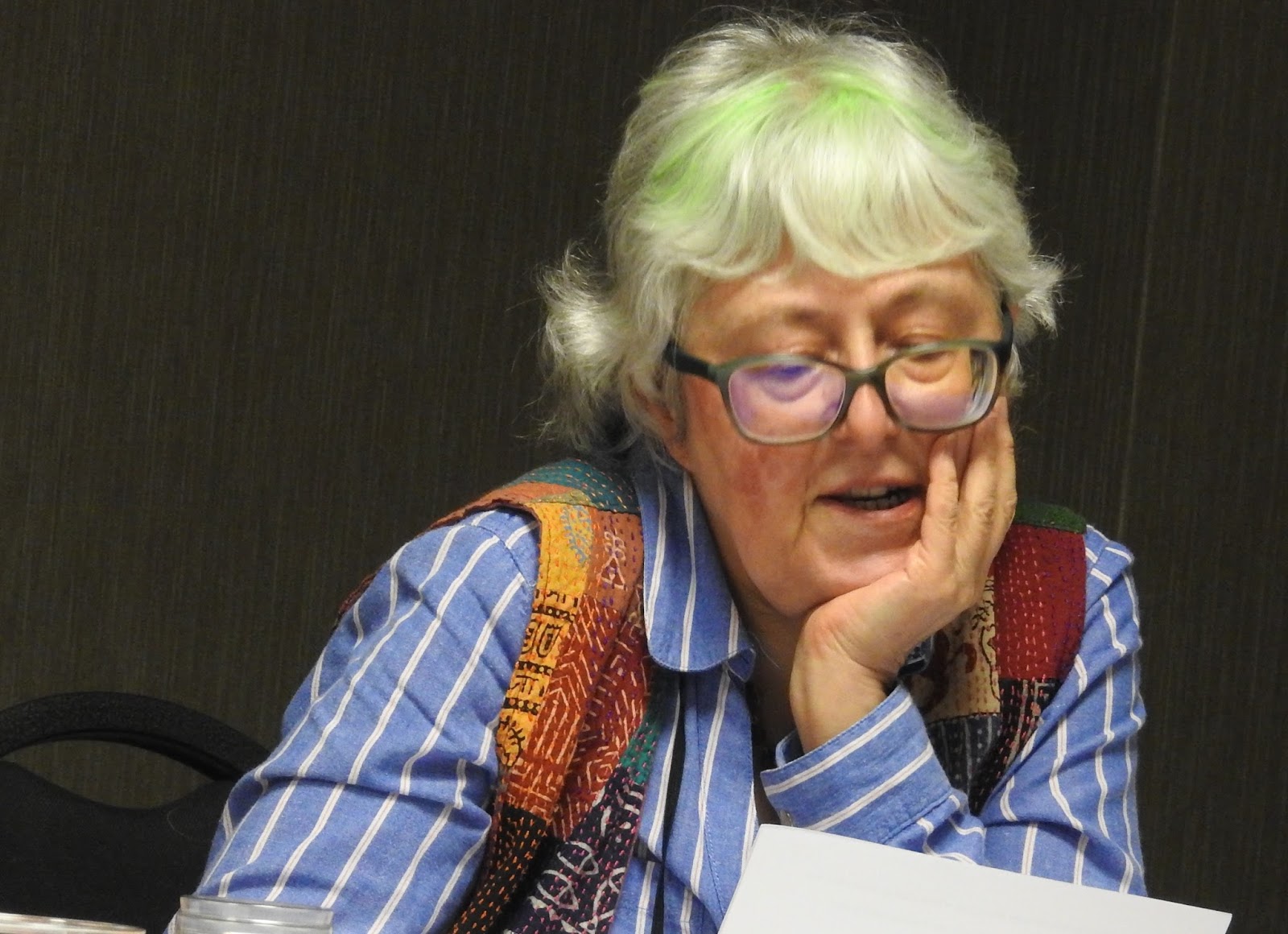
Lesley Hall, reading

Immediately after “Embracing Socialism,” I attended 10,000 Feminisms, 10,000 Feminist SFs. This panel was moderated by Julia Day, with Jackie Gross (aka LadyJax) and Lauren Lacey as panelists. This panel was of particular interest me as a publisher of feminist sf. From the beginning, I’ve been aware of the looseness of the term and the broad spectrum of works that can be so classified—and that was at a time (2004) when a lot of people believed feminist sf was over, years before we began to see certain sectors of the mainstream claiming feminism for their own purposes. Rather than discussing this aspect of the subject, though, the panelists focused on recommending a rich array of different kinds of feminist sf works. Julia began by asking the panelists to talk about both the best and the worst titles of feminist sf they’d encountered. Lauren’s reply focused on a work she particularly disliked, viz Sheri Tepper’s Beauty. Feminist sf needs to ask, she said, what stories do we keep? Which do we remake? What do we throw out? Beauty reinscribes the power roles as traditionally told without attemption to reinvigorate the fairy tale. Jackie Gross recalled Daughters of the Coral Dawn as a poorly written work by an author, Katherine V. Forrest, who wrote a work she loved: “Dreams and Swords.” I was delighted that Jackie spoke often about the importance of the small press for feminist sf in the 70s and 80s, mentioning Naiad Press, Daughters, Crossing Press’s anthologies (to which I myself contributed a couple of stories), Firebrand Books—and since I was seated in the audience, under no pressure at all to remember, I mentally added several more to the list; and Jackie also spoke often, throughout the panel, about the importance, pre-internet, of feminist bookstores in making small-press feminist sf accessible (summoning up memories of my visits to feminist bookstores in cities I was merely passing through, each time snatching up books that would otherwise simply be known to me later by reputation, so hard would they soon be to find).

The panelists also discussed feminist narratives that are neither utopian nor dystopian, and Jackie observed that the entry point for each reader is crucial. She suggested that the dystopias we have now tend to use the dystopian form as a background to clichéd narratives rather than as an examination of the structures and conditions themselves. She also commented on the difference between reading The Handmaid’s Tale at the time it first appeared (1983) and now. In a recent re-reading, she said, she asked what happened had to the people of color who aren’t there. Jackie also talked about finding feminist sf in unexpected places, for instances in a Steve Barnes work in which a guy on the run encounters Motherland. When an audience member asked about new feminist sf, the panel launched into a series of book (and publisher) recs. My last note on the panel is a remark that Jackie spoke a great deal about the need to go outside the mainstream press to find the feminist narratives we need. Everyone who reads this blog will not be surprised to read that to that I uttered a silent Amen.
Therese Pieczynski, reading

My panel notes from then on became a great deal sparser, until finally I stopped taking them at all. The panel “Fandom and Fascism,” featuring Alexis Lothian, Julia Schroeder, and Megan Condis (M) met in a room with too few chairs to accommodate everyone attending. Megan began by noting that when Trump started to interact with (and retweet) gamergaters, she was shocked into realizing that it is necessary to pay attention to questions about what right-wingers are getting out of associating with gamers, who have largely been non-respectable. She said she then came to see that Trump et al are using gamergaters as a means of shedding their old-fashioned images and dressing up racism, sexism etc as cool and hip. Alexis: There’s no laying a claim that gamers are an “oppressed minority” (as some have liked to see themselves)—the language of social justice is being appropriated and adapted to their purposes. “Fascism has always had a fandom,” she noted, and cited the example of Britain in the 1930s. And: The pleasures to be found in fascism [in cosplay etc) are often enjoyed by people who identify themselves as anti-fascist.  Julia: The word “Nazi” is no longer taken seriously in the media. (After which followed a discussion of some of the many ways “nazi” gets slung around, diluting its power as a designation.) Megan: The (HBO/HULU) Handmaid’s Tale is both horrifying and banal. The villains look like ordinary Americans. Julia: The humanization of the other [I think she meant of villains in narratives] is taken to the extreme—we have to make the bad guys real persons—but certain levels of evil shouldn’t be empathized with. Alexis: We need to look at who it is who gets humanized by fandom. [Which concurs with my thought, about how the usual stereotyped “others” so often figure as one-dimensional “bad guys” in the mainstream, and how it’s only when the villain is a straight white male do most narratives bother to humanize them.] An audience member, Wendy Rose, asked: “Is it a trend that oppressors are given understanding and sympathy rather than intolerance?” My notes on Alexis’s response here are not quite legible, except for this “…as if oppressions are all equivalent and work the same way.” Julia: The media take the attitude that every opinion is valuable and acceptable. You can see this in the Harry Potter and Star Wars fandoms: niceness at all costs. Ocala Wings from the audience: We have a fandom of patriotism and a fandom of Trump—the media has been publishing his every tweet. From the audience: What does it mean for fandom that its narratives/characters are so protean that fans who are alt-right see one thing while fans who are leftist see something entirely different? Alexis: She’s struck by the desire to detach Nazis and other fascist iconography from Nazism and fascism—generating meaning shifts—and the desire to separate iconography from politics and its history. “Fandom,” she suggested, “has the capacity for erotic engagement with fucked-up things.” My last note goes to an audience member’s comment: The alt-right treats power structures as interchangeable.

Kiini Ibura Salaam, reading, with Andrea Hairston

Those were the panels I attended on Friday. I attended several more on Saturday and Sunday, but took few notes. The “Sort of” panel, moderated by Susan Ramirez with Lee Blauerstein, W.L. Bolm, Nicole Fadellin, Kiini Ibura Salaam, and Nisi Shawl offered much to think about; Kiini’s “Identity is a created box with boundaries that people kill to preserve” and Nisi’s “Becoming/being “sort of” comes from the outside” demanded to be quoted in my notes. “Borders, Boundaries, and Liminal Spaces” with Julia Starkey moderating, featuring Julia Rios, Isabel Schecter, and Anna-Marie McLemore [subbing for Amal El-Mohtar], and the Speculative Fiction in Translation panel with Rachel Cordasco, Sue Burke, and our own Arrate, at which Rachel provided an amazing list of work in translation published in the last year—and which sent me to Small Beer Press’s table to purchase a new Angelica Gorodischer title in translation. During the “Border, Boundaries, and Liminal Spaces” panel, Julia Starkey clued us in on Amal’s experience traveling from Toronto to the US to be a GoH at this very WisCon—of being detained on Canadian soil by the US Border Patrol, a degrading experience, that she said Amal had noted would have been a great deal worse had her skin been as dark, say, as her brother’s. Oh, I almost forgot! On Saturday evening, I attended a jam-packed panel that attracted too many attendees to fit into the room—titled “The Myth of the Career,” discussing the doom of the gig economy, featuring Richard Dutcher, B.C. Holmes, Victor Raymond, Jessie Sarber, and moderator Rachel Kronick. This panel evoked heavy, intense audience participation and could easily have gone on for hours. It could have been subtitled “Neoliberalism bites.” 
An Aqueduct reading
Eleanor Arnason, reading

And finally, the readings: Aqueduct’s two official readings, as another offered by more Aqueductistas. On Saturday afternoon  Kiini Ibura Salaam, Andrea Hairston, Pan Morigan, and Sheree Renee Thomas gave beautiful, powerful readings.


Andrea Hairston, reading
Andrea Hairston, Pan Morigan, & Sheree Renee Thomas
And on Sunday, two Aqueduct readings took place back-to-back, with Cynthia Ward, Beth Plutchak, Mary Anne Mohanraj, and myself featured in the first session and Eleanor Arnason, Lesley Hall, Nancy Jane Moore, and Therese Pieczynski in the second. A good time, I promise you, was had by all. 
Beth Plutchak
Cynthia Ward, reading

I could report much, much more, but this post already feels far too long. Please do also check out Aqueductista Claire Light’s  At the World’s Preeminent Feminist Speculative Fiction Convention. Because, yes, everyone’s WisCon is different. 

L. Timmel Duchamp, talking


Monday, June 5, 2017

Black Disability Activism at the Whitney


At 6:43 p.m. on June 2, 2017, as part of the Whitney Biennial, artist-activist Leroy Moore gave a presentation on “Black/Brown International Disability Art and Hip-Hop.” Aqueductistas Ann Keefer and Josh Lukin were present, having ridden a bus up from Philadelphia to show support for the speaker and his agenda. Although the event was listed as being full, there were over twenty empty seats; but the diverse group of people who could make it was enthusiastic and appreciative. Upon entering the black box theater on the third floor of the Whitney, visitors found a pile of handouts on each chair, including Moore’s interview with rapper TapWaterz, his San Francisco Chronicle article about Black Disabled History, a list of Twenty-One Black Disabled Trivia Questions, Moore’s definition of AfroKrip, an account of Krip-Hop Nation’s politics, and a bilingual transcript of the youtube video, “Jake explain what Hip Hop is like in Spain for people with disabilities.”

Sasha Wortzel, the Whitney’s director of access and community programs, made a nice access announcement that included a “You may get up and move around during the presentation” and quickly turned the mic over to Carolyn Lazard. Carolyn wrote the intro in the form of a love letter to Leroy. She first met her copanelists Tina and Park at a panel on Access Intimacy two years ago at the New Museum. From Leroy she learned that she didn’t have to hold her blackness in one hand and her disability in the other.

Leroy Moore, artist Sunaura Taylor, artist Carolyn Lazard

Upon taking the mic, Leroy remarked that he was from the area—his mother was awfully excited to hear he’d be at the Whitney—and that it was very hard to be back in the city on account of all the people he’d known who’d been covered up in concrete or gentrified out of New York or . . . he began by showing a BlackDisabled Art History 101 video, then moved into his own personal history. In the eighties, here in New York, three other black disabled boys came up to his room, and they would all write letters—yes, people wrote letters then—to black leaders asking for resources and support and solidarity, and often they got form letters in reply, saying there was nothing out there. Nowadays he doesn’t write letters; he writes emails; but he still sometimes gets the same replies.

When Leroy was a kid, he once dashed into the kitchen yelling, “Mom, I’m on tv!” And his mother came with him into the living room and said, “Leroy, that’s Porgy.” It was the first and only time he’d seen a representation of a black disabled guy in the entertainment media . . . he then read an autobiographical poem about his wild youth and showed a brief interview with Tap Waterz . . . his first work was published in the Amsterdam News, for which he is still extremely grateful; then when he moved west, in the San Francisco Bay Review.  He worked with DAMO—Disability Advocates of Minority Organizations—and then cofounded the National Black Disability Coalition with the great New Jersey civil rights activist Jane Dunhamn.

Next he showed and discussed videos from various Krip-Hop Nation artists, including
Josh Lukin, Sunaura Taylor
Rinnessy, cofounder Keith Jones and DJ Quad, and began to present his definition of Krip-Hop. Krip-Hop Nation has existed for ten years without funding: “We don’t want to be tied up by grant designs and the nonprofit state.” Now Krip-Hop has put out four cd’s, including their 2012 cd on police brutality against people with disabilities; and Leroy has collaborated with Emmitt Thrower on the Where Is Hope? documentary about police brutality against disabled people—hire them to come and speak at your institution. He’s hoping to sponsor an all-women, trans-inclusive Krip-Hop cd with Lisa Ganser in charge, and a cd of South African Krip-Hop. And he recently produced the tenth anniversary Krip-Hop cd, which includes the famous rapper DMC.

There was a bunch of laughter in the audience as the transcription technology of youtube misrendered “Krip-Hop” in like sixteen different ways, and Leroy said, “Sorry about that: youtube has its own language” and segued into the tactics marginalized people have of flipping language: “ . . . people think of ‘Crip’ as a gang, but we flipped it as a positive thing.” Look at the role disability played in the origins of the dozens, a ritual that became the basis of hip-hop. Look at Blind Willie Johnson, accused of inciting a riot by moaning outside the courthouse. Look at Josh White and all the blind musicians he worked with and learned from as a child. All of these stories that music scholars have left out . . . and it’s hard with ableist artists today such as Lady Gaga and Rick Ross and Kendrick Lamar with the blind woman in “Blood” and the Washington Post saying that the president has a mental illness—how do we fight this? Krip-Hop! Krip-Hop uses hip-hop and flips it to the positive. Listen to a song about Blind Willie Johnson, “Moan to Me.” And with international Krip-Hop artists such as Simon Mandela from South Africa, King Montana, Jake from Spain, Billy Saga from Brazil . . . Krip-Hop Uganda, which raised funds to buy AtimEunice and her sister a wheelchair, after which she said, well, this is very nice, but I need to go to school too, so they started another round of crowdfunding—Krip-Hop is more than music.

Park McArthur
After an intermission, there was an introduction of Carolyn Lazard, Park McArthur, and Constantina Zavitsanos that recounted the many venues in which their work—work informed by disability and care—has appeared. They played Leroy Moore and Rob DaNoize Temple’s “Moan to Me” again, to honor Leroy’s accomplishments. Park said she’d been talking about Leroy as archivist/time-traveler, simultaneously reviving the past and navigating the world into the future. Tina said she’d been thinking about slippage: “There’s a lot of slip in that song. Layers and facts and things are traveling in multiple directions.” Leroy noted that the history of black disabled people has been repressed. Hip-hop is the baby of the blues, the fruit of the blues tree: he’s trying to take stories of early blues artists to today.

Park asked if Leroy could comment on two issues. 1) Ableism in pop culture, the appropriation of disability, in genres like mumblerap, and visual artists taking on crip aesthetics 2) Context—what’s the relationship between the criminal justice system and law enforcement and how that system produces disability? Leroy said he’s noticed that, amazingly, hip-hop artists and scholars of hip-hop don’t know how disability is one of the main components of music: it’s astonishing how artists can take disability and riff on it but artists with physical disabilities cannot make it in mainstream hip-hop. Krip-Hop has to push back against the scholars, the artists, the journalists, and say, Here it is. When we got started, there were all kinds of radio stations, but only KPFA would play us. And I love you, Michelle Alexander, but where is disability in The New Jim Crow? The prison pipeline from the schools is mostly special ed—where did that come from? I was talking to an author who did a whole book on sickle-cell anemia under the Black Panthers, and she was like, Oh, I never thought about disability.

An audience member asked, Whom should we be writing to today? Leroy talked about
Pioneering disability scholar/educator Simi Linton
different kinds of dissemination, all kinds of ways one can get the word out, including bringing Krip-Hop to the Whitney. But so much work remains to be done to reach people. “I see a lot of talk about intersectionality, and people still don’t bring up disability! IT’S NOT A GAME! Scholars and writers still need to be told.”

An audience member asked about training police to deal with people with disabilities. Leroy said he’d seen calls for police training in the Eighties, he’d seen calls for police training in the Nineties; he’d believed in training the police thirty years ago, he’d believed in training the police twenty years ago, and the police have not improved. We need to flip our focus from what the police need to what the community needs, We’ve been focusing on the police since the Eighties, and they get all the money, they get all the resources—and when you come back to the community, there’s nothing there. Sounding like Jane Dunhamn, he said that we need to flip the focus so that when a disabled person is in crisis, you don’t call the police; you call your neighbor. And that’d be a hard change. A member of the audience mentioned the killing of Ethan Saylor, remarking that Saylor had been universally loved and was a superstar in his community, and that he’d had a paraprofessional with him communicating on his behalf, but that didn’t stop the police ‘cause they weren’t interested in listening. And he, audience member, has a son with Down Syndrome who could be Ethan Saylor, And what do we do?

Of the anti-police brutality organizations, Leroy has only seen October 22 consistently addressing disability. A lot of movements don’t deal with disability justice—it’s not sexy.

David Linton talks with UPenn's Heather Love and NYU's Mara Mills
Park asked a question about the Harriet Tubman Collective, and Carolyn answered: it’s completely run online, so it brings people from many locations together. It points in both directions; and it’s truly intergenerational, encompassing elders like Leroy and young activists. It’s in conversation with Black Lives Matter. And—we know these are complex issues, but the ubiquity of disability in police brutality cases, environmental justice cases, etc. is not talked about! Park considers the question of what happens when we think of Harriet Tubman as a disabled woman. It’s a love letter to the past. It’s that archival process. Tentatively, because she doesn’t want to alienate her friends who do conventional archive work, Tina generates the word “anarchivism,” a form of archiving that’s at odds with the Official and the Academic. Leroy said, how much could we have done back in the Eighties if we’d had something like the Harriet Tubman Collective and how great it is to have it now. Back then all we could do was go to police commission hearings.

A guy who’d already asked two questions started saying something and Leroy replied,
Leroy Moore, Ann Keefer
“Can we get other voices in the room?” A woman then asked about invisible disability and its place in Krip-Hop, especially now that we’re aware of how mental disability issues play a role in police brutality, and in black feminism—and we have mainstream singers talking about their affective disorders. How do you see the role of madness and invisible disabilities evolving? Leroy agrees about the importance of these disabilities but is iffy on mainstream hip-hop’s taking on mental health, because if you look closely it’s coming from a medical model. “I want it to go deeper: I want to really challenge where it’s coming from . . . I don’t think a lot of hip-hop artists have a connection to activists on the ground who can teach them . . . I wish they had more disability justice in the mix.”

Leroy concluded by saying that we need to learn more about global disability activism. Especially now that we’re ruled by these fools, we have to examine the movements in other countries who’ve had similarly horrible rulers. Look at recent activism in Bolivia: it’s amazing, and the people doing it live on ten dollars a month!

Watch the whole event (intermission and post-lecture mingling included!) here, starting at the fourteen-minute mark.

Friday, June 2, 2017

The WisCon Chronicles Vol. 11: Trials by Whiteness, ed. Jaymee Goh


I'm pleased to announce the release of the eleventh volume of The WisCon Chronicles: Trials by Whiteness, edited by Jaymee Goh. In short fiction, poetry, personal essays, academic thinkpieces, Twitter rants, and informal Q&As, this volume begins conversations on liberation and limitations, intergenerational and international conflicts, intra-community and internal tensions.

In her introduction, Jaymee Goh writes: "Beautiful ones, we come to WisCon because through science fiction and fantasy, we know better than to simply accept the status quo. Why should we be as Caliban, whose only profit form the language of his colonizer is to curse in't? Can we not re-shape it--have we not re-shaped it for our own ends?"

The cover, by the way, features an image of the quilt created by Annie Chen, who replies in "Entralink," to a question from Jaymee:
When you first emailed me asking me in all caps “IF I WANTED TO WRITE SOMETHING FOR WISCON?” I was flattered, but I am not much of a writer. So immediately I thought of things I do like to make and responded (jokingly) “DO YOU WANT A QUILT?”
            Then as I lay in bed that night, I thought to myself, “How cool would it be to use my experiences at WisCon to inspire a quilt, have it published in the Chronicles, and then auction the finished project in the tip tree auction?” My next thought was, “Shit, now I have to make a quilt for WisCon.” So then the next day I emailed you back with, “Actually….
The volume is available in both print and e-book editions now at at www.aqueductpress.com, and in print at Room of One's Own, and will be available at a few other places soon.


Contents
            Introduction
            Jaymee Goh

            WisCon 40 Guest of Honor Speeches
       
            WisCon 40 Guest of Honor Speech
            Nalo Hopkinson

            WisCon 40 Guest of Honor Speech
            Justine Larbalestier

            WisCon 40 Guest of Honor Speech
            Sofia Samatar

            Our Immediate Vicinity

            WisCon 40 Opening Ceremonies: WisCon is my Family Reunion
            Kat Tanaka Okopnik

            All Our Relations
            Nisi Shawl

            Who is Safe?
            Beth Plutchak

            Legacy of the Past and Foundation for the Future
            Isabel Schechter

            On WisCon, and Who Is Allowed to Feel Welcome
            K. Tempest Bradford

            Navigating WisCon 39 as a Local POC on the Ground  orA Tale of Two WisCons: WisCon 39  & WisCon 40
            LaShawn M. Wanak

            Five Scenes between WisCon
            Kat Tanaka Okopnik

            Whiteness’ Myriad Forms

            Being Jewish, Being White?
            Veronica Schanoes

            Where is the WORLD in Worldcon?A Twitter thread
            Crystal Huff

            Ansibel (odlomek)
            Tea Hvala

            Ansible (excerpt)
            Tea Hvala

            Far Away Enough to Count: Ansible Q&A
            Tea Hvala and Jaymee Goh

            Touching Whiteness

            asian flavours
            Joyce Chng

            The Long Arm of the West
            Nibedita Sen

            The Lies You Learned
            S. Qiouyi Lu

            I Used to Call Myself a Coconut
            Susheela Bhat Harkins (@SoosheBot)

            Our Defiant Selves

            “Entralink”: A Quilting Q&A
            Annie Chen and Jaymee Goh

            Science Fiction for My Failing Heart: On the Purposes of Speculation in Adverse Circumstances
            Regina Yung Lee

            Rolodex
            Mark Oshiro

           Mammie Don’ Left the Plantation  [And Took the Good Seasoning with Her] —How     WisCon Helped Me to Stop Cleaning Up White People’s Messes
            Jennifer Cross

            Advice for the Broken: Curating Weaponized Love Amongst the Multiply Marginalized
            Medieval POC

Monday, May 1, 2017

Andrea Hairston & L. Timmel Duchamp reading in Seattle this week

I hope to see some Seattle-area friends of Aqueduct on  Thursday evening this week, when Andrea Hairston, accompanied by Pan Morrigan, and I will be appearing at the University Bookstore in Seattle at 7 pm. Here's the event description from UBS's event calendar:

The Waterdancer's World and Will Do Magic for Small Change (ADUEDUCT PRESS)
Thursday • May 4 • 7pm
U District store
Discussion & Book Signing 


The Waterdancer's World and Will Do Magic for Small Change

Discover two richly imagined new works of science at this exciting discussion and signing with authors L. Timmel Duchamp and Andrea Hairston .

For almost 500 years, humans have struggled to adapt themselves to the punishing gravity and hallucinogenic plants that dominate the planet Frogmore's ecology in Duchamp's The Waterdancer's World. Inez Gauthier, daughter of the general commanding the planets occupation forces, dreams of eliminating the deadly spores that have impeded efforts to crush the native insurgency and fully exploit the planets resources. She's fascinated by the new art-form of waterdancing, which celebrates the planets indigenous lifeforms and assumes her patronage will be enough to sustain it even as she ruthlessly pursues profit at the expense of all that made this art possible. Readers navigate an alien planet through the eyes of five individuals and an analytical guidebook called "A Star-Hoppers View of the Galaxy" in this thought-provoking book.

Hairston offers a potent blend of West African religion and history, magic, science fiction, theater, in Will Do Magic for Small Change. The curtain opens on Cinnamon Jones, a young theatrically challenged aspiring actress living in Pittsburgh during the 1980s. Cinnamon's half-brother, Sekou, is dead and her family life is a tangle of mystery and secrets. But before Sekou passed away, he gave her a book called The Chronicles of the Great Wanderer—the story of an extradimensional being who first materialized in the embattled West African kingdom of Dahomey in 1892. Whether The Chronicles are magic or alien science, Cinnamon can't be sure, but the story is definitely connected to her family's secrets. When an act of violence wounds her family, she and her theater squad team up to solve the mysteries and bring her worlds together.

Visit new worlds with these beautifully written, wonderfully original new books.

No Image Available L. Timmel Duchamp is the author of the five-novel Marqssan Cycle, which was awarded a Special Honor by the 2009 James Tiptree Award jury; two collections of short fiction, Loves Body, Dancing in Time and Never At Home; the short novel The Red Rose Rages (Bleeding); and numerous uncollected stories, for which she has been a Nebula and Sturgeon Award finalist and short-listed numerous times for the Tiptree Award. She lives in Seattle.

Andrea Hairston is a Professor of Theatre and Afro-American Studies at Smith College, as well as the Artistic Director of Chrysalis Theatre. Her first novel, Mindscape, which was short-listed for the Philip K. Dick and James Tiptree Awards, was awarded the Carl Brandon Societys Parallax Award, while her next novel, Redwood and Wildfire was awarded the James Tiptree as well as the Carl Brandon Society's Kindred Award. Her plays have been produced at Yale Rep, Rites and Reason, the Kennedy Center, Stage West, and on Public Radio and Television. She has received many awards for her dramatic writing and directing, including NEA and Ford Foundation grants.         

Monday, April 24, 2017

The Cascadia Subduction Zone, Vol. 7, 1

It's hard to believe it's our seventh year of publication. And this issue was very long in coming. (Nisi joked, back in January, that we should blame it on the POTUS.) Rather than skip an issue, we opted to remove the month from the designation of issues. We'll still be putting out four issues in 2017, just not according to our original schedule.

This issue contains essays by Anya DeNiro and L. Timmel Duchamp, poetry by Mark Rich, Sonya Taaffe, and Bogi Takács, art work by Janet Essley, and reviews by Nancy Jane Moore, Maria Velazquez, Joanne Rixon, Steven Shaviro, and Bogi Takács. You can purchase a single issue or subscription, electronic or print, at http://thecsz.com/.


Essays
After the Election: An ever-present emotional weight
  by  Anya DeNiro

The Second Annual James Tiptree Jr. Symposium: Celebrating Ursula K. Le Guin
  by  L. Timmel Duchamp
Poems
Before Helicopter-Heads Arrived
   by Mark Rich

Continuity Imperative
   by Bogi Takács

The Firebird’s Revenge
   by Sonya Taaffe

Reviews
Testosterone Rex: Myths of Sex, Science, and Society, by Cordelia Fine
   reviewed by Nancy Jane Moore

Spill: Scenes of Black Feminist Fugitivity,
by Alexis Pauline Gumb
  reviewed by Maria Velazquez

The Island of Lost Girls, by Manjula Padmanabhan
  reviewed by Joanne Rixon

Sisters of Tomorrow: The First Women of Science Fiction, edited by Lisa Yaszek and Patrick B. Sharp, with a Conclusion by Kathleen Ann Goonan
  reviewed by Steven Shaviro

Judenstaat , by Simone Zelitch
   reviewed by Bogi Takács

Featured Artist
Janet Essley

Sunday, April 23, 2017

Quote of the day

Writing requires maximum ambition, maximum audacity, and programmatic disobedience.--Elena Ferrante

Friday, April 21, 2017

Black Speculative Arts Movement #BSAMfuturismo2017


I want to give a brief heads-up for an Afrofuturist event at the Bronx Museum of the Arts on Saturday, April 22 (tomorrow!). Aqueduct authors Sheree Renee Thomas, Jennifer Marie Brissett, and Kiini Ibura Salaam will all be participating. For the full schedule of the conference, check out the official website: https://www.evensi.us/black-speculative-arts-movement-bsamfuturismo2017-bronx/194016603.

At 12pm a panel titled 25 YEARS OF AFROFUTURISM & BLACK SPECULATIVE THOUGHT, will feature  Dr Reynaldo Anderson, Mark Dery, and Sheree Renée Thomas, moderated by Tiffany Barber. And after lunch, at 2 pm, Sheree Renee Thomas, Jennifer Brissett, Kiini Salaam, and Ibi Zoboi will present BLUE BLACK MAGIC WOMEN.

 I so wish I could attend. If you have a chance, it sounds like a wonderful--dare I say inspiriting-- way to spend the day.

Sunday, April 16, 2017

"That factory of characters and protagonists"


I'm currently reading Frantumaglia: A Writer's Journey by Elena Ferrante. I'm finding much in it interesting, even as I'm thinking that a few of its pieces hold only mild interest for me. But I know very well that some readers will find the bits I'd happily dispense with the best parts. Obviously a book with a broader variety of pieces will have wider appeal. (I know that my own taste is always far from the mainstream.) In any case, Ferrante's thinking is incisive and thought-provoking, though her orientation to Italian "difference feminism" (as she identifies it) is at an angle to my own feminism. (Which is nothing new for me. As a publisher, I try to pay respect to a wide spectrum of feminisms, some of which with I take serious issue.)

Ferrante's struggles writing consciously political fiction particularly interests me. The 2002 letter titled "Suspension of Disbelief," written to her book editors, who had solicited a short story to be published in an anthology of stories "on conflict of interest" by the publisher's Italian authors. "It depresses me," she says, "that the truth of an abuse of power [the subject of her own story] seems an effect of rhetoric." (97) Ferrante muses on her sense that such stories constitute "a rehtorically complicit nudge given to a public that is already convinced, already in agreement, and whose agreement, beyond a guarantee of success, is also one of the many safeguards against harassment, retaliation, insults, lawsuits, work restrictions, and other common misfortunes that those who express themselves in black and white against the opposing party are exposed to." (91) She writes of posing questions to herself that made her uncomfortable. Then, she says, "to get out of these self-critical convulsions I tried...to write the name of Silvio Berlusconi at the end of the story"--with the idea that doing so could bring the anti-Berloscuoni-ism of her story into the open.

Beware, though, I did not do it to say that a political story, in the current portrait of our civil society, has the duty to emerge from metaphor (literature, good or bad, is always metaphor) but, rather, to indicate that narratives that can state more directly even if through literature, the reasons for our repugnance as citizens are necessary. In other words, blunt questions of the following type should be transformed into novels: Is it true Berlusconi can be a great statesman because he is a great entrepreneur? How did we become convinced that there is a connection between the two things? Was it the great and good works of that grand entrepreneur that convinces us? What are those works? What is the meritorious work that persuaded us of his capacities as a great statesman? Maybe it's his bad television empire, created by his highly prized and highly paid employees? Hence, does one become a great statesman by being the great entrepreneur of a bad television company that has vulgarized all the other television companies and also, out of a crossover attraction, cinema, newspapers, supplements, publicity, the supporting literature, the entire Italy of TV ratings? Is it possible? If the great work of the entrepreneur Berlusconi is what we have before our eyes every evening, how could it happen that half of Italy believed that he really could, as he says, fix the nation? And besides, what Italy does this man want to fix, if he governs alongside someone who would rather dismantle Italy, in the name of a good and very pure geographical area that he has christened Padania?

It's this credulity not of citizens but of the audience that I find narratively interesting. If I were capable of writing about our Berlusconian Italy not through allegories, parables, and satires, I would like to find a plot and characters that could represent the mythology within which the symbol of Berlusconi is dangerously encysted. I say symbol because the man will disappear, his personal troubles and those of his management have their power, one way or another the political struggle will remove him from the scene, but his ascent as supreme leader within democratic institutions, the construction of his figure as a democratically elected economic-political-television duce, will remain a perfectible, repeatable model.(90-91)
Obviously, this articulation of "a dangerously encysted" symbol strikes me powerfully at this moment of US history. Clownish and perilously simple-minded as I found Dubya and his venal, villainous minions, I could not imagine him as a powerful symbol encysted with a toxic mythology spawned by the vilest desires and most self-serving, privileged ignorance that has dogged US culture and values for all the US's history. Ferrante, confronting Berlusconi, puts her finger on why our current Megalomaniac-in-Chief, regardless of which minions he chooses to keep around him, is different.

Here's more from Ferrante:
Berlusconi, for me, is the most garish expression (for now) of the traditional illusionism of politicians, of their capacity to pretend, even within the democratic institutions of which they should be the willing servants, that they are benevolent divinities on some Olympus from which they govern the fates of wretched mortals. That illusionism...unfortunately for us has been definitively welded, thanks to a bold proprietary relationship, to the fictions of what is today the most powerful means of mass communication: television, that factory of characters and protagonists, as the media call them, justly adopting the terminology of products of the imagination. And the characters, the protagonists of social-television mythology, are experienced by the audience just as characters are in novels, by suspending disbelief, accepting, that is, an agreement on the basis of which you are wiling to take as true everything you are told. (91)


She notes that this suspension of disbelief has transformed "citizens into an audience," and that it is "for now the most unprincipled exponent of the reduction of democracy to imaginary participation in an imaginary game." (92) In our personal shorthand, Tom and I have long referred to political news reports and shows as "gossip." For a brief moment after the election I actually hoped that confronted with a new set of outrages that prodded commentators to declare they wouldn't "normalize" the new regime that the news media would decide to focus on the complex consequences and implications of the Republican-controlled government's decrees and actions rather than on the melodramas of the invented "characters and protagonists" (as Ferrnate calls them) of the game as imagined by the US's dominant political culture. At almost 100 days in, the reality of the policies being rammed through without discussion (much less serious consideration) has apparently become too boring for the news media to bother with. Politics as soap opera and political reportage as gossip* is back with a vengeance. If I never read another article about which minions are in favor and which are out of favor, it will be too soon.
_______________________
*And of course, United Airlines' thuggish assault on a seated, nonviolent passenger resulting in the passenger's concussion, broken nose, and loss of two teeth has also been turned into a tidbit of gossip, rather than a broad demand for regulation of an industry that routinely abuses its customers with impunity in a variety of once unimaginable ways. If every news story must necessarily be reduced to a carefully framed drama with characters and protagonists set apart from the complexities of the large systems within which most people must negotiate, if, that is to say, everything must always be cast in mythological terms (which render hard facts both irrelevant and contestable), we're on our way to species extinction. Amitav Ghosh's The Great Derangement notes that the refusal to construct or attend to narratives that don't valorize instrumental individualism make it almost impossible to talk about global warming in any useful or meaningful way. And global warming is only one of the serious challenges besetting us.   

Friday, April 14, 2017

The 2017 Philip K. Dick Award


The 2017 Philip K. Dick Award ceremony was held tonight at Norwescon 40; Gordon Van Gelder presided. Congratulations to Claudia Casper, whose novel The Mercy Journals (published by the excellent Arsenal Pulp Press) was given the award, and also to Susan diRende, whose novella Unpronounceable (published as a volume in Aqueduct's Conversation Pieces series) was given a Special Citation. (The photo shows Claudia and Susan holding the framed award and special citation respectively). The judges for this year's award were Michael Armstrong, Brenda Cough, meg Elison, Lee Konstantinou, and Ben Winters. The other nominees were Kristy Aceveo with Consider (published by Jolly Fish Press), who was present, Matt Hill with Graft (published by Angry Robot Books), who was also present, Eleanor Arnason with Hwarhath Stories: Transgressive Tales by Aliens (published by Aqueduct), and Yoss with Super Extra Grande (published by Restless Books). The authors attending each read for five minutes from their books. (Excerpts of Hwarhath Stories and Yoss were read by members of the Northwest Science Fiction Society.)

It's probably needless to say that I was quite pleased to see two of Aqueduct's books so honored.

Susan, by the way, read from Ch. 2 ("Alien Sex") in Rose's inimitable voice.


Wednesday, April 12, 2017

THE SFWA SCIENCE FICTION BUNDLE


Cst Rambo has curated a SFWA-focused Story Bundle offering e-bundles that include Nancy Jane Moore's The Weave, which is an Aqueduct Press title. Here's Cat Rambo speaking:
The SFWA Science Fiction Bundle - Curated by Cat Rambo
I am so pleased to present the first ever SFWA-focused StoryBundle. The idea for it has been hovering in my head for a several years but it was only last year that we finally had the contacts and volunteer structure to actually enact it. Last year I asked SFWA members to send in their science fiction and fantasy works for consideration in the bundles, and the enthusiastic response to that call let me assemble this awesome bundle as well as a second one, this time with a fantasy focus, for later this year. Midway through this year, we'll open up the call for applications for the 2018 bundles.
If you're curious about other SFWA offerings, sign up for our quarterly newsletter, which features new and backlist releases from our members in the area of fiction, games, and other offerings.
One reason I've pushed this StoryBundle along is because it's a program that works well for our small press and independently published members, whose market agility allows them to make full use of the bundle. The membership voted to accept these new members in 2015 and one of the challenges was making sure SFWA served their needs. They've added immense enthusiasm and knowledge to our hive mind, and it's great to have a way that helps them promote their work while also supporting the organization's Givers Fund, which gives grants each year to encourage and promote fantasy and science fiction writing, including organizations such as the the African Speculative Fiction Society, Alpha Workshop, Clarion and Clarion West, and Launchpad.
If you're unfamiliar with the Science Fiction and Fantasy Writers of America, it's over 50 years old, and has a membership of professional writers and publishing professionals from around the globe. It administers the Nebula Awards each year. If you're in the Pittsburgh area, stop by the mass autographing session on the evening of May 19, which will feature (literally) dozens of authors, including many authors on this year's ballot and SFWA's latest Grand Master, Jane Yolen. Check out the SFWA website at sfwa.org for information on genre writing, the field, and other services. – Cat Rambo
The initial titles in the SFWA Science Fiction Bundle (minimum $5 to purchase) are:
  • Saiensu Fikushon 2016 by TOBI Hirotaka, Toh Enjoe and Taiyo Fujii
  • Borrowed Tides by Paul Levinson
  • The Weave by Nancy Jane Moore
  • Truck Stop Earth by Michael A. Armstrong
  • Children of Arkadia by M. Darusha Wehm
  • Beyond the Gates by Catherine Wells
If you pay more than the bonus price of just $15, you get all six of the regular titles, plus SIX more!
  • Unidentified Funny Objects by Alex Shvartsman
  • Factoring Humanity by Robert J. Sawyer
  • Strangers Among Us by Susan Forest and Lucas K. Law
  • Tech Heaven by Linda Nagata
  • The Burning Eye by John F. Carr
  • The Leaves of October by Don Sakers
This bundle is available only for a limited time via http://www.storybundle.com. It allows easy reading on computers, smartphones, and tablets as well as Kindle and other ereaders via file transfer, email, and other methods. You get multiple DRM-free formats (.epub and .mobi) for all books!
It's also super easy to give the gift of reading with StoryBundle, thanks to our gift cards – which allow you to send someone a code that they can redeem for any future StoryBundle bundle – and timed delivery, which allows you to control exactly when your recipient will get the gift of StoryBundle.
Why StoryBundle? Here are just a few benefits StoryBundle provides.
  • Get quality reads: We've chosen works from excellent authors to bundle together in one convenient package.
  • Pay what you want (minimum $5): You decide how much these fantastic books are worth. If you can only spare a little, that's fine! You'll still get access to a batch of exceptional titles.
  • Support authors who support DRM-free books: StoryBundle is a platform for authors to get exposure for their works, both for the titles featured in the bundle and for the rest of their catalog. Supporting authors who let you read their books on any device you want—restriction free—will show everyone there's nothing wrong with ditching DRM.
  • Give to worthy causes: Bundle buyers have a chance to donate a portion of their proceeds to The Science Fiction and Fantasy Writers of America!
  • Receive extra books: If you beat the bonus price, you'll get the bonus books!
StoryBundle was created to give a platform for independent authors to showcase their work, and a source of quality titles for thirsty readers. StoryBundle works with authors to create bundles of ebooks that can be purchased by readers at their desired price. Before starting StoryBundle, Founder Jason Chen covered technology and software as an editor for Gizmodo.com and Lifehacker.com.
For more information, visit our website at storybundle.com, tweet us at @storybundle and like us on Facebook.