Showing posts with label Susan W. Lyons. Show all posts

Wednesday, December 13, 2017

The Pleasures of Reading, Listening, and Viewing in 2017: pt 7: Susan W. Lyons


 Pleasures 2017
by Susan W. Lyons 

When Timmi asked me to write about the pleasures of reading, viewing, and listening in 2017, my immediate thought was that, in this strange time, these are the very acts that release us, if only momentarily, from the nastiness and venality of today’s politics.

Yes, it’s a strange time. In fact, it’s a strange spacetime in a stranger universe (or multiverse, if you’re into that sort of thing). Fortunately, Robert B. Crease and Alfred Scharff Goldhaber offer friendly guidance for those of us who like our physics without all that messy mathiness. The Quantum Moment (W.W. Norton and Company, 2014) does not explain Trumpery, but it does suggest that a queasy uncertainty about what constitutes normality is—well—normal, given the realization that foundational classical physics does not account for the discovery that energy comes in packets (quanta). The “Newtonian Moment” suggests a world ruled by “causality, consistency, and continuity” (21), but the “Quantum Moment” is “murkier and more unsettled” (25). If you’ve ever wondered why reality seems so fractured or why wicked Walter White from Breaking Bad chooses “Heisenberg” as his nom de guerre, this is the book for you.

Nastiness and venality happen to be the fictional subjects of the Australian television series Rake (Essential Media and Entertainment, ABC1, 2010). If I tell you that the hero of the series is a Sydney barrister by the name of Cleaver Greene who enthusiastically defends some of greediest and guiltiest clients available, you’ll wonder, “Why bother? If I want greed and guilt all I have to do is read the paper or plug into my news podcast.” But I’ll add that Greene is also an idealist and a romantic with one of the wittiest and most eloquent voices since Sir John Falstaff. Brilliantly played by Richard Roxburgh, Greene manages to slink his way through the roughest trials inside and outside the courtroom with a cynical smile and just the right bon mot. The juiciest villains, naturally, are not Greene’s clients but the judges and politicians who determine their prosecution and fates: the ones who play outsized power games, presciently as it happens, since the series first aired in 2010.
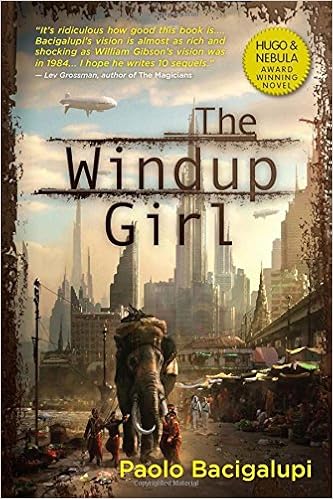

2017 seems to be a year we read, view, and listen through a dystopian filter, and Paolo Bacigalupi’s Windup Girl (Nightshade Books, 2010) shows us just how dark and dirty that filter can be, particularly in terms of gender, race, sexuality, and what it means to be “natural” or “human” in a Thailand set two hundred years in the future, where American genetic-engineering companies use calories as currency. Ecocritics will find this book, winner of the 2010 Nebula award, brilliant. I admire the world-building without wanting to venture further into its forbidding speculations.

Instead, I am indulging my passion for Margaret Atwood’s worlds, where genetic engineering and corporate greed are as dismaying and dystopian as Bacigalupi’s, but where energetic and sprightly characters prevail in even the most daunting circumstances. As I’m writing this, having not quite finished The Heart Goes Last (Doubleday, 2015), I’m hoping Charmaine and Stan—with the help of a crop of Green Men, a troupe of Elvises, and a Marilyn who is the love slave of a blue knitted teddy bear—will eventually reunite after their separate exits from the for-profit prison called Positron Project in the Town of Consilience in a place somewhere in Rustbelt, U.S.A.
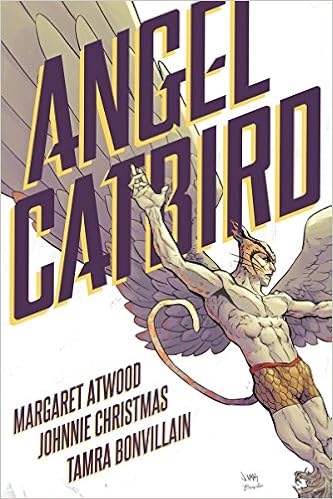


And then there’s Atwood’s graphic novel Angel Catbird (Dark Horse Comics, 2016), the illustrator of which has the wonderfully improbable name of Johnnie Christmas. Angel Catbird is cosponsored by the Canadian Conservancy’s initiative to Keep Cats Safe and Save Birds’ Lives. Trust me: in this story about another world of genetic engineering gone awry, keeping your cats inside the house is the best way to prevent them from becoming mutants.

And finally, there are the hysterically funny and sometimes just plain hysterical doings of Jimmy, Amanda, Glenn, and the rest of the characters of the MaddAddams trilogy (McClelland and Stewart: Oryx and Crake, 2003; The Year of the Flood, 2009; MaddAddams, 2013). In this dark world of genetically-engineered hybrids (ChickieNobs, anyone?) and postapocalyptic ecological disaster, the future may well rest with the gentle post-human Crakers, who turn blue when they’re in heat and travel in herds.

As to the pleasures of listening in 2017, you can hear Pamela Bedore speak more about the perils of environmental dystopias in Great Utopian and Dystopian Works of Literature (Great Courses, 2017). In this series of lectures ranging from Utopia to The Walking Dead, you’ll also find provocative and entertaining insights into the speculative worlds of Atwood, Charlotte Perkins Gilman, Ursula K. Le Guin, Octavia Butler, and Suzanne Collins. Bedore, an Associate Professor of English at the University of Connecticut, publishes extensively on popular culture, rhetoric, and genre fiction.

Speaking of The Walking Dead, I hear there are more near-future Congressional discussions about “reproductive rights” and “protecting the homeland.”

I think I’ll reread The Handmaid’s Tale.


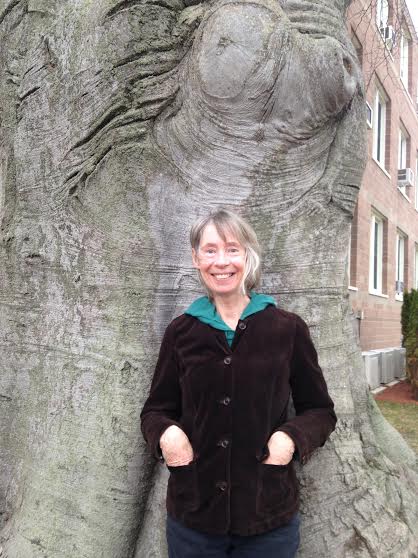
Susan W. Lyons worked at the Avery Point campus of the University of Connecticut for over twenty years teaching courses in writing and literature and, later, directing Academic Services, where she coordinated curriculum, scheduling, and academic support in writing, literature, history, math, chemistry, biology, and physics. She lives in East Lyme, Connecticut. Aqueduct published her debut novel, Time's Oldest Daughter, earlier this year.

Wednesday, February 22, 2017

Four Questions and Answers about Time's Oldest Daughter


Aqueduct Associate Editor Arrate Hidalgo Sanchez put four questions to Susan W. Lyons about her just-released debut novel, Time's Oldest Daughter:

Why Sin [the novel's protagonist]?

Because I always thought of her as, forgive me, more sinned against than sinning.  She has such an intriguing genealogy. I think about one of her literary ancestors as the Scylla in Homer’s Odyssey but also in Ovid’s Metamorphosis, a beautiful virgin who is transformed by the jealous sorceress Circe into a woman fair above the waist but with dog’s jaws below (maybe the original vagina dentata) that whelp hellish creatures.

Yikes! 

Another more recent ancestor, as described in Spenser’s Faerie Queene, is Errour: half woman, half serpent, who gives birth to all kinds of ugly little heresies.

Gender is destiny for them as well as both female characters in Paradise Lost, who are commanded to report directly to their authors rather than God. Eve reports to her author Adam from whose rib she is generated. Sin, less fortunate, reports to Satan, who births her parthenogenetically, the way Athena springs from the head of Zeus, although with none of his love or pride in her, nor with Athena’s early association with Wisdom. 

Come on, Milton!  Really?

Seriously, what kind of authority figure is Satan? To make matters worse, when Satan ignores her, it is God who assigns Sin to live with Death, bear more creepy monsters, and guard the gates of Hell. Where’s the free will in that? 

She’s a character begging to tell her own story her own way.

                                                                                                  
One of the things I love about Time's Oldest Daughter is its cheerful mingling of the chemical and the biblical. It seems to reflect your background in teaching science and literature at the same time. How has this informed your writing, and more generally, your approach to art?

I learned from Milton that distinctions between the metaphor, the metaphysical, and the physical are relatively recent. When, in book 2, he describes chaos with its “embryon atoms” (900) and “shock of fighting elements” (1014-15), can particle physics be far behind?  And while Milton’s timeline about Earth’s creation may be a little hazy, his ordering of light, water, and the “washy ooze” of the primordial (7, 303) travels companionably with evolutionary theory toward the origin of life. Sarah Tolmie, author of The Stone Boatmen and Two Travelers, has characterized Milton as the “domineering father of speculative fiction in English.” Although an irritating misogynist, Milton was also a marvelous world-builder who made connections between and among the emerging bodies of knowledge in 17th century metaphysics, natural science, and philosophy. 

Among more contemporary academics, the temptation is often to disaggregate knowledge into piles of specialized disciplines, but the metaphor remains as useful to a physicist constructing string theory as to a writer playing with time.  And who can resist a cosmic big bang?

You discovered feminist science fiction later on in life. How did it happen, and through whom?

It turns out I liked feminist science and speculative fiction all along, but I didn’t know that’s what it was called.  I admired the feminist writings of Betty Friedan, Simone de Beauvoir, Marilyn French, Elaine Pagels, and, in particular, Carol Gilligan, but I didn’t associate them with the kinds of speculative literature I enjoyed by Madeleine L’engle, Margaret Atwood, Ursula Le Guin, Angela Carter, Peter S. Beagle, and, later, Marie de France. I also liked the stories of John Milton, J.R.R. Tolkien and T.H. White, despite their offensive ground rules about race and women. I just didn’t put feminism and speculative fiction together.  Nor did I associate any of those stories with science fiction. You know—Chewbacca and outer space? 

Fortunately, my friend Pamela Bedore, an associate professor at the University of Connecticut whose areas of scholarship include popular literature and feminist theory, guided me gently into the vocabulary of literary genres. For non-theorists like me, Margaret Atwood’s In Other Worlds: SF and the Human Imagination (New York: Anchor Books, 2011) provides a wonderful introduction to the kind of world-building that can occur away from the patriarchal gaze.  In the introduction, Atwood describes an amiable argument with Ursula Le Guin about  fantasy, science fiction, and speculative fiction, the genre borders of which, Atwood writes, are “increasingly undefended, and things slip back and forth across them with insouciance” (7). 

An insouciant little story shrugs her shoulders as she travels freely and charmingly across those genres still guarded by canons and other academic artillery. “You can call me fantasy,” she murmurs to the remaining gatekeepers, “or you can call me science fiction.” Then she whispers, “Just make sure you call me.”


You have mentioned in the past that something you admire about feminist science fiction is the ability to re-imagine myths and fairy tales that are traditionally told by authoritative male voices in new ways. What does it mean for you to reimagine Milton's particular view on Genesis, the source not only of religious dogma but also of deeply-running assumptions about humanity's purpose on Earth?

Fairy and folk tales, quests, and myths are our creation stories: the first ones we learn as children; they form the foundation of our understanding of what it means to be human and gendered.  How did we get here?  Why are we here? What is our purpose? Do we discover knowledge or construct it?

Genesis provides a fundamental set of western creation stories and not one but two versions of how God makes humans.  In the first, from the King James version (1.27) “God created man in his own image, in the image of God he created he him; male and female he created him them.”  What a confusion of pronouns!  Robert Alter, in his Genesis: Translation and Commentary (New York: W.W. Norton, 1996), points out that “man” (the Hebrew is adam) is generic for human, and that ‘him’ is “grammatically but not anatomically masculine” (p. 5).  


The second version of this story occurs in the second chapter of Genesis: God creates Adam (Man) first and Eve (Woman) out of Adam’s rib, to be his helper.

Guess which version Milton chose?

But Milton was only reinforcing the dogma already in place for 17th century Crown and Cross, when the pronouns and sources of power had syncretized into the portrait of a ruler God who is singular, male, domineering, frequently angry, dangerously whimsical, and entirely transactional.  Eerily contemporary, yes?

And Milton was also writing literature that would find generations of Paradise Lost readers believing such a God was simply dull and overbearing when compared to Satan with his high energy, rhetorical flourishes, and championing of individuality. Talk about unintended consequences.

So you have to hope and believe that the dogma that locks Genesis in a dusty case in a dim room in the museum of the past can be trumped by literature that brings these stories out into the light of day and invites everyone to take a fresh look.


Monday, February 20, 2017

Time's Oldest Daughter by Susan W. Lyons


I'm pleased to announce the release of Susan W. Lyons' debut novel, Time's Oldest Daughter, in both trade paperback and e-book editions. As the cosmic Big Bang propels Time, energy, and matter into motion, God and Satan squabble over their respective domains while Sin and her son Death stew in squalor and despair at the Gates of Hell. All she wants is to care for her child, who has an enormous appetite but nothing to eat in their dreary prison, other than herself, of course. But then Sin notices, far above the stink and squalor of Hell, the clean and sparkling garden of Eden, where Death’s apple-cheeked cousins Adam and Eve enjoy delightful childhoods and plenty of fresh, wholesome food in a setting where Death himself could thrive. So what’s a good mother to do?

Sarah Tolmie, author of the acclaimed novel Stone Boatmen and Two Travelers, writes:
Time’s Oldest Daughter tells an impossible story of the world before the world, the time before time, when none of the categories we use to think with yet existed. Lyons spins out the intertwined beginnings of semiotics and physics, from the first separation of subject and object in language (Satan’s separation from God) to the necessary co-presence of matter and time in the universe (as Satan and his daughter Sin fall into the world of physical and temporal forces and order them through their experience). The primary agent who navigates the ongoing process of a creation that includes quarks and photons, bacteria and algae is female, and infinitely older than Eve: Sin, born in heaven before the fall, the shadow that fell as Satan stepped away from God. John Milton, Sylvia Plath, Stanley Fish and Julia Kristeva would all recognize themselves in this book, though none of them wrote it. Lyons did, and her remarkable rethink of Paradise Lost in the person of Sin, Satan’s daughter, struggling to find a place for her son, Death, in creation is wonderfully and determinedly original.”
Faren Miller, in Locus, notes, "Susan W. Lyons's lead quotes in Time's Oldest Daughter ignore the limits of fantasy, with a line from biblical ''Genesis,'' three from Paradise Lost, then Einstein at his most succinct: E=mc². The daughter (Sin) speaks in the first-person, addressing a Daddy who’s not Time (as the word always appears here, regardless of context) but Lucifer, Bringer of Light, AKA Satan.... Time's Oldest Daughter magnifies notions like winter-death to cosmic dimensions without excessive length, solemnity, or bombast. This Divine Comedy can be genuinely comic (raucous and vulgar, with a great cast of caricatures) yet manages to slip both wise and touching moments into its sly insights about life, the universe, et cetera.

You can purchase copies of Time's Oldest Daughter from Aqueduct here