Showing posts with label Gwyneth Jones. Show all posts

Sunday, December 20, 2015

The Pleasures of Reading, Viewing, and Listening, pt. 16: Gwyneth Jones


Movies, Books, Music, TV: My favourites of 2015
by Gwyneth Jones 


Movies

Girlhood: Celine Sciamma's Bande des Filles
 
Something totally out of the ordinary, a thrilling, touching, and unexpected story. (I’ve written a long review of this movie in a blog post: but the post is full of spoilers: http://www.boldaslove.co.uk/blog/index.php?/archives/352-Girlhood.html )

I watched the Oscar-laden Boyhood this year too: but on the tv. I thought the project, the real-time movie-making, was an interesting record. Didn’t see anything else special going on.

Mad Max: Fury Road  George Miller

Charlize Theron as Imperator Furiosa! The Desert Mothers! Like watching a Suzy McKee Charnas story come to life. I loved it.


Doctors Of The Dark Side, Martha Davies. A documentary account of all the procedures not rated as torture practiced on detainees held without trial or charge; sanctioned by the US authorities and carried out (my God) under medical supervision. It took me a long time to get round to this. A tough watch but essential viewing. 

The Guantanamo 22  (2 episodes: you can watch them on al jazeera) The story of 22 Uighurs, from what used to be Turkistan until the Chinese decided to add it to their territories, who got sold as terrorists to the US, and ended up in Guantanamo Bay; where they spent many years, although everyone agreed they were completely innocent. And of  the courageous people, lawyers and others, who fought with amazing, endless, determination to get them out. Explains, at least, what a bizarre bind the Obama government authorities found themselves in, when they finally tried to release the innocents scooped up in the first “War On Terror”. Does not explain the hideous treatment and conditions these men still had to endure. One of the lawyers puts it like this: “This is never going to go away. Some mistakes are not biodegradable”. Indeed. Humbling and dreadful; dreadful and humbling.

Books

I didn’t read any sf novels that really excited me this year (limited to what is available in the UK nb), so I’m going to go with two non-fiction books about the future-present, that I think everybody should read. They’re both about India, but they’re equally about the darkening world we’re all living in; if not now, then very soon. And about how to repair it.
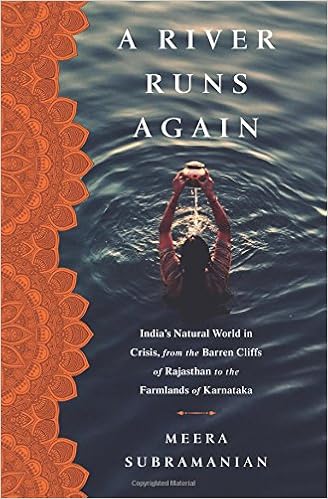

A River Runs Again, Meera Subramanian; Public Affairs, 2015

Mixed race US/Asian-Indian Meera Subramanian explores the global near future (ie, present day India). Crowded, hot, subject to violent swings in climate, with a government unable or unwilling to face the most vital challenges, the rich and poor living in worlds apart . . . Is there any hope? Well, yes there is. Absorbing, lyrical, down to earth and visionary. This is an beautiful and important book. You should read it.

Behind The Beautiful Forevers, Katherine Boo; Random House; 2012

Actually I saw the stage show of Behind The Beautiful Forevers, this year, done by the National Theatre (UK), in February. But  I immediately sought out the book, and though the stage show is terrific, the book is better. An unflinching, deeply sympathetic documentary account of the most abject poverty, clinging to life in the shadow of the New India’s wealthy elite. Unlike the stage show Katherine Boo’s original text does not find the greed, corruption and ruthless cunning of the destitute  cute & attractive (Oooh look at those poor people down there! They’re just like us! How reassuring!)

Music

Same as science fiction, I really haven’t done much music this year, except for going to the Green Man Festival in the Brecon Beacons (that’s in Wales); in August. Good music, good food, beautiful setting, great atmosphere, beautiful people; but the rain was just unbelievable. And the mud! In a class of its own.
But my music of the year?


Favourite Hit Single: has to be Lean On (Major Laser and DJ Snake; featuring MØ. Probably, mainly, for the absolutely gorgeous candy-coloured video, and MØ & all’s great dancing.

Favourite band: Songhoy Blues  Encounterd this exiled Malian guitar band at Green Man, where they were the hit of the weekend, wonderful to dance to (while the thunder and the hail roared outside the tent). The CD (Music In Exile) is mostly the same material, but slower, more thoughtful; more sad. I haven’t seen their movie They Will Have To Kill Us First yet.

Favourite Artist: Canadian Claire Boucher, aka Grimes I’m sort of hoping to get her album Art Angels for Christmas. But that’s a secret. Wouldn’t be the same if I asked for it.

TV

Elementary. The US version of Sherlock Holmes for the 21st century, and to me Jonny Lee Miller makes much more sense than Benedict Cumberbach’s infantile fop, in the UK’s Sherlock. I really don’t like it when people make out (in all forms of fiction) that very clever people are amoral babies, helpless fools in the real world. I started watching Elementary for Lucy Liu’s wardrobe. She looks amazing throughout, her clothes are absolutely divine. Kept on watching because I got hooked, and also because her “Joan Watson” role is brilliant. 

Series 1 was special. We’re now onto series 4, and inevitably the formula is somewhat formulaic. But still more entertaining than most.

& that’s all I can think of right now. Merry Christmas and a Happy New Year to all.


 Gwyneth Jones is the critically acclaimed author of numerous novels, short stories, and essays. She has been honored with the Philip K. Dick, World Fantasy, Clarke, and Tiptree Awards for her fiction, and the Pilgrim Award for her criticism. Aqueduct Press has published her short fiction collection Universe of Things, her essay collection  Imagination/Space: Essays and Talks on Fiction, Feminism, Technology, and Politics, her novel Life, her short story suite The Buonarrotti Quartet, and ebook editions of her Aleutian novels White Queen, North Wind, Phoenix Cafe, and Spirit. She lives in Brighton, England. 


Tuesday, October 13, 2015

Last call for P K Dick Award e-book bundle


If you haven't purchased the Philip K. Dick Award e-book bundle (see this post) and would like to, the sale ends Thursday at midnight EST. It's a great deal, and includes novels by Gwyneth Jones, Pat Murphy, Elizabeth Hand, Kathe Koja, and others. Just go here.

Tuesday, September 22, 2015

The Philip K. Dick Award Storybundle

Lisa Mason, one of this year's judges for the Philip K. Dick Award, has curated an e-book bundle of novels that have won the Philip K. Dick Award. Gwyneth Jones's wonderful novel, Life, is among these. This bundle will be available for a limited time, from Sept 23 through October 15. Here is Lisa, with the details:

 Above and beyond earning the distinction of the award, this unique and historic collection of eleven amazing books showcases the many-splendored spectrum of science fiction from classic themes to the avant-garde.
Visit the majestic city of the Ascendants in Elizabeth Hand’s Aestival Tide, the spooky abandoned storage closet down the hall in Kathe Koja’s The Cipher, rock-n-rolling San Francisco in 1967 in my own Summer of Love, a Martian colony with a terrible secret in Lewis Shiner’s Frontera, the visionary far future in Walter Jon Williams’ Knight Moves

As always at Storybundle.com, you the reader name your price—whatever you feel the books are worth. You may designate a portion of the proceeds to go to a charity. For the Philip K. Dick Award Bundle, that’s Science Fiction and Fantasy Writers of America (“SFWA”). SFWA champions writers’ rights, sponsors the Nebula Award for excellence in science fiction, and promotes numerous literacy groups.
The basic bundle (minimum $5 to purchase, more if you feel the books are worth more) includes:
  • Aestival Tide by Elizabeth Hand (PKD Finalist)
  • Life by Gwyneth Jones (PKD Winner)
  • The Cipher by Kathe Koja (PKD Finalist)
  • Points of Departure by Pat Murphy (PKD Winner)
  • Dark Seeker by K. W. Jeter (PKD Finalist)
  • Summer of Love by Lisa Mason (PKD Finalist)
To complete your bundle, beat the bonus price of $15 and you’ll receive another five books:
  • Frontera by Lewis Shiner (PKD Finalist)
  • Acts of Conscience by William Barton (PKD Special Citation)
  • Maximum Ice by Kay Kenyon (PKD Finalist)
  • Knight Moves by Walter Jon Williams (PKD Finalist)
  • Reclamation by Sarah Zettel (PKD Finalist)
All of these accomplished, traditionally published authors have received recognition and won multiple awards in addition to placing as a PKD Finalist or Winner, and we’re delighted their ebooks are available for the Philip K. Dick Award Bundle. Elizabeth Hand has won the World Fantasy Award (among many others), as has Gwyneth Jones. Pat Murphy has won the Nebula twice, Kathe Koja the Bram Stoker. The list goes on.

If you’re just dipping your toe into science fiction and not sure where to begin or if you’re a long-time fan and reader, this historic and unique collection is an excellent addition to your elibrary, providing world-class, award-winning reading right now and into the holidays.


So there you have it, my friends. The Philip K. Dick Award Bundle is available only from September 23 to October 15, 2015 and only via Storybundle. The bundle is easy to read on computers, smartphones, and tablets, as well as Kindle and other ereaders via file transfer, email, and other methods. You get multiple DRM-free formats (.epub and .mobi) for all books.

When the bundle is gone, it’s gone. So download yours today!

It’s super easy to give the gift of reading with StoryBundle, thanks to our gift cards – which allow you to send someone a code that they can redeem for any future StoryBundle bundle – and timed delivery, which allows you to control exactly when your recipient will get the gift of StoryBundle.
Why StoryBundle? Here are just a few benefits StoryBundle provides.
  • Get quality reads: We’ve chosen works from excellent authors to bundle together in one convenient package.
  • Pay what you want (minimum $5): You decide how much these fantastic books are worth to you. If you can only spare a little, that’s fine! You’ll still get access to a batch of thrilling titles.
  • Support authors who support DRM-free books: StoryBundle is a platform for authors to get exposure for their works, both for the titles featured in the bundle and for the rest of their list. Supporting authors who let you read their books on any device you want—restriction free—will show everyone there’s nothing wrong with ditching DRM.
  • Give to worthy causes: Bundle buyers have a chance to donate a portion of their proceeds to charity. The Philip K. Dick Award Bundle features Science Fiction and Fantasy Writers of America.
  • Receive extra books: If you beat our bonus price, you’re not just getting six books, you’re getting eleven!

Sunday, December 14, 2014

The Pleasures of Reading, Viewing, and Listening in 2014, pt. 3: Gwyneth Jones


The Pleasures of Reading, Viewing, and Listening in 2014
by Gwyneth Jones

This is going to be about books and movies, with a couple of excursions into Art. Music would be another essay!

January: we went to see the Katniss Everdeen show #2 (I mean The Hunger Games: Catching Fire) for our Christmas outing. Much better than the book, good idea to ditch all the "Peeta is interesting too! He has his cute handicrafts!” ; and to boost the revolution.  Downside: I don't know if you'd get me inside a Center Parcs holiday world now. I'd never be able to enjoy the fencing or the tree climbing, I'd be waiting for the poisonous fog and the mad mandrills the whole time.

February: we saw American Hustle, and I didn’t like it. Megastars, ingenuously dressed up to look tawdry, and loving themselves in the mirror. The best bit, the very best bit, was Jennifer Lawrence and the science oven. I'll stick with The Sting. Which I assure you is more authentically "Seventies." Then we saw Inside Llewyn Davis. Very well-crafted, excellent central performance,  limited folksong repertoire (the scraps left over from O Brother?); whole thing very mean-spirited. Those Coen brothers really did not like this Davis guy! And then we saw Under The Skin.  I like the original Michel Faber novel, which is grim but not horror, better. And Isserly the sympathetic fictional character makes a lot more sense than Jonathan Glazer’s blurred, confusing, alien femme fatale. But as arthouse scifi horror this was pretty good. Scarlett Johannson so has that bruised, slightly fleshy Monroe look worked out.

April: we saw John Michael McDonagh’s Calvary & it was stunning. Quirky "black" Irish  humour
fans of McDonagh’s  In Bruges and The Guard got a shock, Calvary  is a full-on, uncompromising morality play, harsh and pure as they come. I don't know what to compare it with, except maybe Park Chan-wook's Sympathy For Mr Vengeance. And all played out beside the bleak and beautiful strand under bare Ben Bulben's head. The entire audience at The Dukes sat in dazed silence without stirring as the credits rolled, and I have never seen that before.

May: I went to Manchester to visit my friend Mary. We saw Simon Armitage's The Last Days Of Troy at the Royal Exchange Theatre.  The production looked really good, and the action was thrilling, but everything lost focus after the interval, when Armitage strays  away from lifting stuff directly from The Iliad, and makes a bit of a hash of Book II of the Aeneid instead. Shabby treatment of Helen. I know Lily Cole is a supermodel, not an actress, but she’s not an idiot, and there’s no excuse for mutilating the really extraordinary thing Homer does: making Helen, of all people, his viewpoint character: the person who has been weaving on her loom the story the poet’s words tell. Wouldn't you think, in this day and age, a dramatist would know better? Also went to Opera North’s La Bohème at The Lowry, which was lovely. Young cast, believing every word of their story, looking like real, young examples of the bohemian life, and very sweet. 

JuneI didn’t get out much, but I read some books, including: Natsuo Kirino, The Goddess
Chronicle, a Japanese Creation Myth tale, a poignant, strange reminder of what "Okinawa" and "Iwo Jima" might have meant, if they didn't mean The War In The Pacific. Have to admit it's all about Death, and mainly about women (or Yin) getting the short end of that stick, but I liked it a lot. Will now seek her futuristic “hardboiled detective novels”  Belinda Bauer, Rubbernecker:  At first I thought this one was a bit of a conjuring trick. You say Our Hero has Asperger's, then you can do anything you like with him, including using any quirky internal musing (such as we neurotypics might easily indulge in), sound like you Know Everything about the Autistic Spectrum.  But I soon changed my mind. Really liked it. Gruesome fun, with compassion and a good heart. What more can you ask?


July and August: I have nothing special to report.

September: we saw Ben Power’s Medea, filmed live at the National Theatre,  and it was another stunner. Helen McCrory excellent in the name part, and Danny Sepani's Jason impressive: this imposing, successful man who's so good at compartmentalising, putting the brutal piracy and all that business in Colchis out of his mind, astonished that the foreign wife he needs to discard is cutting up rough. The type of man, I would say, if I was a savage or an Ancient Greek,  who positively calls down on himself (and others) the unstoppable, black, implacable force of a Medea. Great music by Will Gregory and Alison Goldfrapp.  NB, not a lot like Euripides.  I read Karen Joy Fowler’s, We Are All Completely Beside Ourselves : I was completely wrapped up in this book, and devoured it in a sitting. Only thing, I thought the storytelling ended too soon. I wanted the reunion, when the sisters meet again, for the first time, to be part of the story. Just that moment, no need to go further: let the rest of the book be (as it is) righteous and necessary footnotes. And then we saw Two Days One
Night, which I also loved. The Dardennes Brothers are so good at passionate drama about ordinary things, happening to ordinary people. I spent most of this movie, totally involved in  the action, thinking, oh no, this isn't going to work. Sandra isn't coping. If she wins this cruel little game and gets her job back, she’ll lose the last shreds of her self-respect. It'll be awful, terrible, she won't last a day . . . But the Dardennes were ahead of me. I can't tell you how or why (even though, after visiting with the Ancient Greeks, I'm feeling more annoyed than usual with that 'spoiler' concept) but it works. Just go and see the movie

October: we visited Shrinking Space's Digital Brighton show : a digital audio-art  installation about the Solar System, in a huge dank hangar, graffitied like an underground car park. Pairs of stools set by roof pillars dotted the endless concrete floor. We were given headsets, MP4 players, a brief induction, and were launched to wander.  Disappointed at first: I never read the advertising properly, I'd been expecting an update on NASA's "music of the spheres" (sound transcription of the radio emissions of the different planets), and instead I was getting human space science voices. I slowly became hooked. I didn't like Earth so much, it was too mundane (the Moon was a bit mundane too), and I didn't like the Sun, it was too big. I liked Venus and Mercury best of the planets, and Enceladus best of the moons, because it was most active, but it was difficult to hear Mercury: the Sun kept eating it. I liked Voyager a lot, because it was so thrillingly quiet, so mysterious; and I got confused by Rosetta. All the voices (apart from Earth and Moon) use the second person plural, uniformly, without a second thought. It's not a device out there, it is we. It is the people who are running the experiment, themselves. They had made a transition.

I also read a lot of sf, in preparation for two public engagements. Notably  The Girl In The Road,
Monica Byrne: A travelogue around India and Africa, in a day after tomorrow world where no we didn't get around to doing anything about global warming, but yes the technology did go on getting more and more marvellous. Pay attention when our free and easy heroine casually tells you, around page two, that she is psychotic. Of course she's psychotic, we're all psychotic, we are brutally murdering our own, literally our own, flesh and blood. An enthralling debut, full of wonderful invention but perhaps not meeting the criteria for positive, corporate-compliant sf;  in territory where older "Western" writers might fear to tread these days. NB, if you don’t like magical realism, walk away now. And The Machine, by James Smythe. A story all about male violence; why women stay with violent men; how women can feel ownership of a violent man’s power, even when he’s brutally abusive, and all against the backdrop of a stifling, paralysed, near future UK. Very impressive.

November: we went up to London to see the Anselm Kiefer Retrospective at the Royal Academy: having done our prep by watching the Imagine feature on the artist the night before. The staggering humungous scale of his operations had a somewhat chilling effect on me, so that when we reached the exhibition I ended up feeling most moved by the "Attic" pictures; that I first saw in the Liverpool Tate many years ago, and immediately co-opted into White Queen, my London-based, Wagnerian alien invasion story.  (Interestingly, the "Attic" picture I quoted in White Queen, Parsifal I was the only print available on sale when we exited through gift shop. Maybe Braemar Wilson bought it here! I didn't: just felt a little spooked, by a ghost of the fictional future.)

I was thrilled, I admit, by the mesmerising Aschenblume; the Shulamith and Margarethe diptych, and the Black Sunflower series ; and enjoyed watching people make the alarm go bleep by peering too closely at the sheets of lead embedded with real diamonds.  But move over, I kept thinking. Move over, Holocaust. We are entering uncharted territory now, you are no longer the terrible, absolute, unrepeatable, high water mark you once were. Our damnation is not in the past, it's engulfing this new century, and the huge mass of Keifer's evidence weighs against his ethereal promise of hope like a lead cathedral against a feather . . .

Installations of piled up paving stones, with a coulis of red grit, did nothing for me, however.
Very much impressed by Ida. This is SUCH a beautiful film, such limpid clarity, such economy of storytelling images: & absolutely amazing, as many people have said, to know that this is entirely digital. A story from the past, but timeless as the light on wintery Poland. What do you do, after the genocide? Years after, when you finally cannot live with what you know and partly know; when you decide the bodies cannot be left buried.  Good article from the director about the making of the movie here (if a little bit cocky):


December: two bookend movies , Effie Grey (Richard Laxton) and Mr Turner (Mike Leigh). I’m out of step here, I know, but I far preferred Effie Grey. Clearly this is the way things were,  but J.M.W Turner’s habit of routinely grabbing female flesh (of unthreatening inferior status)  and raping the woman  as briefly and complacently as he would take a bite from a veal and ham pie — was not endearing. Is “I know I’m unattractive” an adequate defense? No, it is not. Not now, not two hundred years ago. Bookends because both movies deal with a pivotal moment in art history, when the misty Modernism of the Age of Revolution (Turner) gave way  to the lurid colours (and awful drawing!) of the High Victorian Pre-Raphaelites. Comparing the two John Ruskins,  I felt Mike Leigh had it very wrong with his infantile fop. It's a long time since I read anything by Ruskin, but I know he had power & I think the twisted bully in Effie Grey was nearer the mark.  

I have no idea what anyone sees/saw in Interstellar. Possibly this is because I’m a jaded sf fan, unable get all excited by wild terms like "time dilation" or "the fifth dimension" if they don’t come with an engaging story or believable characters attached. Or possibly because it was unutterably boring, very much too long, and hogwash. But then as a treat we watched Guardians of the Galaxy the other night on Netflix, and it was pretty good.

Right now I’m reading  Jessica Cornwell's The Serpent Papers, a spooky mystical thriller about Alchemy and Barcelona.  And looking forward to my Christmas holidays, during which I plan to read The Goshawk, T H White,  H Is For Hawk, Helen MacDonald, Tangara, Nan Chauncy, and The Heart Of Midlothian, Walter Scott.  And finally, here’s something rare and strange, a surreal, all female apocalypse from dissident film makers in Communist Czechoslovakia: introduced to me by David Sorfa of the University of Edinburgh: Late August At The Hotel Ozone

Happy New Year

 Gwyneth Jones is the critically acclaimed author of numerous novels, short stories, and essays. She has been honored with the Philip K. Dick, World Fantasy, Clarke, and Tiptree Awards for her fiction, and the Pilgrim Award for her criticism. Aqueduct Press has published her short fiction collection Universe of Things, her essay collection  Imagination/Space: Essays and Talks on Fiction, Feminism, Technology, and Politics, her novel Life, her short story suite The Buonarrotti Quartet, and ebook editions of her Aleutian novels White Queen, North Wind, Phoenix Cafe, and Spirit. She lives in Brighton, England. 

Friday, November 22, 2013

Remember Gywneth Jones's Eve Wars?

Remember my post last month linking to a NY Times article about the problems faced by women and girls doing science? And about how the article discussed the difficulties created by US culture in particular? Browsing the SF Signal's linkpost for today, I came across a piece titled "Saving Science Fiction from Strong Female Characters." (If you want the link, you'll have to go to the SF Signal to find it.) This lengthy rant is a farrago of assertions so confused and irrational that I finally had to give up trying to make sense of. What I did make out, though, is that the post's author, one John C. Wright thinks science fiction is (once again) being threatened, particularly by reviewers who draw a distinction between sex and gender-- on the grounds that it is obscuring the true, essential categories of "masculinity" and "femininity." I gather, also, that he sees the distinction as an attack on culture tout court (not on a culture, but on culture itself).

Here's the nub of his argument:
Anyone reading reviews or discussions of science fiction has no doubt come across the oddity that most discussions of female characters in science fiction center around whether the female character is strong or not.

As far as recollection serves, not a single discussion touches on whether the female character is feminine or not.

These discussions have an ulterior motive. Either by the deliberate intent of the reviewer, or by the deliberate intention of the mentors, trendsetters, gurus, and thought-police to whom the unwitting reviewer has innocently entrusted the formation of his opinions, the reviewer who discusses the strength of female characters is fighting his solitary duel or small sortie in the limited battlefield of science fiction literature in the large and longstanding campaign of the Culture Wars.

He is on the side, by the way, fighting against culture.

Hence, he fights in favor of barbarism, hence against beauty in art and progress in science, and, hence the intersection of these two topics which means against science fiction.
I suspect it's significant that the author's antagonism is directed at reviewers (who are, in his view, apparently only innocent dupes). Whether these reviewers are male or female or both is unknown, since we can safely assume that someone who suggests that innocent reviewers are subject to the corrupting influence of "mentors, trendsetters, gurus, and thought-police" is likely to insist that "he" is a "universal" pronoun. The very idea of a gender-neutral pronoun, of course, would be anathema to someone who believes that drawing a distinction between sex and gender is barbarous. And distinguishing between culture in general and US culture in particular is also probably anathema.  Regarding US culture as merely one of many cultures (and US culture as it currently exists as only one possibility among many) would of course make gender essentialism impossible, since the white heterosexual male of US culture could not then stand for the unmarked universal human such arguments insist he is. 

Why, you may wonder, am I granting any attention at all to such a confused mess of a post written by someone I've never heard of? I suppose it's because I see it as coming from the same place as the more laconic but equally simplistic pronouncements of more powerful speakers who keep insisting that "real girls" and "real women" have only limited capabilities for doing so science and that women/girls who excel at science must therefore not be "real women" or "real girls." What particularly interests me in this case is that it illustrates how visible and more apparent the complications of gender have become in our field than in US culture as a whole. This rant against "strong female characters" is not unusual within the field, of course. (And certainly the attack last summer on NK Jemison was by far more vicious.) But it strikes me as significant that the argument here has shifted from attacking the active presence of women in the field to attacking an acknowledgment of any degree of complexity of gender, making the very idea of gender the enemy of science fiction in particular and culture in general. It is precisely the scenario of Monique Wittig's utopia Les Guérillères.When a translation of that novel was first published in the US, the very idea of separating sex from gender was still new and strange. And so quite a few people reading it didn't understand that the war "the women" were fighting was not against men, but against gender essentialism. (Gwyneth Jones's "Eve Wars" in her Aleutian series offers another version of that war, fought by men and women on both sides of the conflict.)

Have defenders of gender essentialism actually become conscious of the distinction between sex and gender? If so, we might be entering a new phase of the struggle. Changed consciousness about gender isn't necessarily a positive thing. (See the Aleutian series for more on that.) But it is certainly something to think about, especially with reference to certain works of feminist sf.


Monday, December 10, 2012

The Pleasures of Reading, Viewing, and Listening in 2012, pt 2: Gwyneth Jones

2012 Review 
by Gwyneth Jones 

Looking back, I managed to get out of the house for an unusual number of new movies this year, but I don’t know if that reflects a good year, or the fact that my son Gabriel, indefatigable movie-fan, was at home, and Brighton’s only Art&Indie house is at the bottom of our hill. The ones that stand out for me are Sean Durkin’s Marsha Marcy May Marlene, the short-on-answers account of how a young woman, already robbed of personhood for reasons only hinted at, gets recruited to a brutal little backwoods cult, and ends up (we glimpse, as the credits roll) bringing the horror back home to her own family; where maybe it began? This is so much a movie for reading between the lines, I felt at times that my own reading was a found object, but the artful, slow-building, bewildering wrongness is definitely really there. Fine performances from Elizabeth Olsen as the identity-stripped girl, and John Hawkes as the (somewhat generic!) Evil Psycho Patriarch.
Also Headhunters, a very black comedy adapted from a Jo Nesbo thriller, was so much fun. From my blog: “I feel many will agree that the passage involving the Vicious White Attack Dog, and the Venal Farmer's Horrible Old Tractor, had a special and glorious charm”. A guilty pleasure. A Royal Affair was unexpectedly engrossing, an intellectual and affecting costume drama about mad King Christian VII of Denmark, and the lovers (the king’s tutor and his wife) who used their power over him, and his affection for both of them, to transform the grim fate of all but the ruling class, in feudal/oligarchic Eighteenth Century Denmark. Of course it can’t last, and of course there is hell to pay, but what a story. The arrogant carelessness of the young Utopian couple is heart-breaking, the coda rather wonderful. A true story? Well, maybe. To a surprising extent, maybe yes. Mikkel Boe Følsgaard was absolutely fantastic, and touching, as the mad king.

Honorable Mention to Weekend: the simple story of two young men, picking each other up at a club in Nottingham and spending the weekend together while accidentally, truly, falling in love. Refreshingly, no fuss is made of the sex scenes, and they are frank as they would be for a heterosexual version, without any apology. Unusually, for the British Midlands Realist school of filmmaking, Weekend is not aggressive, distressing, miserable or violent, and nor is it sugar-coated. A gentle gem.

The line between right and wrong is not drawn between the sexes, especially not in Eighteenth Century Denmark, but the pathologies of the traditional sex roles are harshly spotlit in Marsha Marcia May Marlene. Child soldiers, sexual slaves, utterly corrupted, corrupting in their turn... I thought of that feral patriarch, and his awful, sinister, coaxing, assistant wives, when my library-book reading lead me to Aminatta Forna’s beautiful, lyrical novel The Memory of Love, and Elsa Osorio’s dry, docufiction style My Name Is Light (read in translation, nb). Respectively, an unravelling of the terrible recent past that the people of Sierra Leone have to live with (and mostly prefer not to think about), and a forensic examination of what happened to the children, in the tragedy of Argentina’s “disappeared” generation, these are two gripping modern history books, and  I think they’re better for being fictionalised. Fiction, ironically, can tell more of the truth and leaves the most awkward questions fewer places to hide.

In March I went to Katwijk aan Zee as the guest of Beneluxcon. I’d decided to speak on “Ghosts” with an emphasis on M R James and Arthur Machen. The coast of Suffolk, the Grandmaster’s favourite haunting ground, is just across the North Sea from Kawijk, and has the same character, in season. (Out of season it’s a pretty and cheery holiday spot): lost villages, the mysterious dunes; the long, silent, chill and desolate sands). This gave me an excuse to revisit Sheridan Le Fanu’s classic Irish novel of macabre, not as well known as some of his works: The House By The Churchyard. There’s a rather nasty ghost story embedded in these expansive pages, and a murder mystery featuring startlingly modern detective work, but really I love it for the atmosphere of a bygone age recollected (Le Fanu always liked to set his stories in the past): lost souls, who strive in vain to save themselves from damnation; the fragility of innocence. Also highly recommended, and a genre novelist completely new to me, Caitlin Kiernan. I very much admired (and envied) The Red Tree, an assured and scary psychological updating of Lovecraftian themes. I read The Hunger Games, before I went to Benelux, and enjoyed it —a lot more than I liked Twilight, anyway, though maybe not as much as I liked Susanne Collins’s Gregor The Overlander series. Later I thought the movie was very successful. Jennifer Laurence is a great choice for Katniss Everdeen, and the visual medium can skim over the details of outfits, manicures and hairdos which become tedious in print. My problem with the trilogy (shared by young adult readers I’ve talked to) is the third episode, in which Katniss pretty much appears only to tell us, every so often, that she is bored out of her mind by all the politics... I hope the moviemakers will do better.

Finally, I’ve spent most of this year on short stories and on the project of getting my backlist into eprint. For the last few months —far longer than I intended!— I’ve been obsessed with the remastering of Divine Endurance (1984) and Flowerdust (1993), “companion novels” set in a far future South East Asia. I’ve got the single narrative, single volume edition up on Kindle now, but on the way to this happy conclusion I was lucky enough to spot The Garden Of Evening Mists, Tan Twan Eng, on the Booker short list, and surfaced for long enough to snag a copy. Set in the Cameron Highlands of the Malaysian Peninsula, this is partly the summing up of a Malaysian-Chinese judge’s life, at a time when she knows her mind is on the brink of dissolution, and partly a reconstruction of yet another savage, largely forgotten “low intensity” war; the Communist Insurgency in Malaya in the fifties. Very beautiful, absorbing, and evocative. I didn’t get the tattooing strand, but I really loved the rest.

Best Theatre, The Heresy of Love (a new play by Helen Edmonton based on the life of Mexica poet and thinker, Sor Juana Inés de la Cruz) at Stratford.

Best visual arts show: Bronze at the Royal Academy, by a mile. On a much smaller scale, Lindsey Seers' immersive, disorienting, and gender-bending Entanglement at the Turner, Margate, in July.

And if by any chance you think Modernism isn’t too weird... Or only for old hippies... Brighton’s Music Of Our Time strand, in the Brighton Festival, in May, “The Musician’s Body’ made a huge impression on us. A highlight was virtuoso of the seventies, Frederick Rzewski, playing his epic masterpiece The People United Will Never Be Defeated (variations on a Chilean revolutionary chant), but MOOT goes from strength to strength. Jonathan Powell came to Brighton to play Messiaen's Vingt regards sur l'enfant Jesus in October, which was just fabulous.

This week, but too late for this deadline, I’ll be going to MOOT’S Christmas with the Schoenbergs (more Modernism) and getting harrowed and torn apart by Hanecke’s Amour. It’s for my own good.

Oh, I see I missed out non-fiction reading. And TV. Never mind. Enough is enough.


Gwyneth Jones is the critically acclaimed author of numerous novels, short stories, and essays. She has been honored with the Philip K. Dick, World Fantasy, Clarke, and Tiptree Awards for her fiction, and the Pilgrim Award for her criticism. Her most recent books are Universe of Things,  Imagination/Space: Essays and Talks on Fiction, Feminism, Technology, and Politics and Spirit, a novel.  She lives in Brighton, England.