(Extracted from Alexis Lothian's post at https://otherwiseaward.org/news)
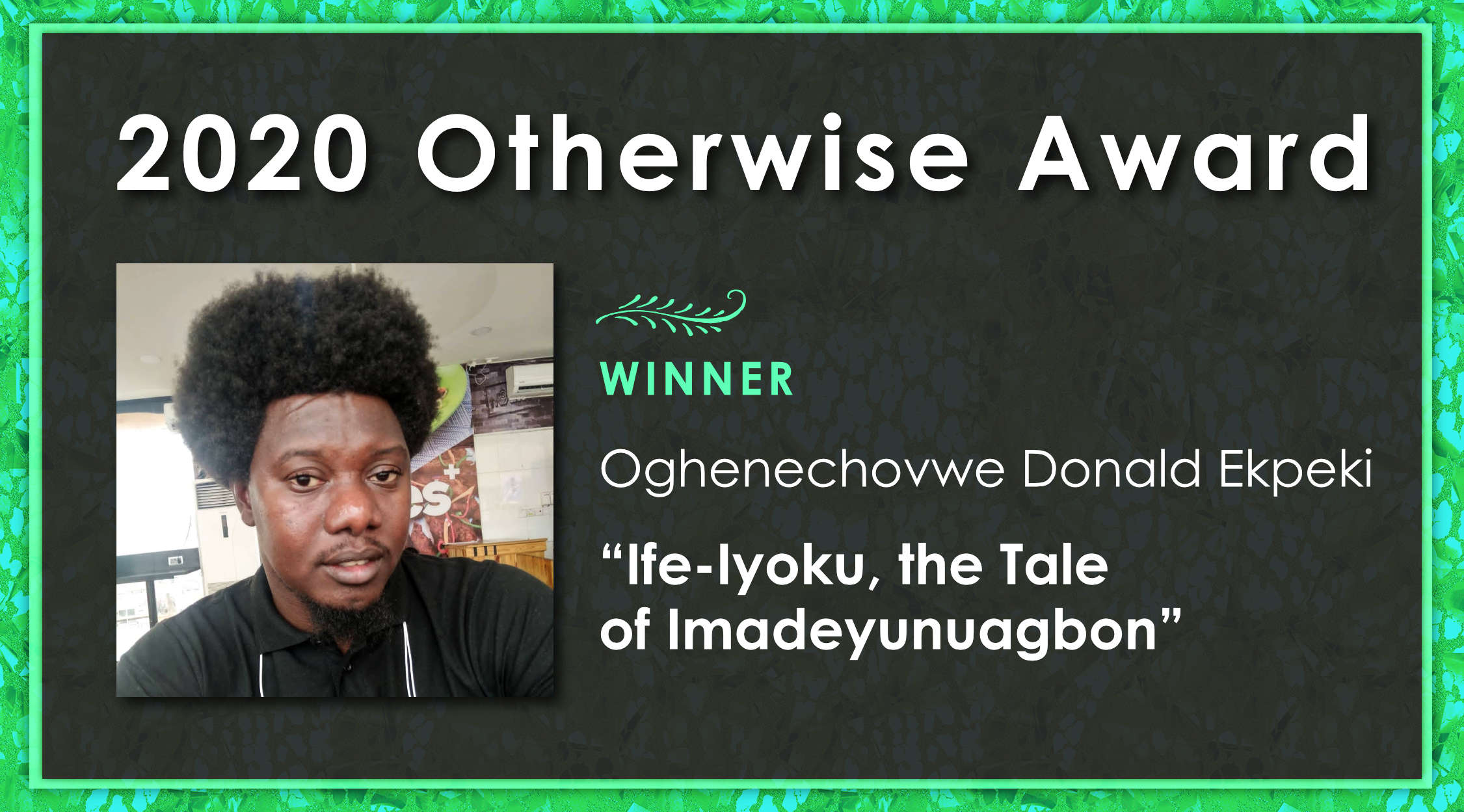
Oghenechovwe Donald Ekpeki has won the 2020 Otherwise Award for “Ife-Iyoku, the Tale of Imadeyunuagbon” (in Dominion: An Anthology of Speculative Fiction from Africa and the African Diaspora, edited by Zelda Knight and Oghenechovwe Donald Ekpeki, Aurelia Leo, 2020).
The 2020 jury comprised Chesya Burke, M.L. Clarke, Liz Henry (chair), Annalee Newitz, and Tochi Onyebuchi.
A virtual award ceremony will be held on Saturday, October 30, 2021, at 3pm EST. For details on how to join, please check the website for A Room of One’s Own Bookstore, which is hosting the event.
This year’s winner, “Ife-Iyoku, the Tale of Imadeyunuagbon” by Oghenechovwe Donald Ekpeki, was a unanimous favorite in a rich field of literary explorations around gender, sex, and related societal roles. We are delighted to present Ekpeki’s tale, a novella first published in Dominion: An Anthology of Speculative Fiction from Africa and the African Diaspora (Aurelia Leo), as this year’s recipient of the Otherwise Award.
In the winning story and the Honor List, several overlapping themes stood out. Like “Ife-Iyoku,” many of the Honor List stories treat gender in the context of intersectionality—we see how racialized, national, and ethnic identity, as well as disability, affect gendered experience. Several stories grapple with the fact that trans men, trans women, nonbinary people, and other embodied entities walk different paths than cisgender people, and that affects how they experience the world as gendered beings.
A number of stories deal with queer elders, including City of a Thousand Feelings, The Seep, and The Four Profound Weaves. Though science fiction and fantasy have a long tradition of celebrating wise elders, whether they are high-level wizards or ancient AIs, it is rare to see them explored in a queer context. These stories demand we acknowledge that one doesn’t stop growing, healing, hurting, or being lost and in need of re-forging community and place with age. They also describe ways that queer elders provide models to the young, how they may fall short, and how younger generations engage with them, while also celebrating the different ways each generation expresses themselves.
Given the events of the past several years, perhaps it is no surprise that exile was a theme that came up in these stories over and over: in “Ife-Iyoku,” “The Moon Room,” Depart, Depart!, The Mermaid, the Witch, and the Sea, City of a Thousand Feelings, and Four Profound Weaves, we meet characters who have been cast out of their homelands and are searching for a way back. As they struggle with their sense of dislocation, our heroes and antiheroes must find a way to construct new kinds of home, with their chosen communities. Often, this sense of exile is compounded by environmental destruction associated with climate change—another theme in many of these stories, which grapple with the multi-generational legacy of industrial production and agricultural waste.
The environment isn’t just a force “out there”—it affects our bodies, both physical and political, as well as our social roles. In these stories, we can feel those effects. We meet people who can wring rain out of the air, build floating cities, transform themselves into clouds of gas, merge with machines, and transcend the world altogether. We feel the heat and moisture and sickness that come with a carbon cycle that is perturbed beyond all measure. Our identities do not end where our skin meets the air, but instead are part of ecosystems. And when those ecosystems are under attack, so are we.
Many of the Otherwise honorees grapple with this idea by showing us how our bodies are permeable to the environment. This is especially apparent when it comes to the mechanized bodies of the characters in “Helicopter Story” and “Custom Options Available.” Here we see characters whose gendered bodies have been rebuilt to function as weapons, or hyper-productive workers—a literalization of the ways that patriarchy and capitalism demand that we refashion ourselves as things-to-be-used rather than people.
The Otherwise Award honors stories that expose the many ways we experience gender in this world and others. This year we were thrilled to see so many brilliant authors taking a nuanced, complex approach to the topic—giving us characters we will never forget, in worlds as alien as our own.
The jury for the 2020 Otherwise Award wishes to thank readers and writers alike for their deep engagement with works that explore and expand our concepts of gender.
Winner: 2020 Otherwise Award
In a year crowded with stellar work that interrogated, celebrated, and contextualized gender in the way that only speculative fiction can, “Ife-Iyoku, the Tale of Imadeyunuagbon” stood out. Not only did it distinguish itself with the thematic concerns in which it engaged but also through the cohesion with which the story’s concerns were handled. This story situated discussion and depictions of gender, attendant expectations, constrictions, and transcendence in a situation and cultural and religious schema still vanishingly rare in the genre, and remained an entertaining and emotionally scopic story in the process.
What could have easily slipped into a stereotypical depiction and affirmation of patriarchal norms among the pre- or post-colonial African societies presents itself instead as the struggle of a community in the context of colonialism and colonization, a context that pits the impetus for communal survival against the dictate toward individuality. What does it look like to have gender roles enlisted in the pursuit of a community’s survival against larger, aggressive, unreasoning entities? How does the threat of annihilation further entrench that social schema? In the context of the story, childbearing isn’t a mandated duty because those identified by the community as women are too weak for combat but because childbearing is the only vehicle of the community’s continued existence. Such a distinction read to us, the jury, as a lived principle among the characters rather than mere scaffolding for oppressive policies, and the skill to which this dynamic was pulled off in the story impressed us greatly.
We loved the story’s critique of the idea that an extremely special, powerful place can ever be magically protected from the ravages of colonialism. Here, Ekpeki is careful to show us the downside of living inside this protected shell: the village is still operating as a monarchy, where women’s views are marginalized, and this leads directly to repeating the very scenario that made many African civilizations vulnerable to the incursions of European slavers. As the story unfolds, we realize that it is impossible for any community to remain isolated from imperialism, even if they have superpowers. And this makes the story a more powerful allegory—as well as a more truthful account of how power works.
A story that contains everything that “Ife-Iyoku” contains could easily have burst at the seams, but one of this work’s most stunning and impressive qualities is its cohesion. In the exciting cinematic opening, a team of psychically gifted hunters battles a mutant, winged, lava-breathing dinosaur. Over the next few chapters, the complex web of the community, its history, its divisions, and its context in the world are revealed, leading us to a situation that shows the disruptive power of a single woman’s choices, and her insistence on self-determination. In addition to presenting a dramatic and three-dimensional discourse on gender, community, and sacrifice, the story also gives us an inversion of a creation myth wherein the gendered nature of such tales is treated in a grounded and nuanced manner. Not once did it feel like the story’s many themes and aspects existed in isolation. That the story, as much as it holds within it, reads as a seamless piece is a testament to the craft on display.
“Ife-Iyoku” is a work of daring moral imagination as well as a story expertly constructed. What makes this story’s achievement even more spectacular is that it hardly emerged as the lone blossom in an otherwise fallow field of storytelling on gendered themes. Rather, this year’s winner stood out for the jury in a bumper crop of thought-provoking and challenging speculative fictions. For this reason, we are delighted to share the following Honor List, of eight other 2020 tales that significantly advanced our genre’s explorations of gender, sex, and societal roles, in unranked order but with the deepest of congratulations to all.
Honor List: 2020 Otherwise Award
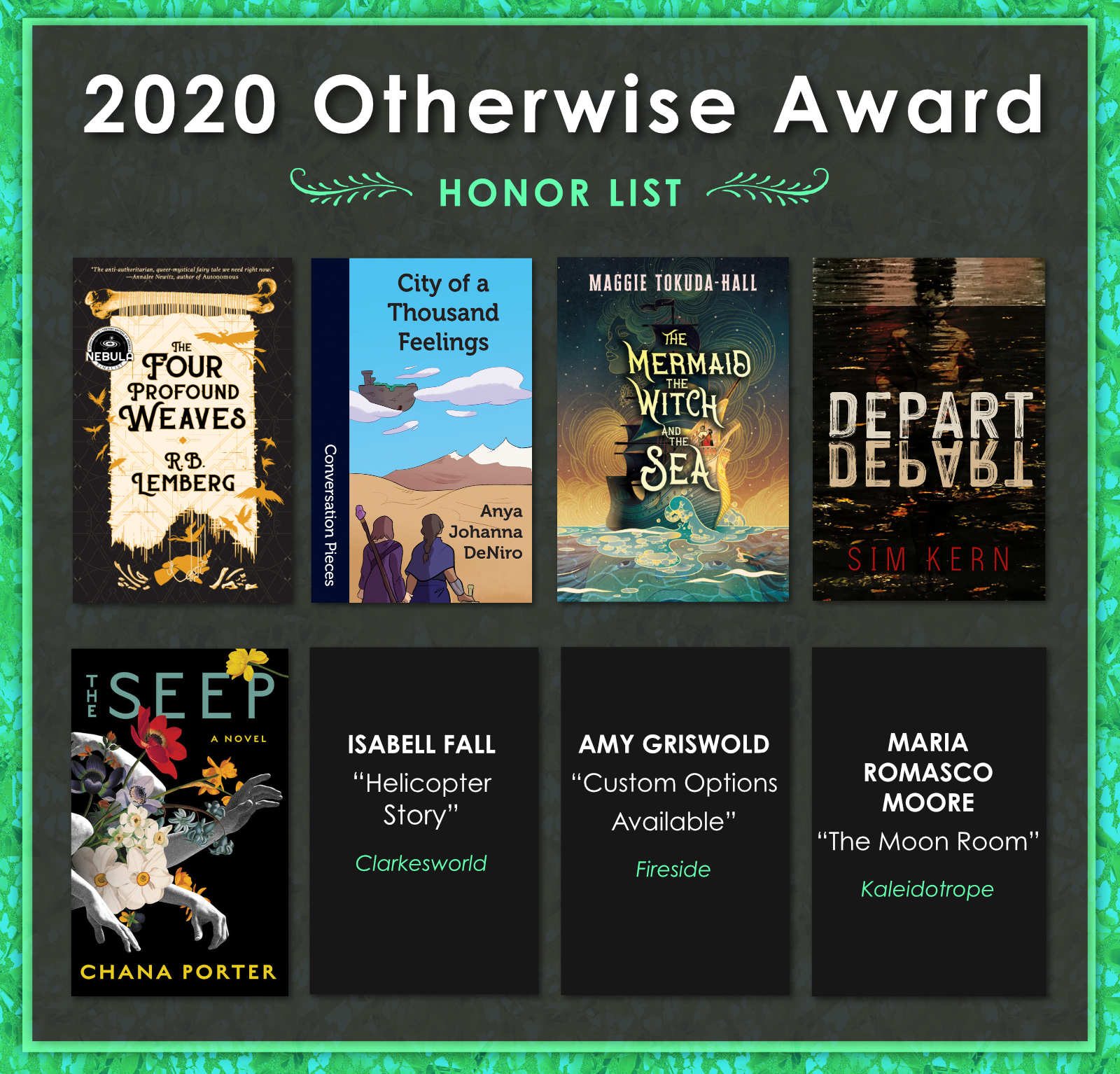
- R.B. Lemberg, The Four Profound Weaves (Tachyon Publications, novella)
- R.B. Lemberg’s The Four Profound Weaves explores the intertwined lives of genderfluid and trans elders who live in a world that hovers between dreams and ancient history. It centers on a nameless man, exiled from his home for moving between genders. He’s on a quest to find an old friend, Benesret, who has the power to weave textiles that embody the four “profound” human experiences of hope, change, wanderlust, and death. Haunting and delightful by turns, the story explores a world of nomads and city-states, magic and art, youth and age, and ultimately what it means to remain friends even as the world and our identities shift like desert sands.
- Anya Johanna DeNiro, City of a Thousand Feelings (Aqueduct Press, novella)
- In a swooping poetic allegory, Anya Johanna DeNiro’s City of a Thousand Feelings takes us with trans exiles into battle as they try to enter a city of dreams and wonders, only to be turned away by militant patriarchal villains. Relationships form under pressure, lapse, and are taken up again years later, as the protagonists hide in exile or continue to fight in wars. Finally, new generations are born with new goals, creating their own amazing city, built on the work of the elders who fought so hard to make a world where that was possible. Deeply moving.
- Maggie Tokuda-Hall, The Mermaid, the Witch, and the Sea (Candlewick Press, novel)
- Maggie Tokuda-Hall’s The Mermaid, the Witch, and the Sea is an exciting, complex story about a young nonbinary pirate and an aristocratic young woman figuring out who they are in the face of danger. Unable to return to their homelands, pursued by nasty colonizers, they form an alliance that grows into a fierce and wonderful romance. We can’t wait to return to the world of The Mermaid to learn more about these delightful characters, their cool magic system, and the ways they might start to resist a tyrannical empire!
- Sim Kern, Depart, Depart! (Stelliform Press, novel)
- Depart, Depart! follows Noah, whose escape from climate disaster in Houston to a refugee camp further north is complicated by more specific needs for safety and key resources as a young trans man. Luckily, he has a ghostly ancestor for an ally, and a wealth of ethno-familial history to lean on as he navigates his distinct instant of a struggle for a sense of home, belonging, and acceptance that stretches back eons.
- Chana Porter, The Seep (Soho Press, novel)
- The Seep, set in San Francisco in homage to Starhawk’s The Fifth Sacred Thing, takes a somewhat bitter, leather-jacket-wearing butch dyke protagonist into a post-singularity future where alien nanobots ingested as a drug make almost everyone super happy. Her search for meaning and connection takes place within a community indifferently giving up specific embodied histories, to become whoever and whatever they wish with seemingly no adverse consequences, while she questions whether identity can have meaning without its histories.
- Isabel Fall, “Helicopter Story” (Clarkesworld Magazine, short story)
- Isabel Fall’s “Helicopter Story” created an intense and divisive reaction. For the jury, this is a story that extols the triumphant gender/sex-messiness of the protagonist’s transition into a military weapon, exposes the ways that the military industrial complex can co-opt some of our deepest human social structures to weave our identity construction into components of a bigger machine, a military force. With beauty, depth, and sensitivity, Fall describes Barb’s gendered precision, feelings, fierceness, and relationships built on the trust developed in battle. It is a love story in the mil-sf tradition, one where its heroes, whose identities are tied to war, begin to question the ethics behind that war.
- Amy Griswold, “Custom Options Available” (Fireside Magazine, short story)
- Another story that explores mechanization and gender-modelling is Amy Griswold’s “Custom Options Available,” a joyous romp in which a retired mining robot chooses gender and sexuality configurations, then cruises for partners. The protagonist then starts to uncover feelings and preferences that they didn’t choose, including a fierce desire for freedom and self-determination.
- Maria Romasco Moore, “The Moon Room” (Kaleidotrope, short story)
- Maria Romasco Moore’s “The Moon Room” brings us into a glittering, but gritty, urban world of drag bars and clandestine identities as seen through the eyes of an alien. Trained from a young age to hide her true nature, she takes photographs of drag queens and revels in their ability to be seen—while the pressures of hiding her polymorphous body drives her to drink and blackouts. Luckily, queer joy saves her from a life of hiding—and she’s finally able to come out as the beauty she is.


