Aqueduct Press kicks off the new year with a new issue of The Cascadia Subduction Zone. This issue includes a speech by Nisi Shawl given last fall, poetry by Neile Graham and Maya Chhabra, a Grandmother Magma column by Jennifer Stevenson, and reviews of books by Seanan McGuire, Jane Yolen, Ursula Pflug, and others. The issue's art work and art essay is by Chris Roberts, who illustrated Claire North's novel The First Fifteen Lives of Harry August. You can purchase a single issue (electronic) for $3 or $5 (print) or a year's subscription for (electronic) $10 or (both print and electronic) $16 at http://thecsz.com/.
Vol. 8, 1 (2018)
Essay
Genius Communitas
by Nisi Shawl
Poems
Suite of Poems
by Neile Graham
Singers of the Deep
a response to Alexander
Pushkin’s “Arion”
by Maya Chhabra
Grandmother Magma
Why Science Is Practiced So Awkwardly Reflections on Gender and
Science, by Evelyn Fox Keller
by Jennifer Stevenson
Book Reviews
The Wayward Children series,
by Seanan McGuire
reviewed by Arley Sorg
Mountain, by Ursula Pflug
reviewed by Joanne Rixon
The Obama Inheritance, edited by Gary Phillips
reviewed by Cynthia Ward
Luminescent Threads, edited by Alex Pierce
and Mimi Mondal
reviewed by Ayana Jamieson
The Emerald Circus, by Jane Yolen
reviewed by Kristin King
The new issue of the Cascadia Subduction Zone is out. This issue features an essay by L. Timmel Duchamp on living amid the many unevenly experienced apocalypses of the early 21st century, poetry by Rose Lemberg and Sonya Taaffe, a Grandmother Magma column on Mildred Clingerman by Nancy Kress, a half-dozen book reviews, and art work by Karen McElroy. You can purchase an electronic edition for $3, or a print issue for $5, or subscribe, at http://thecsz.com/index.html.
Volume 7, 3
Essay
Until the Next Time
by L. Timmel Duchamp
Poems
The Repository
by Rose Lemberg
Dis Genite et Geniture Deos
Cosmopolitan Bias
by Sonya Taaffe
Grandmother Magma
Mildred Clingerman: Imperfect Subversive
in a Peter Pan Collar
by Nancy Kress
Book Reviews
Bodies of Summer, by Martin Felipe Castagnet, translated by Frances Riddle
reviewed by Maria Velazquez
The River Bank, by Kij Johnson
reviewed by Lynette James
Re-visioning Medusa: From Monster to
Divine Wisdom, edited by Glenys Livingstone, Trista Hendren, and Pat Daly
reviewed by Phoebe Salzman-Cohen
Time’s Oldest Daughter, by Susan W. Lyons
reviewed by LaShawn M. Wanak
Mormama, by Kit Reed
reviewed by Arley Sorg
Amatka by Karin Tidbeck
reviewed by Tansy Rayner Roberts
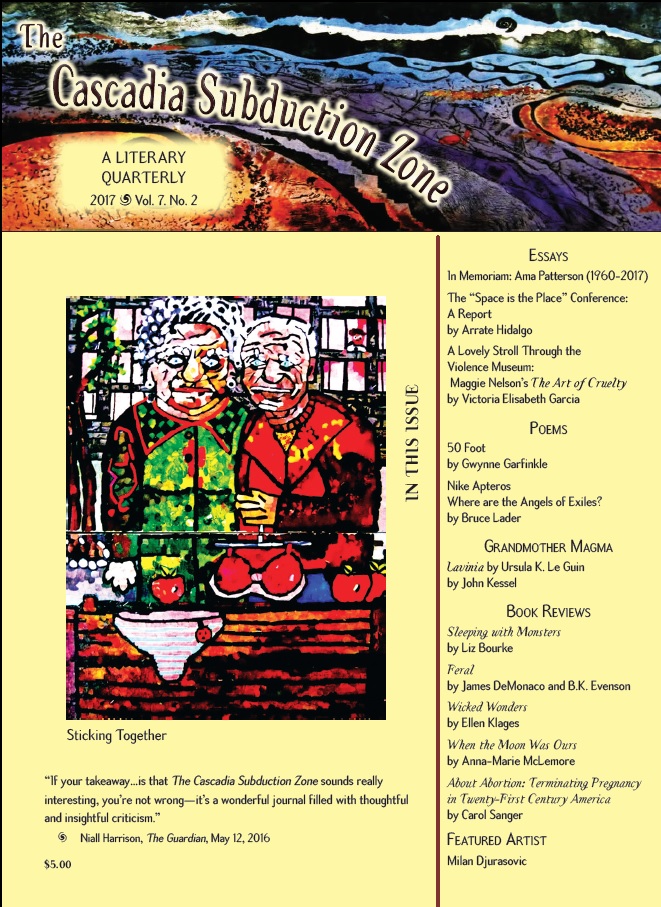
The new issue of the CSZ is out. It includes an essay by Victoria Garcia on Maggie Nelson's The Art of Cruelty, a report by Arrate Hidalgo on the Space is the Place conference held in Tel Aviv in April, and a memorial for Ama Patterson; poetry by Gwynne Garfinkle and Bruce Lader, a Grandmother Magma by John Kessel on Ursula K. Le Guin's Lavinia, and reviews of several recent titles. This issue's featured artist is Milan Djurasovic.
The issue is available in pdf format for $3, and in print for $5; a print subscription is $16, an electronic subscription $10, here: http://thecsz.com/.
Essays
In Memoriam: Ama Patterson (1960-2017)
The “Space is the Place” Conference: A Report
by Arrate Hidalgo
A Lovely Stroll Through the Violence Museum:
Maggie Nelson’s The Art of Cruelty
by Victoria Elisabeth Garcia
Poems
50 Foot
by Gwynne Garfinkle
Nike Apteros
Where are the Angels of Exiles
by Bruce Lader
Grandmother Magma
Lavinia, by by Ursula K. Le Guin
by John Kessel
Book Reviews
Sleeping with Monsters, by Liz Bourke
reviewed by Erin Roberts
Feral, by by James DeMonaco and B.K. Evenson
reviewed by Arley Sorg
Wicked Wonders, by Ellen Klages
reviewed by Joanne Rixon
When the Moon Was Ours, by Anna-Marie McLemore
reviewed by Lynette James
About Abortion: Terminating Pregnancy in Twenty-First Century America, by Carol Sanger
reviewed by Nancy Jane Moore
The new issue of The Cascadia Subduction Zone is out! This issue opens with an essay by Karen Lord, "Unbought and Unbossed: Jane Eyre, Wide Sargasso Sea, and Amaryllis Collymore." The issue also includes poetry by
Tonya Liburd and T.D. Walker, a Grandmother Magma
column by Jewelle Gomez, and reviews of six new books; the issue's
featured artist is Susan diRende (who is also the author of Unpronounceable, a novella in Aqueduct's Conversation Pieces series). If you're not already a subscriber, you can subscribe or purchase the issue here.
Vol. 6, 3 (July 2016)
Essay
Unbought and Unbossed: Jane Eyre, Wide Sargasso Sea, and Amaryllis Collymore
by Karen Lord
Poems
Contemplation
by Tonya Liburd
Canals of Mars
In Which Miss Emily Bethel Wakes a Hundred Years Later in Every Possible Future
New Moon: Naming, Rites
by T.D. Walker
Grandmother Magma
The Handmaid’s Tale, by Margaret Atwood
by Jewelle Gomez
Reviews
The People in the Castle, by Joan Aiken
reviewed by Victoria Elisabeth Garcia
To Shape the Dark, edited by Athena Andreadis
reviewed by Lauren Banka
The Devourers, by Indra Das
reviewed by Anil Menon
The Geek Feminist Revolution, by Kameron Hurley
reviewed by Karama Horne
Arabella of Mars: The Adventures of Arabella Ashby, by David D. Levine
reviewed by Cynthia Ward
Fae Visions of the Mediterranean: An Anthology of Horrors and Wonders of the Sea, edited by Valeria Vitale and Djibril al-Ayad
reviewed by Joanne Rixona
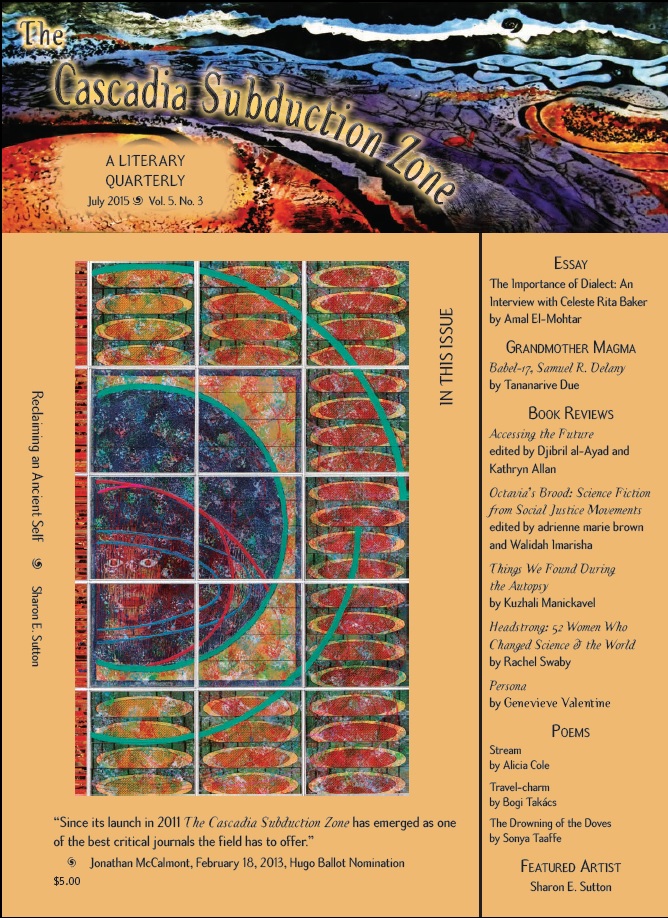
The Summer issue of the Cascadia Subduction Zone is out. This issue features an interview of Celeste Rita Baker by Amal El-Mohtar, discussing the uses of dialect in written fiction, poetry by Alicia Cole, Bogi Takács and Sonya Taaffe, an essay on Samuel R. Delany's Babel-17 by Tananrive Due, art work by Sharon Sutton, and reviews by Rachel Swirsky, Karen Burnham, and others.
In case you've forgotten or don't know, all but the last two issues are available for free download from the CSZ's archives. The new issue
is available as a pdf for $3, or a print copy (in the US only) for $5.
Subscriptions are $10 for the pdf edition and $16 (in the US only) for
the print edition.
Here's the new issue's table of contents:
ol. 5 No. 3 — July 2015
Essay
The Importance of Dialect:
An Interview with Celeste Rita Baker
by Amal El-Mohtar
Poems
Stream
by Alicia Cole
Travel-charm
by Bogi Takács
The Drowning of the Doves
by Sonya Taaffe
Grandmother Magma
Babel-17 by Samuel R. Delany
by Tananarive Due
Reviews
Accessing the Future, edited by Djibril al-Ayad and Kathryn Allan
reviewed by Rachel Swirsky
Octavia’s Brood: Science Fiction from Social Justice Movements, edited by adrienne marie brown and Walidah Imarisha
reviewed by Maria Velazquez
Things We Found During the Autopsy, by Kuzhali Manickavel
reviewed by Karen Burnham
Headstrong: 52 Women Who Changed Science & the World, by Rachel Swaby
reviewed by Victoria Elisabeth Garcia
Persona, by Genevieve Valentine
reviewed by Kristin King
Summer, oh summer, how I love it. Amazing things happen in summer, here in Seattle. For instance: the day before yesterday we had, out of the blue, a day in which the thermometer hit 94F. (It had mostly been in the 60s and 70s for all of June.) And voila, by zucchini tripled in size, and my tomato plants enjoyed a fabulous growth spurt.
And so, since it's July, the summer issue of The Cascadia Subduction Zone has arrived from the printer and is now available in print and digital editions here. This is another excellent issue, with poetry by Terry A. Garey (who will be a Guest of Honor at Diversicon later this month) and a retrospective essay on Garey's oeuvre. It also includes an insightful essay by Kim Stanley Robinson on The Female Man in particular and Joanna Russ in general, as well as a variety of reviews that will be of keen interest to Aqueduct readers, and art work by Mark Rich (who wears two of his large collection of hats in this issue).
Here's the issue's table of contents:Vol. 4 No. 3 — July 2014
Essay
Imaginary Junctions: On Terry A. Garey and
Speculative Poetry
by Mark Rich
Poems
Elephants in the Alley
&
Cave Discovery
by Terry A. Garey
Grandmother Magma
The Female Man by Joanna Russ
by Kim Stanley Robinson
Reviews
Lovecraft’s Monsters, edited by Ellen Datlow
reviewed by Usman T. Malik
Long Hidden, edited by Rose Fox and Daniel José Older
reviewed by Maria Velazquez
Lonely Stardust: Two Plays, a Speech, and Eight Essays,
by Andrea Hairston
reviewed by Adrian Khactu
Kantianism, Liberalism, and Feminism:
Resisting Oppression, by Carol Hay
reviewed by Nancy Jane Moore
Daughter of Mystery, by Heather Rose Jones
reviewed by Liz Bourke
The Memory Garden, by Mary Rickert
reviewed by Caren Gussoff
What Makes This Book So Great and My Real Children, by Jo Walton
reviewed by Cat Rambo
The April 2013 issue of The Cascadia Subduction Zone is now available at http://thecsz.com. I have a long essay in it myself, one prompted by a recent re-reading of Raccoona B. Sheldon's "Your Faces, O My Sister, Filled of Light" and the reflections on changing perceptions of sex and gender that it (inevitably, I think) provoked. I've written on this subject before, but obviously its not through with me yet. The issue has a second (shorter) essay, for our Grandmother Magma column, that was especially pleasurable to read: Karen Joy Fowler's piece on Sylvia Townsend Warner's classic feminist fantasy, Lolly Willowes (or the Loving Huntsman).
Here's the entire table of contents for the issue:
Current Issue
Vol. 3 No. 2 — April 2013
Essay
Asking the Wrong Questions:
Alice Sheldon,
the Gender Learning Curve, and Me
by L. Timmel Duchamp
Poem
1995
by Kelly Rose Pflug-Back
Grandmother Magma
Lolly Willowes
(or the Loving Huntsman)
by Sylvia Townsend Warner
reviewed by Karen Joy Fowler
Reviews
These Burning Streets
by Kelly Rose Pflug-Back
reviewed by Evan Peterson
Sister Mine
by Nalo Hopkinson
reviewed by Ama Patterson
Necessary Ill
by Deb Taber
reviewed by Nic Clarke
A Stranger in Olondria
by Sofia Samata
reviewed by Nisi Shawl
How to Greet Strangers
by Joyce Thompson
reviewed by Daniel José Older
Bio-Punk: Stories from the Far Side of Research
edited by Ra Page
reviewed by Victoria Elisabeth Garcia
First the brag: I recently edited an essay by Ursula K. Le Guin for The Cascadia Subduction Zone, and afterwards she told me I was "not only a good editor but a nice one." (Thank you, Ursula!) Next the confession: As a zine's "poetry editrix" I once responded to a letter from a rejected submitter by peeing on it and mailing it back. 25 years passed between these two exchanges--years during which I got a lot of experience on both sides of the editing equation. So now I look at where I've ended up and where I started out and I feel qualified to wonder:
Do editors have mighty powers? Do they ever use these powers for ill? Or only for good?
The Summer issue of The Cascadia Subduction Zone is out!
The issue begins with a tribute to poet and theorist Adrienne Rich, who made an enormous contribution to feminism as we know it today, and includes poetry by Alex Dally MacFarlane and Kiik A.K., Graham Joyce's thoughts on Angela Carter's magnificent Nights at the Circus, a very personal essay by Abby Koenig on that expensive, tricky sfnal procedure known as IVF, reviews of new work from Samuel R. Delany, N.K. Jemison, Nancy Kress, and others, and concludes with the art of Meredith Scheff. If you aren't a subscriber, you can purchase a single issue or subscribe here. For me, personally, Thomas Foster's essay-review of Nalo Hopkinson's Report from Planet Midnight alone is worth the price of the issue.
Current Issue
Vol. 2 No. 3 — July 2012
Essays
In Memoriam: Adrienne Rich
by L. Timmel Duchamp
Back at Day 1, Again
by Abby Koenig
Poems
adam
by Kiik A.K.
wedding in the uncut hair
of the meadow
by Kiik A.K.
Most Beautiful in Death
by Alex Dally MacFarlane
Grandmother Magma
Nights at the Circus
by Angela Carter
reviewed by Graham Joyce
Reviews
Through the Valley
of the Nest of Spiders
by Samuel R. Delany
reviewed by Victoria Garcia
Report from Planet Midnight
by Nalo Hopkinson
reviewed by Thomas Foster
The Killing Moon
by N.K. Jemisin
reviewed by Ebony Thomas
Fountain of Age
by Nancy Kress
reviewed by Cynthia Ward
Beyond Binary: Genderqueer and Sexually
Fluid Science Fiction
edited by Brit Mandelo
reviewed by Paige Clifton-Steele
Caught up in the madness of our 2011 Pleasures series, I forgot to post this earlier: the third issue of The Cascadia Subduction Zone is now available for free download, here.
Here's the issue's table of contents:
Vol. 1 No. 3 — July 2011
Feature Essay
Can Science Fiction Change the World? by Kristin King
Poems
Where Are You? by Mary Merriam
Three Lessons by Shweta Narayan
Grandmother Magma
Memoirs of a Spacewoman by Naomi Mitchison An Appreciation by Gwyneth Jones
Reviews
Fairy Tales in Electri-City by Francesca Lia Block reviewed by Maria I. Velazquez
Isles of the Forsaken by Carolyn Ives Gilman reviewed by Nic Clarke
This Shared Dream by Kathleen Ann Goonan reviewed by Deb Taber
Redwood and Wildfire by Andrea Hairston reviewed by Maria I. Velazquez
Up Against It by M.J. Locke reviewed by Karen Burnham
Paradise Tales by Geoff Ryman reviewed by Victoria Garcia
Blackberries and Redbones edited by Regina Spellers and Kimberly Moffitt reviewed by Tanya C. DePass
Thief of Lives by Lucy Sussex reviewed by Cynthia Ward
I'm pleased to announce that the new issue of The Cascadia Subduction Zone-- the first of our second year of publication-- is out! In addition to a full complement of reviews, it has an essay by our own Josh Lukin on disability in literary criticism in general and Anne Finger's brilliant short fiction in particular, another essay by Mary Meriam on Lilian Faderman, Kij Johnson on Margaret Cavendish, and a poem by Anne Sheldon. If you aren't already a subscriber, this would be an excellent time to subscribe, especially since we have a special-- supplemental-- issue on Joanna Russ in the works, which we intend to distribute to subscribers without additional charge. And if you're subscription has expired, surely you'll want to renew! You can do both of those things here.
Here's the Table of Contents of the new issue:
Essays
Ishmael in Love: Anne Finger and the Reclamation of Disability by Josh Lukin
My Muse by Mary Meriam
Poem
History Lesson by Anne Sheldon
Grandmother Magma
The Blazing World by Margaret Cavendish reviewed by Kij Johnson
Reviews
With Fate Conspire by Marie Brennan reviewed by Ebony Thomas
Master of the House of Darts by Aliette De Bodarda reviewed by Deb Taber
The Kingdom of Gods by N.K. Jemisin reviewed by Mikki Kendall
Mr. Fox by Helen Oyeyemi reviewed by Nic Clarke
Distances by Vandana Singh reviewed by Ama Patterson
Song of the Swallow by K. L. Townsend reviewed by Karen Szymczyk
The fourth issue of The Cascadia Subduction Zone is out and available here. This is our first special issue, on Women and Science, and is 28 pages (instead of the usual 24). I'd have liked to have announced it on Ada Lovelace Day, but that just didn't work out.
Essays
Gender, Science, and Narrative Inversion by Ann Hibner Koblitz
Women in Science and Science Fiction: A Mutual Relationship? by Helen Merrick
Bad Science: The Flawed Research into Gender Differences in the Brain by Nancy Jane Moore
Where the Juice Is: An Interview with Julie Czerneda by Nisi Shawl
Grandmother Magma
Symbiotic Planet by Lynn Margulis reviewed by Andrea Hairston
Reviews
Tesseracts Fifteen edited by Julie Czerneda & Susan MacGregor reviewed by Nic Clarke
Frankenstein's Monster by Susan Heyboer O'Keefe reviewed by Siobhan Carroll
The Highest Frontier by Joan Slonczewski reviewed by Karen Burnham
Revolution World by Katy Stauber reviewed by Tom Foster
Featured Artist
Jennifer Mondfrans
The image above is Jennifer Mondfrans' "Henrietta models a distant galaxy," a portrait of astronomer Henrietta Swann Leavitt (1868-1961). In her career at Harvard College Observatory, she discovered more than 2,400 variable stars. She saw a direct correlation between the time it took a star to go from bright to dim and the star's actual brightness. Knowing this relationship helped other astronomers, such as Edwin Hubble, make their own groundbreaking discoveries.
Now that The Cascadia Subduction Zone is six months old, the first issue, as promised, is now available for free download from the CSZ site. You can find it here.
The electronic edition of the third issue of The Cascadia Subduction Zone is going out to subscribers today, and we're expecting the print version to arrive from the printer on Monday. Here's the issue's table of contents:
Vol. 1 No. 3 — July 2011
Feature Essay
Can Science Fiction Change the World? by Kristin King
Poems
Where Are You? by Mary Merriam
Three Lessons by Shweta Narayan
Grandmother Magma
Memoirs of a Spacewoman by Naomi Mitchison An Appreciation by Gwyneth Jones
Reviews
Fairy Tales in Electri-City by Francesca Lia Block reviewed by Maria I. Velazquez
Isles of the Forsaken by Carolyn Ives Gilman reviewed by Nic Clarke
This Shared Dream by Kathleen Ann Goonan reviewed by Deb Taber
Redwood and Wildfire by Andrea Hairston reviewed by Maria I. Velazquez
Up Against It by M.J. Locke reviewed by Karen Burnham
Paradise Tales by Geoff Ryman reviewed by Victoria Garcia
Blackberries and Redbones edited by Regina Spellers and Kimberly Moffitt reviewed by Tanya C. DePass
Thief of Lives by Lucy Sussex reviewed by Cynthia Ward
The electronic edition of the second issue of The Cascadia Subduction Zone has just gone out to subscribers, and we're expecting the print version to arrive from the printer this week. Here's the issue's table of contents:
Vol. 1 No. 2—April 2011
Feature Essay
Hyperbolic Futures: Speculative Finance and Speculative Fiction, by Steven Shaviro
Poem
She Lives, by Shweta Narayan
Grandmother Magma
Vonda N. McIntyre’s Dreamsnake, by Ursula K. Le Guin
Reviews
Akata Witch, by Nnedi Okorafor, reviewed by Uzuri Amini
Birdbrain, by Johanna Sinisalo, reviewed by Carrie Devall
The Broken Kingdoms, by N. K. Jemisin, reviewed by Ama Patterson
Destination: Future, edited by Z. S. Adani and Eric T. Reynolds, reviewed by Karen Burnham
Under the Poppy, by Kathe Koja, reviewed by Rachel Swirsky
Of Blood and Honey (Fey and the Fallen), by Stina Leicht, reviewed by Paige Clifton-Steele
The Universe of Things, by Gwyneth Jones, reviewed by Nisi Shawl
Steam-Powered: Lesbian Steampunk Stories, edited by JoSelle Vanderhooft, reviewed by Liz Henry
Featured Artist
Susan Simensky Bietila
Ursula Le Guin's piece inaugurates the Grandmother Magma column, which will be devoted to retrospective reviews. And Liz Henry's review includes a "Lesbian Steampunk Bingo Card." You can purchase the issue or start a subscription here.
I'm thrilled to announce the debut of a new zine from Aqueduct Press: The Cascadia Subduction Zone. (The table of contents can be found below, as well as here.) Although I am, I suppose, its founder, this is not a publication I'm actually in charge of. After much struggle about what the zine's editorial organization should look like, it emerged as a collective of four editors:
Lew Gilchrist, Managing Editor
Nisi Shawl, Reviews Editor
L. Timmel Duchamp, Features Editor
Kath Wilham, Arts Editor
Aqueduct Press offers both print and electronic single issues and subscriptons here. After six months, back issues will be posted in an electronic archive, downloadable free of charge.
Mission Statement
Here in the Pacific Northwest, we live in the Cascadia subduction zone, with massive, almost unimaginable earthquakes lurking in our past and looming in our future. Frequently we experience “slow earthquakes” moving the earth beneath us, imperceptible to humans except through technology. Occasionally a mountaintop blows, awing us with its power. The denser plate of oceanic crust—the Juan de Fuca Plate—is being forced deep into the Earth's interior beneath the North American continental plate in a process known as subduction, and as the plate encounters high temperatures and pressures that partially melt solid rock, some of this newly formed magma rises toward the Earth's surface to erupt, forming a chain of volcanoes above the subduction zone. (Brantley, 1994, Volcanoes of the United States) Humans like to think of the earth as the ultimate symbol of stability: hence the cliché “down-to-earth.” But in the Cascadia subduction zone, “down-to-earth” necessarily means something else. To be grounded, here, is to be ever mindful of the plates shifting below us, slipping and striking and moving magma, of sloping fault lines that separate and yet merge, of one plate being inexorably pushed beneath another, with enormous consequences.
The Cascadia Subduction Zone aims to bring reviews, criticism, interviews, intelligent essays, and flashes of creative artwork (visual and written) to a readership hungry for discussion of work by not only men but also women. Work by women continually receives short (or at best inadequate) shrift in most review publications. And yet the majority of readers are women. As Ron Hogan writes in an August 2011 post on Beatrice.com, “[Jennifer]Weiner and [Jodi] Picoult, among others, are giving us a valuable critique of a serious problem with the way the [New York] Times [Book Review]—and, frankly, most of the so-called literary establishment—treats contemporary fiction. Which is to say: They ignore most of it, and when it comes to the narrow bandwidth of literature they do cover, their performance is underwhelming, ‘not only meager but shockingly mediocre,’ as former LA Times Book Review director Steve Wasserman said three years ago. And it hasn’t gotten any better since then, leaving us with what Jennifer Weiner describes as “a disease that’s rotting the relationship between readers and reviewers.”
The relationship between readers and reviewers interests us. We want to bring attention to work critics largely ignore and offer a wider, less narrowly conceived view of the literary sphere. In short, we will review work that interests us, regardless of its genre or the gender of its author. We will blur the boundaries between critical analysis, review, poetry, fiction, and visual arts. And we will do our best to offer our readers a forum for discussion that takes the work of women as vital and central rather than marginal. What we see, what we talk about, and how we talk about it matters. Seeing, recognizing, and understanding is what makes the world we live in. And the world we live in is, itself, a sort of subduction zone writ large. Pretending that the literary world has not changed and is not changing is like telling oneself that the world is a solid, eternally stable ball of rock.
The Cascadia Subduction Zone, Vol. 1, No.1---January 2011
Table of Contents
Welcome to the Cascadia Subduction Zone
by the Editors
Another Weather: Mount St. Helens
a poem by Ursula K. Le Guin
On Black Literature & Battle Flags
an essay by Sheree Renee Thomas
A Conversation with Chandler Davis
transcribed by Josh Lukin
Reviews:
The History of White People by Nell Irvin Painter
reviewed by Nancy Jane Moore
What I Didn't See and Other Stories by Karen Joy Fowler
reviewed by L. Timmel Duchamp
Holiday by M. Rickert
reviewed by Carrie Devall
A Cup of Normal by Devon Monk
reviewed by Cynthia Ward
Under the Poppy by Kathe Koja
reviewed by Rachel Swirsky
Steampunk II: Steampunk Reoladed edited by Jeff VanderMeer and Ann VanderMeer
reviewed by Liz Henry
80! Memories & Reflections on Ursula K. Le Guin edited by Debbie Notkin and Karen Joy Fowler
reviewed by Victoria Garcia
This morning I learned that a "slow" earthquake expected to last several weeks is now in progress, under the Olympic Peninsula and en route via the Strait of Juan de Fuca to Vancouver Island. It started early Sunday morning in an area north of Olympia and west of Tacoma and is now on the move. I'd previously had no idea that such earthquakes even existed. (Good thing we can't actually feel them, yes?)
Episodic tremor-and-slip events have been associated with the entire Cascadia subduction fault zone, which runs along the Northwest coast, as well as a dozen other dangerous faultlines worldwide. The fault zone is created by the Juan de Fuca tectonic plate sliding beneath the section of the North American plate where western Washington is located.
It is believed the two plates are locked together by friction near the surface but that they slide past each other easily at greater depth, where heat has made the rock more pliable. Slow-slip events are likely to be occurring at a depth where the plates transition from being locked to being free-moving, Malone said.
"Models indicate these events are loading a little extra stress on the fault zone," he said.
Interest in slow-slip events has been intense in recent years because they alter stresses in the subduction zone, which ruptures in magnitude 9 megathrust earthquakes on the order of every 500 years. The last one occurred in 1700. (The earthquake that caused the devastating 2004 Indian Ocean tsunami had a magnitude of 9.1.)
With better understanding, changing slow-slip patterns might provide hints in advance of the next Cascadia megathrust quake, said John Vidale, a UW professor of Earth and space sciences and director of the seismic network.
"Maddeningly, we have no understanding of why the episodic slow slip lasts a month, rather than the few seconds of a normal earthquake or the continuous motion of flow deeper in the Earth, and we aim to figure it out," Vidale said.
As someone living in the Cascadia subduction zone, I couldn't be more fascinated.