The Pleasures Reading, Viewing, and
Listening in 2015
by Katrinka Moore
Throughout the year I kept returning to Shakespeare. In the spring I read Tina Packer’s Women of Will: Following the Feminine in Shakespeare’s Plays. An actor and director, Packer is the founding artistic director of Shakespeare & Company in Lenox, Massachusetts. Her premise is that the playwright changed in his attitude toward women over the course of his career, eventually writing fully realized female characters — women who “own” their sexuality and find their own means of power. She imagines him learning and reveling in an equal relationship with the Dark Lady of the sonnets, which experience led him to create Juliet, who is Romeo’s equal in love and better in speaking and action.
In the
book’s prologue, Packer describes her project:
The
story of this book is a simple one. It
follows the progression of the women in Shakespeare’s plays. Then, from the way in which Shakespeare wrote
about women, we follow his spiritual growth. And I have a hope that
understanding the spiritual growth of an artist of Shakespeare’s magnitude may
provide a road map for the kind of creative action and understanding we need to
alter the dangerous course the world is on — for Shakespeare pulled back from
the apocalypse of Lear, Coriolanus,
and Macbeth and found a way to the
regeneration of The Winter’s Tale and
The Tempest.
Over the
summer I reread Will in the World by
Stephen Greenblatt, which describes the society in which Shakespeare lived —
the religious tensions, the recurring plague, class and education and how these
affected Shakespeare and his writing.
Best of all
was the London-based Donmar Warehouse production of Henry IV, parts 1 and 2,
which I saw at St. Ann’s Warehouse in Brooklyn in the fall. This is an all-female cast, set as a play
performed in a prison. Jade Anouka’s
Hotspur and Sophie Stanton’s Falstaff stood out. My favorite scene was the first in Act III,
when Hotspur, Glendower, and Mortimer divide up England on a map, which is
drawn on the floor with different colors of spray paint. Hotspur dances on her section, insisting she
will straighten the borderline river — just to annoy Glendower.
I bounced
around with fiction, mostly reading books friends and family recommended. I’ll mention a few that meant a lot to me.

Preparation for the
Next Life by Atticus Lish tells the story of Zou Lei, born in Central Asia
to an Uighur mother and a Chinese father, who lives as an undocumented
immigrant in Queens. She meets Skinner, a veteran of three tours in Iraq, and
Lish takes us through a period of their hardscrabble lives, affected by
political events beyond their control.
Like most of America I read Elena Ferrante’s Neapolitan Novels. These complex stories and characters give a
sense of life in Italy in the post WWII years, the battles women and activists
faced, the cultural and political upheavals.
I’m not normally a Richard Ford reader, but Canada is a dreamlike tale of a shy boy
who escapes to Canada when his parents go to prison. The writing is a lyrical portrayal of an
inner life.
Jennifer Egan finished Look
at Me in early 2001, but the plot is prescient, covering extreme selfie
culture and business people who promote it.
I saw three
films about girls in Muslim cultures, all worth watching:

Mustang, directed
by Deniz Gamze Ergüven, is the story of five free-spirited sisters in rural
Turkey who come up against the patriarchal culture when their uncle moves in
with them and their grandmother.
Abderrahmane Sissako’s Timbuktu
takes place in Mali and shows a young girl’s herding family at odds with a new
order of jihadis.
In Haifaa al-Mansour’s Wadjda,
a ten-year-old Saudi girl enters a contest reciting the Koran to win the prize
money — she wants to buy a bicycle.
It was a
good year for poetry. In Agua, Fuego
(Finishing Line Press), Guillermo Filice Castro writes about the passing of his
parents. He opens with a poem about his mother.
On A New Anniversary of Her Death I Make Myself
Buckwheat Pancakes
One scoop
And a world is born
In this skilled skillet
With gravity
And a clumpy mixture
That flattens into
An almost round
Moon so hot
Blueberries begin to bleed
And smear eye shadow
Across the pock-
Marked face
I flip
& judge
Its less bubbly
Darker side
With my spatula’s
Bird foot
Under which
The tart and naked disc
Firms up
Hissing a wish
To be
Cooled
& cheered
By sliced strawberries
Then forked into my mouth
Filling with the murmurs
Of water and milk
And the one egg
That in cracking
Bound it all
Reprinted by
permission of Guillermo Filice Castro.
In Vexed (Wipf and
Stock), Elizabeth Poreba examines her relationship to religion, and in this
poem she puts her own spin on the tradition of a dialogue between body and
soul.
One-Sided Dialogue Concerning the Soul
Like the old friend who calls
only to tell you about herself,
the mind does all the talking.
It’s so interesting.
Besides, it thinks
that the soul is not very bright.
In that place within the many mansions,
the mind doubts that the soul
would know where to hang the pictures.
The mind is almost ready to give up on the soul,
except it hears a humming somewhere,
something knitting together,
like a great tree in full leaf.
Reprinted by
permission of Elizabeth Poreba.

Louise Glück’s Faithful
and Virtuous Night (Farrar, Straus) is dark without being hopeless. “Parable” explores the idea of purpose.
Parable
First divesting ourselves
of worldly goods, as St. Francis teaches,
in order that our souls not be distracted
by gain and loss, and in order also
that our bodies be free to move
easily at the mountain passes, we had then to discuss
whither or where we might travel, with the second question being
should we have a purpose, against which
many of us argued fiercely that such purpose
corresponded to worldly goods, meaning a limitation or constriction,
whereas others said it was by this word we were consecrated
pilgrims rather than wanderers: in our minds, the word translated as
a dream, a something-sought, so that by concentrating we might see it
glimmering among the stones, and not
pass blindly by; each
further issue we debated equally fully, the arguments going back and forth,
so that we grew, some said, less flexible and more resigned,
like soldiers in a useless war. And snow fell upon us, and wind blew,
which in time abated — where the snow had been, many flowers appeared,
and where the stars had shone, the sun rose over the tree line
so that we had shadows again; many times this happened.
Also rain, also flooding sometimes, also avalanches, in which
some of us were lost, and periodically we would seem
to have achieved an agreement; our canteens
hoisted upon our shoulders, but always that moment passed, so
(after many years) we were still at that first stage, still
preparing to begin a journey, but we were changed nevertheless;
we could see this in one another; we had changed although
we never moved, and one said, ah, behold how we have aged, traveling
from day to night only, neither forward nor sideward, and this seemed
in a strange way miraculous. And those who believed we should have a purpose
believed this was the purpose, and those who felt we must remain free
in order to encounter truth, felt it had been revealed.
in order that our souls not be distracted
by gain and loss, and in order also
that our bodies be free to move
easily at the mountain passes, we had then to discuss
whither or where we might travel, with the second question being
should we have a purpose, against which
many of us argued fiercely that such purpose
corresponded to worldly goods, meaning a limitation or constriction,
whereas others said it was by this word we were consecrated
pilgrims rather than wanderers: in our minds, the word translated as
a dream, a something-sought, so that by concentrating we might see it
glimmering among the stones, and not
pass blindly by; each
further issue we debated equally fully, the arguments going back and forth,
so that we grew, some said, less flexible and more resigned,
like soldiers in a useless war. And snow fell upon us, and wind blew,
which in time abated — where the snow had been, many flowers appeared,
and where the stars had shone, the sun rose over the tree line
so that we had shadows again; many times this happened.
Also rain, also flooding sometimes, also avalanches, in which
some of us were lost, and periodically we would seem
to have achieved an agreement; our canteens
hoisted upon our shoulders, but always that moment passed, so
(after many years) we were still at that first stage, still
preparing to begin a journey, but we were changed nevertheless;
we could see this in one another; we had changed although
we never moved, and one said, ah, behold how we have aged, traveling
from day to night only, neither forward nor sideward, and this seemed
in a strange way miraculous. And those who believed we should have a purpose
believed this was the purpose, and those who felt we must remain free
in order to encounter truth, felt it had been revealed.
At the
Basilica SoundScapes in Hudson, NY, I heard Holly Anderson and Chris Brokaw
read from Anderson’s The Night She Slept
with a Bear (Publication Studio) accompanied by music Brokaw created for
the book. Bear is full of narratives
and mesostics. One of my favorites is
“Signe”:
Look, it’s Aunt Signe yanking bleached sheets across my
empty white page. Thin
fingers stained with bluing. Bed sheets hung to dry, slung
high on a line strung
from the red cabin to her wood pile to the sauna on the
shivery river. Water sings
stories. Wood is
always speaking. Tight tongue-in-groove
conjures wainscoting in
Signe’s kitchen and the outhouse with spider forever
spinning in a far corner. A
fierce turtle lived under her clanking plank bridge. Signe
liked to tease that crank
hiding in the shadows.
He could snap her stick in half.
He would and we’d laugh
— terrified. Blue
crayfish pinched toes we poked under the splintery dock and we’d
shriek with joy. Fear delicious as the cake doughnuts Signe
had waiting most morn-
ings. The dough mixed and proofed then fried and sugar
dusted by dawn. Soon we’d
tumble out of the sleeping porch slung over the murmuring
river and begin. Again.
Watch two syrupy-red nectar feeders hung on a low branch and
hummingbirds
blurred to green gauze.
Always feeding. Always darting off like dreams. There’s
never been deeper sleep than on that screened porch when all
was still ahead and
shimmering.
Reprinted by
permission of Elizabeth Poreba.
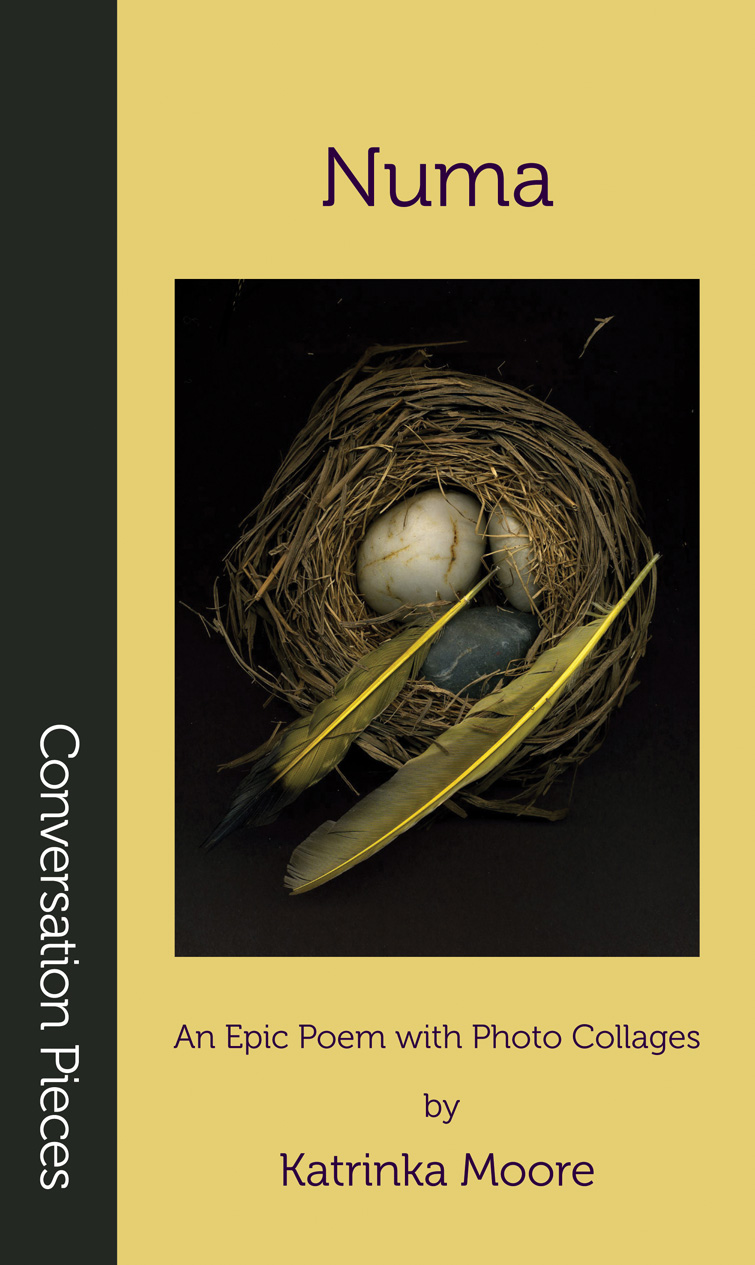
Katrinka Moore is the author of Numa (Aqueduct 2014), Thief, and This
is Not a Story. She is at work on a collection of lyric and
visual poems for Pelekinesis Press.


