Showing posts with label l. timmel duchamp. Show all posts

Tuesday, December 9, 2025

The Pleasures of Reading, Viewing, and Listening in 2025


 Our annual Pleasures of Reading, Viewing, and Listening series will begin tomorrow.  It's been a difficult year for many of us. For me personally, although I didn't read less this year, I turned to many more rereads than in past years--including not only comfort reads but also a couple of door-stopper classics in translation that I last read many decades ago. War and Peace, which I hadn't read since my early adolescence, was astonishingly familiar to me (we're talking memories that are more than half a century old, here). Doctor Faustus, which I'd last read in the late 1980s, was apparently much less memorable. In my earlier readings I hadn't appreciated the attention their authors lavished on walk-on characters on the one hand, and the sharpness of the novels' political and social criticism on the other hand. Most striking, though, was how relevant I found them. What I didn't remember and couldn't have appreciated at age 12 was Tolstoy's scathing critique of the Great Man Theory of History, which I myself revolted against as a graduate student in History in the 1970s. My recent reread made me wish I'd read (or reread) War and Peace when I was a graduate student. Another reread that astonished me with its relevance was Machiavelli's Discourses. In many ways, that essay is more interesting than The Prince. But then if people were more familiar with The Discourses than with the Prince, the adjective Machiavellian would mean something entirely different than it does now. 

While 2025 has been a difficult year, it has also been a year of building resistance, both in individuals and in grassroots communities. And so, for many individuals, reading, viewing, and listening pleasures this year have been in pursuit of sustenance as well as escape. I've been saying for years that what we most lack in the US is political imagination. I've long been hoping this will change; I'd like to think that the apparent chaos of 2025 and the irrevocable rupture of "what is" may at last have stimulated the expansion of our collective political imagination. Various old guards may be longing for a return to what was, but a good many of us know that not only is that impossible, it is also actually undesirable.   

The Pleasures series always includes more than the pleasures offered by books, although books are the general focus of this blog. In past years the series has shown that reading, viewing, and listening pleasures vary widely. And that is what has made me keep this series going. I love the variety of tastes and practices it repeatedly reveals. This year's iteration will include posts by Andrea Hairston, Christopher Brown, Nisi Shawl, Sarah Tolmie, Eleanor Arnason, and others.

I hope you'll enjoy reading the pieces in this year's series as much as I do and that they'll swell the list of titles you want to read, view, and listen to yourself. We all know that the volume of books published is so tremendous that that really wonderful work often slips below one's personal radar. 

Sunday, June 1, 2025

L. Timmel Duchamp's Like Shards of Rainbow Frolicking in the Air


 I'm pleased to announce the release of a new collection by L. Timmel Duchamp, Like Shards of Rainbow Frolicking in the Air, from Aqueduct Press in both print and e-book editions. You can purchase it now from Aqueduct Press at https://www.aqueductpress.com

Like Shards of Rainbow Frolicking in the Air collects three early and one new story by L. Timmel Duchamp. The Tiptree/Otherwise Award Honor list story “Motherhood, Etc.” explores gender issues through a nineteen year-old’s defiant challenge to medical authorities determined to control their body and contain their sexual difference. Another Tiptree/Otherwise Honor List story, “Welcome, Kid, to the Real World,” explores the grip that sexual dimorphism presented as an either/or choice has on a culture offering a seemingly limitless menu of choices to young adults. In “The Last Nostalgia,” Daisy Q seeks to map the City, a territory lying between the Real World and the Excellent World, home to poets and mathematicians. And finally, in “When Joy Came to the World,” a USian graduate student doing archival research in Florence experiences the joys of mass hedonism following a mysterious snowfall in the Arno.

Richard Kadrey writes about “Welcome, Kid, to the Real World”: “I admired its brains and awareness of its subject matter immensely. It’s a wonderfully imagined externalization of all the little decisions we make every day that add up to who we will be as adults. Only in Duchamp’s world, the decisions are entirely self-conscious and deliberate and revolve around the gender role you will carry, like a big digitally-crafted, chrome albatross around your neck for the rest of your life.” 

“Duchamp writes some of the most rewarding science fiction stories you can read today; she is simply and unarguably among the best.”—Samuel R. Delany, author of Dhalgren and Nova

You can read a sample from the book here: https://www.aqueductpress.com/books/samples/978-1-61976-276-3.pdf

And you can read an essay, "What We're Fighting For," about my reasons for publishing this collection now, here:  https://ltimmelduchamp.com/essays/Like-Shards-essay.pdf

Tuesday, December 10, 2024

The Pleasures of Reading, Viewing, and Listening -- the 2024 Edition


 Our annual Pleasures of Reading, Viewing, and Listening series will begin tomorrow. As someone firmly embedded in old age, I've become increasingly focused on the importance of pleasure. Granted, on difficult days, pleasure can be fleeting. But for those of us old people who don't believe we will achieve immortality or super-longevity, there can be no contest between pleasure and its economic opposite, capital accumulation. 

(Hmm... Does that mean that old people are akin to Aesop's grasshopper? It's complicated, I guess. But it certainly does suggest that spending a lifetime playing music, writing books, making art doesn't count as productive work...)

Not that the writers and readers of these year-end pieces are all old people blessed (or cursed) with a heightened awareness of their mortality. I think pleasure--and an outright emphasis on it and a recognition that it is necessary for any human's flourishing (which includes the recognition that making other human beings miserable is an attack of their very existence)--is especially important now. 

 The Pleasures series includes more than the pleasures offered by books, although books are the general focus of this blog. In past years the series has shown that reading, viewing, and listening pleasures vary widely. And that is what has made me keep this series going. I love the variety of tastes and practices it repeatedly reveals. This year's iteration will include posts by Andrea Hairston, Christopher Brown, Nisi Shawl, Sarah Tolmie, Sofia Rhei, Cheryl Morgan, and others.

I hope you'll enjoy reading the pieces in this year's series as much as I do and that they'll swell the list of titles you want to read, view, and listen to yourself. We all know that the volume of books published is so tremendous that that really wonderful work often slips below one's personal radar. 

Part 1: Tara Campbell

Part 2: Xian Mao

Part 3: Cheryl Morgan

Part 4: Lesley Wheeler

Part 5: Nisi Shawl

Part 6: Kendal Simmons

Part 7: Erin K. Wagner

Part 8: Joanne Rixon

Part 9: Holly Wade Matter

Part  10:  Sofía Rhei

Part 11: Rebecca J. Holden 


Friday, June 2, 2023

The 2023 Pride Bundle

As in past years, Aqueduct has titles in the year's Pride Bundle. For those of you who read e-book editions, this is a great deal. Here's the scoop:

 We're back with another queer-themed bundle to celebrate Pride! This year, we have a total of seventeen books on offer, with eight in the main bundle and another nine in the bonus. It's a big bundle, but it was still hard to narrow it down: every year, there are more and more writers out there who are creating intelligent, nuanced, and queer SF/F.

Because this is for Pride, we looked for books that depicted queerness in all its aspects. You'll find profoundly hopeful work as well as darker themes, but what you won't find is stories in which being queer means you're evil, nor any in which it's a purely doomed and tragic fate. Instead, these are stories that showcase the myriad ways that queerness manifests — the many ways that we have chosen to be.

You can read more about the bundle here, and make sure to click on each cover for a synopsis, reviews and preview of each book!


HOW IT WORKS

  • Support awesome authors by paying however much you think their work is worth!
  • Pay at least $20 to unlock another 12 bonus books, for a total of 17!
  • Read all our books on just about any tablet, ereader, laptop or
    even your smartphone.
 

SELECTED REVIEWS

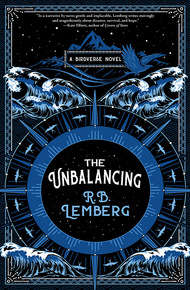
The Unbalancing by R. B. Lemberg

[STARRED REVIEW] "Lovingly crafted with a deep and rewarding world full of complex characters who are often LGBTQIA+ and/or neurodiverse, this is an outstanding novel from a rising star in fantasy fiction."

– Booklist

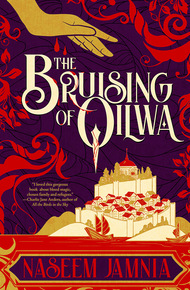
The Bruising of Qilwa by Naseem Jamnia

[STARRED REVIEW] "Naseem Jamnia's brilliant and insightful novella, The Bruising of Qilwa, explores questions of identity and belonging in a nuanced medical mystery. . . . Jamnia has built an intricate, multi-layered world full of magic and queerness."

– Shelf Awareness

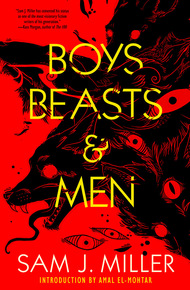
Boys, Beasts & Men by Sam J. Miller

[STARRED REVIEW] "Highly recommended for any reader interested in speculative fiction that concerns itself with queer themes, particularly messy or emotional ones."

– Booklist

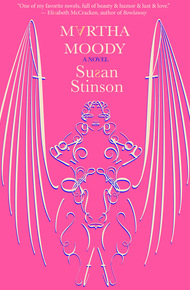
Martha Moody by Susan Stinson

"This 'speculative western' first came out in 1995 but was just reissued. The first sentence is magnificent in the way it's a microcosm of the whole book, as well as a glimpse at the way Stinson writes so beautifully about fat bodies: 'I was crouched next to the creek baiting my hook with a hunk of fat when I heard a rustling on the bank upstream.'"

– Alison Bechdel, Elle Magazine

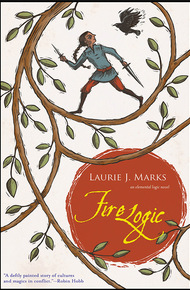
Fire Logic by Laurie J. Marks

"Fire Logic is a delightful, feminist fantasy epic featuring a ragtag bunch of misfits, swashbuckling, romance, and some weird elemental magic."

– Bustle

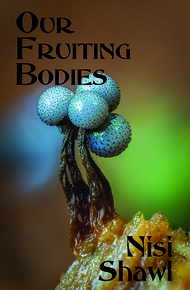
Our Fruiting Bodies by Nisi Shawl

"Nisi Shawl's Our Fruiting Bodies is a wilderness of untamed magic to explore, ever changing underfoot, beauty thorned and fertile with meaning, nurtured by the most talented of keepers. Shawl trusts their readers to be attuned to the mysteries of the imagined, rather than sated by formula or convention."

– Indrapramit Das, author of The Devourers

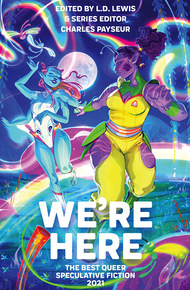
We're Here - The Best Queer Speculative Fiction 2021 by L.D. Lewis and series editor Charles Payseur

"With this lovely anthology, Lewis and Payseur collect 15 speculative shorts that range widely in tone and genre, but all circle themes of love and identity...There's something here for any reader of speculative fiction to admire."

– Publishers Weekly

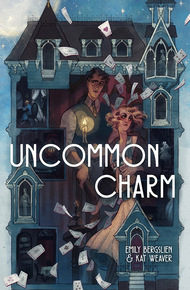
Uncommon Charm by Kat Weaver and Emily Bergslien

"An enchanting and poignantly subtle story told with deft humor and thoughtful absences, where the initiation into mysteries is both esoteric and deeply personal."

– Caitlin Starling, author of The Death of Jane Lawrence

Night Sky Mine by Melissa Scott

"Mature, balanced, absorbing work, with a richly detailed, enchanting backdrop: something of a breakthrough in overall technique, and Scott's best so far."

– Kirkus Reviews

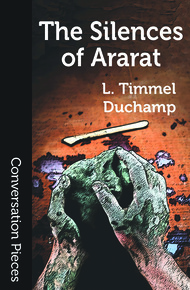
The Silences of Ararat by L. Timmel Duchamp

"Duchamp tells the story in straightforward style, using a setting only slightly removed from the here-and-now and characters many of us will recognize as drawn from some of our neighbors. The magical component, while crucial to the plot, doesn't divert attention from the relevance of the story to the world we see on the nightly TV news. Not always a comfortable read—nor is it meant to be—but well worth tracking down."

– Asimov’s On Books by Peter Heck

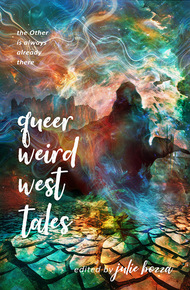
Queer Weird West Tales by Julie Bozza

"a varied and entertaining set of stories … Bound to be something for everyone to enjoy."

– Matt the Womble, Runalong the Shelves

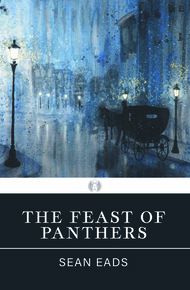
The Feast of Panthers by Sean Eads

"…If you love history with a twist, I highly recommend "A Feast of Panthers," an incredible story with paranormal aspects that are at times gruesome and frightening…"

– Queer Sci Fi

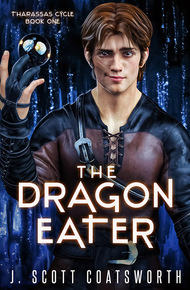
The Dragon Eater by J. Scott Coatsworth

"The only thing wrong with this book is that it ended. Scott Coatsworth has produced an adventure that is a rich mélange of science fiction and fantasy, creating the world of Tharassas and its denizens with vivid detail... It's going to be hard to wait for book two. Five stars."

– Ulysses, Liminal Fiction

Perishables by Michael G. Williams

"Stephen Colbert meets Stephen King."

– Book Nerd's Brain Candy

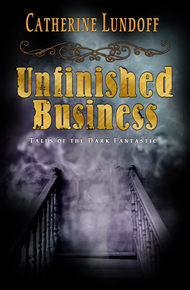
Unfinished Business by Catherine Lundoff

"And we are here in October where the weather and season turns; the nights darken as we start to feel more comfortable at home rather than wandering in the dark. Like many of you at times like this, I love to hear tales of ghosts and the things that go bump in the night. Queen of Swords Press has just launched a new series of mini-collections of short stories and novella collections. In Unfinished Business, this starts with the work of Catherine Lundoff and provides a smart, scary and progressive set of horror tales – perfect for a dark and stormy night."

– Runalong the Shelves Book Blog

In the Deep by Kelly Jennings

"…as gritty and complex as the first novel-length adventure… // Strongly reminiscent of C.J Cherryh at her best."

– Gwyneth Jones, author of the Aleutian trilogy, winner of the World Fantasy, Clarke, Dick, and Tiptree awards
 
Get the Pride Bundle at https://storybundle.com/pride.

Wednesday, March 24, 2021

The Silences of Ararat by L. Timmel Duchamp


 I'm pleased to announce the release of The Silences of Ararat, an original novella by L. Timmel Duchamp, in both print and e-book editions, as the seventy-ninth volume in our Conversation Pieces series. It's available now at www.aqueductpress.com.


It’s an old, old story: the King loses what passes for his mind and accuses his perfect trophy wife of adultery and prepares to have her put to death. Temporary insanity, right? Often in such cases, there’s collateral damage, and that’s the case in this story. But who, in a monarchy like Ararat, can oppose the King? Enter, Paulina, stage left, a sculptor with a hidden talent, a dea ex machina with her own ideas about how this story should end. 

Read a sample from the book.

Also available is the author's essay, A Few Thoughts on Writing The Silences of Ararat, on her website.

(Yeah, it does feel weird writing about myself in the third person. Forgive me, please.This is the problem of wearing two different hats in the same blog post.)

Saturday, March 23, 2019

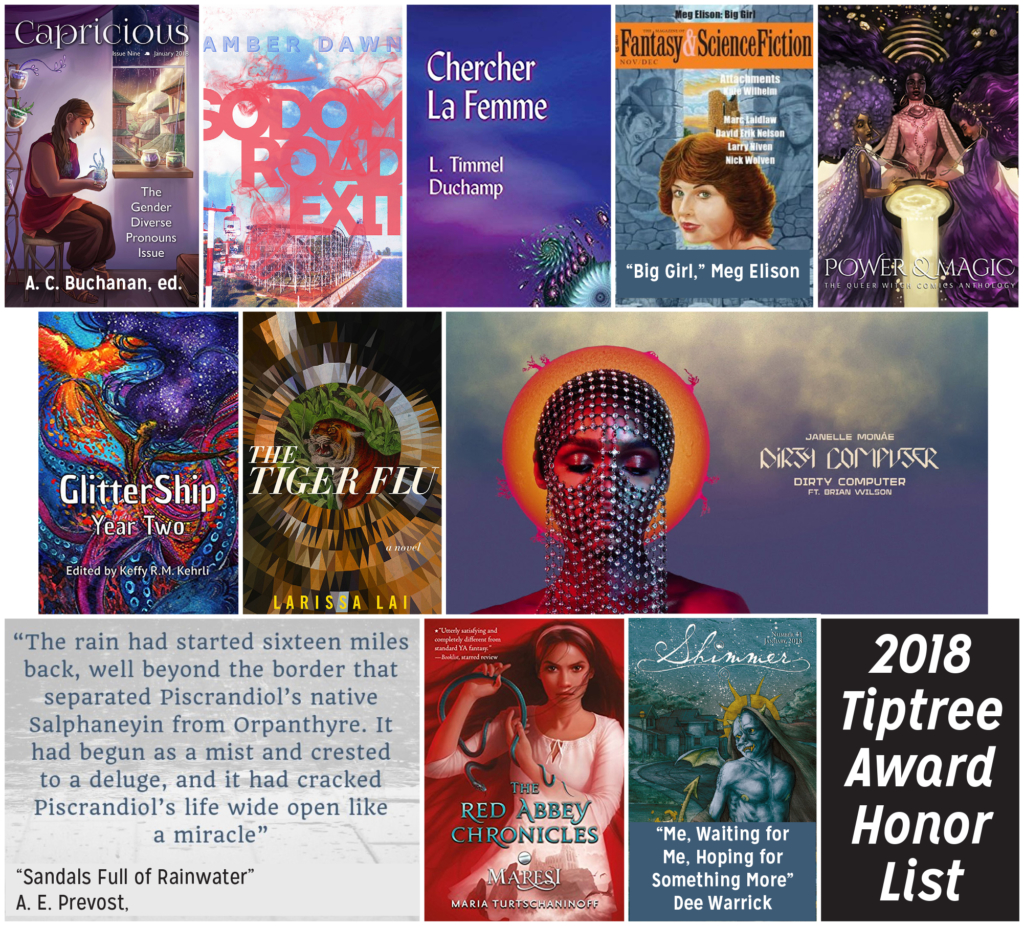
The 2018 Tiptree Award


Congratulations to Gabriela Damián Miravete! Her story, “They Will Dream In the Garden,” translated by Adrian Demopulos and published online by Latin American Literature Today (May 2018), as been named the 2018 Tiptree Award winner.

“They Will Dream In the Garden,” a beautifully written and translated story, uses the future tense to imagine a Mexico in which femicides are already part of history. In a collective attempt by survivors to preserve memory and justice, traces of the minds of the women murdered are encapsulated in interactive holograms “living” in a beautiful garden. The story looks at the economic, social, and racial dimensions of violence against Mexican women today, focusing on indigenous women, poverty, and unemployment, on repression of women’s educational opportunities, and of women’s ability to move about freely. The story hints at positive change as some women decide to fight back through collective action, mutual support, and self-defense, eventually shifting the public perception of gendered violence and improving the actions of the next generation. By offering a possible look into the future, far from giving the sense of a closed chapter, the story itself is a device of memory preservation, a call to action, and a fine example of science fiction as a tool for feminist exploration and social change.

Gabriela Damián Miravete is a writer of narrative and essay, a film and literature journalist, a professor at CENTRO university, and (according to her bio) the imaginary granddaughter of Ursula K. Le Guin. Miravete was part of “The Mexicanx Initiative,” a group of Mexican and Mexican American artists who attended WorldCon 76. With other authors, artists and people from different scientific disciplines, she co-founded Cúmulo de Tesla, a collective that wishes to strengthen the relationships between art, science, and science fiction. She has published short stories in several anthologies in Spanish. You can find her work in English in Three Messages and a Warning, an anthology of contemporary Mexican stories of the fantastic (Small Beer Press, 2010) and in A Larger Reality. Speculative Fiction from the Bicultural margins, an anthology of 14 stories, presented in both Spanish and English.

In addition, the Tiptree Award judges have recognized Adrian Demopulos, the translator of “They Will Dream in the Garden,” with a special honor for her translation.


In addition to selecting the winners, the judges choose a Tiptree Award Honor List. The Honor List is a strong part of the award’s identity and is used by many readers as a recommended reading list. These notes on each work are excerpted and edited from comments by members of this year’s jury. This year’s Honor List is:
A collection of delightful, thought-provoking stories that fulfill the intended purpose of normalizing diverse pronouns as well as suggesting that the binary can be broken or even left behind. Buchanan writes: “In English, the personal pronouns we’re most used to are he and she. Not only do these require the speaker to know the gender of the person they’re talking about, but they only properly cover two genders. Humans don’t always fit in these boxes.” This collection addresses the complaint that people find it hard to learn new pronoun sets. Buchanan writes that the answer is to normalize new pronouns — “in conversation, yes, but also in our stories, in fiction, in all media. In stories about spaceships and about magic, heroism and exploration, families and home.” As an added bonus, the authors and editor make recommendations for other works to read.
This ghost story set in a small depressed Ontario town in the 1990s explores concepts around sexual agency and slutdom with extraordinary doses of humanity, humor, and lyricism. With issues of women’s sexual autonomy being currently (and always) very much under the spotlight, the author presents myriad ways in which the book’s characters’ sexualities clash with (or struggle under) patriarchal power structures and lays them across queerness, whiteness, poverty, religious and moral values, and public opinion. Through the eyes of the protagonist and of the queer ghost who is haunting her, the reader experiences the pains and thrills of inhabiting a gendered, sexualized, queer body in this story full of caustic language and powerful images. WARNING: descriptions of child sexual abuse and adult suicide.
This cerebral, investigative novel presents a future society in which humans have divided into Paxans and Outsiders. Paxans are committed to “a collegial, laterally organized meritocracy.” In this technologically advanced society, Paxans spend only a small portion of their lives in “meatspace” and the majority of their lives in virtual realities, inhabiting and conversing with their secondary and tertiary bodies, which represent selected and isolated aspects of their consciousness. Paxans have been given FTL travel by an alien race they call Delta Pavonians, and some women, cis and trans, are able and willing to undergo body modification and training to be able to communicate with the aliens. The story traces the mystery of a second alien planet, La Femme, and its telepathic inhabitants. The novel is an absorbing exploration of the many ramifications of the notion of gender and the myriad ways in which it is represented and exploited.
  • Meg Elison, “Big Girl” Fantasy and Science Fiction (Nov/Dec 2017)
A story about a common problem in society—fat shaming. This is especially a problem for women, both white and of color, and for teens who lack self-confidence and easily fall prey to ads and movie portrayals. With satirical condemnation of society and media reactions, this story portrays how internalizing the perceived norms of “feminine” leads to low self-esteem.
As the cover promises, so the book delivers: 15 graphic short stories by “seventeen women, demigirls, and bi-gender creators of color.” The rich heart-warming fantasy stories deal with folk tales, fairy tales, disability, immigration, race, grandmothers, baking, depression, romance, and much more magic. This anthology is a good way to find authors you’ll want to read again, and a great display of the dramatic potential and innovative storytelling in contemporary comics today.
An anthology of over 30 short stories and poems. About half were originally published in Glittership Magazine, and all have queer themes and characters. “The Little Dream” by Robin M. Eames (in which a character wears a t-shirt that reads “IN SPACE NO ONE CAN HEAR YOU INSIST THERE ARE ONLY TWO GENDERS”) and “Graveyard Girls on Paper Phoenix Wings” by Andrea Tang are particularly recommended. A wonderful variety of stories and a great way to find authors you want to read more of.
Because of a plague that kills men more frequently than women, one society in this polluted future has mostly women. But men still have more power and women still need to fear sexual assault. The other society is all women — many with special powers, including doublers who have multiple clone births, “starfish” who can grow new body parts, and girls given special treatment so they can help breast feed the multiple babies. The religion is Mother-based. A beautifully written novel.
This album follows the struggles, joys, incarceration, and eventual liberation of a queer, Black woman who is punished by a system that seeks to “cleanse” her of all elements in her life that deviate from the norm. She is sent to a prison in which her memories (each of which is a separate music video and an ode to mutual love in rebellion) will be erased. The workers in charge of the erasure, who sit back and enjoy the memories prior to destruction, serve as a sharp metaphor of the white supremacist, cisheteropatriarchal system that is obsessed with Black bodies and creativity while still remaining profoundly anti-Black. This concept album forms a cohesive science fictional narrative, introducing futuristic elements in a way that is rarely seen so explicitly in the medium, opening up new pathways for the musical exploration of feminist science fiction.
This story portrays a culture in which gender pronouns change depending on a multitude of factors for each individual at any given time. This story shows a character at the beginning of a new life whose sense of identity is affected by this new language with a multitude of unfamiliar pronouns. The story also touches on issues of immigration, poverty, unemployment, romance, and building a new family. The reader is given linguistic issues and endearing characters in a well-done story.
This young adult novel was translated from Swedish. In it, a society of women (in groups acknowledging the Maiden, Mother, and Crone) live apart from a patriarchal world. They populate their society by rescuing women and girls from poverty, evil men, and lack of education. The leader of the Abbey is the First Mother. This story is told in the time of the 32nd First Mother. The women of the Abbey preserve knowledge within a vast library. The novel ends with the narrator, a teenage girl, deciding to go back out into the world to see if she can help change how men and women see themselves and one another.
This visceral story with vivid writing explores in a literalized way the dysphoria that can come with being trans. The monster in the basement works as both a powerful metaphor and a plot device.


In addition to the honor list, this year’s jury also compiled a “long list” of twenty-eight other works they found worthy of attention.


The Tiptree Award winner, along with authors whose works are on the Honor List, will be celebrated at WisCon in Madison, Wisconsin during Memorial Day weekend. The winner will receive $1000 in prize money, a specially commissioned piece of original artwork, and (as always) chocolate.
Each year, a panel of judges selects the Tiptree Award winner. The 2018 judges were Margaret McBride (chair), Marina Berlin, Ritch Calvin, and Arrate Hidalgo.

The 2019 panel of judges will be chaired by Carol Stabile, and reading will begin soon. The Tiptree Award invites everyone to recommend works for the award. Please submit recommendations via the recommendation page. Full information on all the books mentioned above will be in the Tiptree Award database by late April 2018.

Monday, December 31, 2018

2018: Closing out the Year


For me, this has been a year of doing a lot of reading to help me think--which, in a sense, is a return to an earlier practice, one I pretty much gave up when I started Aqueduct Press. I suppose I thought of this loss of mental discipline as unavoidable, at least for the first few years of Aqueduct's existence. Dropping a habit of discipline, though, has the downside of making it tough to do casually what was previously habitual. I wonder now whether that might not be the reason I began to feel out-of-synch with the world, despite my spending hours in online activity, plugged into social media, the blogosphere, and the 24/7 news cycle. I assumed it was the effect of aging. 

And then, in late 2016, like many people I knew, I felt massively confused; the political events of 2016 clobbered me into a momentary mental/psychic standstill. Appalled by this standstill, I vowed to return to the kind of interior life I felt I'd lost, an interior life that I knew requiring sustained slow-reading and slow-thinking. To reclaim that interior space, I withdrew from most of my online activity and struggled to establish a new set of habits. It took a protracted effort and the determination to reallocate my attention. My spending three months a year writing in seclusion in Port Townsend has been enormously helpful in doing that.

2018, perhaps as a result of this personal reorientation, perhaps for other reasons, has been a year of clarification. I'm currently drafting an essay about some of the reading that has helped clarify my thinking, so I don't really want to say much more about that here. Instead, to close out the year, I'd like to quote from a Walter Benjamin essay that I've recently reread, "Theses on the Philosophy of History." Benjamin drafted this essay in the spring of 1940, shortly before his death. It's a piece full of glittering gems of thought as quotable, I think, as many of Nietzsche's aphorisms. I'll quote only the eighth thesis (translated by Harry Zohn). Although our moment is not that of Europe in 1940, the challenge Benjamin issues in this thesis has mostly yet to be met. (And what a different world we would be living in, I think, if it had been met.)
The tradition of the oppressed teaches us that the "state of emergency" in which we live is not the exception but the rule. We must attain to a conception of history that is in keeping with this insight. Then we shall clearly realize that it is our task to bring about a real state of emergency, and this will improve our position in the struggle against Fascism. One reason why Fascism has a chance is that in the name of progress its opponents treat it as a historical norm. The current amazement that the things we are experiencing are "still" possible in the twentieth century is not philosophical. This amazement is not the beginning of knowledge--unless it is the knowledge that the view of history which gives rise to it is untenable.

I don't think that thinking of our current situation as an instance of "Fascism" is helpful. But examples abound of people wondering at how what we are experiencing now (and fearing to experience in the near future) is "still" possible--and, perhaps more to the point, that all these new "populist" regimes are derailing the "progress" and "competence" assumed to drive history. Sad to say, this attitude informs the most popular strains of feminism, and it unfortunately dominates the loudest voices in the Democratic party. Resistance doesn't lie in rolling back time and getting the Progress Train back on track. It means going someplace new, somewhere we've never before been. Given all we've learned about the climate-change juggernaut this year, it's our only hope.


Monday, July 9, 2018

L. Timmel Duchamp's Chercher La Femme


I'm pleased to announce the publication of Chercher La Femme, a new novel by L. Timmel Duchamp (i.e., me!), which is scheduled for official release on August 1, 2018. It is available for purchase in print and e-book formats through Aqueduct's website now.

Novels, of course, always have origin stories..Sometimes a word or phrase, sometimes a dream, sometimes even an image that however fleeting lingers long after it has been glimpsed. In this case, reading Stanislaus Lem's Solaris and watching Andrei Tarkovsky's exceedingly long film based on that novel planted the seed of this novel in my mind. Over the course of two years I drafted the original version in the early 1990s.  I then set it aside. Some fifteen years later, Helen Merrick offered me a perceptive critique. Since I lacked the time to do anything with it then, I saved it for future consideration;.it proved tremendously helpful when I decided to read the manuscript during one of my Port Townsend writing retreats.

On a more personal note, because the novel is written from a non-dystopian perspective, a part of me worried loudly that it might seem out of step with 2018's horrendous fake reality, but in fact its perspective has proven to be helpful for my thinking, rather than evasive. In a sense, it's more fully grounded in 2018's reality than it was in 1993's, without being swallowed up by the social psychological pervasiveness that many of us are struggling to escape. Dare I say aloud that that in our hearts, many of us feel certain that the triumph of neoliberalism can only be a dead end for our species? 

You can  read a sample from the book.Or purchase it here: http://www.aqueductpress.com/books/978-1-61976-147-6.php.

Here's a brief description:

"Everything about the humanoids inhabiting the planet La Femme is beautiful and desirable. Even their names are a pleasure to the tongue, a pleasure that can be experienced only in meat space."  —Paul 22423
They named the planet "La Femme" and called it a paradise and refused to leave it. Now Julia 9561 is heading up the mission to retrieve the errant crew and establish meaningful Contact with the inhabitants. Are the inhabitants really all female, as the first crew claimed? Why don't the men want to return to Earth? What happened to the women on the crew? And why did Paul 22423 warn the First Council to send only male crew members?

"Speculative fiction at its purest."
 —-Vonda N. McIntyre, author of Dreamsnake and The Moon and the Sun

"Chercher La Femme, which unfolds in a strange, complex, alien future, effectively explores several themes: of personal identity and how it holds itself together but is also porous to experience; of communication with alien life forms and how amorphous and challenging that might be; and of the visceral power of alien forms of beauty and art, giving the story compelling depths. The tense stretch between the Pax and the "Outsiders" offers an interesting representation of the real-world tension we now live with, between low-tech societies and those racing to colonize outer (and inner, personal) space in all sorts of ways.

"There's some interesting tidal stirring going on at the more cerebral levels of modern SF, which I think began with books like A Voyage to Arcturus and Solaris. It's now manifesting itself in, for example, Jeff Vandermeer's Southern Reach books and in this book, Chercher La Femme, as well as in films like Arrival, They Remain, and of course Annihilation. Human bafflement and consternation characterize these stories, in the face of the most alien kind of alien-ness we can imagine at this point, and a necessary softening and yielding of our age-old infatuation with a propulsive, often violent drive to control (or kill) whatever is ineffable and strange to us.
 —Suzy McKee Charnas, author of The Vampire Tapestry and the Holdfast Chronicles


And here's Publishers Weekly's review:


Aqueduct editor Duchamp's concentrated and demanding examination of what's accepted as "self" is cleverly and convincingly presented as a simple piece of science fiction. Diplomat Julia, a member of a socialistic human society known as the Pax, is the head of a mission to a far-off world, La Femme. The mission's primary purpose is recovery of the first ship sent to make contact with La Femme's inhabitants, though further diplomatic advancement is planned as well. Julia is distracted from the mission objectives by her deep analysis of her life thus far and the utopian ideal she lives by, particularly when she deals with her splintered crew. What she and her crew find upon arrival is enough to shake them all. Duchamp (Stretto) makes abundant challenges to gender norms and raises questions of what constitutes alienness, and the novel's humanistic approach and unwavering commitment to Julia's frank introspection go beautifully with a precisely detailed world. This thoughtful tale bears rereading and contemplation.
  —Publishers Weekly, June 2018

Monday, May 1, 2017

Andrea Hairston & L. Timmel Duchamp reading in Seattle this week

I hope to see some Seattle-area friends of Aqueduct on  Thursday evening this week, when Andrea Hairston, accompanied by Pan Morrigan, and I will be appearing at the University Bookstore in Seattle at 7 pm. Here's the event description from UBS's event calendar:

The Waterdancer's World and Will Do Magic for Small Change (ADUEDUCT PRESS)
Thursday • May 4 • 7pm
U District store
Discussion & Book Signing 


The Waterdancer's World and Will Do Magic for Small Change

Discover two richly imagined new works of science at this exciting discussion and signing with authors L. Timmel Duchamp and Andrea Hairston .

For almost 500 years, humans have struggled to adapt themselves to the punishing gravity and hallucinogenic plants that dominate the planet Frogmore's ecology in Duchamp's The Waterdancer's World. Inez Gauthier, daughter of the general commanding the planets occupation forces, dreams of eliminating the deadly spores that have impeded efforts to crush the native insurgency and fully exploit the planets resources. She's fascinated by the new art-form of waterdancing, which celebrates the planets indigenous lifeforms and assumes her patronage will be enough to sustain it even as she ruthlessly pursues profit at the expense of all that made this art possible. Readers navigate an alien planet through the eyes of five individuals and an analytical guidebook called "A Star-Hoppers View of the Galaxy" in this thought-provoking book.

Hairston offers a potent blend of West African religion and history, magic, science fiction, theater, in Will Do Magic for Small Change. The curtain opens on Cinnamon Jones, a young theatrically challenged aspiring actress living in Pittsburgh during the 1980s. Cinnamon's half-brother, Sekou, is dead and her family life is a tangle of mystery and secrets. But before Sekou passed away, he gave her a book called The Chronicles of the Great Wanderer—the story of an extradimensional being who first materialized in the embattled West African kingdom of Dahomey in 1892. Whether The Chronicles are magic or alien science, Cinnamon can't be sure, but the story is definitely connected to her family's secrets. When an act of violence wounds her family, she and her theater squad team up to solve the mysteries and bring her worlds together.

Visit new worlds with these beautifully written, wonderfully original new books.

No Image Available L. Timmel Duchamp is the author of the five-novel Marqssan Cycle, which was awarded a Special Honor by the 2009 James Tiptree Award jury; two collections of short fiction, Loves Body, Dancing in Time and Never At Home; the short novel The Red Rose Rages (Bleeding); and numerous uncollected stories, for which she has been a Nebula and Sturgeon Award finalist and short-listed numerous times for the Tiptree Award. She lives in Seattle.

Andrea Hairston is a Professor of Theatre and Afro-American Studies at Smith College, as well as the Artistic Director of Chrysalis Theatre. Her first novel, Mindscape, which was short-listed for the Philip K. Dick and James Tiptree Awards, was awarded the Carl Brandon Societys Parallax Award, while her next novel, Redwood and Wildfire was awarded the James Tiptree as well as the Carl Brandon Society's Kindred Award. Her plays have been produced at Yale Rep, Rites and Reason, the Kennedy Center, Stage West, and on Public Radio and Television. She has received many awards for her dramatic writing and directing, including NEA and Ford Foundation grants.         

Tuesday, March 14, 2017

2016 James Tiptree Jr. Award

I'm late to this party-- I've just seen the announcement for the 2016 James Tiptree Jr. Award. I've taken this from the Award's website:

Congratulations to Anna-Marie McLemore, who has won the 2016 Tiptree Award for her novel When the Moon Was Ours (Thomas Dunne Books/St. Martin’s Press, 2016).


About the Winner

When the Moon Was Ours by Anna-Marie McLemore is a fairytale about Samir, a transgender boy, and Miel, an orphan girl who grows roses from her wrists and is bullied as a result. In fact, there is a fairytale within the fairytale: the first chapter telling us the version of the story that mothers would tell children for years after — before also telling us what that story leaves out. Then the book takes us through all of it, step by step, exploring the heartache and frustration that being and loving differently generates. Beautifully, the novel never lets go of its unique magical realism framework. While the thoughts and emotions these characters share are incredibly familiar to anyone who is queer or trans or has loved someone who is trans, the imagery and particular scenarios the characters encounter are also completely bright and new.

In the author’s note at the end of the book, Anna-Marie McLemore tells us that when she was a teenager she fell in love with a transgender boy who would grow into the man she married. This is their story, reimagined as legend.

 In addition to selecting the winners, the jury chooses a Tiptree Award Honor List. The Honor List is a strong part of the award’s identity and is used by many readers as a recommended reading list. These notes on each work are excerpted and edited from comments by members of this year’s jury.

This year’s Honor List is:


Eleanor Arnason, Hwarhath Stories:Transgressive Tales by Aliens (Aqueduct Press, 2016) — This is a wonderful collection of stories that examine the ways that culturally, deep-rooted assumptions around gender restrict vocation and recognition of skills. Arnason tells of a culture with significantly different gender assumptions and customs that lead to a number of subtly shifted societal impacts — both positive and negative.

Mishell Baker, Borderline (Saga Press, 2016) — A fascinating whodunit with wonderful characters, Borderline spotlights diversity and intersectionality. Most of the characters in this novel are viewed as disabled by others, even by each other. But the characters’ so-called disabilities give them advantages in certain situations. Understanding this helps the characters love each other and themselves. Almost every character can be described as having attributes that are both disabilities and advantages. What builds us up can bring us down. Or put another way: our imperfections are openings to beautiful achievements.

Nino Cipri, “Opals and Clay” (Podcastle, 2016) — A beautiful love story about solidarity. With just three major characters, this story does a lot with gender, demonstrating how gendering can be something one does to control or out of love.

Andrea Hairston, Will Do Magic for Small Change (Aqueduct Press, 2016) — A beautiful story of magic and love that spans two centuries and three continents, moving between times and places through a book-within-a-book structure. Its 1980s protagonists are a family who has been torn apart by an act of homophobic violence. Through a discovery of their past, they are able to reconnect and find love again. Among other things, this novel depicts an amazing range of queer characters. Importantly, the book de-colonizes these representations, making queerness not a white or American thing, but something that emerges in different shapes and structures at different times and places, particular to individuals as well as the cultures and communities that they are a part of.

Rachael K. Jones, “The Night Bazaar for Women Becoming Reptiles” (Beneath Ceaseless Skies, 2016) — A moving story set in a world where people live separate lives by night and day, with an opposite-sex lover by day and same-sex lover by night as the standard family structure. The theme of being trapped in one’s body and circumstances and in the customs of one’s times is dealt with well. The metaphor of a city/body that traps people in prisons of identity was very powerful. A surprising (yet well set up) twist to the story broadens its scope.

Seanan McGuire, Every Heart a Doorway (Tor Books, 2916) — This is a lovely YA novel about teenagers who return to our world, against their wishes, from magical lands that they entered through secret pathways — a magic door, an impossible stairway at the bottom of a trunk, a mirror. Their parents cannot understand their pain and misinterpret the stories their children tell and send their children to Miss West’s Home for Wayward Children. Miss West, herself a returned child, helps them deal with their separation or return to what they all think of as their real homes. This novel came to the attention of the Tiptree jury because of the reasons the children are taken from or rejected by their magical worlds. The protagonist, Nancy, is asexual, and finds an ideal world through her door. A character named Kade was born Katie, and discovers he is a boy, not a girl. He is thrown out of Fairyland as punishment for his transition. Two twin girls named Jack and Jill take up identities opposite from those their parents imposed upon them. There are beautiful lessons here about the importance of finding one’s home–that place where one can be one’s self. An emotionally engaging novel.

Ada Palmer, Too Like the Lightning (Tor Books, 2016) — This book will start conversations about gender, philosophy, religion, government, even war.The judges perceived contradictions within this book that may be resolved in the sequel, but these only serve to spark interest. In the future in which it is set (the twenty-fifth century of our world), gendered language is considered taboo in most circles and gender/sex-related cues are minimized and overlooked in clothing, vocation, and all other public areas of life. However, the book slowly reveals that gender stereotypes, sexism, and sexual taboos still remain strong despite the century’s supposed enlightenment and escape from such notions.

Johanna Sinisalo, The Core of the Sun (Grove Press/Black Cat, 2016) — This emotional, moving and thought-provoking novel, set in an alternate present in Finland, provides a critique of heteronormativity, eugenics, and all forms of social control, done uniquely and with humor. In this alternate present, the government values public health and social stability above all else. Sex and gender have been organized as the government sees fit, much to the detriment of women, who are bred and raised to be docile. All .drugs, including alcohol and caffeine, have long been banned. Capsaicin from hot peppers is the most recent substance to be added to the list. Our protagonist, Vera/Vanna, is a capsaicin addict. Consuming peppers provides an escape from a world that has treated her horribly. Most chapters are from Vera/Vanna’s perspective, but others relate the history, laws, fairytales, and other literature of this fictional Finland.

Nisi Shawl, Everfair (Tor Books, 2016) — In this gorgeous steampunk revisionist history of anticolonial resistance, a coalition of rebels defeat King Leopold and transform the former Belgian Congo into Everfair: a new nation whose citizens comprise Africans, European settlers, and Asian laborers. Told from many different perspectives, the story switches among the viewpoints of a dozen protagonists. This novel shows how relationships can grow over time between people of different races, classes, and religions as they build community together. Characters work through their internalized racisms and demonstrate how this is necessary for those in interracial relationships.


But Wait — There’s More!

In addition to the honor list, this year’s jury also compiled a long list of twelve other works they found worthy of attention.


All the Birds in the Sky, Charlie Jane Anders (Tor, 2016)
The Waterdancer’s World, L. Timmel Duchamp (Aqueduct Press, 2016)
Lily, Michael Thomas Ford (Lethe Press, 2016)
King of the Worlds, M. Thomas Gammarino (Chin Music Press, 2016)
Vesp: A History of Sapphic Scaphism,” Porpentine Charity Heartscape (Terraform, 2016 – an online interactive story),
Cantor for Pearls, M.C.A. Hogarth (De La Torre Books, 2016)
The Obelisk Gate, N.K. Jemisin (Orbit, 2016)
An Accident of Stars, Foz Meadows (Angry Robot, 2016)
Sleeping Under the Tree of Life, Sheree Renée Thomas (Aqueduct Press, 2016)
Suddenly Paris, Olga & Christopher Werby (CreateSpace, 2015)
The Arrival of Missives, Aliya Whiteley (Unsung Stories, 2015)
The Natural Way of Things, Charlotte Wood (Europa Editions 2016)


Now What?

Anna-Marie McLemore, along with authors and works on the Honor List, will be celebrated during Memorial Day weekend at WisCon 41 in Madison, Wisconsin, May 26-29, 2017. She will receive $1000 in prize money, a specially commissioned piece of original artwork, and (as always) chocolate.

Each year, a panel of five jurors selects the Tiptree Award winner. The 2016 judges were Jeanne Gomoll (chair), Aimee Bahng, James Fox, Roxanne Samer, and Deb Taber.


Reading for 2017 will soon begin. The panel consists of Alexis Lothian (chair), E.J. Fischer, Kazue Harada, Cheryl Morgan, and Julia Starkey.


The Tiptree Award invites everyone to recommend works for the award. Please submit recommendations via our recommendation page. Full information on all the books mentioned above will be in the Tiptree Award database before the end of March 2017.

*******************************
It's me again, just to express special pleasure that two Aqueduct Press books (and three Aqueduct Press authors) are on the Honor List, and two Aqueduct Press books are on the long list. I have to say, between the works named above and the Lambda Literary Award finalists' list, no one can say that 2016 wasn't a fruitful year for those of us hungry for sharp, challenging reading.  

Saturday, October 8, 2016

L. Timmel Duchamp's The Waterdancer's World

I'm pleased (if I'm honest, wildly excited) to announce that my new novel, The Waterdancer's World, is just being released byAqueduct Press in trade paperback and e-book editions. Humans have been struggling to live on Frogmore for almost five centuries, adapting themselves to punishing gravity and the deadly mistflowers that dominate its ecology. Financier Inez Gauthier, patron of the arts and daughter of the general commanding the planet's occupation forces, dreams of eliminating the mistflowers that make exploitation of the planet's natural wealth so difficult and impede her father's efforts to crush the native insurgency. Fascinated by the new art-form of waterdancing created by Solstice Balalzalar celebrating the planet's indigenous lifeforms, Inez assumes that her patronage will be enough to sustain Solstice's art even as she ruthlessly pursues windfall profits at the expense of all that has made waterdancing possible.

Carolyn Ives Gilman, author of Dark Orbit and Halfway Human, writes of the novel: "Timmel Duchamp specializes in rule-breaking fiction, and The Waterdancer's World lives up to her reputation. This passionate book explores the interdependence of art and oppression on a vividly imagined colonial world. It is as challenging and ethically complex as anything Duchamp has written."

Reviews

Frogmore is not the ideal world for human colonists, but they have arrived, they intend to stay, and the military is in control and determined to eliminate any threat to the human population, even if that means doing major damage to the local ecology and trampling the rights of the indigenes. The major player in the story is the daughter of the commanding general, who commands a commercial empire in her own right, and who is firmly behind the plan to terraform the world despite her fascination with a new artform that is directly inspired by the life forms she hopes to eradicate. The interplay of emotions unfolds on both an individual and a mass level, and the role of art in human history becomes a major theme. This author's work is almost always just a bit outside the mainstream of science fiction, and that is I think part of the reason that it is so often, as in this case, intensely appealing.  —Critical Mass, Don D'Ammassa,  October 5, 2016

This creative (though at times academic) novel takes place on the planet, Frogmore, as seen by five different individuals, and features the analytical guidebook, "A Star-Hoppers View of the Galaxy." The narrative explores the struggles the first few generations face while establishing life on the harsh and unforgiving planet... Generations later, when Frogmore is thriving, a government-like group, the Combine's Council for Developmental Strategy, seeks to use the planet only for its resources. The balance of the planet is on the line while groups grapple to gain control while managing oppression and ostracism. Readers looking for a breezy beach read will need to keep looking, for this is a formidable novel that takes concentration and patience. The rewards are great, however, for those who stick with it and wind up reflecting on it long after they've finished.  —Booklist, Stormie Petrakovitz,  September 29, 2016

You can get the book now from Aqueduct at  http://www.aqueductpress.com.

Friday, June 3, 2016

WisCon 40 panel report-- "Our Stories Matter"

One of my favorite panels at WisCon 40 was "YES, Our Stories Matter: Encouragement and Support for Creators with Marginalized Identities." It was held on Friday afternoon at 4, in a small room (University C), moderated by Jaymee Goh, featuring panelists Susan Simensky Bietila, Alex Jennings, Mark Oshiro, and Riley. More people attended than WisCon's programming mavens anticipated (I imagine that most of the time, estimating attendance for a particular panel is a crap-shoot), resulting in attendees standing against the back wall and sitting on the floor in the aisle.

The panel's topic was one that many of us have been thinking about for a long time now; certainly it's one that writers and other creators attending WisCon are likely to be grappling with or have in the past grappled with. What strikes me as new about the subject, though, is an accumulating understanding of and greater consciousness all around that people with marginalized identities are likely to meet with an additional set of obstacles when attempting to sell and otherwise disseminate their work. For most of my life I found it difficult to articulate this problem without finding myself thrust into a scripted defensiveness. Founding Aqueduct Press allowed me, for the first time, to escape that script. I'm more pleased than I can say that many, many people are now getting it. And I was delighted to find that the discussion afforded by this panel was both practical and sophisticated. Here's the official description, taken from the Pocket Program Book:
Marginalization affects our success as creators, oppression impacts our ability to create and can grind us down. At the same time, encouragement can come in many ways, from reader comments to supporting each other as marginalized creators. Let's discuss issues like: Why do you keep creating? When do you know you've touched someone with your art? How do you recharge after a setback? How can we support each other within and between different marginalized groups? When it feels like the whole world is telling you that your story doesn't matter, where do you find the strength to pick up the pen?
The notes I took are, I'm sorry to say, sketchy, perhaps because so much of the discussion was rooted in very particular experiences I felt I couldn't abstract generalizations from lest the lack of context introduce distortion.

First: I found the composition of the panel a great advantage. Sue Bitelia drew on her experience of her long struggle to get around the barriers confronting her in the 1960s when she began her career as an artist, an experience that at many points resonated with the experiences of the three younger members of the panel--offering, I think, some hope, since Sue has, after decades, achieved gratifying recognition. Alex, Riley, and Mark, working in twenty-first century media as they are, face different circumstances but are, in the main, grappling with some of the same issues Sue had to take on to pursue a career in art. The one generalization I can safely make is that for all of them, engaging in some degree of Do It Yourself has been essential. This makes great sense to me, of course, not only because of my having founded Aqueduct Press (a prime example of DIY, if I do say so myself), but also because when I was 19and still composing music I understood that organizing performances without official sanction was the best chance I had of getting my music performed and heard. (This only stopped working for me when I lost all confidence in myself as a composer; many of this blog's readers will be familiar with the story of how I lost confidence, which I described in my WisCon 32 GoH speech.)

Perhaps the most striking moments of the panel came when the panelists discussed networking. For decades now, "networking" has been offered up as the most important thing young creators (or even academics) can do. But as one panelist noted, networking with people who have said horribly racist things on panels is horrifying. Conventions--including science fiction conventions-- often (usually?) serve up boundaries and obstacles creators with marginalized identities can't escape. "The whole weekend at most conventions are a nightmare for me of one bad experience after another," one panelist said.

I should also point out that Sue, Alex, Mark, and Riley all noted the importance to them of feedback from individuals who appreciate their work. Creators who are out of the mainstream for one reason or another don't receive the public notice mainstream creators do; that makes extra-institutional (and here I'm using "institutional" so broadly as to include reviews in periodicals) feedback of greater import than it might be. (Which is a hint, by the way, for all of us to make the extra effort to offer that kind of support when we can.) 

 Finally, I'll end by confessing that my notes come to an abrupt halt with the intriguing phrase "leveraging with language." I have some memory of what this refers to but not enough confidence in that memory to try to expand on it. If anyone who attended that panel is reading this and can expand on it, please do so in a comment. The more illumination we have on this subject, the better.

Tuesday, May 31, 2016

The day after WisCon 40

Wow. I slept in this morning, then packed, checked out of my room, & left my luggage in the bellman's closet & ambled over to Michelangelo's for coffee & a bagel. I'm there now, & as happy & relaxed as could be. Why? Because I had a wonderful WisCon, one of the best ever. As most people who've been to WisCon know, one of the most common small-talk questions at the con is, "How's your WisCon?" Unless you have a serious problem that needs articulating, the de rigueur answer is a positive one. My answer in past years has ranged between whole- and half-hearted. No half about it this year, though.

I read from my forthcoming novel, "The Waterdancer's World," but otherwise did not participate in programming. This was the first year of all the WisCons I've attended, in which I didn't appear on a panel. I wasn't sure how I would feel about it, but it feels, in retrospect, like a brilliant decision to have made. I'm going to listen, reflect, & ask questions this year, I told myself. I in fact still did a lot of talking this year (especially on Friday, for some reason, as a few people who might be reading this might readily attest to), but looking back over the weekend, I think I did spend more time than I usually do listening with my full attention to what other people had to say. I half-think this had to do with my decision not to sit on any panels (thus unconsciously shifting my orientation), & also suspect it might have to do with the fact that last year I was depressed, which meant that my energy level was way down & my interest in the rest of the world sadly reduced. This year I was hungry for news of what others had been thinking & doing. I was also pretty lucky in my choice of programming to attend. (I made one wrong choice, which is actually not so bad.) & I sadly had to miss the panel on Octavia Butler's work (which I've heard was dynamite), because it coincided with one of the three Aqueduct Press authors' readings. I missed another panel I wanted to attend because I was in the middle of a conversation when it started and had gotten caught up in another when it was about two-thirds through. It can be a tough call, choosing between conversation & a panel one wants to attend, but the fact is, for me, those conversations are part of what makes WisCon so vital for me.  They're the reason I always go home from WisCon changed. At 65, I've never been more aware of how important it is to me to feel myself still learning & changing. I may not have the energy & stamina I once had, but my capacity for engagement is, I hope, as strong as it's ever been.

Speaking of those Aqueduct author readings, I have photos for each, which I'll be posting once I'm home (& rested). The photos above are from readings. The other one, below is of our tables in the Dealers Room that I took as we were finishing setting them up. This was the first year we didn't bring at least one copy of all our books. We have too many titles now to bring them all, even with three tables. Can you believe that? But then our next volume in the Conversation Pieces series, Sleeping Under the Tree of Life by Sheree Renee Thomas, will be the fiftieth.