In the Trump era, I do less reading than I did in the
eras before. Instead, I have been feeding my narrative addictions with
some wonderful television shows. TV is getting to the point where I can
apply the same critical faculties to it that I do to fiction.
For
instance, The Good Place is a comedy about philosophy and the afterlife
that you've probably heard of before. Eleanor Shellstrop wakes up in
the not-heaven but-basically-heaven afterlife--but she's not supposed to
be there. The show's sophisticated engagement with the discourse of
academic philosophy is the only thing like it I've seen on TV.
Russian
Doll is the most sophisticated single-arc season of television I've
ever seen. It follows the story of a woman who dies over and over again,
only to begin again at her birthday party in the kind of situation we
tend to associate in the US with the movie Groundhog Day. While the
show is left open to continue after the first season, if it ends where
it is right now, it will still be a satisfying narrative. Great
characterization and conceptual development.
Bojack
Horseman, while using a superficially light-hearted cartoon format, is
experimenting with form and structure in a more sophisticated way than
anyone else. Episodes wind together with strange flashbacks and
metafictional intrusions, using techniques from literature and from the
stage in a disjunctive narrative in which never lets the viewer settle
into an easy view of the world.
Two of these
are Netflix original series, and I don't think that's coincidental. The
original content flourishing on Prime and Netflix has been able to get
weird and smart and interesting fast, without having to deal with the
rigorous network requirements for broad popularity. I'm excited to keep
watching where TV goes next, even while the rest of the world seems to
keep exploding.
A few years ago, I started reading young adult fiction.
I’d
read some before, sure. But I started reading it seriously. And then
ravenously.
At
first, I read because I wanted to write a young adult novel. I still do.
However, I’ve also fallen in love.
There’s
a lot of argument about what can and can’t be done in young adult novels, and I’m
pretty convinced with the people who say “you can do anything.” For every
example you can think of, there are exceptions. For instance, people will argue
that you can’t have young adult novels without a young adult protagonist, but
that hasn’t stopped people from writing from the perspectives of, e.g.,
centuries-old inanimate objects.
I’m
sure there’s an exception to this rule, too, but my friend Katie Sparrow once
told me that young adult novels can do anything but ennui.
That’s
something I love about young adult novels, the energy of freshness and
discovery. Reading YA, adopting the mindset of a young person who hasn’t been there and done that, I can enjoy the illusion of new encounters. Lone teen
protagonists whining a lot as they search for meaning in a world they don’t
understand? Okay! Epic plotlines so worn they have grooves? Yup! Ridiculous, angsty
angel-winged warriors? You got it. They have feathers!
Of
course, I still like my ennui. I’m a both/and kind of girl.
For
me, loving young adult novels is partially about loving teenagers. I don’t mean
that I love all teenagers (oy) or that I loved being one (at least not all the
time). But there are beautiful things about that developmental stage, and I
think that young adult novels allow us to explore those.
Right
now, I’m just absolutely in love with the process of adolescent awakening as
children move from trying to become familiar with the wondrous basics of their
immediate surroundings and senses, and are starting to come to terms with the
deeper mysteries of their minds, and the even more strange discoveries of the complexity
of the world.
Young
adult novels can form an interesting exploration of politics, for instance.
Even something like THE HUNGER GAMES—which some have dismissed as pulp or fluff—really,
at its heart, is chronicling the main character’s development of a social
consciousness. In Shipbreaker and Drowning Cities, Paolo Bacigalupi broadens
young people’s political awareness by showing them other young people. His
protagonists are presented in science fictional scenarios, but their
circumstances exist, horrifyingly, in the real world, and his books provide
young people with a framework for learning about those realities.
I
love the rich engagement between young adults and their literature. I want to
participate in that conversation, both as a reader who’s absorbing it, and as a
writer who hopes to contribute new energy in the future.
A few truly wonderful young adult novels to consider:
One for Sorrow by Chris Barzak
The Summer Prince by Alaya Dawn Johnson
Please Ignore Vera Dietz by A. S. King
Liar by Justine Larbalestier
Rachel Swirsky is an award-winning literary, speculative fiction and fantasy writer, poet, and editor living in California. She was the founding editor of the PodCastle podcast and served as editor from 2008 to 2010. Her novella "The Lady Who Plucked Red Flowers Beneath the Queen’s Window" won the 2010 Nebula Award and was also a nominee in the Best Novella category for a 2011 Hugo Award and in the Novella category of the 2011 World Fantasy Award.Aqueduct published her short fiction and poetry collection, Through the Drowsy Dark, in 2010. Her new collection, How the World Became Quiet, has just been released by Subterranean Press.
For once, I’ve actually kept up my reading during the year, so I can
recommend books and stories from 2012 instead of from 2011!
I still have some reading to do, of course – another fifteen or so
young adult books to consider for the Norton, the November and
December issues of some magazines, and another half-dozen anthologies.
And I’ll be doing more comprehensive analyses and reviews in January
and February once I’ve had a chance to look back at the completed
year. But I feel confident in picking out some of the highlights I’ve
found so far.
For my own reference this year, I started rating the stories I read on
a scale of five stars, with three stars meaning “a perfectly good,
professional quality story.” I mostly did this as an aid to memory;
it’s hard, by December, to remember my specific emotional reactions to
stories published in February. However, monkeying around with the
numbers gave me some interesting information.
At the end of October, I averaged my scores for the magazines I’ve
been following. Almost all of them averaged just above or just below
3.0. The positive exception was CLARKESWORLD, which provided me the
best bang per page view in 2012.
The average Clarkesworld story isn’t necessarily any better than the
average, perfectly good pro quality story one can find
elsewhere—although Clarkesworld has the benefit of publishing few
duds. Instead, their high score derives from the fact that they often
catch the year’s highlights. The average stories are average, but
there are much more frequent standouts. (I’ll go further into some of
those later.)
By crunching the numbers, I also learned that—for me, at least—the
best way to ensure a consolidated, strong reading experience is to
pick up an anthology. It makes sense—anthologists are able to focus on
curating a one-time collection. This year, I particularly enjoyed
anthologies by Strahan, Datlow, and Mamatas.
YOUNG ADULT NOVELS:
So far, I’ve read about twenty-five SF/F young adult novels. Because
I’m mostly reading based on recommendations, I’ve pretty much only
picked up strong books, which has itself been a pleasure.
Of those novels, four have really stood out to me, but I haven’t
decided yet how I feel about two of those four. I’m still trying to
reconcile their strengths with their weaknesses. The ones I can
endorse without complication are:
VESSEL by Sarah Beth Durst, is an epic fantasy quest, in which a girl
must search the desert in order to find her people’s goddess. The
imagery is unexpected and the characters well-drawn, and it does a
good job of balancing epic fun with thoughtfulness.
SERAPHINA by Rachel Hartman tells the story of a young music teacher
who finds herself caught up in the struggle between humans and
dragons, and must use her knowledge of and love for both populations
in order to keep the peace. This is one of those books that feels like
it’s longer than it actually is, in a really pleasant way; there’s a
lot of heft and history that’s woven into the story, a sense of depth
and breadth.
“ADULT” NOVELS:
My favorite novel this year was, again, by N. K. Jemisin. I’m just
going to send her my entire sock collection sometime since she keeps
knocking them off.
THE KILLING MOON and THE SHADOWED SUN are a duo, set in the same
world, a quasi-Egyptian-ish fantasy, written with all of the skill one
expects from Jemisin. Both novels are good, but for me, THE KILLING
MOON was clearly stronger, with a slightly more coherent plot, woven
with a deeper sense of mystery and revelation. The main characters are
both priests and assassins; N. K. Jemisin discusses the genesis of the
idea on John Scalzi’s Whatever.
(http://whatever.scalzi.com/2012/05/02/the-big-idea-n-k-jemisin-3/)
SHORT STORIES, NOVELETTES, AND NOVELLAS:
I haven’t finished mulling over all the short stories, novelettes, and
novellas that I read this year. Since I read short stories in such
high volume, it always takes me some time to sift and consider.
Since I’ll be doing a more complete breakdown later, for now I’m going
to give myself an arbitrary constraint, and write down the first five
that come to mind.
FADE TO WHITE by
Cat Valente (Clarkesworld) – Intricately interwoven points of view,
interspersed with excerpts from scripts, present a glimpse into the
lives of teenagers entering their adulthood in a post-apocalyptic
world. The idea of a dystopia that’s reminiscent of the 1950s isn’t
unique to this story, but Valente handles it with a light hand. The
story feels a bit fragile, and a bit beautiful, and unusual in a
lovely way.
MONO NO AWARE by Ken Liu (THE FUTURE IS JAPANESE, ed. Nick Mamatas) –
I really loved reading this anthology, which included both specfic by
Japanese authors, and by Anglophones writing about Japan. I had a
story in this anthology, which only whetted my appetite to read it; I
thought the idea was so cool. There were a number of other stories in
the anthology that merit mentioning as well (including, but not
limited to, “The Indifference Engine” by Project Itoh), but this was
the first one that came to mind. Ken Liu’s direct, simple way of
revealing emotion works well in this story of a child who leaves the
doomed earth and grows into a man who helps sail a generation ship.
Plus, the concept in the title is cool, and I hadn’t known it before.
MURDERBORN by Robert Reed (Asimovs) – This is one of those “thought
exercise” novellas that works best if you take it as a kind of
philosophical entertainment. Reed’s “What if?” is “What if you could
bring back victims by killing their murderers?” Some of the science,
etc., doesn’t really stand up if you think too hard about it, and the
premise is hung on an adventure plotline that I was indifferent about,
but the question was interesting, and I was caught up in Reed’s
speculative answers.
MANTIS
WIVES by Kij Johnson (Clarkesworld) – This is one of Kij Johnson’s
brief, visceral, vicious stories. It’s a story that’s like a knife.
THE SEGMENT by Genevieve Valentine (AFTER, ed. Ellen Datlow) –
Datlow’s anthology AFTER collected dystopia stories written for young
adults. While many were good, Valentine’s stood out to me as the best
(though N.K. Jemisin’s contribution provides some competition). An
orphan who lives in, yes, a dystopia, undergoes the process of social
awakening that leads her to understand herself, her world, and the
people around her. The character is sharp and the story, told through
her point of view, gains the same sense of sharpness. There’s no
tragedy or melancholia, even though the story deals with things that
are both tragic and melancholy. The voice allows the story to take its
premise--which could have been treated with a wink-and-nod smug
cynicism--and go somewhere much more interesting, as there’s a sense
of genuine immersion and surprise as we follow the main character
through her arc.
There are lots of other stories that I loved this year—to name just a
few, Aliette DeBodard’s “Immersion,” Joy Kennedy O’Neill’s
“Aftermath,” Dale Bailey’s “Mating Habits of the Late Cretaceous”—but
I’ll have to save writing about those for another post, or else I’ll
be here all night.
My statement of candidacy is on the SFWA forums, but I thought I'd post a couple of notes around the internet for people who don't often hop over there.
--In another podcast at The Agony Column, Terry Bisson moderates a panel discussion with Andrea Hairston, Pan Morigan, and Howard V. Hendrix held on May 9, 2011 in San Francisco.
--Matt Cheney reviews Gwyneth Jones's The Universe of Things for the Summer 2011 issue of Rain Taxi (print only). It begins:
The Universe of Things collects fifteen short stories published between 1985 and 2009, and one of the most remarkable qualities of the colelction is the consistency of Gwyneth Jones's style over that time. With only a few exceptions, the stories, regardless of their point of view, are narrated in an objective, almost affectless tone, the sort of tone that attracts such adjectives as cold, hard, clear, emotionless.
The stories are not emotionless, though; readers' connections to them will depend very much on how well they respond to Jones's style, but the characters often face emotionally wrought situations. In "Grandmother's Footsteps," a woman perceives the house she is renovating to be haunted and a threat to herself and her family. It is a tale of ghosts and madness and maybe something in between, a cousin to Charlotte Perkins Gilman's "The Yellow Wallpaper" and James Tiptree Jr.s "Your Faces O My Sisters! Your Faces Filled of Light"-- but different from those masterpieces because the narrator's perception of the madness-haunting is restrained, almost reasonable, more like a scientist weighing observations than a person in the midst of deeply disturbing phenomena.
Which may, of course, be part of the point: Life is shell shocking.
Faren Miller reviews Andrea Hairston's Redwood and Wildfire for the June 2011 issue of Locus (print only). Her review concludes:
Hairston gives us an intimate view of lives at the nadir, and takes her time crafting an escape to the North and to a city (Chicago) which proves to be no paradise, since even with the best intentions errant humanity can find new ways to fall.
But the book ultimately breaks free from the conventions of social tragedy and the limits of history to immerse its characters in a rich stew of early 20th-century entertainments (Vaudeville! travelling circuses!), where Americans work alongside exotic immigrants, and humdrum existence can suddenly become surreal. There's room here for humor as well as patter, stage magic and true wonders, sex, sensuality and love, invention and revelations-- all driven by the spirit of raw potential that marked urban American in changing times, and the astounding resilience of the human heart.
Storyteller Linda Goodman reviews Anne Sheldon's The Bone Spindle for Tales from the Tapestry. She concludes:
The bone spindle is an instrument capable of bringing both danger and comfort. This is a book that should be kept by your bedside, for those nights when sleep will not come; when you need assurance that even in the darkest hours, beauty can eclipse the pain.
The June 2011 issue of Locus puts the spotlight on Rachel Swirsky, with four Qs & As
At Omnivoracious, Jeff VanderMeer offers a "then and now" interview with Rachel Swirsky, comparing the answers she made to questions he asked her in 2007, before having a book out, with the answers she is making now.
Here's a brief taste of one of Rachel's "now" answers:
"I love thinking about short stories! You can get the whole thing in your head and turn it around and keep it turning until you know each facet, each quirk, how all the little events influence each other, how tragedy became inevitable and how it could be avoided, how well people thought they meant even as they started doing things that would hurt people they love... "
Now that we're in the run-up to WisCon, the books Aqueduct will be launching at WisCon are starting to arrive here from the printer. The latest is Rachel Swirsky's Through the Drowsy Dark: Short Fiction & Poetry, the 27th volume of our Conversation Pieces series, now available through Aqueduct's website.
Through the Drowsy Dark collects ten stories and nine poems by Nebula-, Locus- and Hugo-Award nominee Rachel Swirsky, “a terrific writer who’s been making a name for herself with a string of intelligent, perceptive stories,” as critic Jonathan Strahan characterizes her. In Through the Drowsy Dark, Swirsky’s characters struggle with too much and too little emotional control, with heartbreak, with grief that has gone deep underground; they search for nothingness, for difference, for oneness. One commits a terrible crime because she believes it’s the moral thing to do, while another digs up a dead dog because the very thought of kissing it on the lips makes her clitoris throb. Swirsky’s explorations of the heart and mind are fearless—and dangerous fictions indeed.
Tis the season for award nominations. A new set is out, this time for the Locus Awards, and some Aqueductistas are that ballot, too. Congratulations to Rachel Swirsky, for yet another nomination for "Eros, Philia, Agape," to Nicola Griffith for "Second Time Around" and to Maureen McHugh for "Useless Things," and congratulations to Ursula K. Le Guin, for Cheek by Jowl (an Aqueduct Press book)!
Here's the full ballot:
Science Fiction Novel
The Empress of Mars, Kage Baker (Subterranean; Tor)
Steal Across the Sky, Nancy Kress (Tor)
Boneshaker, Cherie Priest (Tor)
Galileo's Dream, Kim Stanley Robinson (HarperVoyager; Ballantine Spectra)
Julian Comstock: A Story of 22nd-Century America, Robert Charles Wilson (Tor)
Fantasy Novel
The City & The City, China Miéville (Del Rey; Macmillan UK)
Unseen Academicals, Terry Pratchett (Harper; Doubleday UK)
Drood, Dan Simmons (Little, Brown)
Palimpsest, Catherynne M. Valente (Bantam Spectra)
The Hugo ballot was just announced at Eastercon (and was reported live by Cheryl Morgan via Convention Reporter, which is my source for what follows)-- and looks to be a much more inclusive selection of nominations than in recent years. I was especially pleased to see some Aqueductistas' names on the ballot-- congratulations to Nicola Griffith, Rachel Swirsky, and Helen Merrick! And as you might imagine, I'm particularly tickled to see that Aqueduct's The Secret Feminist Cabal has been nominated for Best Related Work. Also in that category, by the way, is the excellent On Joanna Russ, ed. by Farah Mendlesohn. Imagine that, two strong feminist works of nonfiction on the same ballot!
Without further ado, here's the ballot:
Best Novel: Boneshaker by Cherie Priest (Tor) The City & The City by China Miéville (Del Rey; Macmillan UK) Julian Comstock: A Story of 22nd-Century America by Robert Charles Wilson (Tor) Palimpsest by Catherynne M. Valente (Bantam Spectra) Wake by Robert J. Sawyer (Ace; Penguin; Gollancz; Analog) The Windup Girl by Paolo Bacigalupi (Night Shade)
Best Novella: "Act One" by Nancy Kress (Asimov's 3/09) The God Engines by John Scalzi (Subterranean) "Palimpsest" by Charles Stross (Wireless) Shambling Towards Hiroshima by James Morrow (Tachyon) "Vishnu at the Cat Circus" by Ian McDonald (Cyberabad Days) The Women of Nell Gwynne's by Kage Baker (Subterranean)
Best novelette: "Eros, Philia, Agape" by Rachel Swirsky (Tor.com 3/09) "The Island" by Peter Watts (The New Space Opera 2) "It Takes Two" by Nicola Griffith (Eclipse Three) "One of our Bastards is Missing" by Paul Cornell (The Solaris Book of New Science Fiction: Volume Three) “Overtime” by Charles Stross (Tor.com 12/09) "Sinner, Baker, Fabulist, Priest; Red Mask, Black Mask, Gentleman, Beast" Eugie Foster (Interzone 2/09)
Best Short Story: "The Bride of Frankenstein" by Mike Resnick (Asimov's 12/09) "Bridesicle" by Will McIntosh (Asimov’s 1/09) "The Moment" by Lawrence M. Schoen (Footprints) "Non-Zero Probabilities" by N.K. Jemisin (Clarkesworld 9/09) "Spar" by Kij Johnson (Clarkesworld 10/09)
Best Related Work: Canary Fever: Reviews by John Clute (Beccon) Hope-In-The-Mist: The Extraordinary Career and Mysterious Life of Hope Mirrlees by Michael Swanwick (Temporary Culture) The Inter-Galactic Playground: A Critical Study of Children's and Teens' Science Fiction by Farah Mendlesohn (McFarland) On Joanna Russ edited by Farah Mendlesohn (Wesleyan) The Secret Feminist Cabal: A Cultural History of SF Feminisms by Helen Merrick (Aqueduct) This is Me, Jack Vance! (Or, More Properly, This is "I") by Jack Vance (Subterranean)
Best Graphic Story: Batman: Whatever Happened to the Caped Crusader? Written by Neil Gaiman; Pencilled by Andy Kubert; Inked by Scott Williams (DC Comics) Captain Britain and MI13. Volume 3: Vampire State Written by Paul Cornell; Pencilled by Leonard Kirk with Mike Collins, Adrian Alphona and Ardian Syaf (Marvel Comics) Fables Vol 12: The Dark Ages Written by Bill Willingham; Pencilled by Mark Buckingham; Art by Peter Gross & Andrew Pepoy, Michael Allred, David Hahn; Colour by Lee Loughridge & Laura Allred; Letters by Todd Klein (Vertigo Comics) Girl Genius, Volume 9: Agatha Heterodyne and the Heirs of the Storm Written by Kaja and Phil Foglio; Art by Phil Foglio; Colours by Cheyenne Wright
Schlock Mercenary: The Longshoreman of the Apocalypse Written and Illustrated by Howard Tayler
Best Dramatic Presentation Long Form: Avatar Screenplay and Directed by James Cameron (Twentieth Century Fox) District 9 Screenplay by Neill Blomkamp & Terri Tatchell; Directed by Neill Blomkamp (TriStar Pictures) Moon Screenplay by Nathan Parker; Story & Directed by Duncan Jones (Liberty Films) Star Trek Screenplay by Robert Orci & Alex Kurtzman; Directed by J.J. Abrams (Paramount) Up Story by Bob Peterson, Pete Docter & Thomas McCarthy; Screenplay and Co-Directed by Bob Peterson & Pete Docter (Disney/Pixar)
Best Dramatic Presentation Short Form: Doctor Who: “The Next Doctor” Written by Russell T Davies; Directed by Andy Goddard (BBC Wales) Doctor Who: “Planet of the Dead” Written by Russell T Davies & Gareth Roberts; Directed by James Strong (BBC Wales) Doctor Who: “The Waters of Mars” Written by Russell T Davies & Phil Ford; Directed by Graeme Harper (BBC Wales) Dollhouse: “Epitaph 1” Story by Joss Whedon; Written by Maurissa Tancharoen & Jed Whedon; Directed by David Solomon (Mutant Enemy) FlashForward: “No More Good Days” Written by Brannon Braga & David S. Goyer; Directed by David S. Goyer; (ABC)
Best Editor Short Form: Ellen Datlow Stanley Schmidt Jonathan Strahan Gordon Van Gelder Sheila Williams
Best Editor Long Form: Lou Anders Ginjer Buchanan Liz Gorinsky Patrick Nielsen Hayden Juliet Ulman
Best Professional Artist: Daniel Dos Santos Bob Eggleton Stephan Martinière John Picacio Shaun Tan
Semiprozine: Ansible edited by David Langford Clarkesworld edited by Neil Clarke, Sean Wallace & Cheryl Morgan Interzone edited by Andy Cox Locus edited by Charles N. Brown, Kirsten Gong-Wong, & Liza Groen Trombi Weird Tales edited by Ann VanderMeer & Stephen H. Segal
Fanzine: Argentus edited by Steven H Silver Banana Wings edited by Claire Brialey and Mark Plummer CHALLENGER edited by Guy H. Lillian III Drink Tank edited by Christopher J Garcia, with guest editor James Bacon File 770 edited by Mike Glyer StarShipSofa edited by Tony C. Smith
Best Fan Writer: Claire Brialey Christopher J Garcia James Nicoll Lloyd Penney Frederik Pohl
Best Fan Artist: Brad W. Foster Dave Howell Sue Mason Steve Stiles Taral Wayne
The John W Campbell Award for Best New Writer: Saladin Ahmed Gail Carriger Felix Gilman Seanan McGuire Lezli Robyn
The Gambler, Paolo Bacigalupi (Fast Forward 2, Pyr Books, Oct08) Vinegar Peace, or the Wrong-Way Used-Adult Orphanage, Michael Bishop (Asimov’s Science Fiction, Jul08) I Needs Must Part, The Policeman Said, Richard Bowes (The Magazine of Fantasy and Science Fiction, Dec09) Sinner, Baker, Fabulist, Priest; Red Mask, Black Mask, Gentleman, Beast, Eugie Foster (Interzone, Jan/Feb09) Divining Light, Ted Kosmatka (Asimov’s Science Fiction, Aug08) A Memory of Wind, Rachel Swirsky (Tor.com, Nov09)
The Windup Girl, Paolo Bacigalupi (Nightshade, Sep09) The Love We Share Without Knowing, Christopher Barzak (Bantam, Nov08) Flesh and Fire, Laura Anne Gilman (Pocket, Oct09) The City & The City, China Miéville (Del Rey, May09) Boneshaker, Cherie Priest (Tor, Sep09) Finch, Jeff VanderMeer (Underland Press, Oct09)
Bradbury Award
Star Trek, JJ Abrams (Paramount, May09) District 9, Neill Blomkamp and Terri Tatchell (Tri-Star, Aug09) Avatar, James Cameron (Fox, Dec 09) Moon, Duncan Jones and Nathan Parker (Sony, Jun09) Up, Bob Peterson and Pete Docter (Disney/Pixar, May09) Coraline, Henry Selick (Laika/Focus Feb09)
Another time gap that feminists sometimes talk about is the beauty gap. Setting aside the pressure on women to be beautiful, let’s just look at the pressure on both sexes to maintain an appearance that’s considered acceptable. The amount of effort involved for men to maintain an appearance that will be seen as acceptable is lower than the amount of effort involved for women to maintain an acceptable appearance. Some of this is because women are judged more harshly than men; some of it is because femininity has been defined in ways that require more labor. Either way, most people can’t just opt out of grooming standards — one may be able to eschew vanity, but looking less than acceptable can impair social and professional opportunities. For a full-time, at-home writer like me, this isn’t a big deal; I just skip it on days when I’m staying in the home office. But most writers have a day job, and men and women who work outside the home need to put in time to look presentable — a task which takes more time for women than for men.
There are any number of ways that systemic sexism interferes with women’s careers, but one of the most direct is time. Time spent on housework is time not spent on writing. Time spent on hair and clothes and makeup is time not spent on writing. If women put in more of this time (and overall in America, they do), then that’s fewer woman-hours that are available for writing stories. When we start to address unequal representation in magazines, it’s important to ask questions on the editorial level, the content level, the submissions level, and so on — but it’s also important to interrogate the gendered ways in which sexism blocks opportunities for writing to occur in the first place.
There's a kind of seriousness to year's best lists – if not reading them, then writing them. They seem to be an attempt to define the previous year and make it meaningful. This year was worthwhile because of these best books, these best films, these best celebrity pet names or Dan Savage columns or charity dinners hosted by rodeo clowns.
Personally, I can't muster enough seriousness to ponder the profound insights into the human condition I gained in 2009. I'm still recovering from grad school.
So don't look at me for the best reading, listening and viewing experiences of the year. I can only give you the most entertaining.
1. Ace of Cakes
Charm city cakes is a Baltimore bakery that makes custom cakes in the shapes of things like Venetian architecture, convertible cars, pet dogs, and alien monsters. The reality TV show Ace of Cakes shows the charming, geeky staff going about the strangely artistic business of sculpting with sheet cake and decorating with frosting and fondant.
While Ace of Cakes is my newest discovery, I have long been obsessed with skill-based reality TV. On Top Chef (and better yet Top Chef Masters!), skillful craftspeople compete to make excellent gourmet meals. On Project Runway, fashion designers cobble together outfits from car parts and candy wrappers. I've happily watched photographers on The Shot and hairstylists on Sheer Genius.
While I adore seeing strapless gowns made out of twizzlers, I have to admit that these shows occasionally become tiresome when fifty percent of the camera time gets dedicated to why Will hates Jean-Luc and how Leo and Wyatt might make out even though Wyatt has a fiancé at home and blah blah I don't care make another dress already.
Pleasantly, Ace of Cakes isn't competition-style and – apart from the occasional cake collapse – is entirely drama free.
2. Cute Fucking Animals
Look. If we're talking viewing pleasure, then yeah, yeah, yeah, we all like a great movie, but second for second, very little matches the per-eye-blink awesomeness of watching a cute fucking animal. Seriously. A stray cat had kittens behind our house last month, and every time I looked out my office window, I would see tiny little orange, black and white kittens romping. Romping! I'd start with, "Awwwwwwww," and then start making incoherent gooey gargling noises and finally have to look away because it was too! much! cute!
(Kittens have since been moved inside where we are raising them to adopt out. Want a kitten? Ping me.)
And it's not just real life kittens. Oh, no. Sites like Cute Overload bring hours of viewing pleasure straight into your home – which, if your home is anything like mine, does not usually contain baby bats, baby pandas and baby tigers.
If you're the kind of cynical bastard who prefers to maintain a pretense that you don't like cute animals, you can STILL indulge with your skepticism intact by going over to Cute Overlord instead of Cute Overload where the animals are just as cute, but probably want to kill you.
And if you're an angry son of a bitch, you can go to Fuck You, Penguin where the blog owner berates animals for thinking they're so fucking cute. "Owls are always making snarky fucking asides like they're above it all. A perfect example of this was the other day. We were eating some really good watermelon sorbet together, and I was like, "Is this great or what?" and this owl gave me this look and said, "What." (He actually said "who," but I'm pretty sure that was just his lame meta-commentary on the commonness of the actual "What" joke.)… So I was all, "I should already expect it from owls, but you're a real piece of work even for your species, with the curved beak and the silent judging. Sorry I'm just a person and you get to be inherently wise just because you can turn your head around to look behind your shoulders, Owl. IT'S NOT A CRIME TO OPEN YOURSELF UP TO NEW EXPERIENCES, ASSHOLE."
So you can totally maintain your dignity while watching cute animals.
…though not while watching *these* cute animals.
3. Weird Animal Facts
When you're done sating your misplaced parental instincts by looking at things with big eyes and large head-to-body ratios, you can still derive reading, listening and viewing pleasure from reading about animals.
You can, for instance, pick up Wesley the Owl by Stacey O'Brien, a fascinating and sometimes touching memoir about a biologist who raises a barn owl. The book is fully of funny anecdotes about whacky owl behaviors, such as Wesley's obsession with Stacey's toothbrush. It's also full of funny anecdotes about whacky biologist behaviors.
While discovering a masterful text is a pleasure, rereading books is a lot more time efficient – after all, you already know you love them. It's also familiar, comforting, and nostalgic. My mom would say it's a waste of time, but she's just a librarian. What does she know?
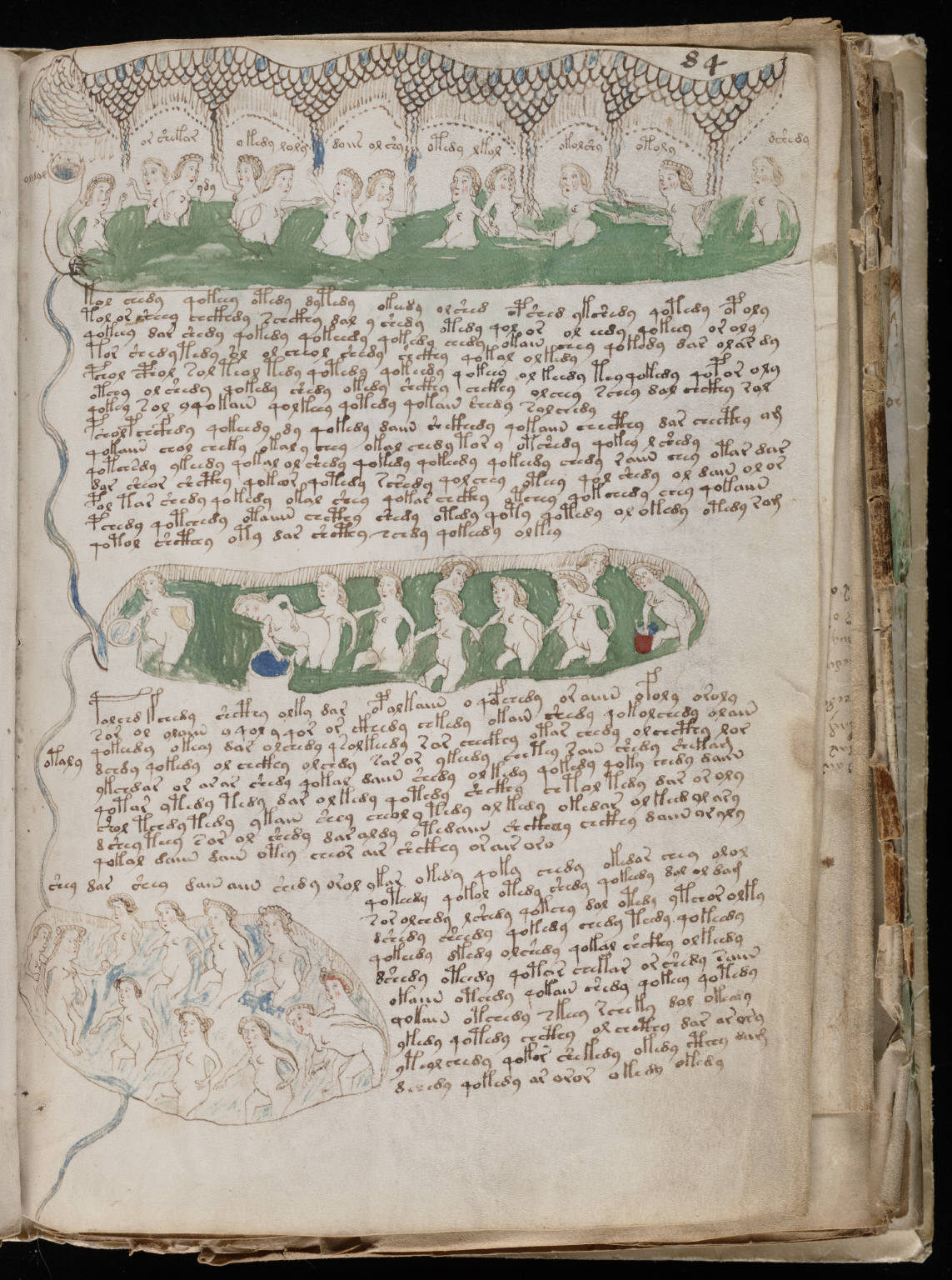
Like a lot of people, I learned about the Voynich manuscript via the web comic XKCD. The Voynich Manuscript is a 240 page illustrated manuscript written in a script that code breakers have been trying to decipher for centuries. Its strange illustrations include both real and unreal plants -- and more intriguingly, strange women immersed in greenish fluid. Some people say they look like bizarre">baths, but I think they look more like organs and the strange women seem to be dying or being tortured.
The manuscript first turned up in the historical record in the 17th century, but seems to come from the 15th or 16th. There are a lot of reasons to think this manuscript might be forged, but no one could figure out how medieval code-writers could have come up with something that looked so much like an actual language until a computer programmer came up with the means for replicating such a hoax.
The Codex Seraphinianus is a similar manuscript, except that we know it records a fake language because its creator, an Italian architect named Luigi Serafini, is still alive. The book imitates an illustrated encyclopedia from another world. Its evocative and sometimes disturbing images depict oddities like eyeball fish, fantastical plants and even a couple turning into alligators while making love.
The pictures are accompanied by an indecipherable alien script that hints at an explanation that will never be forthcoming. The viewer stares at an image of a man and woman being assembled by surgeons with mushroom heads and wonders what meaning, context and explanations the text could give us.
Apparently the daytime soap is dying (although I have to wonder: is this death like the much-discussed death of science fiction?). But luckily nighttime television is ever increasingly more soap operatic! At Big Other, Tim Jones-Yelvington considers this phenomenon: "Even those crappy Jerry Bruckheimer police procedurals seem to be including more connective tissue, more evolving relationships between characters, across episodes. The biggest difference between nighttime soaps and daytime soaps (aside from production values) is, I believe, pacing. While on a daytime soaps, two characters will stand around a country club for an entire week having the exact. same. conversation, entire social worlds rise and fall during a single episode of Gossip Girl."
As someone who never liked daytime soaps in the first place, I salute the evening soap. Happy are the hours I spend in front of my television, devouring Dexter, Big Love, Satisfaction, The L-Word, Pushing Daisies, Dead Like Me, Six Feet Under, and so on.
Much is made of the unintellectual nature of television, but this is silly. Any narrative medium will inevitably contain work that stimulates and work that fails to. Shows like Dexter and Dead Like Me may owe their high-stakes drama to the daytime soap, but they're just a new iteration of serialized fiction. And for someone who spends day in and day out immersed in words, it's a serious pleasure to get on with some visual entertainment.
So, come on over. Let's watch Dexter pull out his syringe.
7. Jojo's Goddamned Fashion Show
According to some people, I'm no gamer – I can't even make it through a few songs of Guitar Hero without starting to yawn, much to my husband's chagrin.
But when it comes to casual games, I – like many women – am a gaming champion.
Not all casual games are created equal. Here are some of the best I've found.
Chocolatier 2 – Secret Ingredients: Travel the world, collecting recipes for chocolates. Buy ingredients so that you can manufacture and sell your own brand. Play involves fulfilling quests, managing prices, and match three.
Dream Chronicles I, II & III: An evil fairy has kidnapped our heroine's husband and she must pursue him through a dream world, fending off malevolent magic. Play is a mix between old infocom games and Myst.
Sally's Spa: The best designed of the time management games in which the player must manage their time to create a successful business – in this case a spa.
Jojo's Fashion Show I & II: Fashion designer Jojo and her daughter have created a new line, and the player must coordinate their fashion shows. It's a bit like a cross between playing paper dolls and watching Project Runway – the player must assemble outfits that match a prescribed style, such as flapper, punk, futuristic, or mod.
Top Chef and Cooking Academy I & II: Top Chef is based on the reality show of the same name. The player chooses and prepares ingredients, gaining bonuses when they select flavors that go well together, such as ginger and chicken or basil and tomato. Cooking Academy provides the player with common recipes that the player follows by playing mini-games to collect ingredients, roll out dough, arrange sushi, and so on. Unfortunately, Cooking Academy II, which includes "world" recipes as well as American ones, indulges in racist caricatures which may make the game unplayable. (Racist and sexist depictions appear in many casual games, just as they appear in many non-casual ones – the example I found most jaw-dropping was Jewelix which features a shady Jew trying to cheat the shop owner.)
Tasty Planet: Like Katamari Damacy, but with a more intuitive playing system. Scientists have created a cleaner that's supposed to devour dirt, but the goo turns out to eat much more. Play the goo as it starts out eating amoebas and eventually grows large enough to devour planets, galaxies, and finally the universe.
8. Magnatune and Pandora
Two online music sites – Magnatune and Pandora – have been instrumental (see what I did there?) in helping me find new listening pleasures.
On Magnatune, I listen to Ehren Starks (minimalized, jazzy piano and cello), Shiva in Exile (gothic world music), and Jami Sieber (enchanting cello music).
Pandora has introduced me to Kate Nash, who brings interesting instrumentation to her pop roots, and my most recent favorite, Gabriel Kahane, whose musical style represents a blend of influences from Stephen Sondheim to arias to popular music.
His Craigslistlieder is my favorite musical find of the year, a song cycle based on anonymous ads posted at craigs list, culminating in the dramatic climax, VIII. Opera Scene, which chronicles the epic difficulty of finding a roommate when you have a compulsion to put ice cubes down people's shirts.
I have a compulsion to put ice cubes down people’s shirts. As my roommate, you will likely bear the brunt of this problem. Don’t ask me why I do this. Why do I do this? Why do I do this? Years of therapy hasn’t helped. Hasn’t helped. Hasn’t heeeeeelped.
Except for Kate Nash, all this work is available for free listening online (though I'm sure all the artists would appreciate a few dollars if you feel it worthwhile).
9. The Video of "Oasis" by Amanda Palmer
Amanda Palmer has posted videos for each of the songs in her latest album, Who Killed Amanda Palmer? These videos have caused some controversy – her record label refused to sponsor her video of "Leeds United" because they declared Palmer too fat, while TV outlets refused to air "Oasis" because it "makes light of rape, religion and abortion."
Luckily, both videos are available online. "Oasis" a strikingly dark song, contrasted with bright music. This strange, uncomfortable mix creates an important sense of disjunction, forcing the listener to engage with the character beyond their preconceptions.
Palmer's videos are always compelling. The Dresden Dolls' "Coin-Operated Boy" is a perfect science fiction story in three minutes. Their angry "Girl Anachronism" is enhanced by Palmer's acting. Also of note is Palmer's reworking of the classic song "What's the Use of Won'drin'?"
Another of my favorite online music videos this year was produced as a protest against California's proposition 8, and features LGBTQ teenagers and their allies lip synching to the Lily Allen song "Fuck You."
10. Green Porno
In this series of two minute videos released by the Sundance Channel, Isabella Rossellini employs puppets, costumes, and props made of cardboard to act out the sex lives of animals. During season one and two, she focused small, easily overlooked creatures that exist on the periphery of human lives, such as spiders (who have no penises) and snails (who are sadomasochistic hermaphrodites). During season three, she concentrated on sea creatures, ending each skit with an appeal to biologist Claudio Campagna for information on how to salvage the over-fished ocean ecosystem.
The skits are compelling, funny, seductively strange, and possibly even sexy -- if your tastes swing toward exoskeletons.
Rachel Swirsky holds an MFA in fiction from the Iowa Writers Workshop. Her fiction has been published in a number of magazines and anthologies, including year's best collections edited by Jonathan Strahan, Rich Horton, and the VanderMeers. Aqueduct Press will be publishing her collection of fiction and poetry, Through the Drowsy Dark, as a volume in the Conversation Pieces series in 2010. She lives in Bakersfield with her husband and two cats.