...for mating displays among ducks. Ducks are always so interesting at this time of year-- in their gorgeous nuptial plumage, in their behavior, even in their apparent inflation in body size. Yesterday when we were out doing the rounds of the Union Bay Fill, the Southwest Pond offered us the most interesting scene, where turtles were basking in the sun, some of them piled atop one another, two great blue herons were perching on different dead tree limbs positioned on the diagonal, one of them staring intently down into the water below, the other preening itself, and most ostentatiously, several male mallards continually reared up out of the water flapping their wings (sometimes it seemed more at one another than for the delectation of the females), occasionally taking flight in order to make showy landings in the water a few yards away. Meanwhile, the blue herons ignored them totally, and the lone pied-billed grebe quietly swam into a far corner of the pond where it spent more time under water than on the surface.
The mallards' performances was the most striking thing we saw. (No, the ducks at the right aren't mallards. I think they're probably American Wigeons.) But probably the most peculiar was seeing two crows fishing on the lake. They fished the way eagles and osprey do--flying over, then circling and swooping in and ascending with fish in their bills. After they'd caught some prey, the crows flew up to the upper branches of a tree on the bank, presumably to dine in style.
In my backyard, in the meantime, the robins have been singing their heads off and the northern flicker and stellar's jay have been making a racket. I feel quite sure they all think winter's a thing of the past.
In short, it feels as though spring is almost here in Seattle, even if my hellebore plants are at their peak. Daffodils and crocus are in evidence, & going onto Daylight Savings Time, while difficult for those routinely short of sleep, confirms that sense.
Showing posts with label birds. Show all posts
Sunday, March 10, 2013
Sunday, June 24, 2012
Links for a Sunday afternoon
Summer officially arrived in the northern hemisphere this week, but Seattle's weather continues to be Spring-like, as though we've settled into mid-May weather for good. Which is all very pleasant, but I worry about my tomatoes and other hot-weather vegetables. (The lettuces and spinach and kales like it just fine, of course.)
I still haven't managed to write anything about WisCon for this blog. (Getting a bit late, I know...) I still hope to do that. In the meantime, here are some links.
--Versification has posted a review by Francesca Forrest of The Moment of Change. "Lemberg," she writes, "has chosen poems that represent the unruly, ungeneralizable expanse of human female experience."
--Electra at Starlady reviews Andrea Hairston's Mindscape-- and does so adopting the narrative form Andrea uses for character Lawanda Kitt's sections of the novel.
--A battle is under way at the University of Virginia between the board that governs the university (all of them--excepting the student representative-- the governor's political appointees who have contributed huge sums of money to political campaigns) on one side and the university's administration, faculty, and students on the other. To kick off its grand plan of turning the university into an online, for-profit diploma mill (explicitly, like Phoenix University), it fired the president of the university. I've been told of similar agendas at work on other campuses, but I've never heard of such a full-frontal assault quite like this one. The corporate-speak board members apparently conceive of themselves as enacting something known in the business world as "strategic dynamism." It's basically an embrace of instability as a way of ramming through measures of massive change before anyone has a chance of questioning much less thinking through the potential consequences of those measures. (Sort of like what happened in the US Government after the Supreme Court installed George W. Bush as POTUS.) The board has also hired the notorious Hill+Knowlton Strategies to manage public perceptions of their machinations. Although the protests at the UVA campus are tremendous (as seen by the refusal to serve of the person the board appointed as the president pro-tem), the fact that it is summer makes it seem unlikely that the protests can be sustained. I also wonder how far the main source of protest-- the faculty-- will be willing to go in the struggle. Of course it is their jobs (and their workplace) that will eventually be on the line. But since lost jobs aren't imminent, and almost all notions of personal interest tend to be located in the short-term, my hopes aren't high.
I still haven't managed to write anything about WisCon for this blog. (Getting a bit late, I know...) I still hope to do that. In the meantime, here are some links.
--Versification has posted a review by Francesca Forrest of The Moment of Change. "Lemberg," she writes, "has chosen poems that represent the unruly, ungeneralizable expanse of human female experience."
--Electra at Starlady reviews Andrea Hairston's Mindscape-- and does so adopting the narrative form Andrea uses for character Lawanda Kitt's sections of the novel.
This is, in a way that I suspect many people would not want to really acknowledge, a truly American science fiction (science fantasy?) novel, and probably one of the few that I have read. Though there is a lot of Afro-futurism in here, there is also a lot of specifically American history, particularly the history of U.S.-Indian relations - born-again Sioux Ghost Dancers are central to the plot, and the final scenes take place at Wounded Knee. Furthermore, movies and a lot of Hollywood permeate the characters' lives and worldviews, as well as the fact that many of them are involved in movies as directors or actors or unwilling Extras. I liked the way that some of the characters were explicit about the fact that they didn't want to be co-opted into mainstream narratives, and probably my favorite character overall was Lawanda Kitt, a loud and proud ethnic throwback who shakes up the corrupt and rotting zone of Los Santos without fully realizing her own power, even though we only get her viewpoint in transmissions to various people. I didn't like Elleni quite so much, but by the end I understood her - indeed, one of the awesome things about this book is just how many awesome female characters there are.--I've discovered a fantastic blog for high-quality local bird gossip: Union Bay Watch. Not only does the author, Larry, post his (and others') observations of avian life in Seattle, but he also provides spectacular photos (currently of eaglets and ongoing crow harassment of eagles, ospreys, and other larger birds) and very brief videos (for instance, of a Northern Flicker performing a mating dance). If you're at all interested in birds, it's well worth checking out.
--A battle is under way at the University of Virginia between the board that governs the university (all of them--excepting the student representative-- the governor's political appointees who have contributed huge sums of money to political campaigns) on one side and the university's administration, faculty, and students on the other. To kick off its grand plan of turning the university into an online, for-profit diploma mill (explicitly, like Phoenix University), it fired the president of the university. I've been told of similar agendas at work on other campuses, but I've never heard of such a full-frontal assault quite like this one. The corporate-speak board members apparently conceive of themselves as enacting something known in the business world as "strategic dynamism." It's basically an embrace of instability as a way of ramming through measures of massive change before anyone has a chance of questioning much less thinking through the potential consequences of those measures. (Sort of like what happened in the US Government after the Supreme Court installed George W. Bush as POTUS.) The board has also hired the notorious Hill+Knowlton Strategies to manage public perceptions of their machinations. Although the protests at the UVA campus are tremendous (as seen by the refusal to serve of the person the board appointed as the president pro-tem), the fact that it is summer makes it seem unlikely that the protests can be sustained. I also wonder how far the main source of protest-- the faculty-- will be willing to go in the struggle. Of course it is their jobs (and their workplace) that will eventually be on the line. But since lost jobs aren't imminent, and almost all notions of personal interest tend to be located in the short-term, my hopes aren't high.
Sunday, April 29, 2012
Just a Sunday afternoon in spring
It's been a long time since I've posted here: sorry about that! My allergies have been in high gear for the last few weeks, compounded, alas, by a persistent sinus infection. As a result, I've spent little time online, except for doing stuff that absolutely had to be done. Today actually seems to be headache-free, probably for the first time in two or three weeks. In fact, I dared to visit the Lake Union Fill to look at birds this afternoon, thinking I'd probably be sake, for the sky is heavily overcast, the air very still, and the air so heavy with water that I swear I could feel tiny, invisible drops brushing my face. And lo, I didn't start sneezing, my eyes didn't run, and a headache didn't start up in my left eye! Yay!
We saw few ducks today (though we did see a spectacular cinnamon teal), but Vaux's swifts were
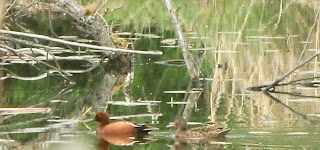
to be seen everywhere, swooping and darting, red-winged blackbirds (of course), and--Great Blue Herons, in the most definite plural. My first sight was of one in a tree, then of several roosting in another tree. And of another one, which looked on the small size, standing in the reeds at the edge of the lake, darting forward and pulling a fish out of the water. That one then took to the air and flew off, to relocate in another set of reeds near the stadium, as we discovered when we continued our walk. We then saw another, much larger blue heron in the southwest pond, standing very still, peering down into the water. Everywhere across the expanse of the fill we passed photographers with huge cameras set on tripods-- a typical of any spring Sunday at the Fill. I heard various warblers, but never managed to actually see any. I was amused to pass a small boy shakily riding his bicycle followed by his father, jogging along behind him: a fortuitous arrangement that probably won't last more than a few months more, since even shaky as he was, the boy already had his father running at a good clip. A robin atop a thin trunk of a dead tree about twice as tall as I caught my amused attention because he wasn't perched on it, as one might expect, but lying on it such that he looked as though the trunk had been thrust through his breast. Since he was singing quite lustily, it was clear that no such thing had happened. We were getting out our cameras in the hope of taking his picture when he flew off, annoyed at us for staring at him.
Bird life in our own yard continues to be interesting. A Stellar's jay, beautiful even in profile, spends most of his time in the tree facing the windows of my office and also likes to forage in the turned-up garden plot in our back yard. The humming bird that visits our yard as part of its routine in the summer has begun making occasional appearances. And sometimes, in the morning, when I look out the window over the kitchen sink, I see black-capped chickadees perching in the kiwi vines below my neighbors' bay window.
I won't speak of the crows, the seagulls, or the geese. No doubt they consider themselves the city's true rulers. They can be seen--and heard-- everywhere.
We saw few ducks today (though we did see a spectacular cinnamon teal), but Vaux's swifts were
Bird life in our own yard continues to be interesting. A Stellar's jay, beautiful even in profile, spends most of his time in the tree facing the windows of my office and also likes to forage in the turned-up garden plot in our back yard. The humming bird that visits our yard as part of its routine in the summer has begun making occasional appearances. And sometimes, in the morning, when I look out the window over the kitchen sink, I see black-capped chickadees perching in the kiwi vines below my neighbors' bay window.
I won't speak of the crows, the seagulls, or the geese. No doubt they consider themselves the city's true rulers. They can be seen--and heard-- everywhere.
Thursday, July 28, 2011
One bird, duly identified
Reporting in from Transcend, again. Tom's conference ends this afternoon, so we'll be off to Calgary tomorrow.
I've identified the bird I mentioned in my On the Road, in Canada post. It's a black-billed magpie. The image to the left is thanks to the Canku Ota site. In their description of these birds is the following characterization:
Well-known as "camp-robbers", the magpies belong to the same family as crows, ravens and jays. They adapt well to people and take advantage of anything left unattended in a camp. They've even been known to go inside of tents!!The description mentions their "scolding call," which to my ear sounds like something between a Steller's Jay and a Belted Kingfisher, maybe with a dash of Northern Flicker thrown in. "Magpie," of course, is a bird I've been encountering in my reading since childhood. Now I've actually seen one in the flesh. It's a little like hearing someone use a word I knew from my reading but had never before heard pronounced and was silently giving it the wrong pronunciation. Haven't had that kind of experience in a long, long time.
Tuesday, February 22, 2011
Getting Ready to Do It
It may be snowing today, here in Seattle, but I saw a clump of yellow crocus on Sunday, and as far as local waterfowl go, it's spring. These days I hardly recognize the (male) ducks that are wearing "nuptial plumage." (The duck in the picture to the left, for instance, is a green-winged teal with nuptial plumage.) I've noticed that some of them are beginning to spend time out of the water, waddling about in the weeds, and hunkering down on logs and low-hanging branches. On Sunday, a showy mallard climbed up onto the shore, walked straight toward me, stopped a foot short of me and paused for about half a minute to look around before continuing on his way. And when I saw a pie-billed grebe carrying a piece of water weed in his bill, I looked around for the female he was likely trying to impress. (Didn't see her, though. But since grebes are accomplished divers, she might well have been busy below.) Every visit to the Union Bay Fill, lately, has been more than usually fascinating.
I'm most curious right now about the behavior of the area's Great Blue Heron. Last week we saw several of them, roosting high in the branches of a tree not far from the resident eagles' nest. I was surprised, not only because I'd never seen more than two blue herons at the same time in the same place before, but also because I thought only two lived in the vicinity. And then on Sunday, eight blue herons came flying in over the lake, swooping low over the cove; one of them headed straight for the blue heron half-hidden in the reeds, fishing, that I'd been watching. And then both of them rose into the air and joined the others. All of them then found perches to occupy in the same two trees I'd see them in just a few days before. I'm so used to thinking of them as solitary (especially in comparison with most other waterfowl) that it seems strange and wonderful to see them hanging out in a crowd. Will they be nesting in those trees? Considering what enemies the eagles are of great blue herons-- probably the single biggest threats to their eggs and hatchlings-- it would seem to be an extraordinary choice for nesting.
Thursday, January 6, 2011
Dots and their spurious mysteries
Have you noticed how the media have created a "mystery" out of recent incidents of mass deaths of birds and fish, which scientists say are unrelated? Such incidents happen around the world with some frequency and mostly get reported as one-off oddities. The latest report is of hundreds, "possibly thousands" of turtle doves dying in the Italian town of Faenza. The dead birds, according to news reports, have "a mysterious blue stain" in their beaks. The media's creation of a spurious mystery kicked off with the incident in Arkansas on New Year's Eve, in which about 5000 birds, mostly red-winged blackbirds, died of internal injuries now being attributed to fireworks. Next was the deaths of a few hundred birds a few hundred miles away (attributed to powerlines), in Louisiana, followed by the deaths of 2 million fish in Maryland, with other mass fish deaths in Brazil and New Zealand (and Arkansas, again) and 40,000 (dead) crabs washed up on New England beaches.
Talk about clueless coverage. The reports may be careful not to suggest a common cause, but sneakily imply some mysterious (cosmic?) cause. (Anything to pique readers' and viewers' attention, right?) But as a matter of fact, 21st-century Earth is an extremely hazardous environment for the planet's wildlife. Habitat continues to shrink at an incredible pace, migration patterns are being forced to shift because of radical changes in the environment, and toxins are everywhere. (BP's blowout & obscene use of methane-generating "dispersants" is just the tip of the iceberg.) And we now know, thanks to Wikileaks, that the EPA approved the use of a pesticide they knew would kill honey bees. (And since approval has done so, on a massive scale.) The fish that have been dying in recent days apparently died from cold. Obviously that's the sort of problem fish faced even before human beings decided that their god-given "stewardship" of the earth is not about care-taking but exploitation. And yet for all I know the shifts in migration patterns and habitats brought about by global warming might have something to do with it. I'm not a marine biologist, so I don't really know. But do you notice that when the media name fireworks, power lines, and poisoning as causes of avian death, the media treat these causes as they would random lightning strikes. Which is to say, a contained but uncontrollable event that is in effect an Act of God (as insurance policies like to phrase it).
Maybe the media thinks human beings are like God? (Or at least that certain human beings are?) Well as far as birds, fish, and amphibians are concerned, I guess they are.
Talk about clueless coverage. The reports may be careful not to suggest a common cause, but sneakily imply some mysterious (cosmic?) cause. (Anything to pique readers' and viewers' attention, right?) But as a matter of fact, 21st-century Earth is an extremely hazardous environment for the planet's wildlife. Habitat continues to shrink at an incredible pace, migration patterns are being forced to shift because of radical changes in the environment, and toxins are everywhere. (BP's blowout & obscene use of methane-generating "dispersants" is just the tip of the iceberg.) And we now know, thanks to Wikileaks, that the EPA approved the use of a pesticide they knew would kill honey bees. (And since approval has done so, on a massive scale.) The fish that have been dying in recent days apparently died from cold. Obviously that's the sort of problem fish faced even before human beings decided that their god-given "stewardship" of the earth is not about care-taking but exploitation. And yet for all I know the shifts in migration patterns and habitats brought about by global warming might have something to do with it. I'm not a marine biologist, so I don't really know. But do you notice that when the media name fireworks, power lines, and poisoning as causes of avian death, the media treat these causes as they would random lightning strikes. Which is to say, a contained but uncontrollable event that is in effect an Act of God (as insurance policies like to phrase it).
Maybe the media thinks human beings are like God? (Or at least that certain human beings are?) Well as far as birds, fish, and amphibians are concerned, I guess they are.
Sunday, November 14, 2010
A Building Epizootic
An epizootic is the "wildlife equivalent of an epidemic." And many birds in the Pacific Northwest and Alaska, it seems, are suffering from avian keratin disorder, which causes beak deformities and could be a sign that a new disease is spreading among birds, or an unknown environmental problem is damaging birds. Andre Revikin at the New York Times offers a Q&A with two biologists, Colleen Handel and Caroline Van Hemert, on the subject. And at Wired Science, Brandon Keim has a short piece-- Alaskan Bird Deformities Are Puzzling, Creepy-- that says basically the same thing, only noting that the black-capped chickadee and crows are especially affected:
Birders in Alaska and the Pacific Northwest are being asked to report any sightings they might make of beak deformities.

(Links thanks to Eileen Gunn.)
About one in 16 crows and black-capped chickadees suffer from a condition called avian keratin disorder, which causes their beaks to become morbidly elongated and crossed.Unlike past outbreaks of beak-deformity epidemics caused by toxins and heavy metals contamination of the environment, which occurred in clusters, this one is widespread and affects species living in different habitats.
Rates of the debilitating disorder are 10 times higher than usual. That’s higher than has ever been recorded in any wild-bird population, and most of this rise happened over the last decade. Dozens of other bird species are afflicted. Nobody knows why, but it’s probably not a good sign.
Birders in Alaska and the Pacific Northwest are being asked to report any sightings they might make of beak deformities.

(Links thanks to Eileen Gunn.)
Friday, October 15, 2010
Links for the Weekend
--On October 4, SF3, WisCon's parent organization, passed two motions on the Elizabeth Moon situation.
--Inspired by 80! Memories & Reflections on Ursula K. Le Guin, Michael Swanwick revists Poughskeepie (Part 1 here, Part 2 here). He writes:
A snippet:
National Geographic, by the way, has a wonderful gallery of photos of the nest males have built to woo females, here.
_______________
One of the authors of the research paper. The abstract of the paper can be found here, and here's a quote from it:
--Inspired by 80! Memories & Reflections on Ursula K. Le Guin, Michael Swanwick revists Poughskeepie (Part 1 here, Part 2 here). He writes:
Now, either you want this book (I did and now I have it) or you don't, and you already know which camp you dwell within, and no amount of descriptive analysis will budge you one way or the other.--Tansy Rayner Roberts reviews The WisCon Chronicles, Vol.4.
So I'm not going to review the book. Why bother?
However, I was inspired by Lisa Tuttle's heartfelt contribution, "'From Elfland to Poughkeepsie' and Back Again, or, I Think We're in Poughkeepsie Now, Toto," on how important a single seminal Le Guin essay was to her, to go back and revisit said essay.
A snippet:
The highlight of the book for me was “We See What You Did There,” a group chat among various POC about their various experiences at the convention, and discussing their relationship with WisCon as a continuing event. This, combined with several standalone “My WisCon” con reports by different participants, definitely gives the impression that the book has achieved wide coverage as far as who and what WisCon is all about.--Rex at Savage Minds writes about The Trashing of Margaret Mead: Anatomy of an Anthropoligcal Controversy by Paul Shankman, which examines Derek Freeman's attack on Margaret Mead's Coming of Age in Samoa (after Mead's death, of course). (Link thanks to the Mumpsimus.) It did my heart good to read
Impartial, but not noncommittal. Shankman describes the personal stakes and intimate social networks on both sides of the debate, and is frank in his assessment of how people’s personal commitments and backgrounds influenced their arguments. In addition, a major part of the book deals with the question of who is right about Samoa and this involves making judgments about the scholarly adequacy of Mead and Freeman’s work. As judicious as Shankman is, then, you still get a sense of where he stands.--And finally, I can't resist mentioning the recent research on great bowerbirds, which are apparently as common in Australia as black-capped chickadees are in my region of North America. When a report on this new piece of research was published in Current Biology on Sept 9, several magazines and newspapers leaped on it, including Science and Discover. Birds, of course, are wondrously various in their sexed division of labor (which variety should, really, be a lesson to to humans). In the case of great bowerbirds, the male spends a good chunk of the year building an elaborate nest for attracting females. Discover Magazine has a post about it on their blog that sums up some of the interesting bits. For instance,
And where he stands is overwhelmingly against Freeman. Freeman’s bizarre personal life — including his mental breakdown — is documented here in a scholarly monograph by a major press for (as far as I know) the first time. The stories that had been circulating about his atrocious behavior, such as contacting universities and demanding that they revoke the Ph.D.s of his opponents, finally get their full airing. Freeman’s arguments about Mead are shown not to hold very much water, and his own claims about Samoa don’t seem to stand close scholarly scrutiny either. At times one feels the book should be called The Trashing of Derek Freeman. But Shankman’s criticisms never seem vindictive and his discussion of Freeman’s psyche never degenerate into ad hominems — despite how easy it would be to do so. In reality, Freeman’s own worse enemy is himself — or at least himself and a scholar willing to rigorously document his actions.
Shankman is not uncritical of Mead and points out the ways in which Coming of Age reaches conclusions about American life that Mead quite liked but which were not really supported by the Samoan data. Still, it is clear from his book that Mead was basically a decent fieldworker and a careful scholar while Freeman was, frankly, a nutcake.
Bowerbirds are relatives of crows and jays that live in Australian and New Guinea. To attract mates, males from each of the 20 or so species build an intricate structure called a bower, which he decorates with specially chosen objects. Some species favour blue trinkets; others collect a mishmash of flowers, fruits, insect shells and more. Surrounded by these knick-knacks, the artistic male performs an elaborate display; the female judges him on his skill as a performer, builder and decorator.Science, the biologists "mapped the positions of thousands of objects in front of 33 male bowerbirds' avenues. [...] When the researchers rearranged the designs, the males put them back in the original order. This behavior suggests that the birds are making deliberate choices, possibly implying some kind of cognitive talent."
The great bowerbird’s taste for interior design seems quite Spartan compared to his relatives. He creates an avenue of sticks leading up to a courtyard, decorated with gray and white objects, such as shells, bones and pebbles. The male performs in the courtyard while the female watches from the lined avenue. Her point of view is fixed and narrow, and according to Endler*, the male knows how to exploit that.
He found that the males place the largest objects towards the rear of the courtyard and the smallest objects in the front near the avenue. This creates forced perspective. From the female’s point of view, the bigger objects that are further away look to be the same size the smaller objects that are close by. If bowerbird vision is anything like humans, the courtyard as a whole looks smaller to a watching female, the opposite effect to the one that Disney visitors experience.
National Geographic, by the way, has a wonderful gallery of photos of the nest males have built to woo females, here.
_______________
One of the authors of the research paper. The abstract of the paper can be found here, and here's a quote from it:
Males make courts with gray and white objects that increase in size with distance from the avenue entrance. This gradient creates forced visual perspective for the audience; court object visual angles subtended on the female viewer's eye are more uniform than if the objects were placed at random. Forced perspective can yield false perception of size and distance [12,15]. After experimental reversal of their size-distance gradient, males recovered their gradients within 3 days, and there was little difference from the original after 2 wks. Variation among males in their forced-perspective quality as seen by their female audience indicates that visual perspective is available for use in mate choice, perhaps as an indicator of cognitive ability. Regardless of function, the creation and maintenance of forced visual perspective is clearly important to great bowerbirds and suggests the possibility of a previously unknown dimension of bird cognition.
Wednesday, October 13, 2010
Birds and memory
I was amazed to learn the other day that some birds grow new brain cells in the autumn-- all in the aid of boosting their memories.
As I've mentioned before, over the summer, I really got into birding. One of the unexpected pleasures of that was discovering the joys of birding gossip. I can't begin to guess how many birders haunt Seattle's Union Bay Fill, which contains, among other things, the wetland reclamation area I've talked about in past posts, but there must be dozens, if not hundreds (easily identifiable by binoculars, or high-powered cameras or even telescopes, and sometimes even folding stools) regularly visiting the site. I've been reading birding books and have become more attentive and focused, and so I'm seeing a lot that I'm sure I previously missed. But even before I got serious about this new pursuit, I had already begun engaging in one of the pleasures intrinsic to birding: making narratives out of the "dramas" going on in the bird world that I've been visiting. Now that I, too, walk around with a pair of binoculars slung around my neck, other birders frequently ask me if I've seen anything interesting. That question is usually the prelude to a gossip fest about certain of the on-going or recent-past bird dramas. For instance, a couple of weeks ago when I mentioned the osprey that I've seen around the Cove since early September and remarked on its ineptness fishing-- diving down to the surface of the water only to ascend empty-beaked-- my interlocutor said yes, she was sure that osprey was a juvenile and that just the other day she saw it successfully catch a fish, which she was delighted to see-- only to have one of the resident bald eagles swoop past it and steal the fish right out of its beak. And then there's the gossip about the three young Cooper's hawks who seem unable to catch anything and will they starve to death if they don't soon figure things out?
And of course there was that pied-billed grebe who laid three eggs in August (see the photo)-- and sat on it for weeks, until finally it abandoned the nest when she figured out the eggs weren't viable, and the next day, the eggs [three of them, but I'm afraid you probably can't make them out in the small version of the photo to the right) were gone. And so on.
I've always been interested in the birds in my own yard, but since I grew up in the midwest, my ability to identify them (beyond crows, robins, sparrows, and starlings) was pathetic. I've always liked to listen to them in the early morning, but again mostly couldn't tell which birds I was hearing. But now I know, for instance, that black-capped chickadees and Steller's jays are habitues. I have actually frequently noticed a couple of Steller's jays hanging out here over the last couple of years. (They like to forage on the ground, which makes them easily visible.) I've only seen black-capped chickadees at the Fill-- but I hear them all the time in my yard. (Their song as well as their other sounds are highly distinctive.) But then it's difficult for me to see anything in the huge old cherry tree that a lot of birds like to perch in, because the leaf cover is thick.
The other day I decided to learn more about them than I could find in my birding books. And this is when I discovered that they are among the birds that discard some brain cells in their hippocampus in the spring and grow new ones-- causing their hippocampus to expand by about 30%-- in the fall. The reason for this? They cache food all over the place and need to be able to remember where they put it. Here's an excerpt from an abstract for a paper by David F. Sherry and Jennifer S. Hoshooley, Seasonal hippocampal plasticity in food-storing birds:
Since the discovery in the 1990s that black-capped chickadees grow new brain cells every year, researchers are exploring the phenomena, some of them interested in finding appplications for humans who are inacapable of growing new neurons to replace the ones they are constantly losing. Kurt Pfitzer reports, for instance:
ETA: Wouldn't you know it-- shortly after posting the above, I was out in the yard and saw two black-capped chickadees in flight.
As I've mentioned before, over the summer, I really got into birding. One of the unexpected pleasures of that was discovering the joys of birding gossip. I can't begin to guess how many birders haunt Seattle's Union Bay Fill, which contains, among other things, the wetland reclamation area I've talked about in past posts, but there must be dozens, if not hundreds (easily identifiable by binoculars, or high-powered cameras or even telescopes, and sometimes even folding stools) regularly visiting the site. I've been reading birding books and have become more attentive and focused, and so I'm seeing a lot that I'm sure I previously missed. But even before I got serious about this new pursuit, I had already begun engaging in one of the pleasures intrinsic to birding: making narratives out of the "dramas" going on in the bird world that I've been visiting. Now that I, too, walk around with a pair of binoculars slung around my neck, other birders frequently ask me if I've seen anything interesting. That question is usually the prelude to a gossip fest about certain of the on-going or recent-past bird dramas. For instance, a couple of weeks ago when I mentioned the osprey that I've seen around the Cove since early September and remarked on its ineptness fishing-- diving down to the surface of the water only to ascend empty-beaked-- my interlocutor said yes, she was sure that osprey was a juvenile and that just the other day she saw it successfully catch a fish, which she was delighted to see-- only to have one of the resident bald eagles swoop past it and steal the fish right out of its beak. And then there's the gossip about the three young Cooper's hawks who seem unable to catch anything and will they starve to death if they don't soon figure things out?
And of course there was that pied-billed grebe who laid three eggs in August (see the photo)-- and sat on it for weeks, until finally it abandoned the nest when she figured out the eggs weren't viable, and the next day, the eggs [three of them, but I'm afraid you probably can't make them out in the small version of the photo to the right) were gone. And so on.
I've always been interested in the birds in my own yard, but since I grew up in the midwest, my ability to identify them (beyond crows, robins, sparrows, and starlings) was pathetic. I've always liked to listen to them in the early morning, but again mostly couldn't tell which birds I was hearing. But now I know, for instance, that black-capped chickadees and Steller's jays are habitues. I have actually frequently noticed a couple of Steller's jays hanging out here over the last couple of years. (They like to forage on the ground, which makes them easily visible.) I've only seen black-capped chickadees at the Fill-- but I hear them all the time in my yard. (Their song as well as their other sounds are highly distinctive.) But then it's difficult for me to see anything in the huge old cherry tree that a lot of birds like to perch in, because the leaf cover is thick.
The other day I decided to learn more about them than I could find in my birding books. And this is when I discovered that they are among the birds that discard some brain cells in their hippocampus in the spring and grow new ones-- causing their hippocampus to expand by about 30%-- in the fall. The reason for this? They cache food all over the place and need to be able to remember where they put it. Here's an excerpt from an abstract for a paper by David F. Sherry and Jennifer S. Hoshooley, Seasonal hippocampal plasticity in food-storing birds:
Both food-storing behaviour and the hippocampus change annually in food-storing birds. Food storing increases substantially in autumn and winter in chickadees and tits, jays and nutcrackers and nuthatches. The total size of the chickadee hippocampus increases in autumn and winter as does the rate of hippocampal neurogenesis. [...] The peak in recruitment of new neurons into the hippocampus occurs before birds have completed food storing and cache retrieval for the year and may therefore be associated with spacing caches, encoding the spatial locations of caches, or creating a neuronal architecture involved in the recollection of cache sites.[...] Available evidence suggests that changes in hippocampal size and neurogenesis may be a consequence of the behavioural and cognitive involvement of the hippocampus in storing and retrieving food.
Since the discovery in the 1990s that black-capped chickadees grow new brain cells every year, researchers are exploring the phenomena, some of them interested in finding appplications for humans who are inacapable of growing new neurons to replace the ones they are constantly losing. Kurt Pfitzer reports, for instance:
Songbirds are the first species of vertebrate in which brain growth during adulthood has been found to occur, Saldanha says. By studying neurogenesis in the black-capped chickadee, Saldanha hopes to learn how hormones help guide the brain’s development and reorganization. He is particularly interested in the role played by the hormone estrogen in the growth of the hippocampus. Songbirds (like most vertebrates) make estrogen in their ovaries; scientists have determined that their brains also express aromatase, the enzyme that makes estrogen. Perhaps not surprisingly, the area of the songbird brain with the highest estrogen-making capability is the hippocampus.This is fascinating research. But I have to say the chickadees can't be too thrilled by it themselves. For them, Saldanha must just be another predator-- only one they don't instinctively recognize.
"We know hormones affect the reorganization of the brain in ovo, in utero and during the early physical development of most vertebrates," Saldanha says. "We are trying to figure out whether the ability to make estrogen in the hippocampus is helping the dramatic reorganization of the [adult] brain."
[Colin] Saldanha [assistant professor of biological sciences at Lehigh University] uses transmission electron microscopy (TEM) to examine neurons (nerve cells) and synapses (connections between nerve cells, where scientists think learning occurs) from the brain of the black-capped chickadee. His goal is to determine whether estrogen is being made in the cellular body or in the synapse, and whether the location of this estrogen-making ability changes seasonally.
"We’re looking at the ability of nerve cells and connections to make estrogen in the brain and asking if this ability is involved in brain reorganization," he says.
"We are the first lab, I think, to look at estrogen-synthesizing neurons in the songbird hippocampus at the electron-microscope level. We may, in fact, be the only lab using this technology to investigate songbird spatial memory."
ETA: Wouldn't you know it-- shortly after posting the above, I was out in the yard and saw two black-capped chickadees in flight.
Subscribe to:
Comments (Atom)


