Co-Editors Isabel Schechter and Michi Trota are extending the submission deadlines for The WisCon Chronicles: Vol. 12: Boundaries and Bridges. The queries deadline has been extended to September 15, 2019; the submissions deadline has been extended to October 15, 2019.
For the complete set of guidelines, please see the original call for submissions: https://aqueductpress.blogspot.com/2019/07/the-wiscon-chronicles-vol-12-call-for.html.
Thursday, August 29, 2019


Tuesday, July 30, 2019
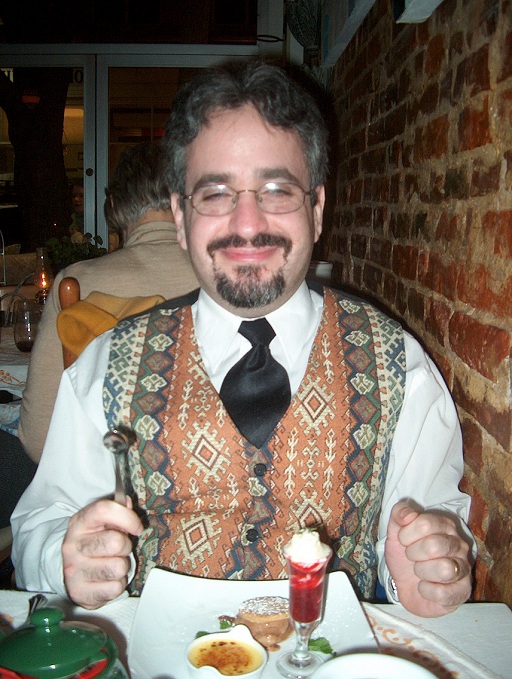
Joshua B. Lukin (1968-2019)

Last week, Josh Lukin, my dear friend and a member of this blog, died, a little less than one month short of his fifty-first birthday. Josh was an Associate Professor in Temple University's English Department, where besides teaching writing, he was a disability studies scholar and a critic. He edited a book published by Aqueduct Press, It Walks in Beauty: Selected Prose of Chandler Davis, and contributed essays to Daughters of Earth (“Cold War Masculinity in the Early Work of Kate Wilhelm”) and The WisCon Chronicles, Volume 7. He co-edited, with Samuel R. Delany, a special issue of Paradoxa on the Fifties, and was the editor of Invisible Suburbs: Recovering Protest Fiction in the 1950s United States, as well as special issue on Samuel R. Delany for the minnesota review. He wrote numerous articles on the work of Philip K. Dick, Patricia Highsmith, Jim Thompson, and, of course, Chandler Davis, among others.
Josh introduced himself to me, via email, early in the summer of 2001, to solicit a review from me for the special issue of Paradoxa he was co-editing with Chip Delany. When I replied to his email, he immediately wrote back, and that was the beginning of a long, intense email correspondence. He was thirty-two at the time, I was fifty; he was working on his dissertation and preparing for the academic job market, and I was someone who'd been reading and thinking and writing about many of the same things he was into for a bit more than twenty-five years. Over the length of that correspondence, we mined several common areas we were passionate about, often through mutual interrogation, and often reverting to old insights we'd shared when resonant examples presented themselves to one or the other of us months or even years later. Within the first week of that correspondence, he wrote:
In general, I'm interested in f & sf works that (a) defy the "bourgeois myth of free will" tradition that I associate with Heinlein and acknowledge the existence and limits of the body (because, having suffered a chronic illness for 25 years in the U.S.A., I have a very personal vendetta against that myth and those who uphold it) and (b) that can be taught in a Literature and Medicine course (because I'm entering the academic job market in two months and have to present myself as able to teach as many things as possible--and if possible, to present my illness as an asset rather than a sin).And of course I recognized at once why he wanted to engage with me, since my own work came at his interests from a different, but highly compatible angle, which his previous references to my work had intimated.
I think anyone who knew him would tell you that while Josh was brilliant and profoundly serious, he was also irrepressibly playful. That playfulness spiced rather than spiked his (or my) seriousness, constantly erupting into his prose (and, in person, into his speech). Early on, he wrote:
[T]o a Canadian scholar who recently said to me, "You laugh about the Bush administration, but it's serious business," I responded, "Of course it's serious business: who laughs about happy events?"
Well, yes. Although I wasn't always fond of his penchant for punning, I shared his need to make "the serious business" funny. ("Making it funny" was one of the few things that ran in both of our familial backgrounds.) I can well imagine it helped him get through the gruesome medical situations he faced in childhood.
We met, face to face, for the first time in Buffalo, on March 22, 2006, where we were both attending the Samuel R. Delany Symposium. He rented a car and picked me up at the airport, all bundled up, wearing a hat with ear flaps. (I had bought a winter coat, of the sort unnecessary for Seattle winters, at a used clothing store: and still found it necessary to dress in layers the next day.) We were both terrified to meet, as any people who have grown close in an online relationship naturally are. The first evening was a bit rocky. But when he picked me up at my hotel the next morning, we became easier with one another. The next night, after having drinks in the bar with Carl Freedman, Steve Shaviro, Chip Delany, and me, Josh broke into song, and Carl joined him. Breaking into song is something Josh did often, which I of course hadn't known from merely email contact. He did this in Madison, too, when attending WisCon with his wife, Ann Keefer. Song--especially Broadway musical songs (but also Dylan and Leonard Cohen et al) was an important part of his life. Josh adored Stephen Sondheim. It got him through the worst of his constant struggle with Crohn's. And he scattered phrases from songs in his emails, and often used them in the subject line.
Finally, I must say this, too: Josh was a writer. Yes, his writing mostly took the form of scholarship. But his prose was always a pleasure to read--even his dissertation, which, in all its elegance, filled me with joy. It bothered him that people generally associate the designation "writer" solely with those who write fiction. But Josh's skill and talent for writing was superb. His prose was a constant reminder to me that every genre of writing, including scholarly genres, ought to be infused with grace and intelligence.
Josh always used to write R.I.P when someone important to us left our world. And so I'll say that now for Josh: R.I.P, beloved friend. (And thanks for all the fish.)
P.S. Please, please feel free to leave anecdotes and remembrances of Josh in a comment. I and everyone else who loved Josh will treasure them.
Thursday, July 18, 2019
The WIsCon Chronicles, Vol. 12: call for submissions
Isabel Schechter and Michi Trota are thrilled to announce that they will be co-editing Volume 12 of the WisCon Chronicles.
We have chosen the theme “Boundaries and Bridges” for this volume of the WisCon Chronicles to reflect how WisCon has often been a place where the exploration of boundaries and bridging of divides in SFF and fandom -- whether personal, cultural, political, or otherwise -- have been at the core of the WisCon experience.
We are interested to learn what boundaries you want to examine, redefine, create, or destroy. Why are some boundaries more acceptable than others? When are boundaries necessary, and when do they need to be torn down? How does our understanding of boundaries influence our ability to build bridges with others, or even within our own psyches? When is it time to build a bridge or burn it? And how does this all play out within SFF and fandom?
Here is a sample of topics we are hoping to see tackled:
● Was there a panel at this year’s WisCon that led to a new recognition of how boundaries function (or don’t function) in SFF?
● How has WisCon shaped/changed your understanding of boundaries among fandoms around gender/race/age/ability and other identities?
● Did a work of SFF encourage you to bridge parts of your identity you previously saw as isolated?
● How do we explore boundaries and bridges between genres (scifi, fantasy, horror, etc)?
● How do different formats of storytelling (written word, graphic novels/comics, film, TV, podcasting, fanfic) create/transcend boundaries and offer opportunities to build bridges?
● How is respecting boundaries a part of responsible storytelling?
We welcome nonfiction delving into these and other topics specifically through the lens of identity and the intersections thereof.
Submitters are encouraged to submit pieces such as personal essays, panel reports, critical essays, and other forms of creative nonfiction. If you have an idea for topics or essay formats that haven’t been mentioned in these guidelines but you feel would be a fit for the scope of the anthology, please feel free to query us. First-time writers, POC writers, and other writers of marginalized backgrounds are especially encouraged to submit; please don’t self-reject, instead allow the editors to do their job by submitting your work and ideas!
We will consider pieces with a word count of 500-4000, but are willing to consider submissions outside these lengths if the piece warrants it. Send queries and submissions to wcc.vol12@gmail.com with “Submission” or “Query” in the subject line. Please send submissions in .DOC, .DOCX, or .RFT formats. Queries are due by September 1, 2019 and submissions are due by October 1, 2019.
Authors will be paid a nominal fee of $25 for accepted pieces, and will receive a hard copy of the anthology.
We have chosen the theme “Boundaries and Bridges” for this volume of the WisCon Chronicles to reflect how WisCon has often been a place where the exploration of boundaries and bridging of divides in SFF and fandom -- whether personal, cultural, political, or otherwise -- have been at the core of the WisCon experience.
We are interested to learn what boundaries you want to examine, redefine, create, or destroy. Why are some boundaries more acceptable than others? When are boundaries necessary, and when do they need to be torn down? How does our understanding of boundaries influence our ability to build bridges with others, or even within our own psyches? When is it time to build a bridge or burn it? And how does this all play out within SFF and fandom?
Here is a sample of topics we are hoping to see tackled:
● Was there a panel at this year’s WisCon that led to a new recognition of how boundaries function (or don’t function) in SFF?
● How has WisCon shaped/changed your understanding of boundaries among fandoms around gender/race/age/ability and other identities?
● Did a work of SFF encourage you to bridge parts of your identity you previously saw as isolated?
● How do we explore boundaries and bridges between genres (scifi, fantasy, horror, etc)?
● How do different formats of storytelling (written word, graphic novels/comics, film, TV, podcasting, fanfic) create/transcend boundaries and offer opportunities to build bridges?
● How is respecting boundaries a part of responsible storytelling?
We welcome nonfiction delving into these and other topics specifically through the lens of identity and the intersections thereof.
Submitters are encouraged to submit pieces such as personal essays, panel reports, critical essays, and other forms of creative nonfiction. If you have an idea for topics or essay formats that haven’t been mentioned in these guidelines but you feel would be a fit for the scope of the anthology, please feel free to query us. First-time writers, POC writers, and other writers of marginalized backgrounds are especially encouraged to submit; please don’t self-reject, instead allow the editors to do their job by submitting your work and ideas!
We will consider pieces with a word count of 500-4000, but are willing to consider submissions outside these lengths if the piece warrants it. Send queries and submissions to wcc.vol12@gmail.com with “Submission” or “Query” in the subject line. Please send submissions in .DOC, .DOCX, or .RFT formats. Queries are due by September 1, 2019 and submissions are due by October 1, 2019.
Authors will be paid a nominal fee of $25 for accepted pieces, and will receive a hard copy of the anthology.
Monday, July 1, 2019
Kate Boyes's Trapped in the R.A.W.

I'm pleased to announce the release of Kate Boyes's debut novel, Trapped in the R.A.W., which Aqueduct is publishing in both print and e-book editions. You can purchase it now at http://www.aqueductpress.com/books/978-1-61976-159-9.php.
A young woman working alone in a small special collections library is trapped in the building when invaders overrun her town. She barricades the doors, peeks through a window, and watches in horror as people are murdered outside. The invaders wear uniforms that cover them completely, making it impossible for her to see their faces. However, she realizes at once that they do not intend to subjugate the population. They intend to annihilate it.
Trapped in the R.A.W. is a journal of the young woman’s solitary struggle to protect the books while keeping herself fed, hydrated, warm, and sane.
Read a sample from the book
Advance Praise
“Kate Boyes’s Trapped in the R.A.W. is a very fresh take on the alien invasion theme. Tracing the story of a young archivist caught up in a terrifying and mysterious assault on her small town campus, the book is simultaneously a first-hand account of survival, a post-apocalyptic memoir, a narrative of first contact, and an ode to libraries. Human, humane, and often darkly humorous, this is one of the most charming dystopian novels I have read in a very long time.“Trying to sit out an alien invasion in a library…for the discerning SF reader it just doesn’t get better than that.” —Jackie Hatton, author of Flesh & Wires
“Everything in this book is unexpected: the invasion, the invaders, and especially the hero, an ordinary young woman who deals with the unspeakable in simple ways that prove quite extraordinary. She is on her own and terrified, with no special powers or super technology, and yet she manages to reason and act. At a time when superhero exploits take up so much storytelling space, it is delightful to read a tale in which people take care of themselves.” —Nancy Jane Moore, author of The Weave
Reviews
The novel demonstrates an impressively assured voice, an ingenious, casebook-like structure in which the journal of the title is supplemented by several ‘‘appendices’’ written years later, and an equally creative use of illustrative material, drawn mostly from 19th-century books and the illustrations of Walter Crane....[T]he effect is unarguably moving, as we watch Kaylee transformed from a desperate and lonely figure into a kind of librarian legend, whose story only becomes richer as we piece it together from these later documents. –Gary K. Wolfe, Locus July 2019
Boyes’s metafictional SF debut convincingly depicts the tenacity of the human spirit in the face of uncertainty. Kaylee is a special collections librarian who’s trapped in the university’s rare books library when aliens invade Earth. She records her thoughts on the pages of old library books, musing about the deteriorating state of the world while making a desperate bid for survival. Even though the invaders destroy her home and those she loves, Kaylee wishes to learn more about them, and forges a relationship with a male of the invading species while attempting to rationalize their destruction of humankind. With her new ally by her side, Kaylee plans her escape from the library, leaving her journal behind. Some 30 years after the invasion, the journal is picked up by a human expeditionary force, and the missing pieces of Kaylee’s story begin to fall into place. Kaylee is undeniably charming; Boyes suffuses her diaries with both humor and weight. Boyes’s attention to detail carries the tale forward, drawing the reader into Kaylee’s journey of survival and discovery. —Publishers Weekly May 2019
Thursday, June 6, 2019
The 31st Annual Lambda Literary Awards

Here at Aqueduct Press, we're elated that The Breath of the Sun, Isaac R. Fellman's debut novel, which we published last year, has won a Lambda Literary Award. Congratulations, Isaac!
You can find the full list of winners for each category below. I was especially pleased to see that Larissa Lai's Tiger Flu (on this year's Tiptree Honor List, as well) won in the Lesbian Fiction category, and Claire O'Dell's A Study in Honor, a science fiction noir novel that I much enjoyed, won in the Lesbian Mystery category. I'd also like to salute Looking for Lorraine: The Radiant and Radical Life of Lorraine Hansberry, in the LGBTQ Nonfiction category, as a very fine book that I also enjoyed. In fact, just as the Tiptree Honor Lists are always a good source of titles to search out, so with the entire list of Lambda Award finalists (which can be found at https://www.lambdaliterary.org/31st-annual-lambda-literary-award-finalists-and-winners/ .
31ST ANNUAL LAMBDA LITERARY AWARD WINNERS:
Lesbian Fiction
The Tiger Flu, Larissa Lai, Arsenal Pulp Press
Gay Fiction
Jonny Appleseed, Joshua Whitehead, Arsenal Pulp Press
Bisexual Fiction
Disoriental, Négar Djavadi, Translated by Tina Kover, Europa Editions
Bisexual Nonfiction
Out of Step: A Memoir, Anthony Moll, Mad Creek Books / The Ohio State University Press
Transgender Fiction
Little Fish, Casey Plett, Arsenal Pulp Press
LGBTQ Nonfiction
Looking for Lorraine: The Radiant and Radical Life of Lorraine Hansberry, Imani Perry, Beacon
Press
Transgender Nonfiction
Histories of the Transgender Child, Julian Gill-Peterson, University of Minnesota Press
Lesbian Poetry
Each Tree Could Hold a Noose or a House, Ru Puro, New Issues Poetry & Prose
Gay Poetry
Indecency, Justin Phillip Reed, Coffee House Press
Bisexual Poetry
We Play a Game, Duy Doan, Yale University Press
Transgender Poetry
lo terciario / the tertiary, Raquel Salas Rivera, Timeless, Infinite Light
Lesbian Mystery
A Study in Honor: A Novel, Claire O’Dell, HarperCollins / HarperVoyager
Gay Mystery
Late Fees: A Pinx Video Mystery, Marshall Thornton, Kenmore Books
Lesbian Memoir/Biography
Chronology, Zahra Patterson, Ugly Duckling Presse
Gay Memoir/Biography
No Ashes in the Fire: Coming of Age Black and Free in America, Darnell L.
Moore, Bold Type Books
Lesbian Romance
Beowulf For Cretins: A Love Story, Ann McMan, Bywater Books
Gay Romance
Crashing Upwards, S.C. Wynne, self-published
LGBTQ Erotica
Miles & Honesty in SCFSX!, Blue Delliquanti & Kazimir Lee, self-published
LGBTQ Anthology—Fiction
As You Like It: The Gerald Kraak Anthology Volume II, The Other Foundation, Jacana Media
LGBTQ Anthology—Nonfiction
Not That Bad: Dispatches from Rape Culture, Roxane Gay, HarperCollins / Harper Perennial
LGBTQ Children’s/Young Adult
Hurricane Child, Kacen Callender, Scholastic / Scholastic Press
LGBTQ Drama
Draw the Circle, Mashuq Mushtaq Deen, Dramatists Play Service
LGBTQ Graphic Novels
The Lie and How We Told It, Tommi Parrish, Fantagraphics Books
LGBTQ SF/F/Horror
The Breath of the Sun, Isaac R. Fellman, Aqueduct
LGBTQ Studies
Toxic Silence: Race, Black Gender Identity, and Addressing the Violence Against Black Transgender Women in Houston, William T. Hoston, Peter Lang International Academic Publishers
Wednesday, May 15, 2019
The Cascadia Subduction Zone, Vol. 9, 2
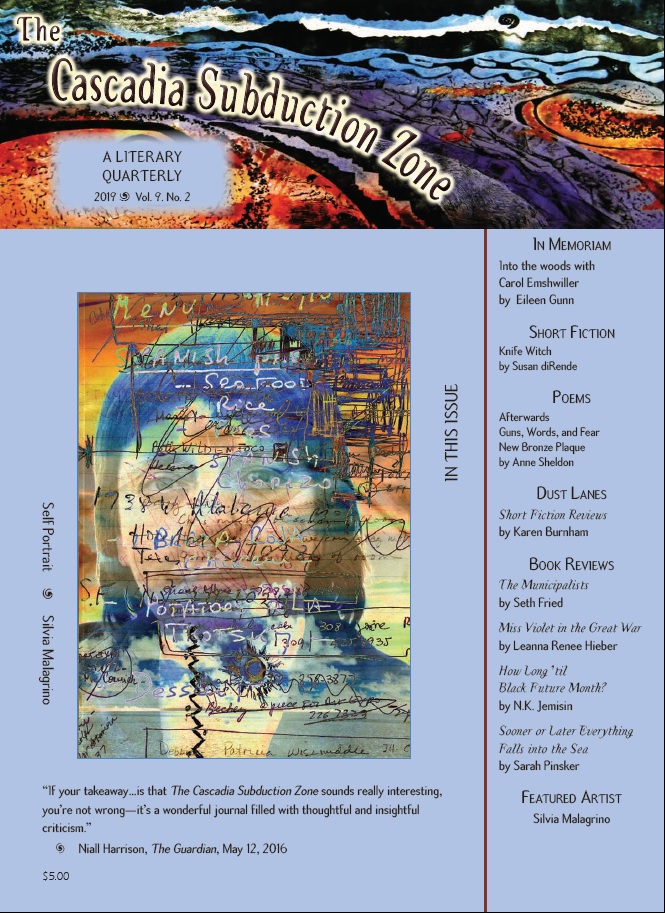
The spring issue of The Cascadia Subduction Zone is out. This issue features a short story by Susan diRende, poetry by Anne Sheldon, a remembrance of Carol Emswhiller by Eileen Gunn, Karen Burnham's Dust Lanes column, and reviews of books by Sarah Pinsker, N.K.Jemisin, and others. The issue's featured artist is Silvia Malagrino.
You can purchase single copies or subscriptions at http://thecsz.com/; the electronic edition is $3 for an issue or $10 for a year's subscription, while the print edition is $5 for an issue or $16 for a year's subscription.
Current Issue
Volume 9, No. 2--2019
- In Memoriam
- Into the woods with Carol Emshwiller
by Eileen Gunn - Short Fiction
- Knife Witch
by Susan diRende - Poems
- Afterwards
Guns, Words, and Fear
New Bronze Plaque
by Anne Sheldon - Dust Lanes
- Short fiction reviews
by Karen Burnham
- Book Reviews
- The Municipalists, by Seth Fried
reviewed by Patrick Hurley
- Miss Violet in the Great War,
by Leanna Renee Hieber
reviewed by Kristin King
- How Long ’til Black Future Month?,
by N.K. Jemisin
reviewed by Kathleen Alcalá
- Sooner or Later Everything Falls into the Sea,
by Sarah Pinsker
reviewed by Misha Stone
- Featured Artist
- Silvia Malagrino
Current Issue
Vol. 9 No. 2 — 2019
Current Issue
Vol. 9 No. 2 — 2019
Current Issue
Vol. 9 No. 2 — 2019
Monday, May 13, 2019
Sarah Tolmie's The Little Animals

I'm pleased to announce the release of The Little Animals, in both print and e-book editions, by Sarah Tolmie. Antoni Van Leeuwenhoek, a quiet linen draper in Delft, has discovered a new world: the world of the little animals, or animalcules, that he sees through his simple microscopes. These tiny creatures are everywhere, even inside us. But who will believe him? Not his wife, not his neighbors, not his fellow merchants—only his friend Reinier De Graaf, a medical doctor. Then he meets an itinerant goose girl at the market who lives surrounded by tiny, invisible voices. Are these the animalcules also? Leeuwenhoek and the girl form a curious alliance, and gradually the lives of the little animals infiltrate everything around them: Leeuwenhoek’s cloth business, the art of his friend Johannes Vermeer, the nascent sex trade, and people’s religious certainties. But Leeuwenhoek also needs to cement his reputation as a natural philosopher, and for that he needs the Royal Society of London—a daunting challenge, indeed, for a Dutch draper who can't communicate in Latin.
Ursula K. Le Guin wrote of The Little Animals, “A vigorous, satisfying historical novel full of interesting and likable characters. To people who do truly unusual things, such as discover microscopic life, or paint Vermeer’s pictures, or hear what plague bacilli are saying, these things are just what they do. Sarah Tolmie’s novel catches this intersection of the everyday with the unearthly and holds it for us like a drop of pond water under the lens, vibrant with life and activity, fascinating in its strangeness and its familiarity.”
The novel received a starred review from Publishers Weekly: "Tolmie intricately weaves together the best of historical and weird fiction in this delicate tale of science and miracles. In 17th-century Delft, Holland, draper and scientist Antonie Leeuwenhoek is on the verge of a breakthrough discovery: that various substances are teeming with living “animalcules” that can only be seen by microscope. He is determined to prove his theories correct, though few people believe him. When he visits the Delft marketplace, he comes across a nameless, homeless goose-herding girl who says that she is followed by a cacophony of tiny voices. Leeuwenhoek strikes up an uneasy alliance with the girl, as he is certain the voices are those of the animalcules. Leeuwenhoek and the goose girl’s investigations into the worlds of the animalcules destabilize the realms of religion, art, and science. Tolmie balances careful characterization with rich historical detail, subtle humor, and energetic prose. Her central characters are suffused with color, and her prose captures the joys and uncertainties of life-changing discoveries. This delightful novel is not to be missed."
And Gary K. Wolfe reviewed it for Locus: "Historical fiction involving scientists has a natural affinity for SF readers, and for the most part Tolmie’s account of Leeuwenhoek’s methods of lens-grinding and his detailed observations of everything from the pond scum called honeydew to blood and eventually semen are fascinating...What Tolmie does, often brilliantly, is develop a theme of patterns that reflect in various ways the underlying sense of order that seems to be emerging into the world she describes—not only the patterns of Leeuwenhoek’s observations, but the manner in which these become popular fabric designs (Delft was apparently known for fabrics before it was known for ceramics, and Leeuwenhoek himself made a living as a draper), and even in such details as his daughter’s dollhouse, the design of looms, and the sheet music that a local madam uses for her spinet...That mysterious goose girl may be the only hint we get of material magic in The Little Animals, but there’s more magic in Tolmie’s tableaux of a place and time, which at once seems like a charming mannerist fairy tale and a provocative account of the birth of our own modern worldview."
Read a sample from the book.
You can purchase it directly from Aqueduct Press here: http://www.aqueductpress.com/index.php
Friday, May 3, 2019
Bogi Takács's Algorithmic Shapeshifting

I'm pleased to announce the release of Algorithmic Shapeshifting, a collection of poetry by Bogi Takács, winner of the Lambda award for editing Transcendent 2: The Year's Best Transgender Speculative Fiction, and finalist for the Hugo and Locus awards. Algorithmic Shapeshifting includes poems from the past decade and previously unpublished work. The scope of the pieces extends from the present and past of Jewish life in Hungary and the United States to the far-future, outer-space reaches of the speculative – always with a sense of curiosity and wonder. Lisa M. Bradley provides a foreword to the collection.
“Bogi Takács is a poet of visceral exuberance and Talmudic invention. Moving as dazzlingly between genres as languages, e makes the reader eir kaleidoscope where ancient traditions, unenvisioned technologies, and children’s toys tumble with ordinary, transcendent precision, imagining new ways of being and observing others signally extant. These poems draw blood and spark synapses, make dauntingly familiar and tenderly strange. You should let them change you.”—Sonya Taaffe, author of Forget the Sleepless Shores
“Mind-bending, imagination-expanding concepts are paired with a uniquely kinetic delight in language(s). Seemingly mundane events, like taking out the garbage, turn into epiphanies. And the poems, speculative or not, always blaze with emotion.”—Lisa M. Bradley, from the Foreword
“Bogi Takács's poetry is gleefully and unabashedly itself, pulling the reader though surreal worlds of visceral magic, body modification, political wit, and interpersonal devotion. Whether looking back into Talmudic history, forward into a science fictional psychic war, or sinking into the earth and growing flowers from its eye sockets, Algorithmic Shapeshifting presents a voice that is consistently fresh, startling, and sincere.”—Ada Hoffman, author of The Outside
You can purchase the book in print and e-book editions at www.aqueductpress.com.
Thursday, April 4, 2019
Tara Campbell's Midnight at the Organporium

I'm pleased to announce the release of Midnight at the Organporium, a collection of short fiction by Tara Campbell, in both print and ebook editions, as the sixty-seventh volume in Aqueduct's Conversation Pieces series.
What do a homicidal houseplant, an enchanted office
picnic, sentient fog, and the perfect piece of toast have in common? They’re
all part of the world of Midnight at the Organporium. At turns
droll, wicked, and surreal, these tales cover topics from white flight, to the
Princess and the Pea, to marriage in the afterlife. Visit Midnight
at the Organporium for a dose of twisted obsession, covert
complicity, and peculiar empowerment—and don’t forget to pick up your spare
heart while you’re there.
Advance Praise for Midnight at the Organporium
Tara Campbell’s stories exist at a delightful
quarter turn to the left from our world — places where CEOs turn into lions,
and hearts are sold in the mall — while simultaneously beautifully and deftly
exploring exactly what it means to be human.—Tina Connolly, World
Fantasy-nominated author of On the Eyeball Floor and Other Stories
So much unexpected happens in
Tara Campbell’s weird and wonderful short story collection, Midnight at the
Organporium, that I didn’t want to let these stories go. From full-length
to flash fiction, Campbell’s stories in Midnight at the Organporium sneak
up on you with an exquisite hyper-realism, a sure-fire wit, and most of all, a
daring sense of adventure and possibility.—Caroline Bock, author of Carry
Her Home, Before My Eyes, and Lie
Sometimes funny, sometimes
frightening, and always full of heart — in Midnight at the Organporium,
the everyday and the fantastic conspire to create the authentic.—Erin Fitzgerald,
author of Valletta73
You can read a sample from Midnight at the Organporium at http://www.aqueductpress.com/books/samples/978-1-61976-163-6.pdf. And you can purchase a copy at www.aqueductpress.com.
Tuesday, April 2, 2019
Vonda N. McIntyre (1948-2019)

Vonda N. McIntyre died yesterday. She was a person of many, albeit overlapping, communities, which makes it unusually difficult for me to give a sense of who she was in our world. The most visible aspect of her life, of course, is her published work, which includes Dreamsnake (winner of both the Hugo and Nebula Awards for best novel), the fabulous historical science fiction novel The Moon and the Sun (winner of the Nebula Award), a few other standalone novels, her four-novel Starfarers series, several Star Trek and Star Wars novels, and a host of short fiction, some of which was collected in Fireflood and Other Stories, and includes, from 2005, "Little Faces," which I especially loved, and which was a finalist for the Nebula and Sturgeon Awards.
Vonda was one of those authors whose work I read and loved long before I met her. In fact, her Dreamsnake was among the first science fiction books I ever read. I found it in a bookstore in Salt Lake City, when I was living there in 1978, and it gave me my very first taste of what I later came to call feminist sf. The idea of women being able to learn to control their reproduction through biocontrol enchanted me (and instantly raised the bar for what I expected from science fiction texts), and made me hungry for more such imaginative approaches to biology-- by which I mean the biology that society had told me was destiny--for girls and women. I suspect that that novel in particular helped prepare me for a different conceptualization of biology that I eventually picked up from feminist science studies. In short, I was an early fan of Vonda's. Much later, reading Joanna Russ's letters to Alice Sheldon (which can be found in the University of Oregon's Special Collections), I inferred, without surprise, that Joanna and Vonda must have had many intense conversations in the 1970s about all things feminist and science fictional because Joanna often referred to what Vonda had said about this or that when writing to Alli Sheldon.
I first saw Vonda in the flesh a few years later, after I'd moved to Seattle, at a women writers conference (graced by such stars as Maya Angelou, Joanna Russ, Toni Cade Bambarra, and Carolyn Forche). Vonda gave a reading as well as participated on a panel I attended. I don't think I'd ever before seen a woman wearing blue jeans and a blazer (which I'd often known male mathematicians and musicians to do), and seeing her do so instantly made me want to, also. What I recall most from both the panel and her reading was my impression of how deeply embedded her science fictional imagination was in her background in biology. She was, to me, a star in a dazzling firmament of stars--all women writers.
Later, of course, after Nicola Griffith dragged my isolated, introverted self into Seattle's community of sf writers, I came to know her, at first as a crusty, trenchantly witty personality and then as a generous force helping make things happen and run smoothly (always unobtrusively). She was, for instance, one of the founders of Clarion West. Later, she helped found the Bookview Cafe and helped produce their ebooks, which I became aware of only when Kath and I were referred to her for much-needed advice for Aqueduct. Her community was larger than these, though, as evidenced by her being a GoH at the 2015 WorldCon, held in Spokane.
I thought a great deal about her last month, while in Port Townsend, because I knew she had only weeks to live. I was stunned by the volume of memories I have of my encounters with her. Like many other people, I know, I'm thankful to have enjoyed her friendship and will miss her actively intelligent presence in the world..
Monday, April 1, 2019
Sofía Rhei's Everything Is Made of Letters

I'm pleased to announce the release of Sofía Rhei's Everything Is Made of Letters, a collection of short fiction translated from Spanish, as the sixty-sixth volume in Aqueduct's Conversation Pieces series, in both print and paperback editions. The stories' translators include Sue Burke, James Womack, and the author herself (with assistance from Arrate Hidalgo and Ian Whates).
A man risks his life by carefully forging bibliographic references in a parallel Barcelona; at the Cyclotech, a woman strives to keep the storytelling different engine safe from ignorant hands that could get words lost; off-planet, an interpreter gives an account of her language learning process involving a realistic alien doll that claims to be a sentient being… Words boast a heavy, at times disturbing, weight of their own across these alternative realities in which language rules supreme, fleshed out by the mind of one of the most prolific writers in contemporary Spanish genre fiction.
You can read a sample from the book here: http://www.aqueductpress.com/books/samples/978-1-61976-149-0.pdf.
You can purchase a copy of the book here: http://www.aqueductpress.com
Saturday, March 23, 2019
The 2018 Tiptree Award
“They Will Dream In the Garden,” a beautifully written and translated story, uses the future tense to imagine a Mexico in which femicides are already part of history. In a collective attempt by survivors to preserve memory and justice, traces of the minds of the women murdered are encapsulated in interactive holograms “living” in a beautiful garden. The story looks at the economic, social, and racial dimensions of violence against Mexican women today, focusing on indigenous women, poverty, and unemployment, on repression of women’s educational opportunities, and of women’s ability to move about freely. The story hints at positive change as some women decide to fight back through collective action, mutual support, and self-defense, eventually shifting the public perception of gendered violence and improving the actions of the next generation. By offering a possible look into the future, far from giving the sense of a closed chapter, the story itself is a device of memory preservation, a call to action, and a fine example of science fiction as a tool for feminist exploration and social change.
Gabriela Damián Miravete is a writer of narrative and essay, a film and literature journalist, a professor at CENTRO university, and (according to her bio) the imaginary granddaughter of Ursula K. Le Guin. Miravete was part of “The Mexicanx Initiative,” a group of Mexican and Mexican American artists who attended WorldCon 76. With other authors, artists and people from different scientific disciplines, she co-founded Cúmulo de Tesla, a collective that wishes to strengthen the relationships between art, science, and science fiction. She has published short stories in several anthologies in Spanish. You can find her work in English in Three Messages and a Warning, an anthology of contemporary Mexican stories of the fantastic (Small Beer Press, 2010) and in A Larger Reality. Speculative Fiction from the Bicultural margins, an anthology of 14 stories, presented in both Spanish and English.
In addition, the Tiptree Award judges have recognized Adrian Demopulos, the translator of “They Will Dream in the Garden,” with a special honor for her translation.
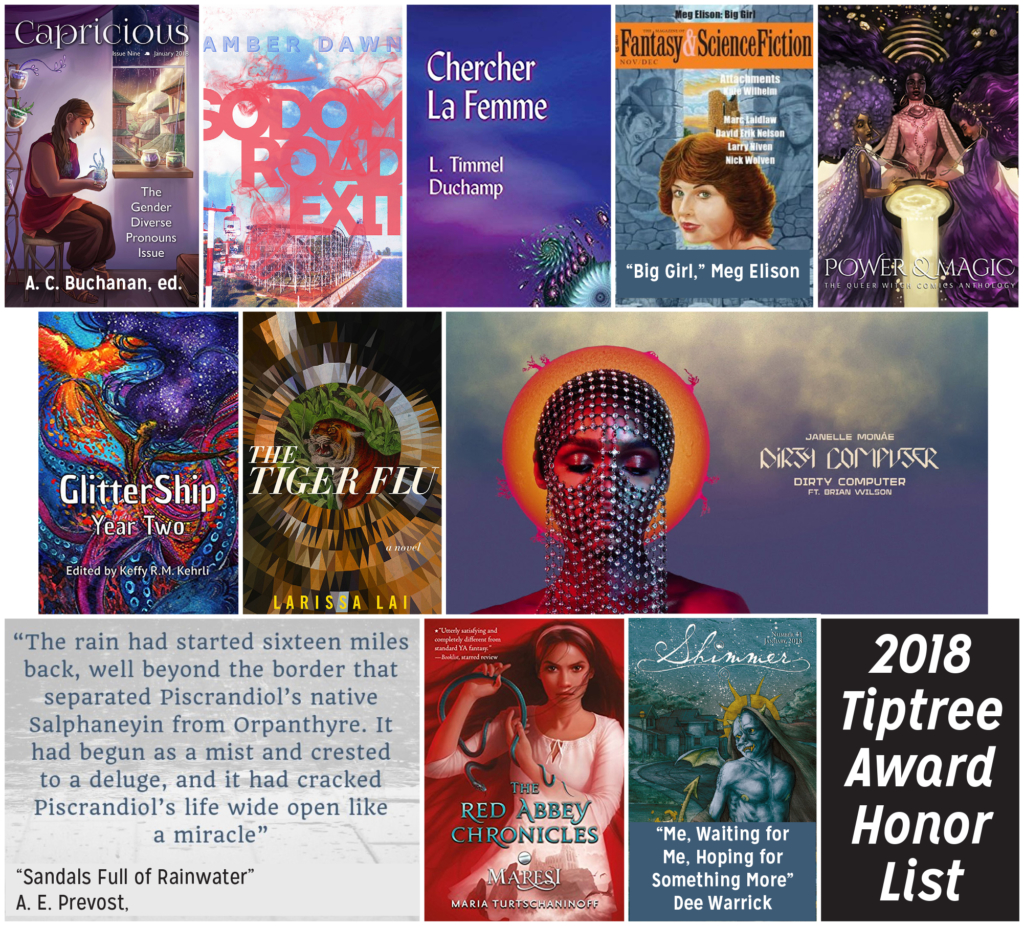
In addition to selecting the winners, the judges choose a Tiptree Award Honor List. The Honor List is a strong part of the award’s identity and is used by many readers as a recommended reading list. These notes on each work are excerpted and edited from comments by members of this year’s jury. This year’s Honor List is:
- C. Buchanan, ed. Capricious Magazine: The Gender Diverse Pronouns Issue (January 2018)
- Amber Dawn, Sodom Road Exit (Arsenal Pulp Press, Canada, 2018)
This cerebral, investigative novel presents a future society in which humans have divided into Paxans and Outsiders. Paxans are committed to “a collegial, laterally organized meritocracy.” In this technologically advanced society, Paxans spend only a small portion of their lives in “meatspace” and the majority of their lives in virtual realities, inhabiting and conversing with their secondary and tertiary bodies, which represent selected and isolated aspects of their consciousness. Paxans have been given FTL travel by an alien race they call Delta Pavonians, and some women, cis and trans, are able and willing to undergo body modification and training to be able to communicate with the aliens. The story traces the mystery of a second alien planet, La Femme, and its telepathic inhabitants. The novel is an absorbing exploration of the many ramifications of the notion of gender and the myriad ways in which it is represented and exploited.
- Meg Elison, “Big Girl” Fantasy and Science Fiction (Nov/Dec 2017)
- Joamette Gil, ed., Power & Magic: The Queer Witch Comics Anthology (P & M Press, USA, 2017)
- Keffy R M Kehrli, ed., GlitterShip Year Two (CreateSpace Independent Publishing, 2018)
- Larissa Lai, The Tiger Flu (Arsenal Pulp Press, Canada, 2019)
- Janelle Monáe, Dirty Computer [visual album] (Wondaland/Bad Boy/Atlantic, 2018)
- E. Prevost, “Sandals Full of Rainwater,” Capricious Magazine: The Gender Diverse Pronouns Issue (January 2018)
- Maria Turtschaninoff, Maresi: The Red Abbey Chronicles, translation by A. A. Prime (Amulet Books, USA, 2017)
- Dee Warrick, “Me, Waiting for Me, Hoping for Something More” (Shimmer Magazine #41, January 2018)

In addition to the honor list, this year’s jury also compiled a “long list” of twenty-eight other works they found worthy of attention.
- Cabaret Rollo Rouge, Sydney Blackburn (Less Than Three Press, 2018)
- Starless, Jacqueline Carey (Tor, 2018)
- The Dragon of Ynys, Minerva Cerridwen (Less Than Three Press, 2018)
- Peter Darling, Austin Chant (Less Than Three Press, 2017)
- “A Robot Like Me,” Lee Cope (in Mother of Invention, Twelfth Planet Press, 2018)
- Vox, Christina Dalcher (Berkeley Publishing, 2018)
- “The Hermit of Houston,” Samuel Delany (Fantasy and Science Fiction, Sept/Oct 2017)
- The Heart of the Lost Star, Megan Derr (Less Than Three Press, 2017)
- The Future Home of the Living God, Louise Erdrich (Harper Collins Publishing, 2017)
- The Breath of the Sun, Isaac Fellman (Aqueduct Press, 2018)
- “Logistics,” A.J. Fitzwater (Clarkesworld, April 2018)
- Beast, Rachel Frank (Less Than Three Press, 2017)
- Strange Grace, Tessa Gratton (Margaret K. McElderry Books, 2018)
- The Mere Wife, Maria Dahvana Headley (McDonnell Douglas, 2018)
- “Ghosts,” Azure Husky, personal blog
- “Substance of My Lives, the Accidents Of Our Births,” Jose Pablo Iriarte (Lightspeed, January, 2018
- “The Heavy Things,” Julian K Jarboe (SmokeLong Quarterly, November 2017)
- Margins and Murmurations, Otter Lieffe (CreateSpace Independent Publishing, 2017)
- Ship It, Britta Lundin (Freeform, 2018)
- No Man of Woman Born, Ana Mardoll (Acacia Moon Publishing
- “Sexy Robot Heroes,” Sandra McDonald (in Mother of Invention, Twelfth Planet Press, 2018)
- “Afloat Above A Floor of Stars,” Tom Purdom (Asimov’s Science Fiction Magazine, November/December 2017)
- Winterbourne’s Daughter, Stephanie Rabig (Less Than Three Press, 2017)
- Theory of Bastards, Audrey Schulman (Europa Editions, 2018)
- “You Can Make A Dinosaur But You Can’t Help Me,” K.M. Szpara (Uncanny Magazine, July 2018)
- “Some Personal Arguments in Support of the Betteryou,” Debbie Urbanski (Strange Horizons, November 2018)
- “Body Drift,” Cynthia Ward (Analog Magazine, November/December 2018)
- Red Clocks, Leni Zumas (Little, Brown and Company, 2018)
The Tiptree Award winner, along with authors whose works are on the Honor List, will be celebrated at WisCon in Madison, Wisconsin during Memorial Day weekend. The winner will receive $1000 in prize money, a specially commissioned piece of original artwork, and (as always) chocolate.
Each year, a panel of judges selects the Tiptree Award winner. The 2018 judges were Margaret McBride (chair), Marina Berlin, Ritch Calvin, and Arrate Hidalgo.
The 2019 panel of judges will be chaired by Carol Stabile, and reading will begin soon. The Tiptree Award invites everyone to recommend works for the award. Please submit recommendations via the recommendation page. Full information on all the books mentioned above will be in the Tiptree Award database by late April 2018.
Subscribe to:
Posts (Atom)