Congratulations to Gabriela Damián Miravete! Her story, “
They Will Dream In the Garden,” translated by Adrian Demopulos and published online by
Latin American Literature Today (May 2018), as been named the 2018 Tiptree Award winner.
“They Will Dream In the Garden,”
a beautifully written and translated story, uses the future tense to
imagine a Mexico in which femicides are already part of history. In a
collective attempt by survivors to preserve memory and justice, traces
of the minds of the women murdered are encapsulated in interactive
holograms “living” in a beautiful garden. The story looks at the
economic, social, and racial dimensions of violence against Mexican
women today, focusing on indigenous women, poverty, and unemployment, on
repression of women’s educational opportunities, and of women’s ability
to move about freely. The story hints at positive change as some women
decide to fight back through collective action, mutual support, and
self-defense, eventually shifting the public perception of gendered
violence and improving the actions of the next generation. By offering a
possible look into the future, far from giving the sense of a closed
chapter, the story itself is a device of memory preservation, a call to
action, and a fine example of science fiction as a tool for feminist
exploration and social change.
Gabriela Damián Miravete
is a
writer of narrative and essay, a film and literature journalist, a
professor at CENTRO university, and (according to her bio) the imaginary
granddaughter of Ursula K. Le Guin. Miravete was part of “The Mexicanx
Initiative,” a group of Mexican and Mexican American artists who
attended WorldCon 76. With other authors, artists and people from
different scientific disciplines, she co-founded Cúmulo de Tesla, a
collective that wishes to strengthen the relationships between art,
science, and science fiction. She has published short stories in several
anthologies in Spanish
. You can find her work in English in
Three Messages and a Warning, an anthology of contemporary Mexican stories of the fantastic (Small Beer Press, 2010) and in
A Larger Reality. Speculative Fiction from the Bicultural margins, an anthology of 14 stories, presented in both Spanish and English.
In addition, the
Tiptree Award judges have recognized Adrian Demopulos, the
translator of “They Will Dream in the Garden,” with a special honor for her translation.
In addition to selecting the
winners, the judges choose a Tiptree Award Honor List. The Honor List is
a strong part of the award’s identity and is used by many readers as a
recommended reading list. These notes on each work are excerpted and
edited from comments by members of this year’s jury. This year’s Honor
List is:
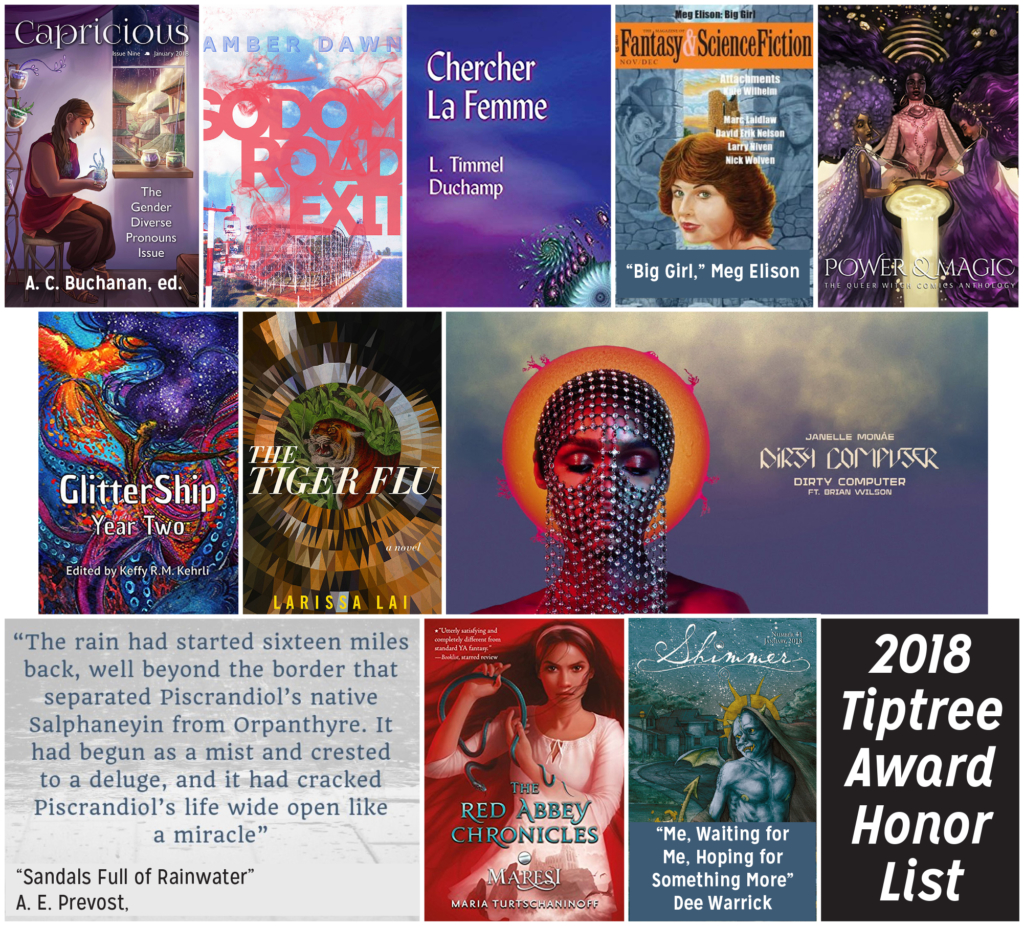
A
collection of delightful, thought-provoking stories that fulfill the
intended purpose of normalizing diverse pronouns as well as suggesting
that the binary can be broken or even left behind. Buchanan writes: “In
English, the personal pronouns we’re most used to are he and she. Not
only do these require the speaker to know the gender of the person
they’re talking about, but they only properly cover two genders. Humans
don’t always fit in these boxes.” This collection addresses the
complaint that people find it hard to learn new pronoun sets. Buchanan
writes that the answer is to normalize new pronouns — “in conversation,
yes, but also in our stories, in fiction, in all media. In stories about
spaceships and about magic, heroism and exploration, families and
home.” As an added bonus, the authors and editor make recommendations
for other works to read.
This
ghost story set in a small depressed Ontario town in the 1990s explores
concepts around sexual agency and slutdom with extraordinary doses of
humanity, humor, and lyricism. With issues of women’s sexual autonomy
being currently (and always) very much under the spotlight, the author
presents myriad ways in which the book’s characters’ sexualities clash
with (or struggle under) patriarchal power structures and lays them
across queerness, whiteness, poverty, religious and moral values, and
public opinion. Through the eyes of the protagonist and of the queer
ghost who is haunting her, the reader experiences the pains and thrills
of inhabiting a gendered, sexualized, queer body in this story full of
caustic language and powerful images. WARNING: descriptions of child
sexual abuse and adult suicide.
This
cerebral, investigative novel presents a future society in which humans
have divided into Paxans and Outsiders. Paxans are committed to “a
collegial, laterally organized meritocracy.” In this technologically
advanced society, Paxans spend only a small portion of their lives in
“meatspace” and the majority of their lives in virtual realities,
inhabiting and conversing with their secondary and tertiary bodies,
which represent selected and isolated aspects of their consciousness.
Paxans have been given FTL travel by an alien race they call Delta
Pavonians, and some women, cis and trans, are able and willing to
undergo body modification and training to be able to communicate with
the aliens. The story traces the mystery of a second alien planet, La
Femme, and its telepathic inhabitants. The novel is an absorbing
exploration of the many ramifications of the notion of gender and the
myriad ways in which it is represented and exploited.
- Meg Elison, “Big Girl” Fantasy and Science Fiction (Nov/Dec 2017)
A
story about a common problem in society—fat shaming. This is especially
a problem for women, both white and of color, and for teens who lack
self-confidence and easily fall prey to ads and movie portrayals. With
satirical condemnation of society and media reactions, this story
portrays how internalizing the perceived norms of “feminine” leads to
low self-esteem.
As
the cover promises, so the book delivers: 15 graphic short stories by
“seventeen women, demigirls, and bi-gender creators of color.” The rich
heart-warming fantasy stories deal with folk tales, fairy tales,
disability, immigration, race, grandmothers, baking, depression,
romance, and much more magic. This anthology is a good way to find
authors you’ll want to read again, and a great display of the dramatic
potential and innovative storytelling in contemporary comics today.
An anthology of over 30 short stories and poems. About half were originally published in
Glittership Magazine,
and all have queer themes and characters. “The Little Dream” by Robin
M. Eames (in which a character wears a t-shirt that reads “IN SPACE NO
ONE CAN HEAR YOU INSIST THERE ARE ONLY TWO GENDERS”) and “Graveyard
Girls on Paper Phoenix Wings” by Andrea Tang are particularly
recommended. A wonderful variety of stories and a great way to find
authors you want to read more of.
Because
of a plague that kills men more frequently than women, one society in
this polluted future has mostly women. But men still have more power and
women still need to fear sexual assault. The other society is all women
— many with special powers, including doublers who have multiple clone
births, “starfish” who can grow new body parts, and girls given special
treatment so they can help breast feed the multiple babies. The religion
is Mother-based. A beautifully written novel.
This
album follows the struggles, joys, incarceration, and eventual
liberation of a queer, Black woman who is punished by a system that
seeks to “cleanse” her of all elements in her life that deviate from the
norm. She is sent to a prison in which her memories (each of which is a
separate music video and an ode to mutual love in rebellion) will be
erased. The workers in charge of the erasure, who sit back and enjoy the
memories prior to destruction, serve as a sharp metaphor of the white
supremacist, cisheteropatriarchal system that is obsessed with Black
bodies and creativity while still remaining profoundly anti-Black. This
concept album forms a cohesive science fictional narrative, introducing
futuristic elements in a way that is rarely seen so explicitly in the
medium, opening up new pathways for the musical exploration of feminist
science fiction.
This
story portrays a culture in which gender pronouns change depending on a
multitude of factors for each individual at any given time. This story
shows a character at the beginning of a new life whose sense of identity
is affected by this new language with a multitude of unfamiliar
pronouns. The story also touches on issues of immigration, poverty,
unemployment, romance, and building a new family. The reader is given
linguistic issues and endearing characters in a well-done story.
This
young adult novel was translated from Swedish. In it, a society of
women (in groups acknowledging the Maiden, Mother, and Crone) live apart
from a patriarchal world. They populate their society by rescuing women
and girls from poverty, evil men, and lack of education. The leader of
the Abbey is the First Mother. This story is told in the time of the
32nd First Mother. The women of the Abbey preserve knowledge within a
vast library. The novel ends with the narrator, a teenage girl, deciding
to go back out into the world to see if she can help change how men and
women see themselves and one another.
This
visceral story with vivid writing explores in a literalized way the
dysphoria that can come with being trans. The monster in the basement
works as both a powerful metaphor and a plot device.
In
addition to the honor list, this year’s jury also compiled a “long
list” of twenty-eight other works they found worthy of attention.
- Cabaret Rollo Rouge, Sydney Blackburn (Less Than Three Press, 2018)
- Starless, Jacqueline Carey (Tor, 2018)
- The Dragon of Ynys, Minerva Cerridwen (Less Than Three Press, 2018)
- Peter Darling, Austin Chant (Less Than Three Press, 2017)
- “A Robot Like Me,” Lee Cope (in Mother of Invention, Twelfth Planet Press, 2018)
- Vox, Christina Dalcher (Berkeley Publishing, 2018)
- “The Hermit of Houston,” Samuel Delany (Fantasy and Science Fiction, Sept/Oct 2017)
- The Heart of the Lost Star, Megan Derr (Less Than Three Press, 2017)
- The Future Home of the Living God, Louise Erdrich (Harper Collins Publishing, 2017)
- The Breath of the Sun, Isaac Fellman (Aqueduct Press, 2018)
- “Logistics,” A.J. Fitzwater (Clarkesworld, April 2018)
- Beast, Rachel Frank (Less Than Three Press, 2017)
- Strange Grace, Tessa Gratton (Margaret K. McElderry Books, 2018)
- The Mere Wife, Maria Dahvana Headley (McDonnell Douglas, 2018)
- “Ghosts,” Azure Husky, personal blog
- “Substance of My Lives, the Accidents Of Our Births,” Jose Pablo Iriarte (Lightspeed, January, 2018
- “The Heavy Things,” Julian K Jarboe (SmokeLong Quarterly, November 2017)
- Margins and Murmurations, Otter Lieffe (CreateSpace Independent Publishing, 2017)
- Ship It, Britta Lundin (Freeform, 2018)
- No Man of Woman Born, Ana Mardoll (Acacia Moon Publishing
- “Sexy Robot Heroes,” Sandra McDonald (in Mother of Invention, Twelfth Planet Press, 2018)
- “Afloat Above A Floor of Stars,” Tom Purdom (Asimov’s Science Fiction Magazine, November/December 2017)
- Winterbourne’s Daughter, Stephanie Rabig (Less Than Three Press, 2017)
- Theory of Bastards, Audrey Schulman (Europa Editions, 2018)
- “You Can Make A Dinosaur But You Can’t Help Me,” K.M. Szpara (Uncanny Magazine, July 2018)
- “Some Personal Arguments in Support of the Betteryou,” Debbie Urbanski (Strange Horizons, November 2018)
- “Body Drift,” Cynthia Ward (Analog Magazine, November/December 2018)
- Red Clocks, Leni Zumas (Little, Brown and Company, 2018)
The Tiptree Award winner, along with authors whose works are on the Honor List, will be celebrated at
WisCon
in Madison, Wisconsin during Memorial Day weekend. The winner will
receive $1000 in prize money, a specially commissioned piece of original
artwork, and (as always) chocolate.
Each year, a panel of judges
selects the Tiptree Award winner. The 2018 judges were Margaret McBride
(chair), Marina Berlin, Ritch Calvin, and Arrate Hidalgo.
The 2019
panel of judges will be chaired by Carol Stabile, and reading will
begin soon. The Tiptree Award invites everyone to recommend works for
the award. Please submit recommendations via the
recommendation page. Full information on all the books mentioned above will be in the Tiptree Award database by late April 2018.