Wednesday, December 19, 2018
The Pleasures of Reading, Viewing, and Listenin in 2018, part 16: Susan diRende
Worldbuilding for This World and Others
by Susan diRende
Worldbuilding has been on my mind, so I see it everywhere. Political pundits on talk shows. Advertisers on my Facebook feed. My sister.
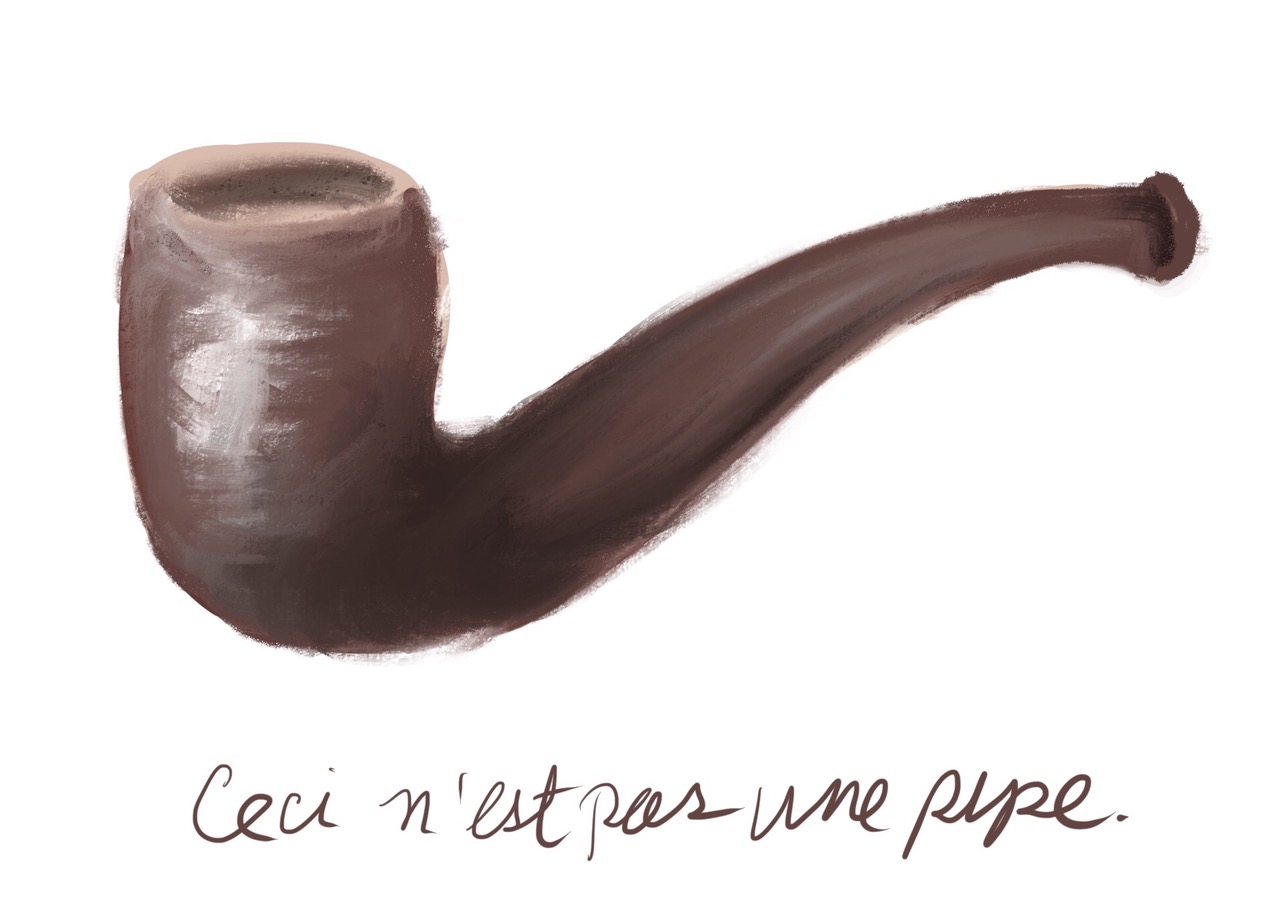
It seems everyone does it to some degree. I suspect that it is some fundamental process of mind, that the dog on the cushion across the room lives in a “world” that forms the foundation upon which he knows his place and how to act. If I made a scale of worldbuilding skill with the dog anchoring one end and with either theoretical physicists or the best speculative fiction writers on the other, most folks would end up much closer to the canine. Political animals in particular seem to create flat worlds just to fit ideologies and fall into the trap that Magritte’s The
Treachery of Images demonstrates. The 20th Century was filled with the horrors of ideology-driven states fueled by pre-internet mass communication. It may be that the 21st will grow such monstrosities exponentially. Which is why I think quality worldbuilding that illuminates minds to possibility rather than trapping them in certainty is desperately needed.
In my reading, I’ve come across ideas that have made me feel the same way I do when I see fireworks in the night sky. I don’t know if it will be the same for you, but if you’d like to check these suggestions out, I hope you’ll tell me. Maybe we can begin a dialogue, do some meta-worldbuilding. Or we could just have coffee.
1. Every Word is a Bird We Teach to Sing by Daniel Tammet
The beginning of this book describes the author’s journey into understanding language the way the rest of humanity does. Words carved paths entirely through his brain, connecting with areas ours cannot and skipping over what most of us recognize as meaning in places. Here was a fellow human with all the same senses who revealed to me how shallow and prosaic every concept I had had of an alien mind really was. NOTE: I highly suggest listening to the audiobook read by the author. It multiplied my understanding to hear him talk about what the world looked like from inside his head.
2 .You Are Not So Smart by David McRaney; Thinking: Fast and Slow by Daniel Kahneman; The Undoing Project by Michael Lewis
I’ve been fascinated by the ways the mind fools you, and while you might think of these books as giving insight to character, the fact that the unconscious mind not only hides reality from our conscious mind but manages to erase the traces of its treachery all in the name of maintaining our psychological equilibrium and physical energy reserves. If you like your nonfiction light and fun, I can recommend again David McRainey’s You Are Not So Smart. But if you want more substance, the ideas in Nobel Prize winner Daniel Kahaneman’s book, Thinking: Fast and Slow has become a mainstay of psychological thought. If you prefer your science embedded in stories about people, the book The Undoing Project talks about Kahneman and his partner, Amos Tversky, as they upended the foundations of psychological study back in the 1970s.
3. The Shipwrecked Mind by Mark Lilla; Suspicious Minds by Rob Brotherton
If you have a political bent and want to find a way to address the current rise of fundamentalism in works, these books offer some fascinating perspective. The introduction to The Shipwrecked Mind lays out an interesting way to look at the contrasting revolutionary and reactionary worldviews that underpin socio-political movements. If nothing else, it’s a fresh perspective on what we’re facing in the world today. And, if I may conjecture that folks writing in this genre belong mostly to the group who see change and progress as the direction of history, his focus on examining the reactionary power as an equal and not lesser force is something we should understand rather than dismiss out of hand.
In Suspicious Minds, Rob Brotherton looks at how the human mind is overtaken by conspiracy thinking and how being conspiracy minded colors your view of every event.
4. Seven Brief Lessons on Physics by Carlo Ravelli
If you’re more inclined toward the science side of speculative fiction, this book is a must if you haven’t already read it. Actually, I enjoy all of Rovelli’s books, and this one is a quick and easy introduction to the outer horizon of what science currently understands in seven discrete areas of inquiry, setting you free to work within or speculate beyond.
Susan diRende ran away from college and joined the circus at 20, where she learned how to step outside the boundaries just far enough to get a laugh. Ever since then, she has been writing, painting, performing, and directing with the goal of bringing about illumination and transformation through laughter. She has won awards as a playwright, screenwriter, filmmaker, and performer. A multilingual US/EU citizen, she currently is living the vagabond life with no fixed abode, chasing images and ideas wherever the impulse leads. Aqueduct Press published her novella, Unpronounceable, in 2016; it received a Special Citation for the Philip K. Dick Award.
The Pleasures of Reading, Viewing, and Listening in 2018, part 15: Karen Heuler
Annual Pleasures 2018
by Karen Heuler
A lot of my real and virtual friends have come out with amazing books this year, books that grab the imagination and charm or alarm the senses. I’ve fallen in love with what they’ve created. But, unfortunately, the world of imagination has spread into the political world, and most particularly, the world of headlines and tweets and memes.
I check a number of sites throughout the day, to see what’s happening, and I lose far too much time plunging after misleading headlines. It’s not merely the current political system that disturbs me, it’s that the distinction between fact and fiction is ending. You’d think, as someone who sees the weird in the everyday, that this would amuse me, but it doesn’t.
The rabbit hole I drop down most often is anything that smacks of new scientific discoveries, but in fact there are many kinds of headlines that take me on a time-sucking romp through the fantastic and the false. Of course headlines are intended to tell you just enough to entice you to read the story, but the end result is that facts are no longer as pleasurable as lies.
We’re addicted to the small bits and pieces now. It’s a hypnotic lure, this “Incredible Frozen Find” and that “They Never Would Have Guessed” and “Scientists Baffled By,” to say nothing of what “Voter Fraud” and “Trade War Threatens” and “Caravan of Criminals” does to us. I suspect that every time we click, we get us a pleasant little shot of adrenaline, so it’s no surprise that the headlines leer and we know it’s nonsense, but still we click. Adrenaline is addictive. Politically speaking, we hear shouts around the corner and have to see what’s happening.
These headlines suggest to me that a new kind of prurience is becoming our national characteristic, and that these bits and pieces of titillation are changing our opinion of the truth.
I can see it; I am caught up by it. And the thing I’ve noticed is how reading the bits is different from reading a book or a story. Reading the bits constantly gives you little charges, little bursts of (small) excitement. Reading something longer requires us not only to stay focused but to imagine the story by putting us there, by being part of it. Bits assures us that we are the normal and everyone else is either wrong or bizarre. The books I like are more often the books that allow us to see the strange or alien as relating to us, or revealing the distinctions not as threatening, but as informative.
I am trying to train myself not to go down the clickbait trail. I know that the astonishing things will not be astonishing, I know that the political things will be biased and incomplete, and I know long-term weather predictions almost always fail.
I will try to wean myself off the adrenaline kick and instead, appeal to the endorphins I get from the books my friends wrote—whether I’ve met them in real life or not. I love my nearby friends, but the friends I can only imagine are also writing fantastic books.
But wait! “Scientists find that imagining friends is a sign of genius.”
Click!
Karen Heuler’s stories have appeared in over 100 literary and speculative journals and anthologies, from Alaska Quarterly Review to Weird Tales. She’s won an O. Henry award, is frequently nominated for Pushcart and Best American Short Story awards, and has been a finalist for the Iowa Short Fiction award, the Bellwether Award, and the Shirley Jackson Award. Aqueduct Press has published her novella, In Search of Lost Time, and her collection, Other Places.
Tuesday, December 18, 2018
The Pleasures of Reading, Viewing, and Listening, part 14: Beth Plutchak
Reading and Playing in 2018
by Beth Plutchak
Last year I was beginning to worry that I could no longer read books. Between all the scare stories that are published about how reading online—on iPads and phones—is destroying our brains and my own level of anxiety (I have the trifecta of an inherited anxiety disorder, PTSD due to domestic violence, and Trump) I was having trouble picking up a book and finishing it.
I spent a lot of time playing video games (good anxiety relief—trust me). The best are when I can totally immerse myself in make-believe worlds and take on the over-the-top, yet life-threatening/life-altering missions of the hero. I’ve been playing video games since Pong made it to the tv screen via Atari in the early 1970s. (Seriously, all you “real gamer” boys if you weren’t around to see Pong for the first time in someone’s home and know what a game-changer that was, how can you call yourself a real gamer?)
I prefer story-focused games and had been a huge fan of the Final Fantasy Series. I replayed some classics last year. Final Fantasy X which genre crosses science fiction and fantasy in a future world where science is shunned and magic is real. This particular cross-over gives me the same rush that reading Andre Norton did when I discovered her as a child. I first played this many years ago with my son, taking turns as we progressed through the story. My partner (who is not a gamer) wandered in and out often enough to follow the story. At the end when we found out that reality was not what we wished it was, we all cried.
In FF XII and XIII I was able to put together all-female teams to make my way through the game. These teams were heavily weighted to magic and archery, not my first choices, but, you know, all girls. The only thing better would have been if there were a few mothers, motherhood being pretty much the defining reality of my life. I replayed all of the Bioshock games. I’ve found myself wishing often in the last few years that Paul Ryan could be required to play Bioshock and see what happens when you take Objectivism to its inevitable conclusion, instead of, you know—the rest of us experiencing it.
I received The Last of Us for Christmas. I’d put that one off because zombies scare me. This game met my distracting and apocalyptic yet not quite real needs. Post-apocalyptic nightmare—check; individuals learning from their mistakes—check; the importance of family—check. Many of the women I knew who played this game were not happy about the limited amount of playtime you got as Ellie and how little agency Joel allowed her. As a mom, I had no trouble identifying with Joel. I would do anything to keep my children safe, whether they approved or not. (For comparison, my kids are in their forties.) I totes would have made the decision Joel did at the end.
I put off upgrading to a PS4 for a long time. My FF addiction was not going to get me there after the release of XV, a male bonding road trip with no female playable characters. I finally broke down for Horizon Zero Dawn. Playable female protagonist—check; compelling storyline—check; post-apocalyptic future—check; science fiction/fantasy cross-over—check. However, Horizon Zero Dawn is problematic in its use of Native American imagery and stereotypes. Dia Lacina does a better job of explaining this than I can .
I’ll probably keep replaying the games I’ve enjoyed in the past while waiting for a game that hits all the right buttons. I think Virginia Wolf’s Orlando would make a great video game.
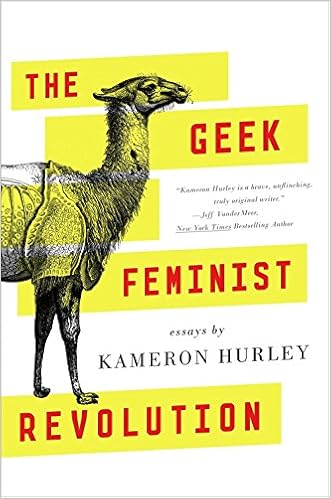
I did manage to read a few books last year and, like the year before, they were mostly nonfiction. I hadn’t followed Kameron Hurley’s blog, so all of the essays in The Geek Feminist Revolution were new to me. Examining fandom and the industry are of especial interest to me. I got so excited when I found out that she had lived in Alaska that I reached out to her on twitter. Her experiences mirrored mine in so many ways I was momentarily sure our paths must have crossed. Apparently at the time I left Alaska, she hadn’t been born yet. Sigh. People are so young these days.
I read a number of non-genre related nonfiction books, including Thinking Fast and Slow by Daniel Kahneman and re-read Complexity: The Emerging Science at the Edge of Order and Chaos, by M. Mitchell Waldrop. Both of those were in service of my ongoing project of using the science of complex adaptive systems to understand social change. I’ve been taking detailed notes of this non-fiction reading. My notes on Complexity are now on Goodreads. My resulting essay “The Edge of Chaos and the Failure of Progressivism” is looking for a home. (Boy, does the Atlantic get their rejections out fast.)
In my mundane life I am a researcher and a member of the Association of Independent Information Professionals, so the first book of Malka Older’s Centenal Cycle Infomocracy was a treat. AIIPers are a pretty small, pretty select group and what we do is a mystery to most people, but Older’s book read like it could have been about us. What fun. The next two are on my nightstand waiting to be read.
I’m a lifelong reader and lover of books. I got in trouble with the nuns in school for reading ahead in the reader. I love books. My collection includes copies of Dickens that are over one hundred years old, not valuable copies mind you, ratty well-thumbed copies from a library sale when I was a child. Used—well-used copies. I love books as objects. The thought that in the digital age perusing my iPad every morning, scanning articles and no longer reading them whole I may have lost my ability to finish books frightened me. But, I think I’m past that now. Taking notes while reading nonfiction has helped.
The love of books and books as objects in my grandchildren also helps. This Thanksgiving I took the middle grandchildren to the fiction library in my bedroom and let them choose a few novels to borrow. They were impressed by the number of books in my room. The two year-old sat on the floor carefully turning the pages of The Geek Feminist Revolution. If there was a “camel” on the cover there must be more camels inside. Books remain, and I too have stories to tell.
Beth Plutchak is a writer and consultant. After a twenty-year
career in commercial banking she started her own business doing economic
development and marketing consulting. Economics and social justice inform all
of her work. She was the editor of the WisCon Souvenir Book for WisCons 21
through 29. Aqueduct Press published Boundaries,
Border Crossings, and Reinventing the Future in 2017 and her collection of short fiction, Liminal
Spaces, in early 2018.
The Pleasures of Reading, Viewing, and Listening, part 13: Christopher Brown
2018 Reading in Review
by Christopher Brown
You would be surprised how many how-to manuals on the administration of martial law you can find in the bowels of the law library. Major Birkhimer’s Military Government and Martial Law (1892, 1904), Lt. Col. Fairman’s The Law of Martial Rule (1930, 1943), General Wolters’ Martial Law and Its Administration (1930), Captain Wiener’s A Practical Manual of Martial Law (1940) and Professor Fairman’s Government Under Law in Time of Crisis (1955) are among the treatises of handy practice points from the period when martial law was quite frequently invoked to keep unruly citizens under control. In that era from the Gilded Age to the Great Depression, it was pretty common for governors to declare martial law in order to deploy military forces to put down strikes and other disruptions of the established order by labor. It was also used to “enforce the operation of the economic principle of free competition”—and its opposite, as when the governors of Texas and Oklahoma declared martial law to enforce compliance with oil & gas production limits. Soldiers were called out to prevent publication of a newspaper in West Virginia, settle strikes by truckers and knitters in Minnesota against the strikers, to shut down a horse racing track in Rhode Island, to enforce segregation zoning in Oklahoma City, to interfere with primary elections in Tennessee in an effort to disenfranchise black voters, to take over and operate coal mines in North Dakota, and even to remove highway commissioners in South Carolina based on the governor’s finding that their department was in a “state of insurrection” against his authority.
When these cases are compiled in dry hornbooks of black letter law, one sees how many of these gubernatorial exercises of domestic military force there have been in the past century, most often to suppress supposed rebellions that were no more than assertions of economic right against powerful property interests. In many instances the imposition of martial law was subsequently invalidated by the court. But in many others it was not, and the reasoning is as diverse as the cases. For a contemporary lawyer, it’s quite a revelation to find an entire American jurisprudence of martial law—a term that really means the suspension of law and the liberties it secures.
After World War II, the phrase martial law seems to have become disfavored by those who impose it. Instead, it’s described as “calling out the national guard,” which somehow is taken as more innocuous—maybe because it has been more frequently done in the modern period to protect minority groups than oppress them, as in the desegregation battles of the 1960s. But it’s the same power, one embodied in many state constitutions, and at least implicit in the federal constitution, as with the express power of Congress to suspend habeas corpus during times of rebellion or insurrection. It’s a power that doesn’t seem to be tied to any clear objective standard, but to a highly subjective and contextual assessment of whether an emergency exists in which military force is necessary to sustain civil order.
I went looking for the not so secret legal history of martial law on U.S. soil as research for my forthcoming novel Rule of Capture, an effort to blend the dystopian novel with the legal thriller. I didn’t expect to find so much true dystopia. It made me see what limited patience there is in this country for the sort of dissidence that disrupts normal commerce, and how ephemeral are the legal protections we assume prevent us from waking up and finding soldiers occupying our own town. The state of emergency suspends the law. And the executive decides, with broad discretion and uncertain checks, when the emergency exists.
I saw similar things in the first book I read this year, Norman Mailer’s Miami and the Siege of Chicago, his journal of the Republican and Democratic National Conventions fifty years ago this year. I picked it up in a used bookstore’s dollar bin, having never read Mailer and trying to read widely about American political tumult for my extrapolative research. I found more than I expected, even though it was history I already knew: political assassinations, offshore wars, unleashed riot cops throwing convention delegates through the plate glass window of the Hilton hotel bar, a damaged president manipulating the scene from off stage, a fascistic mayor running the show as a kind of municipal warlord, a sense of immanent revolution and dissolving democracy, all told with a novelist’s eye for show-don’t-tell detail. It made the insanity of 2018 seem kind of coddled by comparison, and made me wonder how much worse things could get in today’s climate as whatever comes next is incubated and hatched.
In addition to true dystopias, I read a lot of dystopian fiction this year. Indeed, I read most of the science fiction of any sub-genre that came out this year, at least the paperbacks, serving as a judge for the Philip K. Dick Award. That means I can’t talk about those books until our work is done next year. It’s safe to note that the dystopias were in the minority, though I’d hasten to add there were even fewer utopias.
One science fiction I did read this year that I can talk about, which has both dystopian and utopian elements, is Tim Maughan’s Infinite Detail, coming out in 2019 from FSG. Urgent and vivid, it’s the story of a breakaway community in near-future Bristol that manages to engineer its own digital and political autonomy. Maughan writes with great clarity and authenticity of voice, deploying his journalist’s eye for the details of the observed world to build a plausible future that explores cutting edge ideas. It’s the rare science fiction that manages to envision the end of capitalism instead of the end of the world. Maughan gets there through a deep exploration of the liberatory potential of networks, something he manages to visualize beautifully without shirking from the dark truths of the immanent now.
I tried to find my way to a similar place in my 2017 novel Tropic of Kansas, but concluded that the democratization of electronic cybernets couldn’t get you very far into a better future unless you first solved the ecological (and perhaps anthropological) part of the puzzle. That the network-based direct democracy I imagined would never work by itself, because the biggest social and economic problems of the mirror America of the book (and the real one) were rooted in that society’s damaged and dominionist relationship with the land. The nation’s original sins of slavery and the conquest and dispossession of indigenous peoples were all about the means of agricultural production, the core of a property system that produces scarcity, inequality and environmental damage by design. So as I get to work on the untitled book that will follow Rule of Capture, which will be the story of a lawyer in a utopian society, I turned to a couple of deep histories that came out this year in search for fresh ideas about those deeper problems.
Against the Grain: A Deep History of the Earliest States by James Scott examines the origins of urban human societies in the “thin Anthropocene,” as early human settlements in biodiverse wetlands morphed into food monocultures to feed the institutional interests of the city-states that had evolved from those camps. The result was the human modification of most of the natural world to feed the machine. For most of the intervening millennia, Scott contends, hunter-gatherers—who he notes had in many respects a more prosperous, healthy, unlabored and egalitarian society—persisted in a balanced symbiosis with the city-states, until the the gunpowder revolution around four-hundred years ago eliminated the viability of the nomadic barbarian. Scott’s research and analysis suggests that we cannot craft a healthier human and planetary future without reengineering the intrinsic problems created by the agricultural revolution.
The Great Leveler: Violence and the History of Inequality from the Stone Age to the Twenty-First Century by Walter Scheidel explores a similar span of time to conclude that the profound wealth inequality we have now, and have had during much if not most of human history, has never been materially remedied other than through the mass destruction of wealth by war, revolution, plague, or societal collapse—and even then, never for long.
My conclusion from these two tomes is that crafting a plausible utopian future is a lot harder than I thought. And that the closest starting point on the generic shelf probably starts with a post-apocalyptic premise, as small groups of lucky survivors return to their roots on an ecologically recovering Earth. Can you have the benefits of a literate and technologically advanced society, while living the healthier and happier lives of leaderless bands of hunter-gatherers? Probably not with the nine billion of us there are projected to be by 2050.
The other notable book I read this year on this theme is one I re-read—Robert Fagles’ contemporary translation of Virgil’s Aeneid. I read it as a story about the fall of an imperial society, and the creation of a new one from its scattered remnants. In that aspect of its narrative, I learned in some related reading along the way, it was an important inspirational text to the American founders. That made it a doubly interesting reference point for imagining what comes after the end of the current American empire. Unfortunately, while the first half of the Aeneid is wonderful reading, and the translation is compelling throughout, the second half kind of sucks—a retrofitted national creation myth grounded in violent conquest and loaded down with hagiography. Which maybe only makes it an even better source for the modern American myth hacker, except that what it really needs is a third part, where the heroic nobles are toppled by the epic’s invisibles on whose backs the heroes are standing.
But there’s one sure thing the Aeneid gets right for our time: to get to a better future, you have to go through Hell along the way.
Christopher Brown’s novel Tropic of Kansas was a finalist for the 2018 Campbell Award for best science fiction novel of the year. His new novel Rule of Capture is forthcoming from Harper Voyager in 2019. He lives in Austin, where he also practices law.
Monday, December 17, 2018
The Pleasures of Reading, Viewing, and Listening in 2018, part 12: Erin K. Wagner
The Pleasures of Reading, Viewing, and Listening in 2018
by Erin K. Wagner
Since I teach literature for my day job, I often encounter stories and books I like in the line of work. What can I teach? What will instruct my students to be analytical and empathetic readers? My list of texts enjoyed in 2018 include many I brought into the classroom. The other half are those I needed to read and watch to relax and recover from the job!
Novels & Novellas:
--Jemisin, N. K. The Fifth Season. Orbit, 2015.
Jemisin hardly needs any praise from me, given that she’s broken records when it comes to awards. That said, her novel was one of my students’ favorites and the book only gets better with a re-read. Her commentary on today’s reality is embedded in a beautifully-crafted and compelling magic system and world. Not for the faint of heart.
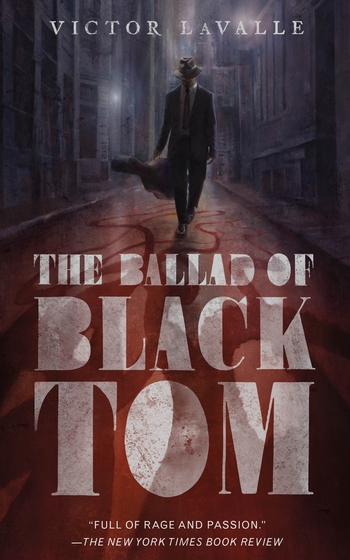
--LaValle, Victor. The Ballad of Black Tom. Tor, 2016.
LaValle takes on the racist and colonialist problems of the perennially famous Lovecraft. In doing so, he creates a chilling narrative all his own that made me a little nervous about turning off the lights.
--Okorafor, Nnedi. Binti. Tor, 2015.
--Okorafor, Nnedi. Who Fears Death. Daw, 2014.
I was teaching Binti in my class at the same time as I was reading Who Fears Death at night. The two complemented each other, emphasizing how much Okorafor’s prose reminds me of Octavia Butler’s. Who Fears Death doesn’t flinch away from the darkness of the world, while Binti embraces a more optimistic Afrofuturistic stance.
--Roanhorse, Rebecca. Trail of Lightning. Saga Press, 2018.
One of the best things I read this year! I waited eagerly for this book to be released, and it did not disappoint, establishing Roanhorse as one of the most vibrant Native American writers today. A nuanced and smart urban(esque) fantasy that imagines a post-apocalyptic future with modern relevance.
--Schwab, V. E. A Darker Shade of Magic. Tor, 2016.
This book reminded me of the wonder and pure fun I had reading fantasy novels as a kid. Fun characters and quick-paced plot. I need to find time to read the rest of Schwab’s work.
Short Stories & Novelettes:
--Butler, Octavia. “Bloodchild.” Bloodchild and Other Stories. Seven Stories Press, 2005.
--Le Guin, Ursula K. “Buffalo Gals, Won’t You Come Out Tonight.” Buffalo Gals and Other Animal Presences. Roc, 1990.
I couldn’t make this list without considering the classic short stories that I re-read and taught this fall. Every time I read “Bloodchild,” I like it more. It is such a clever reconsideration of classic expectations surrounding gender and sex—with some great insectoid aliens. And Le Guin never disappoints as she considers the definition of humanity itself.
TV & Movies:
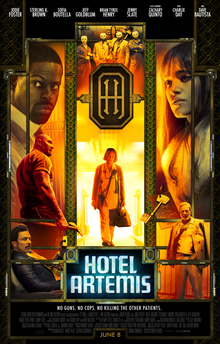
--Hotel Artemis. Directed by Drew Pearce, performances by Jodie Foster, Sterling K. Brown, and Dave Bautista, Global Road Entertainment, 2018.
A (slightly) futuristic film that considers how race and class politics impact networks of crime and family. Some truly empathetic performances. But also, I love Sterling K. Brown in everything (see: Black Panther!).
--Kajganich, David. The Terror. AMC Networks, 2018.
This was one of my favorite TV shows of the year—and of all time? That may sound hyperbolic, but this carefully crafted period drama (with horror elements) examines the true terror of men (and by extension, humans) in desperate situations. Some excellent performances.
--Shaw, Sam, and Dustin Thomason. Castle Rock. Warner Bros. Television, 2018. [available to watch on Hulu]
Even more than the much-acclaimed Haunting of Hill House, this terror anthology series contrasts the struggles of the everyday (with all its prejudices and problems) with the uncanny horror so appealing in Stephen King’s best work.
Looking Forward To Reading in 2019:
--Wilson, Emily, trans. The Odyssey. Norton, 2018.
I may have received this book months ago, but I’m still trying to find the time to read it. I’m hoping winter break will be that time, because this translation has made well-deserved waves as the first translation of the famous epic by a woman. The translation is supposed to provide insight into the marginalized characters and perspectives of the text.
Erin K. Wagner is a speculative fiction writer, interested in examining how the human responds to the inhuman. She grew up in southeast Ohio on the border of Appalachia, but now lives in central New York, where she hikes in the Catskills and listens for ghostly games of nine-pins.She splits her time between academic research, investigating how medieval English writers navigated their own religious identities, and creative writing. Aqueduct will be publishing her novella, The Green and Growing, as a volume in the Conversation Pieces series in early 2019. Her stories have appeared in a variety of publications, from Apex to Luna Station Quarterly, and her short story "Running Straight" was a finalist in the 2015 Omnidawn Fabulist Fiction Chapbook contest. You can visit her website at https://erinkwagner.com/.
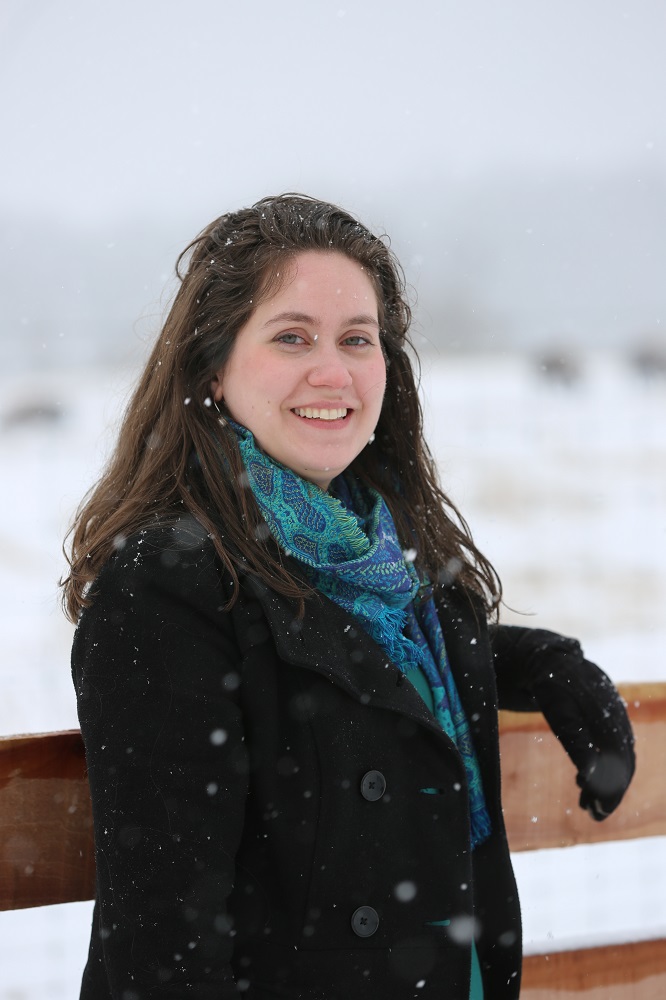
The Pleasures of Reading, Viewing, and Listening in 2018, part 11: Sofia Samatar
![]() |
| Photo by Jim C. Hines |
My Year in Translation
by Sofia Samatar
This has been an exciting year in reading for me, partly because I’m on the jury of the 2019 Best Translated Book Award, which means I’ve been reading lots of books that have just come out in English. Even outside my reading for the award, I found myself drawn to translated literature and stories of movement between languages. Call it my year in translation.
Patrick Chamoiseau’s Slave Old Man, translated by Linda Coverdale, is a dazzling, complex, and moving novel. Published in 1997, it only arrived in English this year, and I can’t help wondering how the course of black studies in the anglophone world might have been different if we’d had access, two decades ago, to this story of an escaped slave, the hound that pursues him, the forest that surrounds them, and the slippery, uneven spacetime in which everything happens and of which everything is made. It’s a startling book, historical and otherworldly at once, and Coverdale’s skill allows Chamoiseau’s language experiments to irradiate English in a marvelous way.
Other new books in translation took me north. Christina Hesselholdt’s Companions, translated by Paul Russell Garrett, is an homage to Virginia Woolf’s The Waves, and a story of intersecting lives in contemporary Denmark that grows deeper and more powerful by the page. The Endless Summer, by Madame Nielsen, another Danish author, is translated by Gaye Kynoch. A single summer unfolds through the eyes of “a young boy, who is perhaps a girl, but does not yet know it,” and, as in Companions, the narrative flows from one character to another, this time exploring how a love affair between two people ripples through multiple lives.
Anne Serre’s The Governesses, translated by Mark Hutchinson, is one of my best reads of 2018: a dreamlike novel that infuses an immense amount of energy, eroticism, and utter weirdness into its few pages. And then, also filed under weird, there’s Comemadre by Roque Larraquy, translated by Heather Cleary, which starts out with a tale of gruesome 20th-century experimentation (some doctors want to explore life after death, so they induce patients at their clinic to agree to have their heads chopped off, hoping the heads will say a few words before expiring), and ends with the autobiography of a 21st-century artist, involving uncanny doubles, extreme manipulations of the body, and the melancholy pursuit of fame.
Outside of awards-related reading, here are some highlights:
I Am the Brother of XX by Fleur Jaeggy, translated by Gini Alhadeff: I completely fell to pieces over Fleur Jaeggy this year, read everything by her in English, and want to recommend it all, but am limiting myself to this pulse-heightening, mind-expanding story collection. The frozen sea within you will crack.
Extracting the Stone of Madness by Alejandra Pizarnik, translated by Yvette Siegert: Pizarnik’s brooding, tumultuous, insomniac poems, 1962 – 1972. “The powers of language are the solitary ladies who sing, desolate, with this voice of mine that I hear from a distance. And far away, in the black sand, lies a girl heavy with ancestral music.”
The Word Book by Mieko Kanai, translated by Paul McCarthy: This was a reread for me, and it was a delight to come back to Kanai’s supple, intricate stories, which bore me away so gently that it took me some time to realize the shore was no longer in sight.
An Episode in the Life of a Landscape Painter by CĂ©sar Aira, translated by Chris Andrews: Heaven help me, why have I not been reading CĂ©sar Aira? If my brain is a sky, this novella is sheet lightning. Like the painter in Aira’s wickedly reimagined biography of Johann Moritz Rugendas, I am marked for life.
The Bitter Life of Božena NÄ›mcovĂ¡: A Biographical Collage by Kelcey Parker Ervick: Božena NÄ›mcovĂ¡ was a 19th-century writer of fairy tales, an unabashedly unconventional woman, and according to Milan Kundera, “the mother of Czech prose.” Through letters, documents, and images, Kelcey Parker Ervick assembles the life of this fascinating figure, as well as the life of a writer named Kelcey Parker Ervick, who meditates on biography, searches for a Czech typewriter, and works to survive a collapsing marriage. As a confirmed fan of fairy tales, research, and researchers, I loved this.
This Little Art by Kate Briggs: A gorgeous essay on the “little art” of translation by a translator of Roland Barthes, this book is as searching, intimate, and risky as its subject. A fitting work to wrap up my year of reading in, around, and about translation.
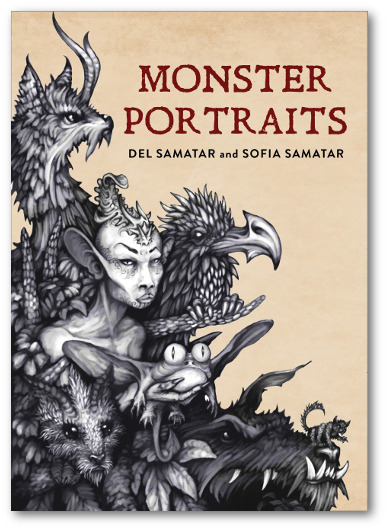
Sofia Samatar is the author of the novels A Stranger in Olondria and The Winged Histories, the short story collection, Tender, and Monster Portraits, a collaboration with her brother, the artist Del Samatar. Her work has won several awards, including the World Fantasy Award. She teaches African literature, Arabic literature, and speculative fiction at James Madison University.
Sunday, December 16, 2018
The Pleasures of Reading, Viewing, and Listening in 2018, part 10: Andrea Hairston
A prayer:
All praises to the spirits of this land! We are storytellers, speaking
in many voices, dancing in many idioms. We ask how can we be different,
together. All praises to the animals and peoples who lived here before, to the
old rocks, rivers, and trees that let us breathe and grow! All praises to
everyone and everything making this world now. We are griots, reaching for
sacred truths, not robber barons hiding behind a high tech curtain of
disinformation.
Many storytellers inspired me this
year. They got me up in the morning, kept me going all afternoon, and helped me
sleep at night.
Weapons of Math Destruction by Cathy O’Neil and Algorithms of Oppression by Safiya Umoja Noble were excellent brain
and spirit food. O’Neil and Noble expose big data algorithms and technological
practices that pose as neutral, as fair and impartial, but in fact are steeped
in imperialist, patriarchal, and white supremacist values. Algorithms are used in the courts and schools, in employment and medicine, banking and finance
for life-changing evaluations and decisions. Algorithms are seen as superior
to subjective, biased humans. Yet, these algebraic wonders create feedback
loops that amplify the privilege and power differentials that have haunted
America from its beginnings. Eagerly deploying invisible, ubiquitous weapons of math deception, we colonize
the future. We chain the new world to the dominant modes of the old world.
The good news is we can recalibrate
and interrupt the vicious cycle. For that, stories are needed, not just data
points. Stories (and prayer) can’t be reduced to Algebra! Human intervention is
essential. The mathematical models must be checked against real-world outcomes,
must be adjusted to the context of specific people and their particular stories.
We can dismantle the feedback loops that strangle our humanity. We just need the vision and will to do this. We need a better story on the limits of
algorithms!
Other engaging nonfiction books
that I read this year: The Patterning
Instinct: A Cultural History of Humanity's Search for Meaning by Jeremy Lent
and Your Brain’s Politics: How the
Science of Mind Explains the Political Divide by George Lakoff and
Elisabeth Wehling. Both books investigate the core metaphors we use to make value
and meaning. Abstract thought emerges from everyday world experience and is embodied/expressed in metaphors. These metaphors structure what we
think and what we don’t think. Lent, Lakoff, and Wehling puncture the myth of
objectivity. There is no God's eye view of a singular universe to be had.We live in a multiverse—yet embracing a plurality of vision is a
great challenge.
Almost fifty years ago I wrote and
directed a play that featured a black cleaning lady as one of the heroes. She
faced down bad guys, solved several mysteries, and helped save the day. I was a
senior in college, and this was my first full-length play. Some audience members
were disturbed that the hero was a cleaning lady. This meant I was putting
“negative images” of black people on stage. A lot of folks just didn’t want a cleaning
lady character in the play at all. A trial was convened and I was accused of
spreading negative images of black people. This was serious social drama in the
1970’s! The verdict was inconclusive. For almost fifty years since, I have faced resistance to the lower
class, black characters I write who use black vernacular English, know
languages other than English, and understand physics and how to solve a tricky mystery
(see Lawanda in Mindscape). So of
course, I was thrilled to see Guillermo del Toro’s Shape of Water and watch cleaning ladies fight the power and set
the world right. The creature from the lagoon stole my heart. I also had a
blast reading Nisi Shawl’s Everfair
and Naomi Novik’s Spinning Silver.
Shawl’s and Novik’s main characters come from the center and margins of their
societies. The labor they perform is not a measure of their spirits. Diversity
is power. The characters figure out how to be different together and transform
their worlds. This is enormously entertaining.
At the movies, I had great fun
watching a crew of women pull off the perfect heist in Oceans Eight and Widows.
The Women of Wakanda who save the day in Black
Panther made me want to write an essay.
Spike Lee’s Black Klansmen and Drew
Goddard’s Bad Times at the El Royale are
a surreal blast from the past. Boots Riley’s Sorry to Bother You is a surreal blast from tomorrow. Forget the one
man with a big stick, ray gun, or wand saving the world. In each of these films, a motley crew
defies the forces that would destroy us all and live to tell their tale.
All praises to the storytellers who keep rescuing me every day
Andrea Hairston is that author of Will Do Magic For Small Change, finalist for the Mythopoeic Award, Lambda Award, Tiptree Award, and a New York Times Editor’s pick. Her other novels include Redwood and Wildfire, a Tiptree and Carl Brandon Award winner, and Mindscape, winner of Carl Brandon Award, finalist for the Philip K. Dick Award, and a Tiptree Honor List book. All her novels were published by Aqueduct Press. She has also published essays, plays, and short fiction and received grants from the NEA, Rockefeller Foundation, and Ford Foundation. Andrea is a Professor of Theatre and Africana Studies at Smith
Subscribe to:
Posts (Atom)