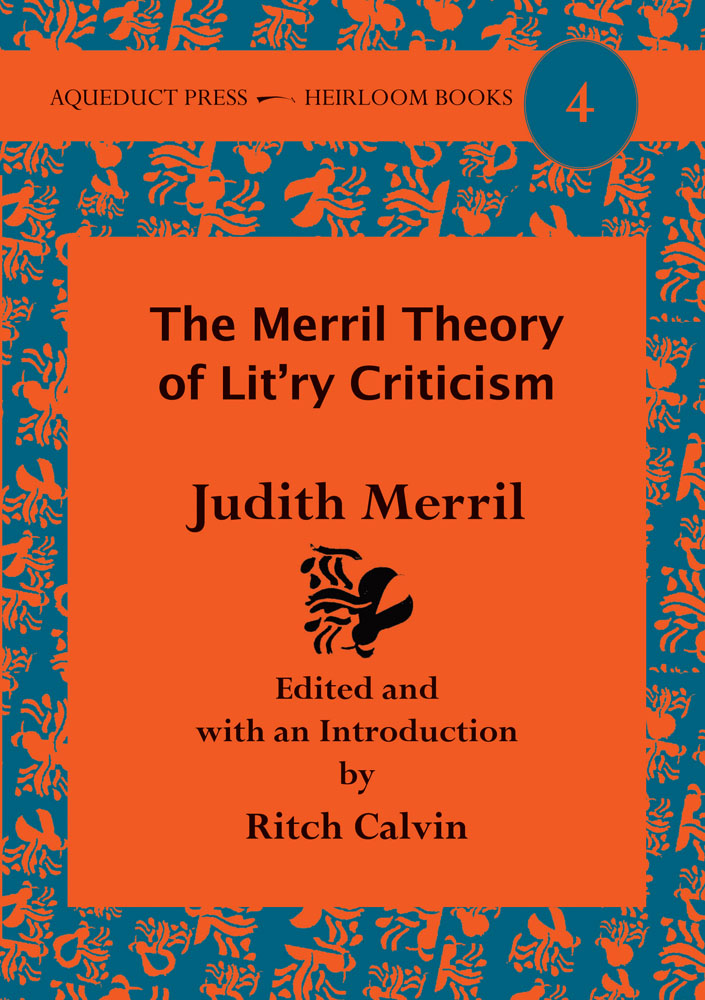
I'm pleased to announce the release of the fourth volume in Aqueduct's Heirloom Books series, The Merril Theory of Lit'ry Criticism, which collects Judith Merril's nonfiction, edited by sf scholar Ritch Calvin. Aqueduct is offering both print and e-book editions.
Although Judith Merril is best known for her short fiction and her novels
(in collaboration with C. M. Kornbluth), she wrote a great deal of
nonfiction. She wrote about SF fandom. She wrote about space and space
exploration. And she wrote about science fiction. This volume collects
Merril’s nonfiction from The Magazine of Fantasy and Science
Fiction, Extrapolation, and her Year’s Best anthologies. In
these collected pieces, Merril works through and develops her definition of
“S-F” and what makes S-F good. She chronicles changes within the genre,
including the emergence of the New Wave. And she provides a history of the
genre: its writers, its publishers, and its magazines.
Decades ago, Samuel R. Delany declared that “Merril…is perhaps the most
important intra-genre critic the field has had and…the absence of any of
her critical work in book form, in a field aspiring to take itself
seriously, is preposterous.… [O]ne cannot know the history of science
fiction from 1956 to 1969 if one has not read the brilliant commentary
that runs through Merril’s best-of-the-year anthologies for that period.”
Now, in 2016, Aqueduct brings Judith Merril and her place in that history
to today’s readers.
Gary K. Wolfe writes of the book in the February 2016 issue of Locus: The Merril Theory of Lit’ry Criticism provides our first chance to see in
one place Merril’s columns for the magazine [i.e., The Magazine of Fantasy and Science Fiction] between 1965 and 1969, plus
appreciations of Theodore Sturgeon and Fritz Leiber, introductions to her
groundbreaking ‘‘year’s best’’ anthologies of the ’50s and ’60s, and a more
or less theoretical/historical piece from the academic journal
Extrapolation. In an unusual strategy, Aqueduct has made available in the
e-book full versions of some pieces that are only summarized in the print
edition. ...Merril was ... a pioneer in assaulting literary moats and
walls, as her anthologies insistently made clear, and it’s fascinating to
find someone articulating a half-century ago some approaches to fiction
that are only now beginning to look like common sense.
You can purchase either the print or the e-book editions at http://www.aqueductpress.com/books/978-1-61976-093-6.php.
Wednesday, February 24, 2016
Monday, February 1, 2016
Worlds of Ursula K. Le Guin
Arwen Curry, who is making a documentary film about Ursula K. Le Guin, has opened a Kickstarter campaign for funding the final stages of production of the film. Curry and her partner organization,
Center for Independent Documentary, were awarded a prestigious grant by the National Endowment for the Humanities to fund work on Worlds of Ursula K. Le Guin,
which is scheduled for wide public television and limited theatrical release in 2017. While a major victory for the production team, the NEH funding presents a new challenge: the agency won’t release it until the entire budget has been raised. Curry and her team are now launching a campaign on the crowd-funding site Kickstarter to raise $80K of the remaining $200K needed to complete the film. The Kickstarter campaign launches on January 31, 2016 and continues through February 29, a leap day. Rewards for Kickstarter donors include signed novels and private recorded messages from the author.
The film's website includes, among other things, a video clip about the film. Check it out!
Thursday, January 21, 2016
Reading as a Writer
The deadline for enrolling in the Clarion West One-Day Workshop that I'll be giving in Seattle on February 21 is February 2. If you're a writer interested in honing your understanding of narrative or are having problems with a particular story (or both), this workshop is absolutely for you. When I offered it last year, I was pleased at how hard we all worked and surprised by how intense and far-ranging our conversations were. The format provided ample space for moving between the particulars of the stories we critiqued and more general narrative issues and techniques that form part of the working writer's landscape.
Here's the official description for the workshop:
Many first-rate, well-published writers take time out of their busy writing lives to attend critique workshops with their peers. Why? First, critiques from a variety of readers give writers insight into how the words they’ve put on the page are being transformed into the stories that unfold in their readers’ heads. And second, participation in critique groups enables writers to sharpen their understanding of technical issues. This workshop will offer insight into how others are reading your story and help make it into the story you would like them to be reading.
Students who enroll in this workshop will be asked to submit a piece of writing in advance, which will be distributed for critique by a subgroup of the class. All students’ works will be critiqued by both the instructor and several other students. Over the course of the day, attention will be given not only to the stories being critiqued but also to the critique process; techniques for reading critically and for communicating effectively will be covered. Because of the intensely interactive nature of this particular workshop, and to ensure that all students receive adequate attention, enrollment is limited to 12 participants.
If you're interested in attending, here's the URL you need: http://www.clarionwest.org/workshops/oneday/how-to-read-as-a-writer-2/.
Here's the official description for the workshop:
Many first-rate, well-published writers take time out of their busy writing lives to attend critique workshops with their peers. Why? First, critiques from a variety of readers give writers insight into how the words they’ve put on the page are being transformed into the stories that unfold in their readers’ heads. And second, participation in critique groups enables writers to sharpen their understanding of technical issues. This workshop will offer insight into how others are reading your story and help make it into the story you would like them to be reading.
Students who enroll in this workshop will be asked to submit a piece of writing in advance, which will be distributed for critique by a subgroup of the class. All students’ works will be critiqued by both the instructor and several other students. Over the course of the day, attention will be given not only to the stories being critiqued but also to the critique process; techniques for reading critically and for communicating effectively will be covered. Because of the intensely interactive nature of this particular workshop, and to ensure that all students receive adequate attention, enrollment is limited to 12 participants.
If you're interested in attending, here's the URL you need: http://www.clarionwest.org/workshops/oneday/how-to-read-as-a-writer-2/.
Sunday, January 10, 2016
The Pleasures of Reading, Viewing, and Listening in 2015, pt. 29: Kiini Ibura Salaam
Pleasures of 2015
by
Kiini Ibura Salaam
One of the essential questions that artists have to answer for
themselves is how they will be present, how they will show up and use their
voices, in service of what sensation, expression, intention? In a 2015 interview,
National Book Award-winning poet Terrance Hayes states:
“I’m just interested
in being present, not in being representative of anything.”
Hayes’s statement holds the tension of public and
private--publicly people want to sort you, classify you, use you as a
mouthpiece, a representation, but as an artist, the only way to authentically
do your work is to be present to your self. It is something of a koan: How can
you truly be present in and with and for yourself if you are representing someone
or something else—even someone or something that looks and sounds exactly like
you?
Much of the art I enjoyed in 2015 pivoted on questions of
presence and representation.
Ava DuVernay’s
Selma
In
January, I started my art immersion for the year with the film Selma. I found it to be a riveting and
intense look at one slice of the Civil Rights movement. What I
appreciated most about it was the layers of the Civil Rights Movement that it
revealed. History has flattened somewhat the broad span of groups involved with
changing the laws and practices of segregation and voter discrimination. The students, the
voting rights activists, the local workers, the movement architects, the
superstars, the rabble rousers, the freedom riders—everyone joined the
resistance from a different angle, representing a different demographic and a
different motivation, and all these disparate strands came together to speak in
one voice.
The
other thing the film did was take an unflinching look at the indiscriminate
violence that was visited upon anyone pushing for an integrated, equal society.
The film demonstrated that the Civil Rights Movement wasn’t a sanitized event
that—with a few marches and songs—created a more just society. The willingness
of so many to be beaten, jailed, and killed was the thing that moved the needle
in awakening the consciousness of a nation.
John
Lewis’s March
Selma dovetailed quite nicely
with the graphic novel March by John
Lewis, Andrew Aydin, and Nate Powell. John
Lewis was a college student during the Civil Rights Movement and was active in
SNCC (Student Nonviolent Coordinating Committee). SNCC was already working in
Selma when Martin Luther King and his leadership from the SCLC (the Southern
Christian Leadership Conference) came to town to support the push for voters’
rights. The graphic novel’s striking illustrations and compelling storyline
tells the boots-on-the-ground story of one young man who was unflinchingly
committed to change in this nation.
Though
Selma
and March deal with times past, both were shockingly relevant to
our nation’s contemporary identity, especially in a year filled with protests,
murders, and marches.
Toshi
Reagon’s musical production of Octavia Butler’s The Parable of the Sower
The
evening after I saw Selma, I went to
The Public Theater to see Toshi Reagon’s musical production of Octavia Butler’s The Parable of the Sower.
One thing that was conspicuously missing from Selma was the music of the movement. With the exception of MLK
calling up Mahalia Jackson in the middle of the night to sing to him so that he
might hear the voice of God, DuVernay chose not to include song. There was, of
course, a soundtrack, but during the march when there was singing, DuVernay showed
the actors mouths moving but did not reveal the audio.
During
that time period, music was a major component part of protests, whether
anti-war or anti-discrimination. There has been a lot of study of protest music,
notably Soundtrack for a Revolution http://www.soundtrackforarevolutionfilm.com/Home.html, a wonderful documentary
about the music of the Civil Rights Movement and what it meant to the marchers,
how it kept them fearless and motivated. I suspect DuVernay did not use the
music in the film because we are saturated with the image of people marching
and singing. To a degree, I think the national narrative we’d like to believe
is that the marching and the singing made change. The song was spirit food—it
fed the marchers, steeled their strength and their resolved, helped them carry
on when they were tired and face death when they were scared, but it isn’t what
won the battle.
Toshi
Reagon was born into the tradition of activist folk music. Her mother, Bernice
Johnson Reagon, was deeply engaged in the Civil Rights Movement and other
activist movements. She was also a founder of the group Sweet Honey in the
Rock. Toshi was named for activist, filmmaker, and wife of Pete Seeger—Toshi
Seeger, so activism runs deep through her lineage. Early in 2015, Toshi did a
series of performances to workshop the songs she’s developing for an opera of Octavia
Butler’s The Parable of the Sower. Because I saw it on the same day as Selma, I couldn’t help but view it in
conversation with Selma and it was almost
like the musical answer to Selma. Performing music from the folk tradition and
the church tradition with nods to rock and spoken word, Toshi gathered a
wonderful group of performers to bring Butler’s words to life through song. I
can’t wait to see the opera. One of the songs—dealing with the company-sponsored
town—referenced how hard it is not to sell out when faced with the difficulties
of life. For me, much of Butler’s oeuvre deals with humans in untenable
situations and the unthinkable acts that we engage in when our backs are
against the wall. One of the songs for this evening had a chorus that went
something like: you think you can’t, but you will; you think you won’t, but you
will, you will, you will. It is so Butler.
Wild
Tales
This film had
nothing to do with representation—except, perhaps, the representation of other
types of stories on film, something Argentinian filmmaker Alejandro Jodorowsky
pleads for in this passionate,
philosophical crowd-funding video.
Wild
Tales features five madcap stories about the ravenous nature of
revenge—how it consumes the person seeking revenge and burns down much more
than the intended target. As stated in a review from The Guardian:
“Characters
surrender, gratefully, to the thrill of losing it and letting someone have it.”
The end result of the film is quite thrilling as you watch people push
themselves to the limit to take revenge on others—and suffer the consequences.
Rotten Tomatoes calls it “Wickedly
hilarious and delightfully deranged.” I wholeheartedly agree.
Amaryllis DeJesus
Moleski’s futuristic romps through time and space
Amaryllis
DeJesus Moleski
Amaryllis DeJesus
Moleski presented a series of drawings at MoCADA in the spring that features
big-bottomed, curvaceous women who seemed to be both futuristic and of the
moment. There was so much playfulness as she explored self-image, mythologies,
and the fantastic. I loved the exuberance, unexpectedness, and other-worldly
nature of the work. More images and thoughts from the artist here.
Cassandra
Wilson’s Tribute to Billie Holiday
For
her tribute concert to Billie Holiday, Cassandra Wilson
created an
immersive experience that built its own setting, aura, and sensation of
romance--transporting us into two hours of altered feelings that mirrored the fluttering
pleasures of being in love. Being vulnerable before others is immensely
challenging. Wilson immersed herself in emotion in front of a packed theater.
She was positively altered by the music, the musicians on the stage,
emotionally embodying that which she was singing. It’s the type of presence I
want to bring to my work.
When
we called her back for her encore, she strapped on her guitar and used it to
introduce sonic dissonance and squeals as accompaniment to her vocals on the
classic Strange Fruit. At the end, she went wild, continuing to improvise on it
while slamming it back down in the stand. She left the guitar squealing while
she exited the stage, leaving her band to reconcile the sound, to handle what
she had flung out into the world.
Basquiat’s
Notebooks at the Brooklyn Museum
You
can’t see Basquiat’s work without thinking about representation, fame and pain.
… I was discomfited at the spectacle of all of us, seeing his notebooks, his private
scribbling, each page in each notebook taken apart so as to spread our
consumption of him wider—especially as I suspect the consumption of him, the
contradictions therein, led to his overdose death. This experience was thought
provoking as it showed how Basquiat worked through his ideas and creative
impulses. I am often jealous when I see artists playing with their thoughts, creativity,
process, ideas, because I dream of returning to a state during which my
creativity roams without constraint. As someone who squeezes in the time to
work when I can, I am inspired when I see other artists existing in state of
creative immersion. The exhibition showed the depth and breadth of his creative
instincts, impulses and compulsions.
One Way Ticket: Jacob
Lawrence Exhibition at MoMA
One-Way Ticket was a fantastic exhibition centered around Jacob
Lawrence's seminal Great Migration
series. I also appreciate seeing art I learned about in art books in
real life. Seeing this series really made me reflect on my commitment to making
work. The series consists of a 60 very small panels made with humble materials.
The small scale and readily available materials, made me think that the artist
was dedicated to telling his story with whatever materials he had on hand. The
work itself was great to see in person, but what really elevated my enjoyment
of the exhibition was the expansiveness with which the exhibition was mounted.
There were additional rooms that stretched out to share literature, music,
video, and photographs of other artists from the time period. It was wonderful to
get a multidimensional view of the explosion of black arts at the time.
Fantastic
What
Happened, Ms. Simone?
I found this Netflix documentary about Nina Simone absolutely
riveting and layered. The level of presence she brought to performing was a major
theme of the documentary, but for me the theme that was most compelling was the
issue of representation—how issues of abuse, family, mental health, freedom,
the cost of life, the cost of fame, genius, racism, social unrest and escape
are explored through her body and her presence. I felt each of these issues
intensely and viscerally through the lens of Nina Simone’s tumultuous life. She
was a woman of the times in one sense—in the sense of a woman being expected to
marry and let her husband take care of things. At the same time, she was
timeless, a woman of another world completely, with her vision, her talent, and
her fierceness. An amazing portrait of both a woman and a time; a society and a
situation.
Michelle
Dorrance’s The Blues Project
Clementine Wamariya’s essay
Everything Is Yours, Everything Is Not Yours
In
a multi-part essay, called Everything Is Yours, Everything Is Not
Yours,
Rwandan Clemantine Wamariya writes about her life as a refugee following the
Rwanda massacre. in addition to the harrowing details of surviving while the
world is crumbling around you, Wamariya has a piercing analysis of the world
and a wit that makes you want to keep reading and reading.
Grace Jones at the AfroPunk
Music Festival
The other thing that
makes me jealous of artists is when I see an artist being completely free. At 67
years old, Grace Jones is a riot of freedom, self-possession, outrageousness,
and ferocity. Changing her robe and headgear between every song, Jones pranced
her way through a full set at the 2015 Afropunk music festival. We were
thrilled, we were enchanted, and we were inspired, as she:
Wearing white paint on her nude body
and a corset/codpiece, Jones took us back to the days of disco with a bubble
machine and riding through the crowd on a man’s shoulders:
https://www.youtube.com/watch?t=27&v=kXpzccEFhaU
She had men in body
paint dancing on poles and she freaked them:
https://www.youtube.com/watch?v=tuMFoM9npDg
She changed her headwear
and covering with every song:
https://www.youtube.com/watch?v=FeoxwDTooL8
And she hula hooped the entire way
through Slave to the Rhythm (This video link doesn’t show the night I went, the
night I went that hula hoop didn’t stop.)
https://www.youtube.com/watch?t=25&v=wyOS08gaw_c
Wishing you all a fierce 2016 full of presence, passion, and
bold artistry.
Be well. Be love[d].
Kiini Ibura Salaam
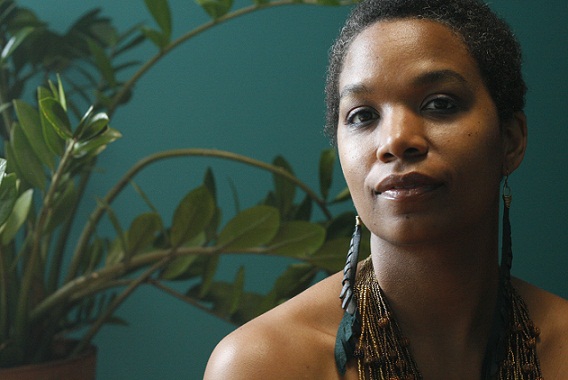
Kiini Ibura Salaam is a writer and painter from New Orleans, LA. Her work is rooted in eroticism, speculative events and worlds, and women's perspectives. Her fiction has been published in a number of anthologies, including Dark Matter, Mojo: Conjure Stories, and Dark Eros. Her essays have been published in Essence, Ms., and Colonize This. She is the author of the KIS.list, an e-column that explores the writing life. Her first collection of short stories, Ancient, Ancient, was published by Aqueduct Press in May 2012 and was a co-winner of the James Tiptree Jr. Award. She lives in Brooklyn.
Saturday, January 9, 2016
Aqueductistas in your online neighborhood
The classic workshop Writing the Other: Bridging Cultural Differences for Successful Fiction, taught by writers and editors Nisi Shawl and Cynthia Ward, returns in its first online offering. This is thefour-hour introductory workshop, and the basis for Aqueduct Press Conversation Piece #8, the diversity-in-fiction writing handbook Writing the Other: A Practical Approach.
The date/time for the workshop will be 2PM - 7PM (Eastern) on Sunday, February 21, 2016.
Registration is now open.
Writing the Other: Bridging Cultural Differences for Successful Fiction
When: 2PM - 7PM (Eastern) Sunday February 21, 2016
(includes 1 hour lunch break)
Location: ONLINE via GoToMeeting
Price: $150 + service fee ($156.24 total)
Learn more and sign up here.
Special thanks to K. Tempest Bradford for serving as our tech goddess.
Monday, January 4, 2016
The Cascadia Subduction Zone, Vol. 6, 1 (January 2016)
The new issue of The Cascadia Subduction Zone is out! This general issue has an essay by me, a remark by Josh Lukin on a letter by Joanna Russ that was published in Twelfth Planet Press's Letters to Tiptree, a lengthy discussion of Frankenstein by Eleanor Arnason, poems by Mary Agner, Anne Sheldon, and Sonya Taaffe, reviews by Tanya DePass, S. Quioyi Lu, Nisi Shawl, Maria Velazquez, and Stevie Watson, and a profile of the art of Erin Harrop. Subscriptions and single copies (print and electronic) can be purchased at http://thecsz.com/.
l. 6 No. 1 — January 201. 6 No. 1 — January 2016
- Essays
- The Tiptree Symposium
by L. Timmel Duchamp
Sighting of an Aqueductista
by Josh Lukin
- Flash Fiction
- A Troubling Reflection
by Wilma Bernard
- Poems by
- Mary Agner
Anne Sheldon
& Sonya Taaffe
- Grandmother Magma
- Thirteen Ways of
Looking at a Monster
by Eleanor Arnason
- Reviews
- Ghost Summer and Other Stories,
by Tananarive Due
reviewed by Tanya DePass
Dark Orbit, by Carolyn Ives Gilman
reviewed by Nisi Shawl
The SEA Is Ours, edited by Jaymee Goh & Joyce Chng
reviewed by S. Qiouyi Lu
Flesh & Wires, by Jackie Hatton
reviewed by Stevie Watson
A Small Key Can Open a Large Door,
edited by Strangers in a Tangled Wilderness
reviewed by Maria Velazquez
- Featured Artist
- Erin Harrop
Sunday, January 3, 2016
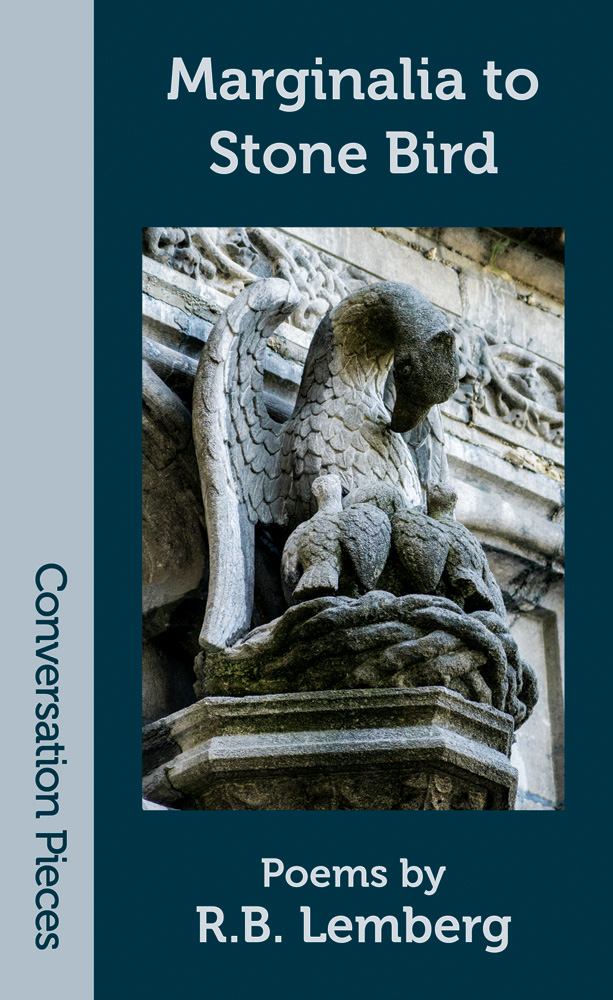
Rose Lemberg's Marginalia to Stone Bird
I'm pleased to announce the release of Marginalia to Stone Bird as the forty-eighth volume in Aqueduct's Conversation Pieces series. In this powerful debut collection, Rannu Award-winning poet Rose Lemberg
explores the deep-rooted fluidity of gender, tradition, language, and
desire in landscapes as familiar as high fantasy and as foreign as San
Francisco. Written in the voices of immigrants, shape-changers, sentient
ships in a distant future and heroes of a mythic past, her poems inhabit a
fragile, vital space of complex identity and story as a conscious act,
stubbornly urging the reader's attention toward the marginal, the liminal,
and the unheard—a firebird cautioned to burn less brightly, a ghost-child
ignored by the gods, a lover laying a road of words for a beloved to
follow. By turns devastating and deeply hopeful, Marginalia to Stone Bird
writes a fearless commentary on our history and others.
It is available now from Aqueduct Press in both print and e-book editions here.
Thursday, December 31, 2015
The Pleasures of Reading, Viewing, and Listening in 2015, pt. 28: Sofia Samatar
The Pleasures of Reading in 2015
by Sofia Samatar
The books I loved most this year work in a shifting space located somewhere between memoir, poetry, and theory. Ladan Osman’s poetry collection The Kitchen-Dweller’s Testimony, winner of the Sillerman First Book Prize, bears witness to small moments: a mother buying sugar, a child playing with a doll, a Muslim family receiving free Christmas presents from the Salvation Army. If we can point to the larger significance of these moments—war, poverty, immigration, girlhood, loss—it’s not because they’ve stopped being small, and that’s what I love about this collection: its commitment to lesser things. This commitment is expressed through a constant questioning that refuses grand statements. “Here, I attend to my book of questions,” the poet writes. Her voice won’t step away from itself in the name of any kind of essentialism, it refuses all the pieties, the pressure to perform some version of black female heroism, it refuses, it remains defiantly small, and it’s absolutely vital. “It’s me who’s getting ugly.” “I just need to ventilate.” “Yes, I have been disgusting so much.”
by Sofia Samatar
The books I loved most this year work in a shifting space located somewhere between memoir, poetry, and theory. Ladan Osman’s poetry collection The Kitchen-Dweller’s Testimony, winner of the Sillerman First Book Prize, bears witness to small moments: a mother buying sugar, a child playing with a doll, a Muslim family receiving free Christmas presents from the Salvation Army. If we can point to the larger significance of these moments—war, poverty, immigration, girlhood, loss—it’s not because they’ve stopped being small, and that’s what I love about this collection: its commitment to lesser things. This commitment is expressed through a constant questioning that refuses grand statements. “Here, I attend to my book of questions,” the poet writes. Her voice won’t step away from itself in the name of any kind of essentialism, it refuses all the pieties, the pressure to perform some version of black female heroism, it refuses, it remains defiantly small, and it’s absolutely vital. “It’s me who’s getting ugly.” “I just need to ventilate.” “Yes, I have been disgusting so much.”
Bhanu Kapil’s Ban en Banlieue is, you could say,
another poetic immigrant memoir, or you could say a meditation on impossible
bodies, or you could say a book of spells, an engine, or a fire. It’s
overwhelming. I still have trouble talking about this book, even though I did
so for three days as part of an online roundtable. Bhanu
Kapil has spent years writing about these unnatural or denaturalized
bodies—immigrant, monster, schizophrenic, wolf—and Ban is in many ways a distillation of that work. “A book of time,
for time and because of it,” she writes. “A book for recovery from an illness.”
“A book as much poetry as it is a forbidden or unfunded area of research.”
Forbidden, unfunded, dazzling.
is maybe what I mean here. Anyway, I loved Suzanne Scanlon’s Her 37th Year: An Index, an alphabetical compilation of life, literature, feminism, and film: its brief, cross-referenced entries are both mysterious and precise. A whole world shimmers here. Anne Boyer’s Garments Against Women is another book that received the high compliment being carried around in my backpack for months after I’d read it: it’s sharp and unflinching and political and Kansas and motherhood and illness and apartments and TV, and you should read the excerpt that made me know I had to have it. Paul B. Preciado’s Testo Junkie: Sex, Drugs, and Biopolitics in the Pharmacopornographic Era, translated by Bruce Benderson, is another book that blew me away: it’s both a fierce work of criticism examining the links between the pharmaceutical and pornography industries, and a memoir of Preciado’s use of testosterone every day for one year. Finally, I have to mention Black Quantum Futurism: Theory and Practice (Volume One), edited by Rasheedah Phillips, a collection of essays on time, space, hip-hop, postmodernism, the imagination, and the future.
Sofia Samatar is the author of the novel A Stranger in Olondria, winner of the William L. Crawford Award, the British Fantasy Award, and the World Fantasy Award. She is also a Hugo and Nebula Award finalist and the recipient of the 2014 John W. Campbell Award for Best New Writer. Her new novel The Winged Histories is forthcoming from Small Beer Press in 2016.
Tuesday, December 29, 2015
The Pleasures of Reading, Viewing, and Listening in 2015, part 27: Arrate Hidalgo
I've sat
down to write this a few times now, and I've given up every time — I'm
currently spending the holidays with my family in my aunt's loud, entertaining
house, where every night the women (that's most of us) sit around the TV and
watch and comment on an average of six films until the small hours, snacking on
leftovers and a couple of holiday/birthday cakes. (Celebrations tend to cluster
in my family.)
Now that we just finished
all three Lord of the Rings films, with the extra labor of walking my mother
through them ("Whose father is that?", "But wasn't that guy
dead", "This Frodo is a pain in the ass"), I've decided that
it's time to recommend all of you some culture. Here's a list of things I've enjoyed this year, in no particular
order.
READING
Diez variaciones sobre el amor (“Ten Variations on Love”), Teresa P.
Mira de EcheverrĂa
I first
encountered Teresa's complex, poetic science fiction in the Spanish-language sf
anthology Terra Nova vol. 1, with her
long short story "Memory," of which a translation into English by
Lawrence Schimel has been recently re-published by Upper Rubber Boots.
This new
collection (unfortunately only available in Spanish — for now!) is a
multi-faceted, monumental journey across the many shapes of love (of yourself, your
lover(s), your clone, your family) across times, realities, and entire
universes. Teresa is incredibly precise; she builds worlds out of delicate,
playful language and synesthesia. Her stories portray and celebrate structures
of loving and living that defy the rules of heteronormativity, respectability,
possibility. From a time-traveling art historian who falls in love with a
young woman accused of being a witch in the middle of a France devastated by the Plague; to
the stormy relationship between two clones who are in love despite prohibitions
and violence; to the journey of two brothers following a robotic spider in the
completion of a prophecy that echoes indigenous RĂo de la Plata traditions, the
book digs deep into the many meanings and personifications of love.
Playing the Whore: The Work of Sex Work, Melissa Gira Grant
Much has
been said about this short book. I picked it up because, for a while, I had
been very confused by the mainstream feminist take on sex work, which I never
felt made me any less ignorant about the subject. Melissa Gira Grant offers a
thorough and informative introduction to issues around sex work and a brilliant
analysis of the different processes and structures of “protection” and
punishment that systematically deny sex workers the right to define their
struggle in their own terms.
Alucinadas (Spanish
Women of Wonder), Various Authors, Cristina Jurado and Leticia Lara (eds.)
This I also
read in Spanish. HOWEVER, the anthology just managed to secure crowdfunding for
its edition in English! Watch out, folks: Alucinadas is the first ever anthology
of sf women writers in Spanish and it features a wide variety of genres, from
space opera to steampunk to a generous number of stories that defy labelling, by
both award-winning and less recognized authors from Latin America and Spain, including Lola Robles, SofĂa Rhei, Marian
Womack, and the legendary Angélica Gorodischer.
MUSIC
I’ve
decided it’s probably a better idea if I just leave links to some music I’ve
enjoyed, rather than describing it. Good luck!
VEGETABLES
Artichoke
My parents have eaten artichokes in front of me my entire
life. But I always refused to eat them until I recently discovered the
loveliness of marinated artichoke hearts, and the fun of dipping the leaves of
a fresh boiled artichoke, one by one, core first, in olive oil and vinegar. But
then, I will love anything sufficiently smothered in vinegar.
Under the skin,
Jonathan Glazer
I intend to watch this film again, now that I’ve read the
Wikipedia page for it. Scarlett Johansson plays an extraterrestrial who,
disguised as a young woman, drives around Scotland and lures men into her
beautifully alien lair.
Advantageous, Jennifer Phang
A stark yet heartfelt tale of a mother and daughter navigating an economic reality in which "hand to mouth" takes a whole new meaning that feels strangely around the corner. The premise features a megacorp offering the service to transfer their clients' consciousness into a new, younger, healthier body.
This year has been big in work-related reading for me, and I
must say that, busy as it has been, I feel really good about it. I wish you all
a happy 2016 full of satisfying, challenging, inspiring, good things.
***
Arrate Hidalgo is Associate Editor at Aqueduct Press. She is also an English to Spanish translator and amateur singer. She will be very excited if you visit her brand-new website, arratehidalgo.com.
Subscribe to:
Posts (Atom)