Tuesday, February 25, 2014

Nebula Award nominations

SFWA has just announced nominations for the 2013 Nebular Awards, and I have to say that you'd never guess from this slate that work by women is as under-reviewed as it actually is. I wonder what this says about the venues that consistently grant a third or less space to reviewing work by women? Apart from that, it's a strong, interesting list--and notes, as you've already probably heard, that Samuel R. Delany, at last, will be given the Damon Knight Grand Master Award.

Here's the list:
Best Novel
We Are All Completely Beside Ourselves, Karen Joy Fowler (Marian Wood)
The Ocean at the End of the Lane, Neil Gaiman (Morrow; Headline Review)
Fire with Fire, Charles E. Gannon (Baen)
Hild, Nicola Griffith (Farrar, Straus and Giroux)
Ancillary Justice, Ann Leckie (Orbit US; Orbit UK)
The Red: First Light, Linda Nagata (Mythic Island)
A Stranger in Olondria, Sofia Samatar (Small Beer)
The Golem and the Jinni, Helene Wecker (Harper)
Best Novella
‘‘Wakulla Springs,’’ Andy Duncan & Ellen Klages (Tor.com 10/2/13)
‘‘The Weight of the Sunrise,’’ Vylar Kaftan (Asimov’s 2/13)
‘‘Annabel Lee,” Nancy Kress (New Under the Sun)
‘‘Burning Girls,’’ Veronica Schanoes (Tor.com 6/19/13)
‘‘Trial of the Century,’’ Lawrence M. Schoen (lawrencemschoen.com, 8/13; World Jumping)
Six-Gun Snow White, Catherynne M. Valente (Subterranean)
Best Novelette
‘‘Paranormal Romance,’’ Christopher Barzak (Lightspeed 6/13)
‘‘The Waiting Stars,’’ Aliette de Bodard (The Other Half of the Sky)
‘‘They Shall Salt the Earth with Seeds of Glass,’’ Alaya Dawn Johnson (Asimov’s 1/13)
‘‘Pearl Rehabilitative Colony for Ungrateful Daughters,’’ Henry Lien (Asimov’s 12/13)
‘‘The Litigation Master and the Monkey King,’’ Ken Liu (Lightspeed 8/13)
‘‘In Joy, Knowing the Abyss Behind,’’ Sarah Pinsker (Strange Horizons 7/1 – 7/8/13)
 Best Short Story
‘‘The Sounds of Old Earth,’’ Matthew Kressel (Lightspeed 1/13)
‘‘Selkie Stories Are for Losers,’’ Sofia Samatar (Strange Horizons 1/7/13)
‘‘Selected Program Notes from the Retrospective Exhibition of Theresa Rosenberg Latimer,’’ Kenneth Schneyer (Clockwork Phoenix 4)
‘‘If You Were a Dinosaur, My Love,’’ Rachel Swirsky (Apex 3/13)
‘‘Alive, Alive Oh,’’ Sylvia Spruck Wrigley (Lightspeed 6/13)
Ray Bradbury Award for Outstanding Dramatic Presentation
Doctor Who: ‘‘The Day of the Doctor’’ (Nick Hurran, director; Steven Moffat, writer) (BBC Wales)
Europa Report (Sebastián Cordero, director; Philip Gelatt, writer) (Start Motion Pictures)
Gravity (Alfonso Cuarón, director; Alfonso Cuarón & Jonás Cuarón, writers) (Warner Bros.)
Her (Spike Jonze, director; Spike Jonze, writer) (Warner Bros.)
The Hunger Games: Catching Fire (Francis Lawrence, director; Simon Beaufoy & Michael deBruyn, writers) (Lionsgate)
Pacific Rim (Guillermo del Toro, director; Travis Beacham & Guillermo del Toro, writers) (Warner Bros.)
Andre Norton Award for Young Adult Science Fiction and Fantasy
The Coldest Girl in Coldtown, Holly Black (Little, Brown; Indigo)
When We Wake, Karen Healey (Allen & Unwin; Little, Brown)
Sister Mine, Nalo Hopkinson (Grand Central)
The Summer Prince, Alaya Dawn Johnson (Levine)
Hero, Alethea Kontis (Harcourt)
September Girls, Bennett Madison (Harper Teen)
A Corner of White, Jaclyn Moriarty (Levine)

Damon Knight Grand Master Award: 
Samuel R. Delany
Special Guest: Frank M. Robinson

About the Nebula Awards
The Nebula Awards are voted on, and presented by, active members of SFWA. Voting will open to SFWA Active members on March 1, and close on March 30.  More information is available from http://www.sfwa.org/nebula-awards/how-to-vote/.
About the Nebula Awards Weekend
The 49th Annual Nebula Awards Weekend will be held May 15-18th, 2014, in San Jose at the San Jose Marriott. The Awards Ceremony will be hosted by Toastmaster Ellen Klages. Borderland Books will host the mass autograph session from 5:30 p.m. until 7:30 p.m. on Friday, May 16th at the San Jose Marriott. This autograph session is open to the public and books by the authors in attendance will be available for purchase. Attending memberships, and more information about the Nebula Awards Weekend, are available at http://www.sfwa.org/nebula-awards/nebula-weekend/. Membership rates increase on March 1. The Weekend is open to non-SFWA members.

Wednesday, February 19, 2014

John and Mary's Insect Army

John Scalzi's post Join the Insect Army! has had me chuckling all day. If you haven't already read it, I urge you to do so now. He and Mary Robinette Kowal have delightfully turned an old white dinosaur's insult on its head, with the help of Ursula Vernon's marvelous image of Cockroach Rosie the Riveter.

Tuesday, February 18, 2014

2013 James Tiptree Jr. Award

Exciting news! 
 
WINNER OF THE 2013 JAMES TIPTREE JR. AWARD ANNOUNCED

The James Tiptree, Jr. Literary Award Council (www.tiptree.org) is pleased to announce the winner of the 2013 Tiptree Award: N.A. Sulway for her novel Rupetta (Tartarus Press 2013).
The James Tiptree Jr. Award is presented annually to a work or works of science fiction or fantasy that explores and expands gender roles. The award seeks out work that is thought-provoking, imaginative, and perhaps even infuriating. It is intended to reward those writers who are bold enough to contemplate shifts and changes in gender roles, a fundamental aspect of any society. N.A. Sulway’s imaginative and highly original novel tells the story of Rupetta, an artificial intelligence created 400 years ago from cloth, leather, and metal, brought to life by the touch of her creator’s hand on her clockwork heart. Although Rupetta is a constructed being, she is not a robot. Her consciousness is neither digital nor mechanical. Nor is she an android, a creature that is, etymologically, male. (The word is not gyndroid). Rupetta’s power does not come from her brain, but from her heart. Sulway has placed her construct not in the future, but the past, and made her female, created with traditionally feminine technology: sewing and weaving. Rupetta is a woman, made by a woman in the image of a woman, and the world changes to accommodate her existence. A deft blend of fantasy, science fiction, romance, and even gothic horror, this beautifully written story challenges the reader’s expectations about gender and of a gendering society. It examines power and what makes an object of power, relationships and love, sexuality and identity, and how culture is shaped and history is made. Rupetta was published by British independent publisher Tartarus Press in a limited hardback edition and a more widely available e-book version. Both are available for purchase from Tartarus’s website (http://freepages.pavilion.net/tartarus/rupetta.htm). Nike Sulway lives and writes in Queensland, Australia. Her novel The Bone Flute won the Queensland Premier's Literary Award for Best Emerging Author in 2000. Since 2007, she has been the co-director of Olvar Wood Writers Retreat, and one of the editors of Perilous Adventures, a literary magazine. Honor List
* Eleanor Arnason, Big Mama Stories (Aqueduct Press 2013) — Big Mamas are galaxy-sized women, powerful beings who can stroll around space and travel through time by sheer force of character. They are feminist, sensible, and adventurous. They come in all kinds of colors, and they survive by their wits, sometimes aided and abetted by Big Poppas. In these five stories, Arnason offers a new mythos, laced with both humor and wisdom.

* Aliette de Bodard, "Heaven Under Earth" (Electric Velocipede #24, Summer 2012,http://www.electricvelocipede.com/2012/08/heaven-under-earth-by-aliette-de-bodard) In a world with few biological women, some men have been medically altered to carry children and live as wives. When a new wife who was born a woman in a household, her presence causes Liang Pao, an altered man, to scrutinize his reasons for wanting to keep the status quo and to re-examine his own sexuality and feelings towards family, culture, status, and gender.
 
    * Nicola Griffith, Hild (Farrar Straus & Giroux 2013) — This stunningly beautiful historical novel describes what life might have been like for a woman whose mother has arranged for her to be "the light of the world": the real-life St. Hilda of Whitby. In a rollicking good read, the reader is drawn into action and adventure as Hild becomes a king's seer, a warrior, and a vessel through which the dynamics of power and gender in war-ravaged 7th-century Britain can be explored.
 
     * Alaya Dawn Johnson, The Summer Prince (Arthur A. Levine 2013) — Set in a somewhat dystopic matriarchal future Brazil, this lavish, provocative YA novel centers on June Costa, a rebellious teenage artist. She and her best friend Gil become entwined with Enki, the Summer King, who is elected to a position of celebrity and social eminence for one year before he becomes a ritual sacrifice. This book grapples with the nature of love, social and political conscience, creative rebellion and personal awakening, and an exploration of sexuality remarkable for its treatment of bisexuality and multiple relationships.
 
     * Ann Leckie, Ancillary Justice (Orbit 2013) — This political revenge story draws the reader into a fraught and ruthlessly colonizing military galactic empire. The protagonist is a human being whose consciousness began as a spaceship inhabiting dozens of bodies and vessels. Now stranded in one body, she bides her time and plots against the leader of the culture she once unquestioningly served. The story examines the brutality of occupation as well as exploring questions of gender and embodiment within a cultural framework that does not recognize gender, only class. 
 
     * Bennett Madison, September Girls (HarperTeen 2013) — In this young adult fantasy, a young man named Sam spends a summer in a beach town where he encounters numerous Girls with mysterious pasts that even they have a hard time recalling. Exploring the myth of mermaids and gods of the deep through an examination of gendered power dynamics, Sam learns how to become a man in ways that differ from the models he's been supplied with by his somewhat clueless father, abrasive older brother, and American culture in general.
  
  * Sarah McCarry, All Our Pretty Songs (St. Martin’s 2013) — A modern-day retelling of the myth of Orpheus, this is the story of two teenagers who grew up closer than sisters despite their parents' drug-fueled rock-star baggage. The girls' relationship is tested when the mysterious Jack moves to town, along with strange and disturbing otherworldly interest in his musical talent. The lyrical beauty of the writing and the way the story's concerns support the value of all of the girls' relationships (not just the romantic ones) make this contemporary myth surprising and affecting. 
 
     * Janelle Monae, Electric Lady (Bad Boy Records 2013) — Janelle Monae’s latest album is a musical work of science fiction, the latest installment in the conceptually rich world of Cindi Mayweather, a prototype android. A cross-medium Afrofuturist fable, loosely inspired by Fritz Lang’s 1927 film Metropolis, Electric Lady has dramatic scope, powered by magnetic waves of sound and rhythm.
 
    * Helene Wecker, The Golem and the Jinni (Harper 2013) — This debut novel combines elements of Jewish and Arab folk mythology in an immigrant tale, the story of two supernatural creatures in 1899 New York. Ahmad is a jinni, a “man” made of fire. Chava is a golem, a “woman” fashioned of clay. A golem is traditionally male. By making Chava a female figure, Wecker expands this well-trod fantasy element. Although she is a powerful and supernatural being, Chava discovers that in 19th-century New York, her choices and freedoms are limited by the gender of the body she inhabits.
   
 * S. M. Wheeler, Sea Change (Tor 2013) — This debut novel tells a dark, fairytale-like story of a young girl and her best friend, Octavius, who is an eloquent, intelligent kraken. When Octavius is captured, Lilly sets out to rescue him, bargaining with a greedy circus master, a witch, and a pair of gay bandits. She is transformed by her quest, giving up everything she has known, including her gender, to save her friend.

The Tiptree Award winner and authors on the Honor List will be celebrated during Memorial Day weekend at WisCon (www.wiscon.info) in Madison, Wisconsin. N.A. Sulway will receive $1000 in prize money, a specially commissioned piece of original artwork, and (as always) chocolate.

Each year, a panel of five jurors selects the Tiptree Award winner. The 2013 jurors were Ellen Klages (chair), Christopher Barzak, Jayna Brown, Nene Ormes, and Gretchen Treu.

Reading for 2014 will soon begin. The jury panel consists of Darrah Chavey (chair), Elizabeth Bear, Amy Thomson, Joan Haran, and Alaya Dawn Johnson.

As always, the Tiptree Award invites everyone to recommend works for the award. Please submit recommendations via the Tiptree Award website at www.tiptree.org, where you can also read more about the award, about works it has honored, and about past winners.


Sunday, February 16, 2014

Guest Post: Mathematics and Narratives, Take Two

Mathematics and Narratives, Take Two
by Neal Koblitz

The title of your recent posting "Mathematics' need for narratives" resonated with me. I am a research mathematician, and when I write a paper, usually jointly with my collaborator Alfred Menezes, we decide whether it deserves a place on our website (anotherlook.ca) by asking ourselves if it truly "tells a story." In our case the "story" is typically an analysis of mathematical proofs of security of computer protocols that reveals a dark underside --- an overlooked flaw in the proof, a misleading interpretation of the result, reliance on a model that is woefully inadequate for the intended application, a hypothesis to the theorem that is so strong as to render the argument essentially circular.  In our critiques of the paradigm of "provable security" (which in my opinion is an oxymoron), we depict scenarios in which the promised mathematical guarantees lose their validity, if possible with humorous references to popular culture and current events. One of our papers, jointly written with Ann Hibner Koblitz, raises some technical issues involving the math while presenting a historical narrative that draws on research in the social construction of science and technology; the subtitle of this paper is "the serpentine course of a paradigm shift." In this paper we introduce the term "narrative inversion" to refer to narratives of mathematical certainty behind which one finds a reality that is full of doubt and contingency.

However, when I read the introduction and perused the table of contents of Circles Disturbed... by Barry Mazur et al, I saw that the contributors' definition of mathematics and of the narratives that guide mathematicians' thinking is narrow and insular. To them, mathematics means pure theory.  They seem uninterested in the stories that arise from applied branches of mathematics or from misguided and self-serving attempts to apply mathematics to social and economic questions.  If anyone needs to be convinced that the mathematical enterprise encompasses a lot more than pure theory --- and can provide many dramatic narratives about topics other than theorem-proving --- it should suffice to point out that the largest employer of math PhDs in the world is the U.S. National Security Agency.

Moreover, in Circles Disturbed... mathematics is identified with the Eurocentric tradition starting in ancient Greece.  This is not the version of the history of mathematics that I present to my students when I teach a course every year on the subject.  Rather, I expect my students to know about the ancient Chinese and Indian traditions, as well as the criticisms of Eurocentric history of mathematics that have been made by Martin Bernal in the controversial book Black Athena (1987) and by ethnomathematics researchers such as Marcia Ascher.

Here are a few of my favorite examples of mathematical narratives in the broad sense in which I would define the term:

(1) Cathy O'Neil (a former PhD student of Barry Mazur, ironically) has a forthcoming book with the clever title Weapons of Math Destruction.  She was a "quant" during the days of the economic meltdown, and writes entertainingly about the misuse of mathematical models on Wall Street and elsewhere. Her blog address is mathbabe.org.


In 2000 David Li, a quant with a PhD from the University of Waterloo, developed a mathematical formula that purportedly predicted the likelihood that a set of companies would successively default on their debts.  His model was based on an optimistic narrative of economic progress under capitalism --- a narrative that ignored the stories of repeated boom/bust that should have been clear to anyone who studies history --- and was based on data of the most recent years of relative prosperity.  His formula was used on Wall Street to give a mathematical justification for sharply increasing investments in newly-created exotic financial instruments such as mortgage-backed collateralized debt obligations.  The failure of Li's mathematical model was a factor in the 2008 economic collapse.

(2) John Ewing (president of Math for America and former executive director of the American Math Society) wrote an article in the AMS Notices titled "Mathematical Intimidation: Driven by the Data" exposing the scam of value-added modeling, a much-hyped pseudo-mathematical approach to evaluating teachers.

(3) The late William Thurston (winner of a Fields Medal, often called the mathematical world's Nobel Prize) led a valiant but ultimately unsuccessful battle to get the AMS to do something about mathematicians' excessive reliance on military and NSA funding.  Thurston was part of a long tradition of mathematicians who rejected the dominant narrative in the profession, which maintained that the profession was at the service of whomever had power and money --- wealthy patrons in medieval and early modern times, the U.S. Department of Defense in our day. (As the prominent computer scientist Phil Rogaway put it, most researchers have never seen a funding source they didn't like.)  Other famous mathematicians of the last century who advocated an alternative humanistic vision included the British pacifist G. H. Hardy (who lauded his field number theory as "gentle and clean" because in his day it was pursued only for aesthetic reasons and had no applications) and Norbert Weiner (see S. J. Heims' 1982 joint biography John von Neumann and Norbert Weiner: From Mathematics to the Technologies of Life and Death, which contrasts the outlook of Weiner with that of the militarist von Neumann, another leading mathematician of the same time period).

(4) In the 1980s Serge Lang led a successful fight to keep right-wing political scientist Samuel Huntington from being elected to the U.S. National Academy of Science.  (I described this battle in an article in the Mathematical Intelligencer titled "A Tale of Three Equations: Or the Emperor Has No Clothes.")  A small example of Huntington's misuse of quantitative methodology was that he favorably cited a statistical study purporting to show that South Africa (this was during the apartheid period) had a population with a high "satisfaction index." How could Huntington (who, according to wikipedia, was a "valued adviser" to the apartheid regime, advising them to increase the repressive power of the state) seriously expect anyone to believe that?  He, like most capitalist economists and political scientists, was using a narrative of economic progress that attached huge importance to numbers such as gross domestic product per capita, number of telephones per capita (which was one of the ingredients in the "satisfaction index"), and so on --- while ignoring the fundamental issue of how those resources were distributed.  In the case of South Africa, it was certainly true that the whites owned a lot of telephones.

The introduction to Circles Disturbed... says that mathematicians are "delighted" to see the ways that mathematicians have been portrayed in recent works of literature and popular culture.  Undoubtedly many are, but I have a less sanguine view of the direction of popular imagery of science and mathematics.  I believe there is far more superstition, ignorance, and anti-scientific bias among Americans now than there was when I was growing up a half-century ago.  If one compares the portrayals of mathematicians in recent popular works with those of earlier decades, the picture is not one of constant upward progress.  Compare, for example, the 1980 movie It's My Turn (in which Jill Clayburgh plays a mathematician) or the 1988 movie Stand and Deliver (about the high school math teacher Jaime Escalante) --- the latter movie was cited by several of my students as what inspired them to want to become math teachers --- with the more recent movie A Beautiful Mind (2001) and the play Proof (2000, film in 2005), in which all the mathematicians are schizophrenic. The view of the mathematical profession that emerges from the latter portrayals is pretty dismal.  Both works suggest that there is an inevitable connection between mathematical creativity and mental illness. In A Beautiful Mind some of the scenes of John Nash's schizophrenia (e.g., when he almost drowns their baby) are horrific, and the depiction of nerd behavior in the Princeton math department also reinforces some of the worst stereotypes about mathematicians.  From the standpoint of mathematicians who want to improve the popular image of the profession and convince young people that it's a rewarding profession to go into, these portrayals are not helpful.

Or take the 1999 novel Cryptonomicon by Neil Stephenson.  I am embarrassed to say that this book was highly recommended to me by a mathematical colleague whom I much respected, and so I read it.  The book's portrayal of the great mathematician Alan Turing is full of juvenile and homophobic humor, with the author inventing an imaginary affair with a gay Nazi during World War II (as if to try to justify the later persecution of Turing by the British government that led to his death).  That the novel is full of racism (against Asians and New Guineans) and misogyny did not prevent it from becoming a best-seller among mathematicians and computer scientists.

The mathematical world -- like the world outside -- is full of struggles and full of narratives, but judging by its introduction and table of contents, the book Circles Disturbed... doesn't come close to telling the whole story.


Monday, February 3, 2014

Mathematics' need for narrative

I had lunch today at a (relatively) new local bookstore, Ada's (and yes, that's in Lovelace) just a couple of doors down from the place at which I often meet Eileen Gunn for writing dates. I can recommend the food. But more to the point, because the audience for the books they sell is strictly geeky, their selection is unusual. (One entire room is devoted to computer programming.) Happily, my browsing unearthed a big fat Princeton University Press hardcover with the title of Circles Disturbed: The Interplay of Mathematics and Narrative. With one look at the table of contents, I knew there was no way I was going to allow that book to languish on the shelf, bereft of my most personal attention, even if an electronic edition would likely be more reasonably priced and take no space on my own bookshelves. The book isn't a monograph, but a collection of articles, edited by Apostolos Doxiadis (a writer) and Barry Mazur (a mathematician). Tom, looking over my shoulder, spotted the name of a geometer in the ToC. ("Just wanted to be sure that geometry got some representation in this book.") The cover image, appropriately enough, is of Archimedes wielding a compass while a Roman soldier has grabbed him by the left arm and has raised his sword, ready to plunge it into the geometer.

Here's the description of the book on the publisher's page:

Circles Disturbed brings together important thinkers in mathematics, history, and philosophy to explore the relationship between mathematics and narrative. The book's title recalls the last words of the great Greek mathematician Archimedes before he was slain by a Roman soldier--"Don't disturb my circles"--words that seem to refer to two radically different concerns: that of the practical person living in the concrete world of reality, and that of the theoretician lost in a world of abstraction. Stories and theorems are, in a sense, the natural languages of these two worlds--stories representing the way we act and interact, and theorems giving us pure thought, distilled from the hustle and bustle of reality. Yet, though the voices of stories and theorems seem totally different, they share profound connections and similarities.

A book unlike any other, Circles Disturbed delves into topics such as the way in which historical and biographical narratives shape our understanding of mathematics and mathematicians, the development of "myths of origins" in mathematics, the structure and importance of mathematical dreams, the role of storytelling in the formation of mathematical intuitions, the ways mathematics helps us organize the way we think about narrative structure, and much more.


"Circles Disturbed offers a range of possibilities for how narrative can function in mathematics and how narratives themselves show signs of a mathematical structure. An intelligent, exploratory collection of writings by a distinguished group of contributors."--Theodore Porter, University of California, Los Angeles
"This collection is a pioneering effort to trace the hidden connections between mathematics and narrative. It succeeds magnificently, and represents a very significant contribution that will appeal to the professional mathematician as well as the general educated reader. The articles are written by top authorities in their fields."--Doron Zeilberger, Rutgers University

The publisher is offering a pdf of the introduction: here. http://press.princeton.edu/chapters/i9764.pdf.


And here's the Table of Contents:

TABLE OF CONTENTS:
Introduction vii
Chapter 1: From Voyagers to Martyrs: Toward a Storied History of Mathematics 1
By AMIR ALEXANDER
Chapter 2 Structure of Crystal, Bucket of Dust 52
By PETER GALISON
Chapter 3: Deductive Narrative and the Epistemological Function of Belief in Mathematics: On Bombelli and Imaginary Numbers 79
By FEDERICA LANAVE
Chapater 4: Hilbert on Theology and Its Discontents: The Origin Myth of Modern Mathematics 105
By COLIN MCLARTY
Chapter 5: Do Androids Prove Theorems in Their Sleep? 130
By MICHAEL HARRIS
Chapter 6: Visions, Dreams, and Mathematics 183
By BARRY MAZUR
Chapter 7: Vividness in Mathematics and Narrative 211
By TIMOTHY GOWERS
Chapter 8: Mathematics and Narrative: Why Are Stories and Proofs Interesting? 232
By BERNARD TEISSIER
Chapter 9: Narrative and the Rationality of Mathematical Practice 244
By DAVID CORFIELD
Chapter 10: A Streetcar Named (among Other Things) Proof: From Storytelling to Geometry, via Poetry and Rhetoric 281
By APOSTOLOS DOXIADIS
Chapter 11: Mathematics and Narrative: An Aristotelian Perspective 389
By G .E .R . LLOYD
Chapter 12: Adventures of the Diagonal: Non-Euclidean Mathematics and Narrative 407
By ARADY PLOTNITSKY
Chapter 13: Formal Models in Narrative Analysis 447
By DAVID HERMAN
Chapter 14: Mathematics and Narrative: A Narratological Perspective 481
By URI MARGOL N
Chapter 15: Tales of Contingency, Contingencies of Telling: Toward an Algorithm of Narrative Subjectivity 508
By JAN CHRISTOPH MEISTER

Anyway, I suspect some readers of this blog will find this as promising and interesting as I do.

Saturday, January 25, 2014

The Cascadia Subduction Zone, Vol. 4, 1


The winter issue of The Cascadia Subduction Zone is out. You can purchase the issue for $3 (or subscribe for $10) at http://www.thecsz.com/. The issue features the art of Kristin Kest; reviews by Victoria Garcia, Cat Rambo, Karen Burnham, Michael Ehart, and Cynthia Ward; a Grandmother Magma column by Nisi Shawl; a poem by Alicia Cole and a poem cycle by Anne Sheldon; and an essay by me, reporting on the Worlds beyond World Symposium in Eugene last November.


Vol. 4 No. 1 — January 2014
Essay
Feminist World-Building: Toward Future Memory
   by L. Timmel Duchamp
Poems
Down Seventh Street Road
   by Anne Sheldon

Coral Bleaching
   by Alicia Cole

Grandmother Magma
Walk to the End of the World, by Suzy McKee Charnas
   by Nisi Shawl

Reviews
The Waking Engine, by David Edison
   reviewed by Victoria Garcia

Dangerous Women. edited by George R.R. Martin & Gardner Dozois
   reviewed by Cat Rambo

Ancillary Justice, by Ann Leckie
  reviewed by Karen Burnham

The Constant Tower, by Carole McDonnell
   reviewed by Michael Ehart

The XY Conspiracy, by Lori Selke
   reviewed by Cynthia Ward

Featured Artist
Kristin Kest

Friday, January 17, 2014

Andrea Hairston reviews Africa SF

Andrea Hairston has a piece, "Dismantling the Echo Chamber," reviewing Africa SF, ed. Mark Bould, at the Los Angeles Review of Books. Here's a little taste:
Rewriting the rules that define/constitute the fantasy we call reality in order to dismantle colonial structures and transform said reality is an incredible challenge. Black to the future was/is a radical, dangerous, and daring dream—an impossibility. Science fiction and fantasy (sf&f) is a rehearsal of the impossible, an ideal realm for redefinition and reinvention. For Africans and their descendants in the diaspora, decolonizing our mind/body/spirits was/is an on-going sf&f project. Freedom is a Magic If. Indeed, for all of us, humans, non-human animals, and plant-life, recovering the past and decolonizing the future is a critical survival question in the subjunctive case. How might we coevolve, but be different, together in a (post)colonial empire hell-bent on global monoculture, the commodification of identity, and the monetization of everything? What of our past should we carry with us? What might we chose to leave behind? What new possibilities could we embrace and manifest?
Read the whole thing here.

Tuesday, January 14, 2014

10 Fabulous Pacific Northwest Authors of Color and the Books They've Written

In honor of its fortieth anniversary, Humanities Washington has begun posting a series of Top Ten lists, "sharing the best of the best from a variety of humanities topics from the past 40 years." Their inaugural list is from Anu Taranth, who offers a "Top Ten Pacific Northwest Authors of Color" list. The list names our own Nisi Shawl, and specifically cites Filter House. Do go and check out the whole list here.

Monday, January 13, 2014

Quote of the day

Considering these things, I can’t help but tell my fellow writers to write fearlessly. Our stories were never meant to speak to everyone. There are those who will read and who will embrace what we write and there are those who will read and hate us for what we write.

But write what you have to write. Write being true to what’s in your heart. Play on the page. Dance on the page. Imagine possible futures on the page. Your stories are important, not just to you. They are important to me. They are important to the generation that is yet to come. --Rochita Loenen-Ruiz, Movements: A Poetics of Struggle (Part 2)

Sunday, January 12, 2014

New Amazonia by Elizabeth Burgoyne Corbett

I'm pleased to announce the release, as the third volume in Aqueduct Press's Heirloom Books series, of a new edition of New Amazonia: A Foretaste of the Future, a feminist utopian novel by Elizabeth Burgoyne Corbett originally published in 1889, which includes an introduction by scholar Alexis Lothian. “Corrupt, Degraded, Rotten to the core is British Civilisation, and yet we find women who ought to know better, actually pretending that they are perfectly contented with the existing order of things,” declares the narrator of New Amazonia. Raging against an antifeminist statement signed by “ladies” opposing the cause of women’s suffrage, a writer falls asleep in 1889 and wakens, in company with a hashish-smoking “masher,” in a future world run by women. New Amazonia tells the story of how this future world came to be and reveals its shiny, futuristic marvels as well as its government-administered horrors. 


“When Elizabeth Burgoyne Corbett sat down in the late 1880s to imagine a world 500 years hence, she can little have imagined that her words would be pored over in another century, on another continent, in a community gathered around the kinds of imaginative engagement with gender that she was pioneering. L. Timmel Duchamp has described feminist science fiction as a "great conversation”; Corbett’s speculations about New Amazonia are part of that conversation’s prehistory, a fictional contribution to political debates with which the writer was intensively engaged. The book you are holding is a piece of utopian fiction, but it is just as much a feminist rant––entertaining, educational, and more than a little over the top.”—from the Introduction by Alexis Lothian

New Amazonia is available now through Aqueduct's site (http://www.aqueductpress.com/books/NewAmazonia.php) in trade paperback and e-book editions. While it is also available online in public domain pdf files (and printed and bound pdf files) of the original 1889 edition (sans Alexis's illuminating introduction), those pdf reproductions are not easy to read. My decision to bring the book back into print was based on a combination of my desire to draw attention to this early feminist utopia (of which I knew only its bare existence until Alexis talked to me about it) and the need for a more readable version of the text. 


Tuesday, January 7, 2014

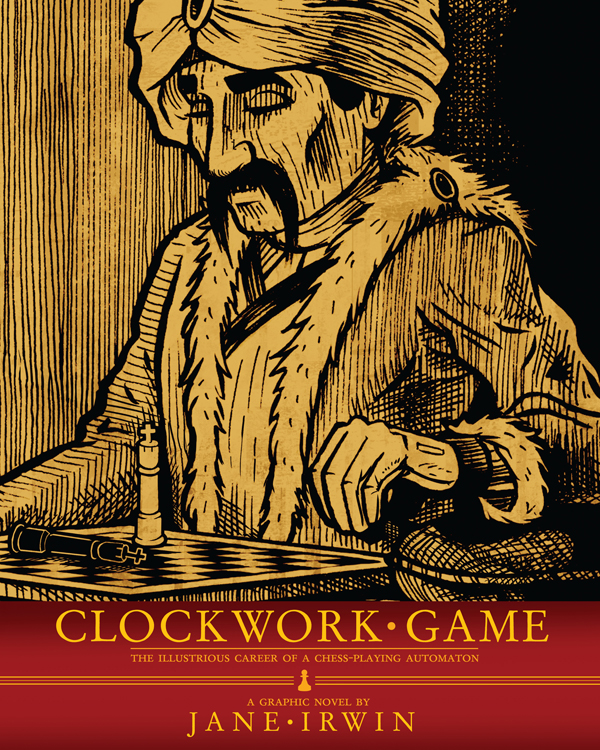
Jane Irwin's Clockwork Game

Jane Irwin's graphic novel, Clockwork Game, has just been released. It can be purchased in both trade paperback and pdf editions at http://www.fierystudios.com/store/. Here is Nisi Shawl's introduction to it:


Into the Canny Valley
by Nisi Shawl

The truth is right there in a word balloon on page 165.  “People believe stories, not facts,” says Johann Maelzel, one in a series of owners of “The Turk,” the figure at the center of the real-life, 85-year conspiracy depicted in Clockwork Game.  Telling The Turk’s strange story through expressive drawings and apt words, Jane Irwin makes us believe everything, from its first appearance before 18th-century Vienna’s royal court up to its blazing finale in 19th-century Philadelphia.  There’s the supposed chess-playing automaton’s match against Benjamin Franklin, Napoleon’s pragmatic skepticism when presented with The Turk in the wake of his Austrian victories, and Edgar Allan Poe’s article debunking the claim that its prowess was that of a pure machine.  The Turk rubbed elbows with Beethoven and shared an exhibit hall with P.T. Barnum’s Joice Heth, who the fledgling impresario said was the 161-year-old former nurse of President George Washington.

Clockwork Game is true.  It’s also, unlike Barnum’s showman’s patter, mostly facts.  Though not entirely.

But to paraphrase Maelzel’s lead-up sentence to the aphorism above, the story’s telling is what Jane Irwin gets right.

The Ottoman Empire had a long and glorious tradition of engineering marvels and expanding scientific knowledge.  Irwin makes this tradition concrete in the book’s opening pages with a charming sequence showing Al-Jazari’s elephant clock in operation, complete with dragon heads and drummer.  In 19th-century Philadelphia, Turkish-American doctor Yusuf bin Ibrahim provides another lens on the racially-charged lampoon its inventor created in his ostensible automaton.  Again and again Irwin challenges herself to question comfortable assumptions, looking at The Turk’s career through the eyes of those so often classified as “others”: workers, women, people of color, the physically disabled.  Again and again she enriches the telling of this fascinating tale by doing so; Clockwork Game is simultaneously funnier and more tragic than readers may expect.

In the field of human aesthetics, the “uncanny valley” is the dip in the graph of our tolerance of human simulacra.  We react with rising positivity to dolls and robots as they become more and more like us--up to a certain point.  At that point there’s a drop-off in acceptance, a sinking into revulsion.  Too lifelike, yet not alive, inhabitants of this figurative valley are uncanny in appearance.  If their similarity to us is developed further and continues to grow, the positive reaction reasserts itself and the graph line trends upward again.


Wolfgang von Kempelen, The Turk’s inventor, despised what he’d created as a fraud, “base trickery.”  Discussing one of his “serious” devices he bemoans the way audiences focus on the odd appearance of his Speaking Machine, explaining that he’d frequently begin demonstrations with its wheezing bellow and nostril-simulating tubes covered by a sheet.  He tells a sympathetic visitor that he hopes eventually to hide the apparatus inside the dummy of a young girl’s body.  I think doing this would have been a mistake; a human-looking doll that spoke would have been far too disturbing to people of that time.  The Turk was saved from inhabiting in the uncanny valley by several factors: the clockwork noises made during its operation; the standing invitation to inspect its inner workings and thus disregard its outward appearance; and its likeness to an exoticized other, which allowed the intended viewers to distance themselves from it rather than identify with it.  These dehumanizing elements kept The Turk on the valley’s far side.

What I call the canny valley--without any experiments or charts to back my theory up--is the sweet spot authors aim for between data and whimsy.   Clockwork Game sits in the canny valley’s exact center.  Here the dip represents a fall in resistance to the unfamiliar.  Beginning with sheer nonsense, what writers and artists offer becomes more captivating as it encompasses more verifiable facts--but not too many.  There is a place on this imaginary graph where, suddenly, facts take on the allure of fantasy and speculation the weight of certainty.  Clockwork Game’s dramatic framing and quick pace make it easy for the book to fulfill our innate biological hunger for narratives, and Irwin’s art—particularly her characters’ enchantingly expressive faces—fleshes out the mere names and dates that would have comprised her initial research.  And that research was both broad and deep, as can be ascertained by referring to her twelve pages of notes and four of bibliography.  It included books, videos, websites, and consultations with people knowledgeable in areas such as Turkish culture and the representation of diversity in fiction.

Composer and comedian Neil Innes once famously said, “I’ve suffered for my music.  Now it’s your turn.”  It was a joke, but other creative artists have sometimes had to strive to avoid meaning something similar—especially when they do lots research to support their projects.  They’re drawn to the far side of the canny valley, the dry and tortuously infertile terrain of facts for facts sake.  A book filled with nothing but the poorly presented results of research will beguile very few of us to spend our precious time struggling through its pages.  Resistance will be high.

Irwin’s motto might well be “I’ve been suffused with pleasure for my work’s sake.  Now it’s your turn.”  Though she carefully describes when, where, how, and why she departed from what’s known about The Turk and its many adventures, she keeps these notes out of the story’s way, confining them to Clockwork Game’s after matter, where they rightfully belong.  This leaves us free to luxuriate in the delightful greenery where the story proper grows—to speed through it or linger, to return to the canny valley as often as we like.


Saturday, December 28, 2013

The Pleasures of Reading, Viewing, and Listening in 2013, pt.22: Sheree Renée Thomas

2013: from Ashe to Amen and Beyond
by Sheree Renée Thomas


The year has seen me thinking about spiritual matters and exploring its roots and history in my work and in some of the art I admire most. Perhaps it is the loss of dear friends and loved ones, or the ever-growing sense and recognition that none of us are promised tomorrow, but I have enjoyed this exploration and hope it will yield sweet fruits in my own work. One of the highlights of the year was having an opportunity to help celebrate the legacy of Octavia E. Butler with writer Tananarive Due and some of my favorite authors, filmmakers, and artists at Spelman College this past Spring.


Between what felt like a family reunion led by Steven Barnes’s lively and inspiring informal “green room” talk on health and happiness from a focused physical and spiritual practice, to beautiful futuristic art and films, and a multimedia lecture on Afrofuturism and music by celebrated DJ Lynnee Denise (check out her Girls Gone Vinyl Project)
where she was literally flat-foot jamming in Spelman’s Museum, I have to say the new year and Spring season started off quite beautifully after what felt like the longest winter ever.
 
 Another fun conference was Onyxcon V held in August at the historic Auburn Avenue Research Library in Atlanta. Onxycon is the Southeast’s largest convention celebrating the presence of the African diaspora in popular arts.


Founded by artists Iyabo Shabazz and Joseph R. Wheeler, this summer’s conference covered writers’ and artists’ tips to how to collect and appraise black popular media like comic books and vintage movie posters. The participants included museum curators, comic book professionals, and even the founder of a soul food museum. The other added treat besides meeting new friends was a chance to see a small but beautiful exhibit of paintings by children’s book illustrator R. Gregory Christie who also runs an open studio in Atlanta.

The conference was a great experience before the back-to-school grind. The end of the summer meant the end to some of my favorite guilty pleasures, including watching obscure and fascinating foreign indie films like I’m Not Scared, the amazing Italian movie that I won’t spoil for you since it was a little surprising and made this closet tearjerker boohoo inexplicably, or the fabulous silent, black-and-white Spanish Snow White adaptation I saw.

Set in the 1920s, Blancanieves explores the world of bullfighting, where the neglected and abused daughter of a beloved Spanish matador is rescued by a family of bullfighting dwarves (I kid you not!), who goes on to glory and tragedy, as befitting the Grimm fairy tale. The cinematography was beautiful, the costumes and actors were memorable even though as usual, the seven (or is six?) dwarves are never given anymore than broad strokes of characterization.


Special praise should be given to the wonderful child actress, Sofia Oren, who delivered a pitch perfect performance, and I loved the music and the over-the-top scenery-chewing satire of the stepmother’s performance. Maribel Verdú as Encarna was a Femme Fatale Betty Boop with some serious issues and a fierce wardrobe to match. While Blancanieves is no The Artists (it didn’t seem to take itself quite as seriously and in case you were wondering, no, no bulls were slaughtered on or off camera for this film), it is well worth watching in my humble opinion, especially for anyone who enjoys a little lore and magic in their movies.

My other guilty pleasure this summer included fussing at the Magical Negroes of the show I love to hate but can’t stop watching, The Vampire Diaries, and its great spin-off series set in New Orleans, The Originals with yet another Magical Negroe with an interesting backstory. Neither of these shows can be watched without also consulting TV.com’s hilarious photo recaps.

Speaking of Magical Negroes, in late September, a couple of days before my birthday, I saw stop. reset, the new Signature Theatre play by actress and playwright Regina Taylor in New York.


Taylor’s science fiction play set in a black independent publisher’s Chicago offices was a moving meditation on how grief can scar the soul and how future tech can enslave or set us free. How one took the play’s ending depended upon whether or not you saw lead Carl Lumbley’s final “transition” as a visitation of the spirits, a riding of the loa, or a case, as one critic saw it, as “contagious insanity.” Needless to say, I loved this nuanced work and the awesome public discussion that took place following the performance.


And speaking of contagious insanity… watch Tina Mabry’s Mississippi Damned. For me, it was a little like watching a Kara Walker picture come to life. Enough Said.


Ashe to Amen: African-Americans & Biblical Imagery is a sensational, provocative traveling exhibit that features work by 50 artists who explore a wide range of faiths, from hoodoo to Vodou, from traditional African religious influences to Islam and Christianity. My favorite works in the exhibit included the amazing 3-dimensional praise tent that is crocheted by artist Xenobia Bailey. Xenobia is an astonishing artist who came of age in Seattle among a few of Jimmi Hendrix’s influences

 and has continued over the years to “press on to Paradise” as she says, keeping her dream and her vibrant art alive. Her latest journey led her last month to a group art show in the United Arab Emirates which she blogs about here: http://xenba.blogspot.com/


This wildly colored textile sculpture is large enough for a priestess or a mother and child to climb inside it, and it is vaguely reminiscent of the intricately woven Camerounian Bamileke crowns worn in Central Africa (or perhaps more memorably, by ZZ Top).


“Sister Paradise’s Great Wall of Fire Revival Tent” by Xenobia Bailey


Antique Bamileke hat and contemporary iconic hat worn by musician Billy Gibbons of ZZ Top


Bailey’s sculpture seemed sentient, magically alive with its two great unblinking eyes staring down at museum visitors, as if the “Mystic Seer” could see right into our souls and minds. I must admit that I had to resist my inner child’s desire to climb right in and sit cross-legged upon the emblazoned sun that adorned the floor beneath the sculpture.


 Renee Stout’s thrilling neon installation piece, “Church of the Crossroads” evokes Esu, Elegba, and Papa Legba more than the hooded Ku Klux Klan reference that was featured in the accompanying description of my local museum in Memphis, The Dixon Gallery and Gardens. Organized by New York’s Museum of Biblical Art and curated by artist and scholar Leslie King-Hammond, Ashe to Amen is one of the first exhibits that trace the shared roots and connections between African and Biblical traditions.


Three poetry and fiction volumes by the late author Wanda Coleman (1946 – 2013) and an essay in The Nation have had an impact on my writing life. When I first read A War of Eyes and Other Stories and African Sleeping Sickness: Stories and Poems (Black Sparrow Press, 1988 and 1990) I had no idea that Coleman also had a connection to a creative writing institution that would serve as a safe haven and encouraging lighthouse for my own journey. A married mother of two by age twenty, Coleman worked numerous day jobs while seeking out writers’ workshops on nights and weekends to help hone her craft and develop the gift she had shown since she began publishing her poetry in a local newspaper at age thirteen. The Watts Writers Workshop was one of those invaluable spaces for Coleman.

January 1, 1966
January 1, 1966: Budd Schulberg (center) conducts a session of the NEA-supported Watts Writers' Workshop. Schulberg created the workshop in his living room in response to the 1965 Watts riots. Photo credit Los Angeles Times 

This workshop founded by Budd Schulberg (probably most well known for his award-winning screenplay, On the Waterfront) would also inspire Fred Hudson, a former librarian, playwright of The Legend of Deadwood Dick, and Paramount Studios screenwriter (The Education of Sonny Carson) to create in 1971 the Frederick Douglass Creative Arts Center in Manhattan where I was a student and later, an instructor.


                                                   Nat Love aka “Deadwood Dick”

                   
                             Fred Hudson, Founder of The Frederick Douglass Creative Arts Center

Wanda Coleman began her writing journey as a reader seeking refuge from the racism of 1950s society and the cruelty that can mark anyone’s youth. Seeking solace, she said that she became an avid reader at a time when public libraries “discouraged Negro readers.” A native of Watts and long considered its unofficial poet laureate, Coleman published over twenty books over four decades, writing eloquently and with dark humor about racial injustice and gender inequality. Not one to mince words, this former critic and columnist for the Los Angeles Times once caused a mini tempest in America’s literary community when she published a scathing critique of beloved Maya Angelou’s A Song Flung Up to Heaven and a follow-up response in The Nation entitled “Book-Reviewing, African-American Style.” This essay got her banned from at least one independent black bookstore and earned her publishers a flood of letters.

At a time when aspiring black women writers were faced in the public sphere with laboring in the wake of literary giants like Angelou or Morrison, Wanda Coleman’s collection, Heavy Daughter Blues: Poems and Stories,1968-1986 (Black Sparrow Press, 1987) was an exciting discovery that offered yet another distinctive voice and view of life that inspired me. And while she is no longer here to offer her powerful live readings or no-nonsense, hands-on writers’ workshops, the spirit and brilliance of her writing—her poetry, her fiction, her essays--will continue to inspire other women writers to find their voices and carry on.

                                                     Wanda Coleman (1946-2013)

 Sheree Renée Thomas is the author of the chapbook, Shotgun Lullabies: Stories & Poems (Aqueduct Press, Conversation Series) and the editor of Dark Matter: A Century of Speculative Fiction from the African Diaspora and Dark Matter: Reading the Bones. Her work has appeared in storySouth, Callaloo, Essence, The New York Times, The Washington Post Book World, Renaissance Noire and in anthologies, including most recently The Moment of Change: An Anthology of Feminist Speculative Poetry. In 2014, Sheree will speak in New York at the exhibition panel for the Studio Museum of Harlem’s Afrofuturist exhibit, The Shadows Took Shape and at the Center for American Literary Studies (CALS) symposium, “Alien Form: Genre and the Production of Ethnic American Literatures,” hosted at Pennsylvania State University.